
Apartment rents are soaring in Miami. New local laws could give tenants some relief
The housing crisis arrived at Yudet Pérez’s door in the form of a notice announcing a 55% rent spike at her unit in a Hialeah apartment complex weeks after the building was sold to a new owner.
Her family had less than a month to brace for an extra $600 due every month for their two-bedroom unit — now the subject of an eviction notice that has Pérez trying to find an affordable home in a market where rents are rising at one of the fastest rates in the country.
“I cried a lot this morning,” the 46-year-old cosmetologist, who came to the United States from Cuba, said in Spanish during an interview last week.
While Florida and local laws mostly give landlords latitude on increasing rents once a lease expires, there’s a push in Miami-Dade County to impose some new rules on the timing of those hikes.
A proposed countywide ordinance would require 60 days notice before a landlord could increase rent by more than 5% at the end of a lease, or for tenants without fixed leases. The legislation by Commissioner Eileen Higgins follows the lead of Miami Beach, which imposed a similar rule within city limits earlier this month, and Hialeah, which on Tuesday advanced legislation to impose its own notice requirement for notable rent increases.
“It buys them more time,” said Higgins, whose county district includes Little Havana, parts of downtown Miami and South Beach. “You’ve got to give low-income folks more time to prepare.”
New rent rules proposed in Hialeah, Miami-Dade
Jeff Hearne, who serves as director of litigation at Legal Services of Greater Miami and also oversees the Tenants’ Rights Clinic at the University of Miami law school, said renters rely on lease language for the kind of notice requirement the Higgins proposal would impose — a protection that’s often absent.
“If the lease is silent, the landlord can say a few days before a lease ends: ‘Hey, we’re going to raise the rent,’” he said.
Advocates for low-income tenants say the start of 2022 brought a flood of reports of people facing hefty rent increases, another symptom of a real estate market that’s been in high demand since the early days of the COVID-19 pandemic.
“We’re seeing apartments in Liberty City that were $800 [a month] go to $1,700,” said Santra Denis, executive director of the Miami Workers Center, a grassroots organization that supports tenants, workers and families in South Florida. “Someone in Little Haiti who was paying $500 for an efficiency is now paying $900.”
Statistics show the Miami area has some of the fastest growing rents among major metropolitan areas, fueled in part by a surge of transplants from New York and California after the pandemic created work-from-home opportunities in low-tax South Florida.
“If you come down from New York where you’re renting a one-bedroom for $4,000 a month, you find one here for $2,000 a month and think it’s affordable,” said Jack McCabe, a real estate analyst and owner of Jack McCabe Expert Services in Deerfield Beach. “Prices have gone up so far, so fast. It’s ridiculous.”
Rents in Miami increasing at a rapid pace
A national ranking of rental costs from apartment-listing company Redfin found the greater Miami area, which includes Fort Lauderdale and West Palm Beach, had the fifth highest rent increases last year in the country, up 31%. Data from Apartment List found the Miami area not quite as inflated as other metro areas, with a 27% rent increase landing the region in 11th Place on that ranking.
The Higgins proposal is one example of county legislation backed by tenant advocacy groups aimed at protecting renters in an increasingly unaffordable housing market. Miami-Dade commissioners Jean Monestime and Raquel Regalado are proposing a county “Tenant Bill of Rights” that landlords would have to give renters outlining existing Florida protections and adding new ones locally, including a prohibition on asking about prior evictions and allowing rent deductions for neglected repairs. Both proposals are up for preliminary votes at the March 1 meeting of the County Commission.
Greg Brown, senior vice president for government affairs at the National Apartment Association, an organization that advocates for the rental housing industry, said new government restrictions on rent decisions usually hit small landlords the hardest and can result in shoddy housing as repairs get squeezed out of small budgets. “Half of the rental owners are mom and pops,” he said. “Their margin on a month-to-month basis is very thin.”
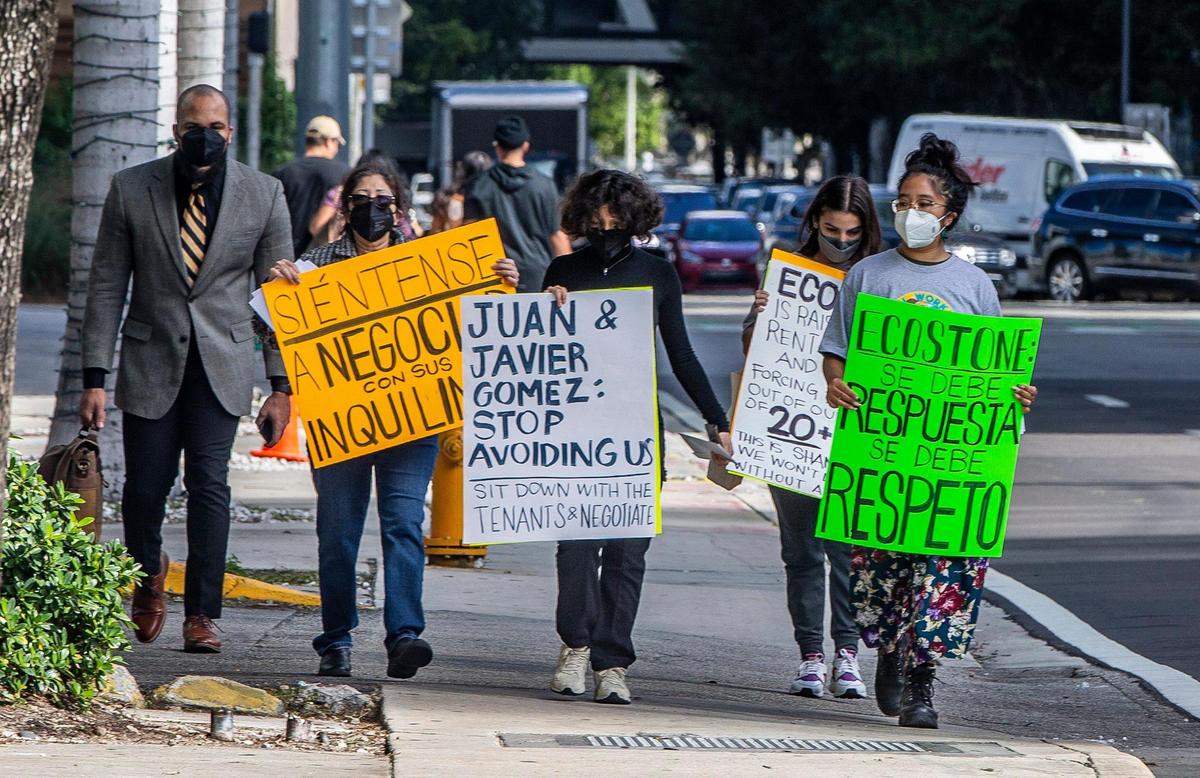
In Hialeah, the rent increases at Pérez’s building became a flashpoint over a broader crunch on housing costs. When Eco Landing Development LLC announced rental increases weeks after purchasing the 20-unit building in December for $4.1 million, the tenants organized, protested and contacted city officials with the help of the Miami Workers Center.
A Jan. 6 letter provided by a tenant from Miami-based real estate investment company Eco Stone Group, which shares corporate officers with Eco Landing Development, announced a $600 rent increase effective 25 days later, on Feb. 1.
At least eight of the building’s tenants have applied for federal emergency rental assistance intended to cover up to six months of rent for people who have been directly or indirectly impacted by the coronavirus pandemic, Mayor Esteban Bovo said at a Feb. 15 press conference.
The company has not responded to the Miami Herald’s numerous requests for comment. So far, court records suggest only one tenant, Pérez, is facing eviction at the building, located on the 1500 block of West 42nd Street. She’s one of several tenant organizers protesting the rent increases, which she said gave her and her husband and adult daughter just a month before her rent jumped from $1,050 to $1,650.
Pérez said four residents have vacated their units because they could not afford the new rents.
María Rubí, a cashier who immigrated to the United States from Nicaragua, has lived in the apartment building for 25 years, along with her adult daughter. Now the 57-year-old is facing a 65% rent hike — a far higher rent bill than she ever expected. “I don’t know what is going to happen next,” Rubí said in Spanish.
Hialeah City Council advances notice rule for rent increases
On Tuesday, the Hialeah City Council voted unanimously in favor of a proposed ordinance that would require landlords to give tenants 60 days notice before the effective date of any rent increase greater than 10%. City Council members must vote in favor of the legislation a second time before it becomes law. The item is scheduled for a final vote at the next council meeting, on Tuesday, March 8.
Council member Bryan Calvo, the ordinance’s sponsor, called the proposed law a first step toward helping tenants.
“This is also not a final, end-all, be-all solution to the problem of rent in our city,” he said. “I think this is a start, this is a kickoff to what our city needs to be doing.”
Hialeah residents interested in applying for temporary rental assistance can call 305-863-2970 and go to the city’s website at www.hialeahfl.gov/690/Funding-Opportunities. Miami has a similar program for its residents, as does Miami-Dade County for residents who don’t live in either city. Miami residents can visit miamigov.com/Housing-Assistance-Recovery and miamidade.gov. The county program is available at miamidade.gov/global/housing/emergency-rental-assistance-program.page.
This story was originally published February 23, 2022 at 7:39 PM.