
‘This will happen in my lifetime.’ Work starts on The Underline’s long-coming second phase
Six months after The Underline’s first half-mile section opened in Brickell to considerable fanfare, crews are now ready to break ground on a second, longer stretch of the long-awaited linear park and trail beneath the elevated Metrorail line.
The new $17.6 million segment picks up where the Brickell Backyard section now ends at Southwest 13th Street. It will bring The Underline through the Vizcaya Metrorail Station and Miami’s The Roads and Silver Bluff neighborhoods to Coconut Grove’s doorstep at Southwest 19th Avenue.
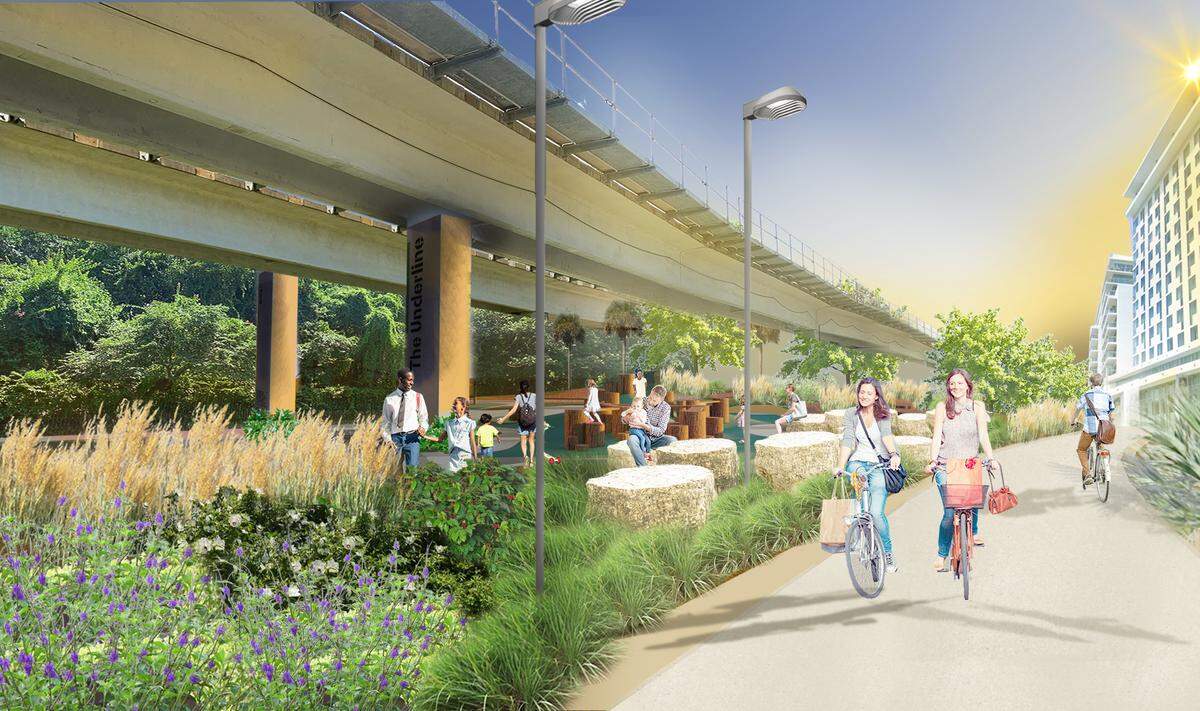
Like the Brickell section, the new 2.14-mile segment will offer a range of features and amenities set amid gardens and shade trees to provide a respite for cyclists, runners and pedestrians using its dedicated trails, as well as activities to draw people from the dense urban neighborhoods along the way.
The impending start of work on The Underline’s phase two, set for Monday, keeps momentum going at an ambitiously high pace to meet the 10-mile-long project’s completion deadline in late 2025. Bidding for a contractor and designer is already under way for the project’s third and final phase. That seven-mile stretch will take The Underline through the rest of Miami, Coral Gables and South Miami to its terminus at the Dadeland South station, also the rail line’s endpoint.
“I am very excited,” said Friends of the Underline director Meg Daly, a volunteer who, inspired by the success of New York’s High Line, developed the idea and persuaded Miami-Dade County and state and municipal leaders to take on what has become a $140 million project. “This will happen in my lifetime.”
Miami-Dade is overseeing construction and development of the project, which has been fully funded through a combination of local, state and federal money, impact fees on adjacent development and private grants. Friends of the Underline is also raising $3 million a year to cover management and maintenance of the trail by a separate non-profit conservancy group.
High Line co-designer James Corner Field Operations of New York was responsible for The Underline’s master plan and its Brickell Backyard segment, but the second phase is being designed and built by a local team made up of Lead Engineering Contractors and landscape architect Ken Gardner of GSLA Design.
The work launch on phase two also means sections of the existing, bare-bones asphalt M-Path under the elevated trains will be removed and shut down as construction advances over a period of two years. Work on the new trail will proceed north in five segments, starting at Southwest 19th Avenue, Daly said.
That’s where crews have begun installing barricades along the existing path to block the corridor off for construction. Signs will direct M-Path users to detours. The stretch from that intersection to the Vizcaya Metro station will be fully shut down for construction by the end of the month, the county said.
The first piece of business: removing topsoil contaminated by the corridor’s decades of use by the Florida East Coast Railway, which gave way to Metrorail construction in the late 1970s. It will be replaced by tons of clean soil to support tens of thousands of new trees and plants for the corridor’s conversion into the Underline.
Motorists on U.S. 1 will also see some daytime and overnight lane closures to accommodate Underline construction.
The existing trail has seen dramatically heavier use by pedestrians and cyclists during the COVID-19 pandemic. Though a monthly Miami-Dade transit count shows a drop off after setting all-time records, use remains significantly higher than before the emergence of the coronavirus.
To accommodate people already using the route, Underline project managers and volunteers have designed a series of linked detours that take people on foot and bikes along mostly low-traffic side and neighborhood streets on the west side of the Metrorail. Daly said volunteers, contractors and county officials rode and walked the detours to ensure they’re safe and convenient to use.
“We spent a lot of time analyzing these detours to make sure they’re as safe as possible,” Daly said. “We’ve been very vigilant.”
Busy crossings along the stretch have already been redone by the Florida Department of Transportation with new, more visible and repositioned pavement markings, and the addition of signs prohibiting right-turn on red lights onto U.S. 1 to protect trail users when they have a green light and right of way.
At the same time, the county transit agency will restore a piece of the old M-Path that was apparently removed mistakenly just to the south of the Underline phase two project. A stretch of about a fifth of a mile, between Southwest 27th and 24th avenues, was wiped out by a temporary gravel parking lot for 100 cars to accommodate overflow from the adjacent Coconut Grove Metrorail Station while a massive, eco-friendly mixed-use development project is built in its former parking lot.
After Underline and M-Path supporters and users complained, Miami-Dade Mayor Levine Cava, in a letter responding to a story in the Coconut Grove Spotlight online news site, said the missing pavement will be restored in the coming weeks. In the meantime, signage is being installed to direct disabled users to use a nearby sidewalk on Southwest 28th Lane to safely bypass the lot until the new path is in place, she said.
Since opening in February, the Brickell Backyard section, which starts at the south bank of the Miami River and includes the Brickell Metrorail Station, has proven an instantly popular part of the dense, high-rise neighborhood.
On a recent Friday evening, the segment’s outdoor flex court was full with people playing basketball and soccer, as others waited their turn. Dog walkers abounded — Brickell Backyard has a dog park — and people waiting for a bus or just lingering sat at its trademark green metal tables and chairs. The butterfly gardens and plantings were thriving and well maintained, and uniformed Underline staff were present throughout.
The new phase of the Underline was designed only after polling was conducted and two virtual community meetings held to collect public input and rank public priorities. Safety and natural features came in first and second, Daly said.
The project will bring another first to the path beneath the Metro: lighting. Because the M-Path lacks a power source at ground level, it’s dark at night. The Underline will be lit for its full length.
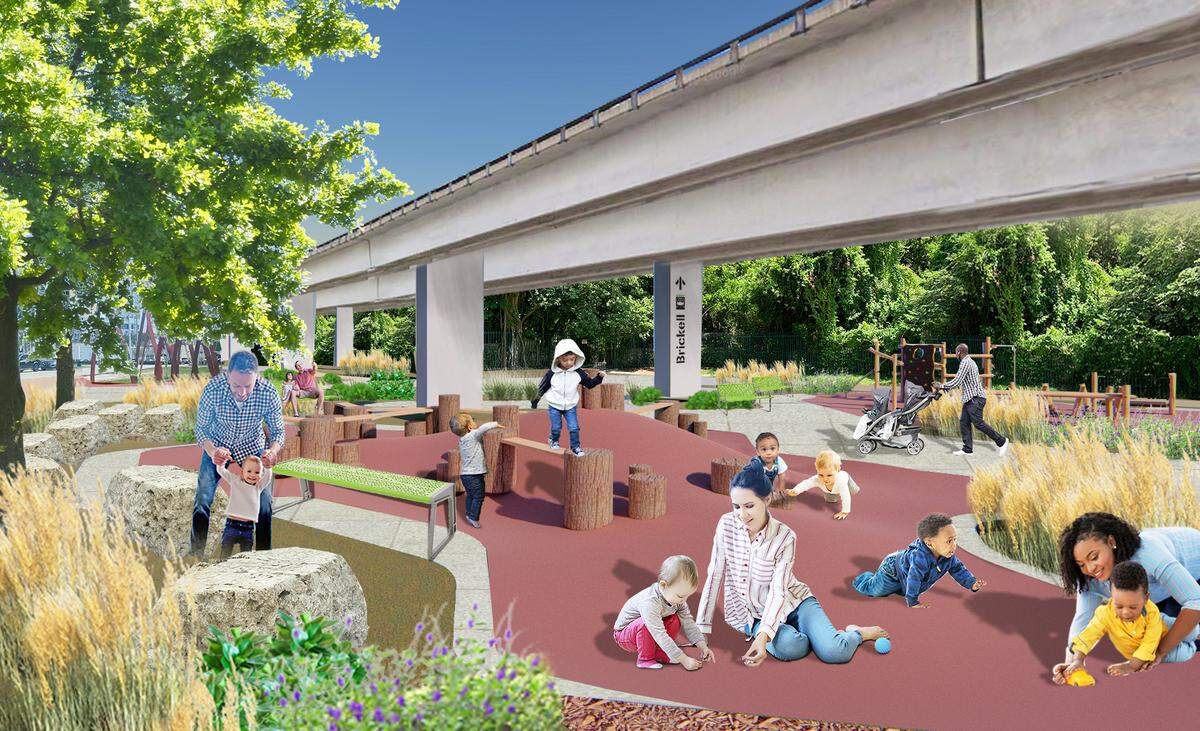
At its north end, the new segment will include an elaborate, 4-acre playground to be installed in a broad, green expanse next to the city’s Simpson Park, a remnant of the original hardwood hammock that once covered the area. The “nature-focused” playground will feature wood climbing blocks and the Underline’s signature limestone seating blocks, Daly said. The plan keeps existing old trees on the site and adds a thick planting of native hardwood species to complement Simpson Park, she said.
The new section will follow the Underline’s goal of providing separate and continuous trails for cyclists and people on foot, except for one narrow stretch where the Metrorail comes down to ground level at the junction of Interstate 95 and U.S. 1. Because there isn’t enough space to keep the trails separate along that bit, that will be a shared path, Daly said. The trails and park features are also fully accessible for people with disabilities.
At Vizcaya Station, a new plaza will provide space for yoga, a farmer’s market and other activities. A “sensory labyrinth” will echo a similar garden at the Vizcaya Museum and Gardens across U.S. 1, Daly said.
As it meets U.S. 1, The Underline’s new phase will also begin to incorporate a bit of ecological engineering that will eventually run all the way to the trail’s end at the Dadeland South Metrorail Station — a series of bioswales along the highway designed to collect and filter rainwater down to the Floridan Aquifer. It will also be the start of the planting of native trees at the roadside edge of the new trail to create a soft, natural boundary between The Underline and its users and the rushing traffic on U.S. 1.
The swales and the perimeter trees are just some of the tens of thousands of new plantings — all of them dog-friendly and needing only rainwater to thrive — that go into the ground for The Underline’s new phase.
In doing so, the project will accomplish one of The Underline’s principal goals, Daly said.
“This is bringing nature back,” she said.
This story was originally published September 20, 2021 at 6:00 AM.