
Miami-Dade County may get a 35th city — but first a fight over higher property taxes
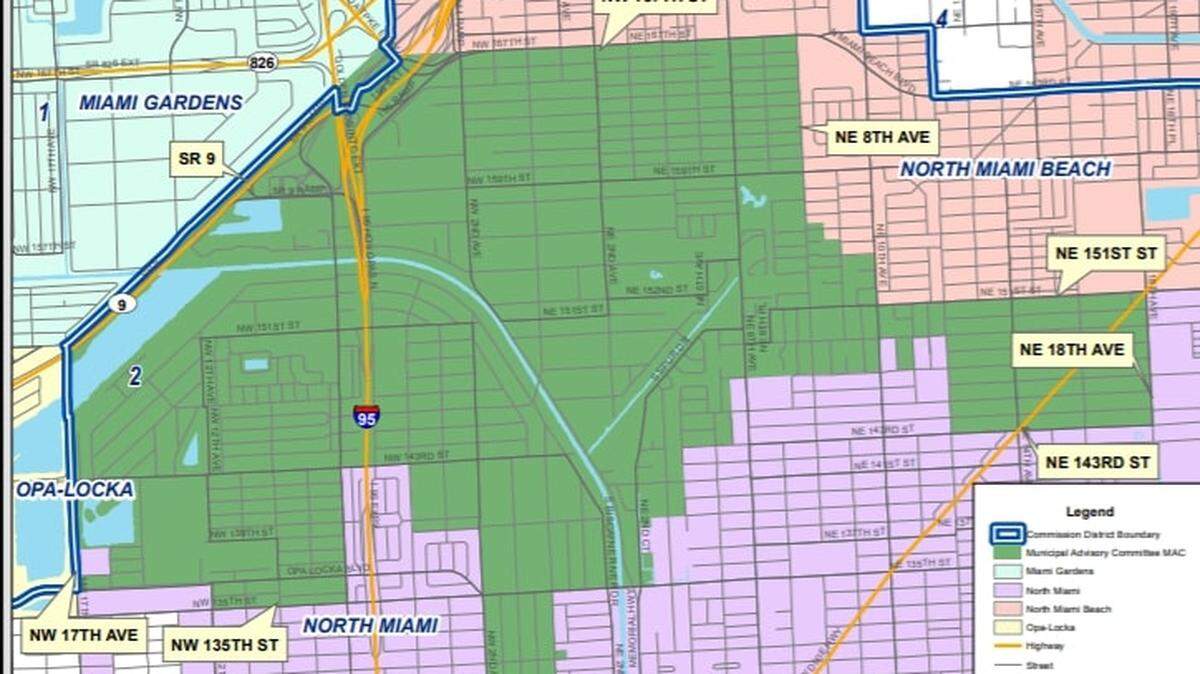
Are the residents of Biscayne Gardens ready to break away from Miami-Dade County government and form their own village? County commissioners will decide Wednesday whether to find out and hold a November referendum to form Miami-Dade’s 35th municipality.
If the item passes at the commission’s first regular 9:30 a.m. meeting since July, the real fight begins, with opposing sides competing for support from the proposed municipality’s roughly 18,000 voters.
Local voters haven’t endorsed a new municipal government since the successful 2005 referendum forming Cutler Bay out of an unincorporated enclave in South Miami-Dade. Voters in the proposed municipality must approve the new government at the ballot box, and the debate typically hinges on whether local governance and services are worth the higher municipal property tax.
That’s how the fight is shaping up in Biscayne Gardens, an area of about 35,000 residents between North Miami and North Miami Beach, with I-95 running through the middle. Some leaders argue its time to break away from all local decisions being made by the 13-member county commission, while others insist Biscayne Gardens would be too costly to sustain as a municipality.
“The county staff and elected officials do the opposite of what we want,” said Bernard Jennings, president of the Biscayne Gardens Chamber of Commerce and a top advocate for incorporation. “We have no say.”
Without a local government, Biscayne Gardens falls under county authority for all municipal decisions and services. While all property owners across Miami-Dade pay a countywide tax to fund transit, roads, police, zoning and other government functions, there’s another county property tax charged outside city limits to cover local services. Those include local police patrols, neighborhood parks, and sidewalk maintenance.
A 2020 county analysis concluded Biscayne Gardens is a drain on Miami-Dade services, since the roughly $9.6 million in municipal property taxes generated there each year don’t cover the roughly $13 million in municipal services delivered there.
A draft $11 million budget for the new government from a 2014 report by the county’s planning staff includes a municipal tax rate that’s double what Miami-Dade charges residents outside of city limits: $4 per $1,000 of taxable value, compared to $1.98 in the county’s municipal services area.
Incorporation opponents warn a newly founded municipality will not only get higher tax rates, but worse service than the county provides through its nearly $500 million general-fund budget for the unincorporated areas across Miami-Dade.
“Our current governance model under Miami-Dade County delivers excellent services that provide an environment for families and businesses to thrive, while keeping property taxes low,” resident Yolette Mezadieu wrote to commissioners Aug. 29 as part of a campaign to defeat the referendum vote.
There are already dueling websites gearing up for the fall battle: sayyes2021.com and badtax.net. Residents are also posting red-and-white signs in their neighborhoods with the “Bad Tax” logo.
Ben Ramirez, an opposition organizer who lives in the Biscayne Gardens area, said he expects the newly formed village would soon see its tax rate climb even higher than county predictions.
The 2014 county report found existing Miami-Dade municipalities with comparable populations and tax bases had rates higher than the $4 forecast rate for Biscayne Gardens. Those range from $5 per $1,000 taxable (Hialeah Gardens) to $7.50 (North Miami).
“Their proposed budget is completely ridiculous,” Ramirez said. “It’s a fairy tale. It’s a bait-and-switch.”
The commissioner representing the area, Jean Monestime, lives within the boundaries of the proposed municipality and is sponsoring the legislation for the referendum. Biscayne Gardens could give Monestime another option for elected office after term limits force him to leave his District 2 commission seat in 2022.
His resolution calls for a special election Nov. 2 to decide the incorporation issue, rather than waiting for the 2022 countywide elections when Miami-Dade will be setting up precincts across Biscayne Gardens anyway. The cost of holding a special election in Biscayne Gardens this fall is $94,000, according to a county memo, and Miami-Dade would only reimbursed if the new village was formed.
Monestime was not available for comment Tuesday. Jennings said Monestime has told him he’s not planning to run for office in Biscayne Gardens, where a full-time village manager would manage the government and the mayor would have mostly legislative power. Jennings said he’s planning to run to be the first mayor of Biscayne Gardens himself.
For Jennings, incorporation gives Biscayne Gardens a chance to make local zoning decisions targeting affordable housing and other needs that he says Miami-Dade isn’t addressing. He also sees it as a guard against some of the area being incorporated by neighboring municipalities, which also charge higher property taxes than the unincorporated areas of Miami-Dade.
Along with North Miami and North Miami Beach to the north, east and south, Miami Gardens sits to the northwest of the proposed Biscayne Gardens village and Opa-locka to the west. He said residents should expect a higher tax bill with incorporation, but with it better quality of life.
For “$180 or $200 a year,” he said, “we can take care of these issues that happen in our community.”
This story was originally published August 31, 2021 at 7:43 PM.