
They have a new way to pray, and it involves cameras. How High Holidays go high-tech
Rabbi Alan Litwak admits that it’s kind of “weird” praying, singing and giving a sermon to a room filled with empty wooden seats.
But he has little choice these days. So he has a trick.
“Speak as if they are in front of me and I am looking them in the eyes.”
Over the past year and half, Litwak, the rabbi at Temple Sinai of North Dade, has learned to adapt to a new way of reaching his congregants. It’s through a screen.
The synagogue invested more than $50,000 in technology to buy cameras and adjust lighting after COVID-19 made it unsafe to pray in person. And technology will play a starring role during this month’s Jewish High Holidays, beginning with Rosh Hashana, the Jewish New Year, at sundown Monday.
With the delta variant continuing to spread disease, some synagogues that had planned in-person services as COVID seemed to wane are now pivoting back to virtual services. And this year synagogues are more prepared. Some are even hiring production companies and tech specialists to take the burden off clergy so they can focus on the liturgy.
“It’s something we never even considered before the pandemic,” said Rabbi Marc Philippe, who leads Temple Emanu-El, a conservative synagogue in Miami Beach. He said they had to buy cameras, computers and hire someone to set up the whole system.
“Last year we had to do that or alienate the whole membership.” he said.
The boost in technology to stream services remotely is a radical shift for most synagogues.
The High Holidays are a time for the faithful to gather with family, friends and fellow congregants, and to disconnect from outside distractions. In some cases, it’s the only time during the year people go to temple. Synagogues also recruit new members and ask for donations above the usual holiday-admission ticket prices.
Now, people must stare at a screen to participate.
“In some ways looking at a computer screen you are closer to the rabbi or cantor than you may be in person,” said Jacob Solomon, the president of Greater Miami Jewish Federation.
And while many say technology is not a substitute for in-person worship, it has opened up new doors for people who live far from a synagogue or can’t attend services.
“I would be lying if I said that the digital experience was the same as in-person,” Litwak said. “There is nothing like hearing people singing around you and looking to the left and right and seeing the person next to you smile. But I have learned over many months that there are some silver linings in online — like being able to engage in ways and places that I wouldn’t be able to engage in if we didn’t have the digital option.”
Lights, camera ... pray
What does a virtual synagogue look like?
At Temple Sinai, three cameras are mounted to the ceiling. Two large TV screens hang from the wall behind where the clergy stand. From the podium, Litwak controls camera angles with a clicker and monitors the service with an iPad.
Virtual congregants see Litwak and Cantor Norman Cohen-Falah throughout the service. But they also see the words to the song or prayer being recited and can follow along.
“It has been quite a journey to turn over to a technologically advanced worship experience,” Litwak during a recent Sabbath service. He spoke into a microphone as if there were people in front of him.
Litwak said in March 2020 that the synagogue had never done any streaming, so it had no equipment.
“And then the pandemic hit and we, like many congregations, realized that for our congregants to feel part of a community, to be able to pray and connect, we needed to move to a technological platform,” he said. “So we started streaming and over the last year and half we have evolved in incredible ways.”
Sage Kantor, a co-president of the synagogue, can still being able “to attend” Friday night services, and enjoy it in a new way.
“Since COVID, I got in the habit of making Shabbat dinner every Friday night and sitting down as a family and watching services on Facebook,” she said. “I never missed a Friday night through COVID.”
Temple Sinai isn’t alone in leaning in to tech.
In 2020, Temple Judea in Coral Gables hired an outside tech company to handle all of its audio and visual and Zoom needs for High Holy Day services. Unlike Temple Sinai, Temple Judea had already been streaming services.
In January 2019, Temple Judea invested in a software program called ShulCloud, which helps with communication with members. The program, the temple says, helped synagogue leaders adjust quickly once the pandemic began.
Now, the temple handles audio and visual and Zoom through a combination of staff and volunteers. Temple Judea member Dr. Ed Gross and Rabbi Jonathan Fisch set up the Zoom multi-camera angles and presets for the 2021 virtual services in advance. While the Zoom services are only open to temple members, services are are also streamed for anyone who wants to click.
An outside tech company will direct the 2021 virtual services. But year-round, Judea designated an employee to handle tech full time. The temple techie handles all of the Zoom accounts, WiFi, and safety and security issues, including for the Margaux Early Childhood School. All classrooms are equipped with 75-inch Apple TVs, iPads, Zoom capability.
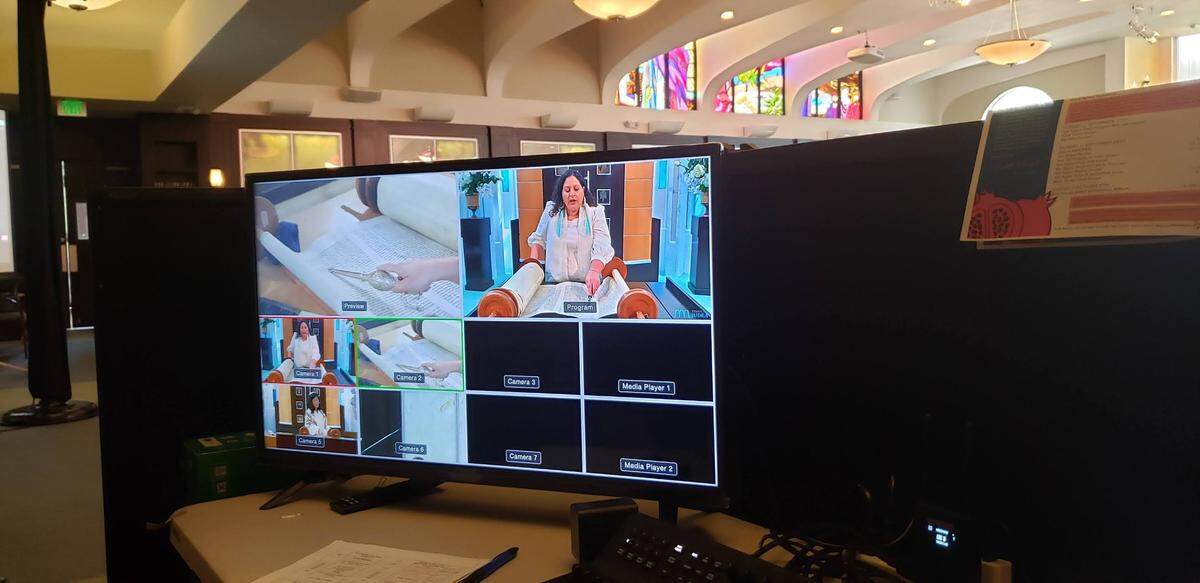
Leslie Sternlieb, who is from Coral Gables and now lives in Rhinebeck, New York, made a “substantial donation” earmarked for technology. Sternlieb, who at one time promoted arts and culture, said she had streamed services “before it was popular” and knows that technology is the future.
“I understood this pandemic was going to be here for the long haul and I think this hybrid approach is the future,” said Sternlieb, 64. “It’s providing a fundamental service.”
How a streaming service is different
At Temple Sinai, which streams services live, Rabbi Litwak can “click on one of the squares” and speak directly to someone. For High Holy Day services, some temple members have pre-recorded the reading of prayers, and those will be worked into the service.
Sharon Israel, executive director at Temple Judea and producer of the holiday services, said “producing the High Holy Day experience virtually uses a completely different side of your brain.”
“Managing the High Holy Days in person is all about the operations, sound, lighting, people ‘in and out’, police/security, spacing, A/C and music,” she said. “Because people aren’t there in person feeling the power of the space, we have to create it for them. On Zoom, we use a more intimate and closed frame, and no wide angles or quick camera changes, which creates the feeling that you’re close to the person. We use handheld cameras which makes one feel that you’re right alongside the rabbi walking down the aisle, like you would feel in person.”
Israel said producing the virtual services allows her to be creative.
“I love that we can be so far apart and yet be together,” she said. “Staff, clergy and synagogue members all work collaboratively to give members a very interactive experience.”
%20with%20children%20cutouts%20in%20front.JPG "Temple Judea clergy on bimah - Rabbi Jonathan Fisch, Rabbi Judith Siegal and Cantorial Soloist Jodi Rozental (L-R) with children cutouts in front.JPG")
New roles for the rabbi and cantor?
Litwak said before they were forced to stream, he didn’t know much about it. He has had to learn how to control the iPad and cameras, especially when the cantor plays guitar.
“He’s been doing great,” said the cantor, Cohen-Falah, who has helped set up the streaming capabilities
Temple Judea clergy had to learn how to use the technology for Torah study and other classes. In some cases, Rabbi Judith Siegal said they have been able to solve pre-pandemic issues of car traffic with a switch to digital traffic.
“What we thought was true about community, really is not exactly true,” she said. “We can continue to be ... a sacred community even when we cannot see each other in person.”
Last weekend, the rabbi and temple volunteers handed out prayer books and other holiday staples in a drive-through distribution so everyone can follow along. And the cardboard cutouts of congregants will return, which Siegal said makes her feel as if she is speaking to a full sanctuary.
High Holy Days
Rosh Hashana is the beginning of the sacred 10-day stretch known as the High Holy Days that ends with Yom Kippur, the Day of Atonement. Yom Kippur, which begins at sundown Wednesday Sept. 15, and ends at sundown Thursday Sept. 16, is a day for Jews to reflect on the past year and start the new year, 5782, with a clean slate.
“The High Holy Days are intended to help us reflect on the year past and to motivate us to make adjustments and a create vision for a better future in the year to come,” said Solomon, the president of the Greater Miami Jewish Federation. “If we can’t be together in person, at least we know that we are together as a community of faith and for a religion that is born out of community.”
Last year was the first time congregations many synagogues switched to the virtual-only format. And religious leaders got creative.
Some turned to drones and others led drive-in services. There was even socially distant horn-blowing.
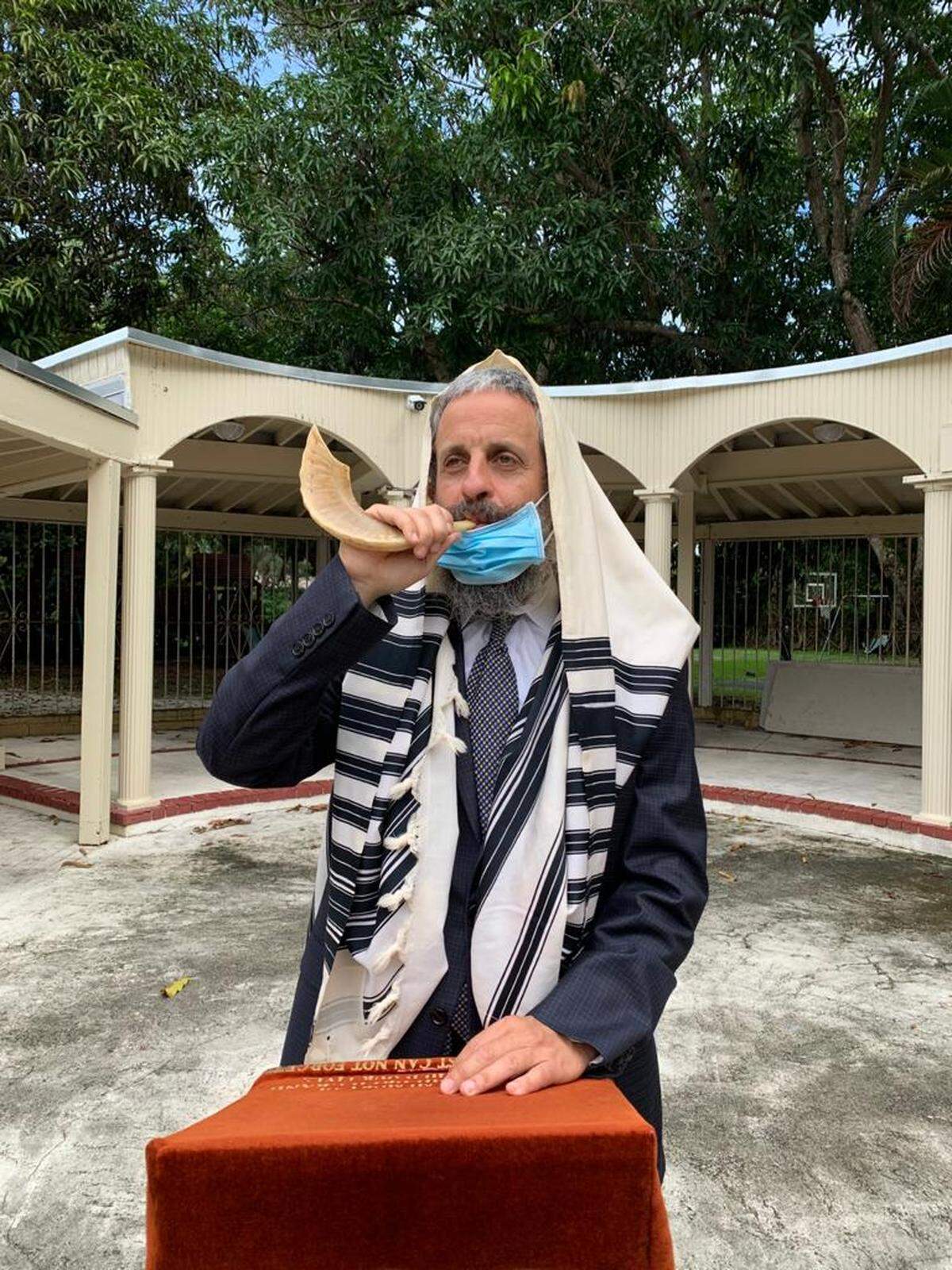
Leading up to this year’s holidays, clergy began planning an in-person comeback as COVID-19 restrictions began to ease. It wasn’t until recent weeks that rabbis realized meeting in person wasn’t a good idea with the current state of COVID.
Recruiting new members and fundraising
In the past, synagogues would sell tickets to High Holy Day services and use the holidays as a time to recruit new members for the congregation. Rabbi Litwak of Temple Sinai of North Dade said while the services are livestreamed free, membership hasn’t changed dramatically.
“We have a lot of loyal partners,” he said.
Litwak said people understand the importance of being a part of a community and helping that community with financial support.
Some synagogues raise money by charging for online access. At Temple Israel of Greater Miami, people can pay $360 to sign up for virtual access, which includes weekly worship services, High Holy Day services and holiday celebrations.
Not using electricity
For Chabad of Kendall & Pinecrest Rabbi Yossi Harlig, technology is a mixed blessing. The most observant Jews don’t use technology on the Sabbath or on holidays. But Harlig said he has found a way to use technology to help people navigate the holidays even if they don’t feel comfortable going to services.
He often posts video messages on Facebook and provides people with prayer books and tips if they don’t feel comfortable going to in-person services. This year, everyone who shows up at the synagogue will have to take a rapid COVID test.
“We understand not everyone is comfortable going inside yet,” he said.
The transition to tech
At Temple Sinai, co-president Darren Friedman said last year was a “very large transition to figure out what digital was,” but added they have come a long way since. The father of three boys, ages 7, 10 and 12, said he grew up at Sinai and is proud of what they accomplished in a year.
He said was “disappointed” not to be able to have everyone in the sanctuary, but safety is a priority.
On recent Shabbat, Litwak used an iPad and clicker to change camera angles as the cantor played the guitar. He paused for “technical difficulties.”
“Over the last year and a half we have evolved in incredible ways,” he said. “We recognize the importance of having a quality worship experience for the person sitting at home.”
List of streaming services
This is how some synagogues plan to host the holidays:
▪ Aventura Turnberry Jewish Center, 20400 NE 30th Ave., will have services both indoors and outdoors for members. Information on Aventura’s livestreamed services is available on the temple’s website at www.atjchome.org or by calling 305-937-1880.
▪ Base Miami is offering a livestream services to help navigate the High Holy Days. The 22-page guide is full of readings, questions to ponder, and even offers holiday recipes.
▪ Bet Shira Congregation, 7500 SW 120th St., hosts High Holy Days @ Bet Shira virtual services free and open to the community with reservations at www.betshira.org or call 305-238 -2601 .
▪ Chabad of Kendall & Pinecrest, 8700 SW 112th St., will host several Rosh Hashana and Yom Kippur services in shifts, as well as shofar and tashlich by the lake. Seating will be limited, says Rabbi Yossi Harlig, and all guests will have to take a rapid COVID test. Masks are required. Make reservations at www.chabadofkendall.org.
▪ Dor Chadash, 9560 SW 107th Ave., Rosh Hashana and Yom Kippur services are available on Zoom. A family service will be conducted live on the synagogue’s Facebook page at 3 p.m. Tuesday. There will also be a shofar experience at 1 p.m. Tuesday at the Baptist Hospital pavilion by the lake, 880 North Kendall Dr.. For more information, email Roxana@dorchadashmiami.org or visit chadashmiami.org or visit chadashmiami.org.
▪ Temple Beth Sholom of Miami Beach will livestream its services — including Evrev, Rosh Hashana, Kol Nidre and Yom Kippur — on its platform and via Facebook Live. Information: www.tbsmb.org/hhdtbs. Says Rabbi Gayle Pomerantz in a note to temple members: “We envisioned and planned for a grand homecoming — even if it was with masks and physically distant. However, unfortunately, the new Delta variant of COVID has hit our community particularly hard.” For more information, call 305-538-7231 or email info@tbsmb.org.
▪ Temple Emanu-El, 1701 Washington Ave. in Miami Beach, will be open for those who buy tickets in advance, says Rabbi Marc Philippe. The temple is asking for those who attend to be fully vaccinated. Masks will have to be worn at all times. Services will also be livestreamed on the temple’s site if worshipers are more comfortable staying at home. For more information, visit www.tesobe.org for log-on details or call the temple at 305-538-2503.
▪ Temple Israel of Greater Miami hosts High Holy Days services virtually via Zoom. Visit www.templeisrael.net for details. Members should have received a mailing with services information. If not, email info@templeisrael.net.
▪ Temple Judea, 5500 Granada Blvd. in Coral Gables, will offer livestream services for Rosh Hashana and Yom Kippur. For information visit www.judeagables.org or call 305-667-5657.
▪ Temple Sinai of North Dade, 18801 NE 22nd Ave., will stream almost all of its services. The Erev Rosh Hashana service will be on the temple’s YouTube page at 5 p.m Monday. A family service will be held at 9 a.m. Tuesday. For more information on the syanogue’s services or to RSVP for Rosh Hashana and Yom Kippur, visit https://www.tsnd.org/hhd.
This story was originally published September 3, 2021 at 6:34 AM.
