These fast-food restaurants were born in Miami. And then everyone else got a taste
.JPG "Burger King in the 1950s.")
They were born in Florida, tickled our taste buds and expanded through the state and country.
Burger King. Miami Subs. Royal Castle. Pollo Tropical.
These fast-food giants were founded in Miami by dreamers, risk-takers and smart business people.
Most of the joints are still going, bigger than ever, and now owned by big corporations. Royal Castle has one restaurant left in the Miami area, but the taste of sliders and Birch Beer remain seared in our memories from all the locations that dotted South Florida into the 1970s.
How did these restaurants start and what did they look like in their first days of operation?
Let’s dive into the Miami Herald archives for a look at how Miami and Florida set the pace for restaurants now known everywhere.
Burger King
Miami never tasted Burger King before 1954. On Dec. 4 of that year, the first location of a reorganized company opened on Northwest 36th Street and 30th Avenue.
But where was the Whopper?
Not born yet. The fast-food chain’s hallmark burger wouldn’t debut at this location for another three years. But there were basic burgers and fries and soda.
Burger King was actually born Insta-Burger King in Jacksonville the year before. But new owners moved the company to Miami and opened the first Burger King location, not far from Miami International Airport.
The company’s logo was red and white then, and the restaurant featured red arches on the roof, an architectural flourish that would span the 1950s and ‘60s.
Since then, Burger King has expanded across the country and the world, rolled out new menus with all sorts of tasty or wacky food (Mac n’ Cheetos or holiday-themed black buns, anyone?), and gone through a couple of mascots (remember Herb?).
At one point, Burger King even tried fancy dinner service, with cloth-covered tables, candlelight, popcorn appetizers, and shrimp platters.
But when it came down to it, people just wanted their drive-thru burgers and fries.
The early years of Burger King:
1954 - James W. McLamore and David Edgerton co-found Burger King of Miami, which later becomes Burger King Corp. McLamore and Edgerton’s first restaurant, at 3090 NW 36th St., sells 18-cent broiled hamburgers and 18-cent milkshakes.
1957 - Whopper sandwich is introduced, selling for 37 cents.
1967 - Pillsbury acquires Burger King for $18 million. Company has 274 restaurants with 8,000 employees. 1975 - First European Burger King opens in Madrid. Drive-through service introduced.
1977 - Burger King opens in Hawaii, putting restaurants in all 50 states.
Royal Castle
Ahh, those scrumptious sliders with a frosty mug of Birch beer.
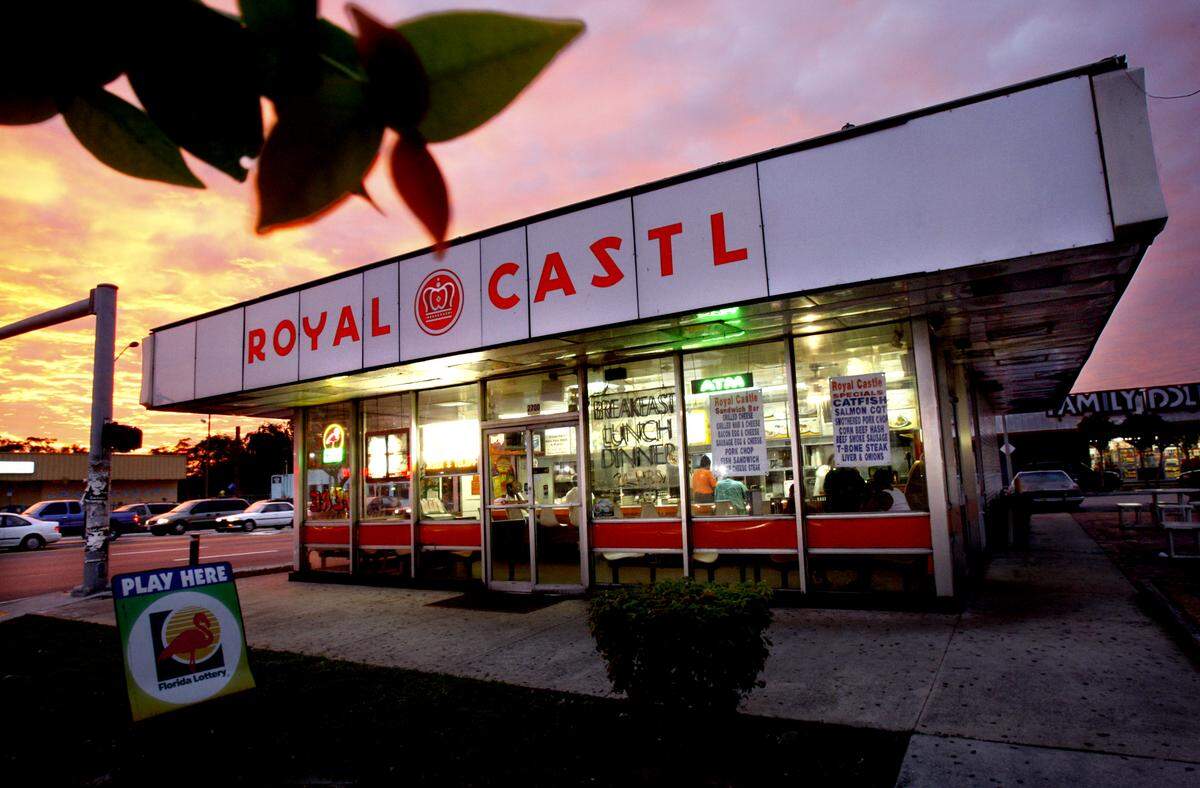
The first Royal Castle opened in Miami on March 18, 1938. Soon they were dotting the South Florida landscape. By the mid-70s, they were gone.
Except for two holdouts, operated independently with the familiar logo, orange facade and menu.
One of those closed a few years ago. Now, there is one left, on Northwest 79th Street and 27th Avenue.
As Flashback Miami says: “Perhaps no eating place is as close to the hearts of long- time South Floridians as the string of Royal Castles. Dozens of them throughout South Florida dished out 15-cent hamburgers, nickel birch beers, and a pretty good breakfast of eggs, bacon, and toast.”
The chain grew from a single hamburger stand opened by William Singer on March 18, 1938. He opened the stand at 7952 NE Second Ave. in Miami after failing in the beer business.
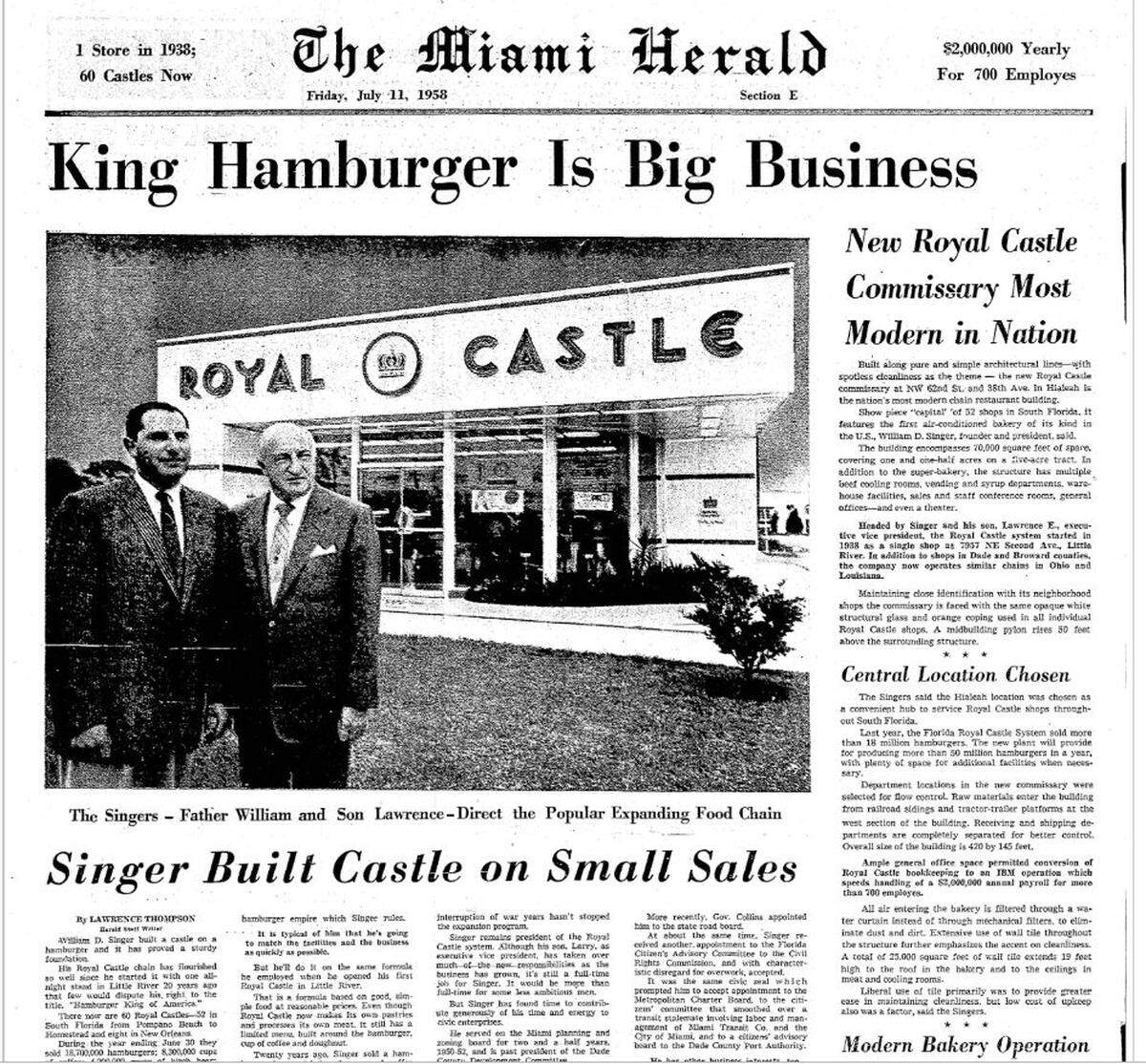
By the 1960s, the number of Royal Castles grew to more than 150.
More from Flashback Miami: “As late as 1961, African-Americans were staging sit-ins to gain counter service. They had been limited to using outdoor take-out windows. Women were not allowed to work behind the counter until 1967. “
And more from Flashback about the restaurant’s final years: “Over most of its history, the business was private, family owned. It went public in 1965. By 1969, the chain reported sales of $221 million from restaurants throughout the south. But while revenues were rising, profits fell. William Singer sold his interest in the company for about $6 million in the late 1960s. His son, Lawrence, ran the show for several years, branching out in unsuccessful efforts to franchise the name and opening higher priced restaurants. None of these was able to pull the chain back into the black. After Lawrence stepped down, former Florida Governor LeRoy Collins ran the company for about a year. In 1975, the company folded, by then owned by the same corporation that failed with Minnie Pearl Fried Chicken stands. “
Pollo Tropical
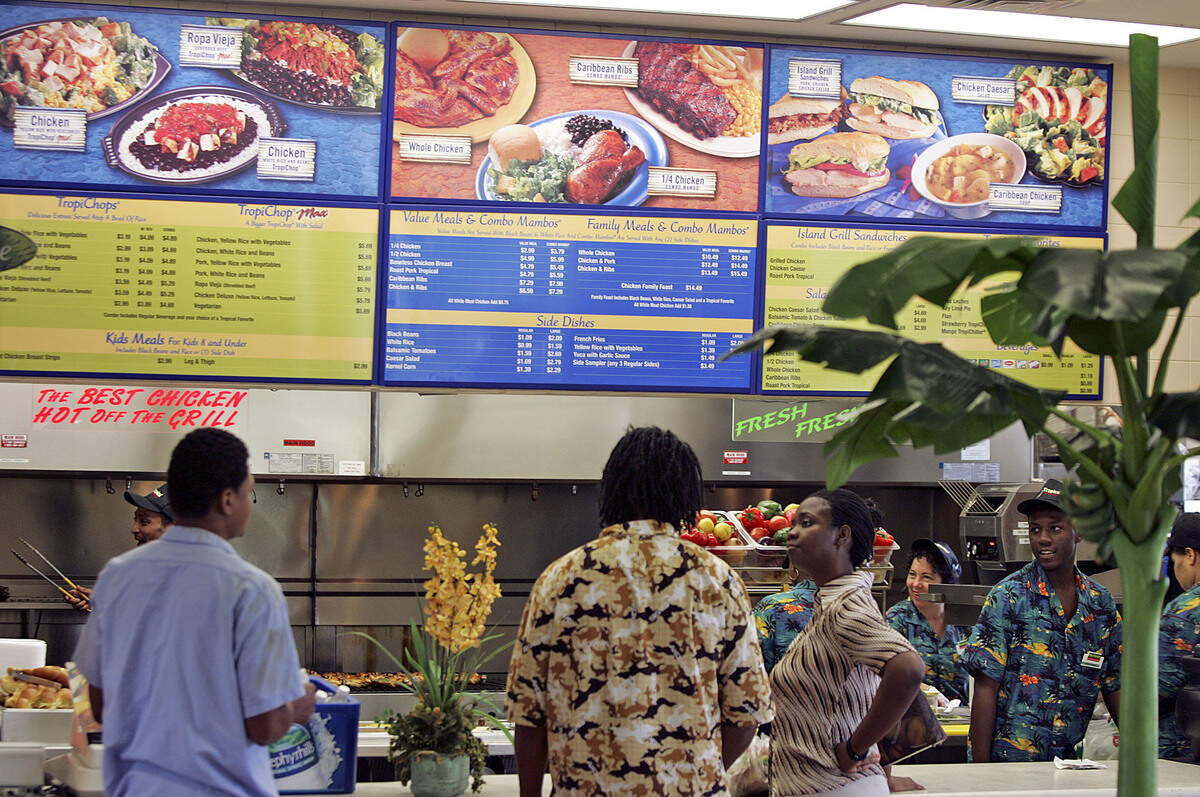
You might think Pollo Tropical’s recipes are family secrets handed down from generation to generation: Tia Tete’s black beans or great-great-grandma’s special mojo sauce first whipped up in Santiago de Cuba in 1897.
Guess again.
The chicken recipe was perfected by Pollo Tropical founder Larry Harris -- through a careful perusing of Latin American cookbooks, backyard grill time and weekends experimenting with a grilling machine in the back of a Food Spot store.
Despite Pollo Tropical’s decidedly Latin flavor and the red tile roofs and the Mediterranean arches of its restaurants, Harris doesn’t claim a drop of Hispanic blood.
But he was a Miami kid who thrived in the ethnic stew that is South Florida.
“This is the food I grew up on,” Harris said last week as he munched on grilled chicken with black beans, rice and Yucatan fries - yucca fries - at the chain’s Coconut Grove restaurant.
The inspiration for the first Pollo Tropical restaurant came not from South Florida but from the Northeast.
While on a trip in 1987, Harris’ brother Stuart, a doctor involved in clinical pharmaceutical testing, wandered into a Mexican restaurant that served a tasty grilled chicken marinated in mojo sauce -- a garlic, citrus juice blend.
He decided that Latin American-style chicken and South Florida would be a perfect fit.
Larry Harris began to research the concept, visiting a few mom and pop chains in California where the chicken was grilled but the side orders were refried beans and tortillas.
Harris knew chicken and mojo would work in South Florida, but he studied local Latin restaurants for inspiration for the side dishes.
At the time, Harris was working for his family’s business: Food Spot convenience stores. But he was intrigued by the restaurant business.
“I enjoy cooking and food and people,” said Harris, 34, a Florida International University hospitality management graduate.
By February 1988, the Harris brothers had picked out the spot for their first restaurant and had a concept in mind. With an initial investor group of 10 people, including family members, they opened the first Pollo Tropical just nine months later.
Harris said he always knew he wanted the first restaurant to evolve into a chain. His brother, the doctor, became the company’s vice chairman and secretary. “He has a good business sense about him,” Harris said.
To help lend authenticity to his embryonic Latin chicken chain, Harris went prospecting for local talent. The Pollo Tropical concept was really “born of the Miami melting pot,” Harris said.
He hired Lazaro Garcia, formerly with the Latin American Cafeteria restaurants, as manager of the first Pollo Tropical. But he had bigger plans for the Cuban-born Garcia, now the company’s vice president for operations.
“He had a strong restaurant background, and we worked with him to develop the Cuban side dishes” -- the black beans, yucca and desserts, Harris said.
Harris also knew he wanted his restaurants to have a warm tropical atmosphere, with the interior evoking a courtyard.
Cuban-born architect Isaac Sklar came up with the Mediterranean architecture and high, airy ceilings. He still does the architectural work for the Pollo Tropicals in South Florida.
For advertising, he went to another local firm, Fernandez Baradat, now FBA. That first year, the ad budget was $40,000, and all the ads were in Spanish.
As restaurants sprang up, the ad campaign became bilingual, and the budget grew to the present $2.5 million.
The centerpiece of Pollo Tropical remains chicken, and the marinade recipe is a closely guarded secret. The proprietary blend of garlic, tropical fruit juices and other spices was “evolved through a lot of trial and error,” Harris said.
Retaining homemade quality remains a key value at Pollo.
“We make the marinade fresh every day, marinate the chicken for 24 hours and rub in salt and pepper before it’s grilled for about an hour,” Harris said.
Miami Subs
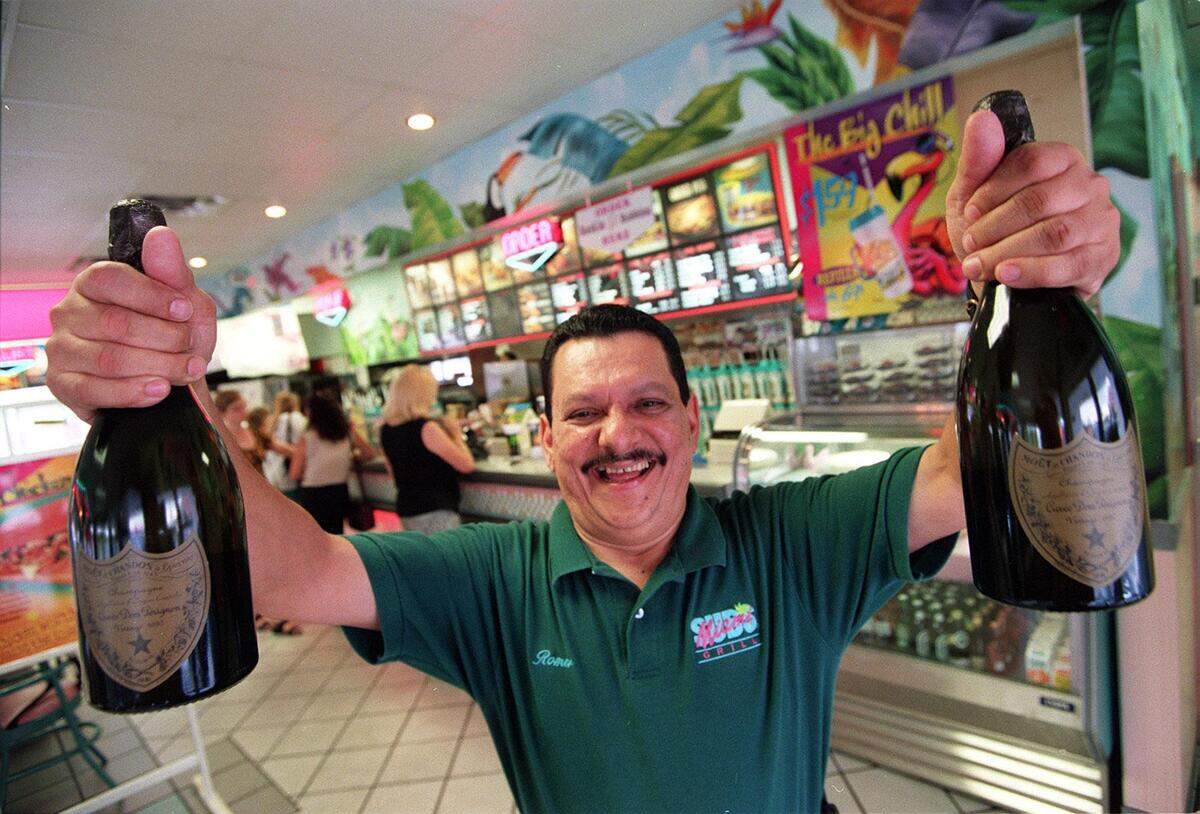
Miami Subs is more than a place for sandwiches — it’s one of the few eateries in South Miami-Dade where patrons can wash down french fries with an $89 bottle of Dom Perignon.
The restaurant, 15725 S. Dixie Highway, opened Mrch 1990 in a building formerly occupied by a Bojangles.
The franchise, decorated with bright colors and marine life replicas, is part of a Fort Lauderdale-based chain. Other branches have opened recently in Hialeah, Miami Springs and Northwest Miami-Dade.
“We have everything all the other places have in one place,” partner Les Oppenheim said Friday. “They can come here and they’re never going to get bored.”
Miami Subs specializes in what Oppenheim called “gourmet fast food.” The menu offers salads, subs, gyros, grilled chicken on pita bread, Buffalo wings, cheese steak sandwiches, hamburgers and fried seafood.
The hours are 9 a.m. to 3 a.m., and the restaurant includes a drive-through window. It is accessible to the handicapped. Oppenheim said he will add breakfast soon.
The chain never has grand-opening ceremonies for new restaurants, said spokesman Sandra Thomas, who works for founder Gus Boulis.
But Oppenheim said his location did fine without hoopla.
Boulis opened the first restaurant in Key West in 1983. There now are more than 35 in Miami-Dade, Broward, Palm Beach and Monroe counties, operated by Quick Service Restaurants. Some of the restaurants are called Mr. Submarine, but the names will be made uniform to Miami Subs soon, Thomas said.
“We started our expansion efforts in Florida about a year ago,” Thomas said. “The food, of course, I think is the first thing that brings them in.”