
Metrorail didn’t have to be so noisy during the pandemic. Fix coming, but not quickly
After two noisy years, Miami-Dade County is on track to quiet down its Metrorail system starting this summer.
The county’s Transportation and Public Works Department expects work to begin in the spring to replace missing noise-dampening barriers, launching a two-year project to erect walls along the 25-mile system.
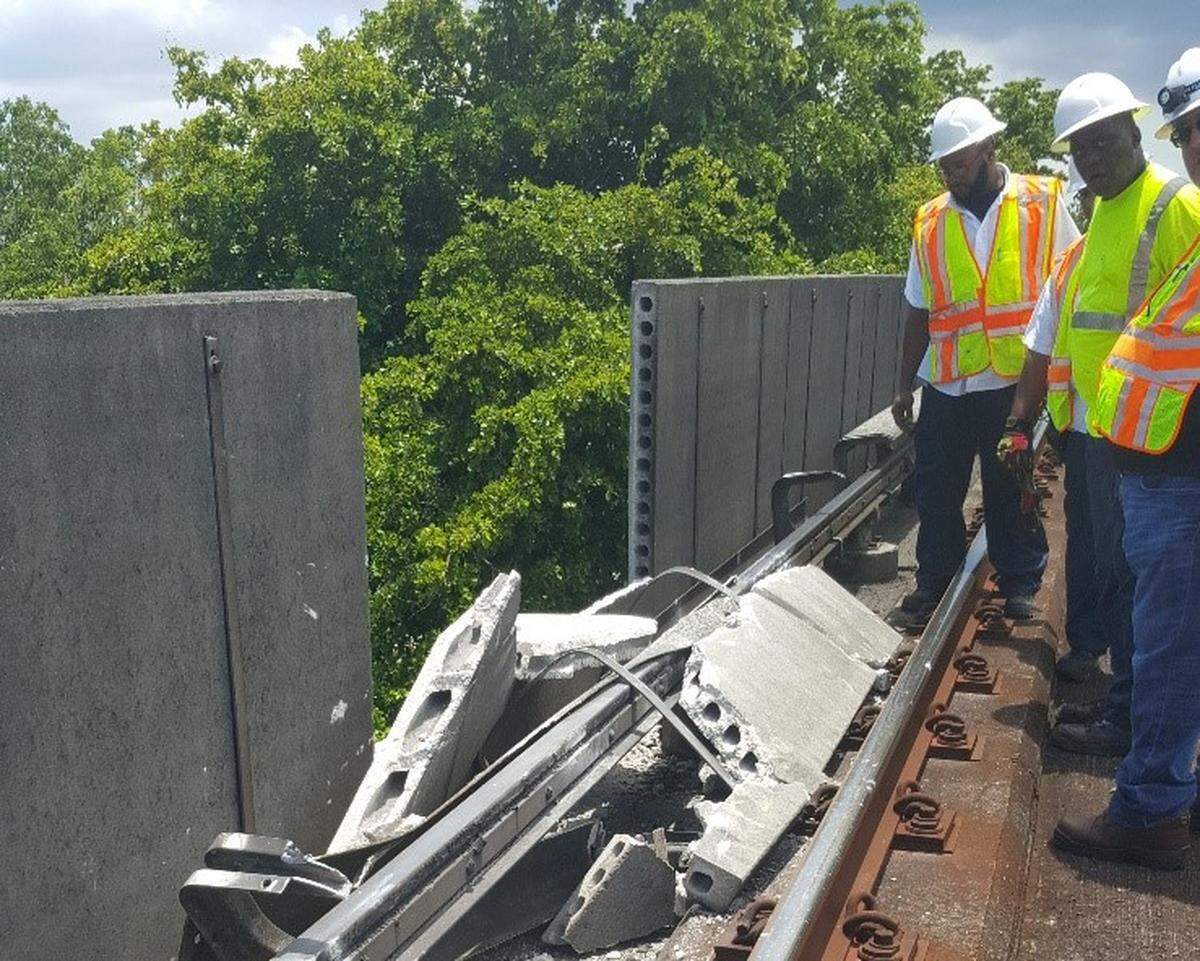
The barriers were removed during emergency repairs in 2019 after bits of concrete from the aging mini-walls stalled a train and fell onto the sidewalk below the elevated Metrorail tracks. Miami-Dade removed all of the walls in a rush to prevent more hazards, but replacing them has been a much slower process.
“The noise is heavy. The vibrations are heavy,” said Luis Herrera, a retired Ryder driver who lives near the Vizcaya Metrorail Station. “We never had noise like that.”
Herrera’s neighborhood is slated to go first on a $75 million replacement plan. The agency expects work on the new acoustic barriers to start in late April around the Vizcaya station, with construction complete by July.
Vizcaya, Coconut Grove stations quieting first
A schedule released Friday shows areas around the Coconut Grove and Douglas Road stations come later in the summer, followed by the Hialeah and Martin Luther King Jr. stations. Earlington Heights and Brownsville are expected to get their barriers at the end of 2021, followed by Allapattah and tracks near the Airport Expressway.
Crews would move on to tracks around Culmer station in the Overtown area at the start of 2022, and Brickell and downtown Miami around the Government Center station would see their first barriers in the summer of 2022.
The second wave of replacement work costs about $35 million and includes areas south of the Douglas Road station, along with some remaining stretches of tracks north of there that weren’t included in the first phase. The same contractor, Halley Engineering, is handling both phases of the project. Commissioners are set to give a final vote approval to the second phase on March 2.
An October 6 memo to county commissioners from Jennifer Moon, then a deputy mayor overseeing transportation, said scheduling priority in the first phase went to areas near hospitals, and where homes are within 150 feet of the missing barriers. It said “budget constraints” required the county to break up the work into two phases. Because the same contractor is handling both parts of the contract, areas in the second phase may get barriers before some areas in the first phase of the contract.
Alice Bravo, the county’s transportation director, said the agency can try to accelerate the work. “We’ll push it,” she said.
For Wendy Kamilar, Metrorail’s arrival and departure at the nearby Coconut Grove station has become a ritual for her — and for her coworkers on the Univision sales team.
“I get laughed at every day at work on a Zoom call,” said Kamilar, a sales executive at the network who has been working out of a second-story room facing the tracks since the pandemic began in March 2020. “I literally have to turn the microphone off and let the train go by.”
Herrera, president of the Vizcaya Roads Homeowners Association, pointed to spots in the neighborhood where Metrorail tracks loom over the trees and the rumble builds as a train approaches from the north. “It’s louder than a plane,” he said.
Tracks near hospitals, homes a priority
Without the barriers, the clatter from metal wheels hitting metal tracks spreads out without interruption into the surrounding areas. “It’s steel on steel,” Bravo said. “The noise and the vibration is significant.”
Engineers hired by the county warned Miami-Dade in 2012 it was “imperative to either replace or strengthen” acoustic barriers across the Metrorail system because they were getting too old to be reliable. The report assumed replacement would began around 2013, according to a 2018 summary of the recommendations by the engineering firm, Atkins.
While some panels were removed, most remained in place. In 2018, two barriers failed at different times around the Vizcaya station, one striking a train and one sending concrete chunks to the sidewalk below.
Nobody was injured, but Miami-Dade opted to rush removal of all barriers with no replacement contract in place. The last of the barriers came down at the end of 2019.
Why the delay in replacing Metrorail’s acoustical barriers?
Commissioners approved the first $30 million replacement contract in October. The first barrier is expected to be up in May, seven months later.
“It has been in queue longer than expected,” Ron Nelson, special projects administrator at the Department of Transportation and Public Works, wrote in a Feb. 4 email to Kamilar. Several residents who complained about Metrorail noise to commission offices said they received calls and emails from Nelson, including follow-ups on the status of the project.
“With the large turnover this election cycle some big ticket items have been held in order to give new commissioners the opportunity to learn the details,” Nelson wrote.
The loss of the acoustic barriers have made Metrorail an even louder presence in some neighborhoods, though still competing with everyday clatter.
In Brownsville, Allen McClenney said a nearby salvage yard remains the noisiest presence when it’s in operation. “At night you hear the train,” said McClenney, who works in the environmental services arm of the University of Miami.
Eileen Higgins, the county commissioner who represents portions of the Vizcaya neighborhood, said Miami-Dade should have moved much quicker to replace the barriers. “Don’t get me started,” she said. “It was poor planning. We should have known these had to be replaced.”
This story was originally published February 22, 2021 at 6:00 AM.