Miami street ‘improvement’ project was anything but. It’s now a dangerous obstacle course
An unattractive section of Northeast Fourth Avenue got a facelift.
Nip and tuck with a little repaving here, realigning there, then add fresh striping, plump new curbs, smart new sidewalks, neat new parking spaces and — voila! The scruffy stretch of a neglected street was ready for the influx of gentrification traffic coming to Little Haiti and to become a moneymaker for the Miami Parking Authority.
Except that some flaws — actually, large hazardous obstacles — have turned this recent street improvement project into a fouled-up mess for motorists, pedestrians and cyclists.
Utility poles in the traffic lanes. Sidewalks ending abruptly in a pile of rocks. Back-In Parking Only (that’s the novel command on each sign) set at a devilish angle that forces even the most skilled driver into a wrestling match with the steering wheel. A white stripe that looks as if it was drawn by crayon. A dangerous jog to avoid another utility pole — this one not planted in the street but on the razor’s edge of it.
The city of Miami won’t say who engineered the project but Dr. Kim Jacobsen, who observes the folly daily from her practice near the corner of Northeast Fourth Avenue and Northeast 54th Street, has her own suspicions: “It looks like a second-grader designed this.”
Elvis Cruz found himself slaloming around poles one night last week when he was driving home to Morningside.
“I drive this route fairly often and all of a sudden there’s a concrete pole in the street. I had to swerve around it,” he said. “If you don’t make an evasive maneuver, you’re going to slam into that thing and die. A block later, you better swerve left again or you’re going to hit the one that’s inches from the street.
“You have to see it to believe it. It’s a liability lawyer’s dream.”
After Cruz complained in an email to city officials, a crew hustled out and placed plastic orange bumpers around the poles. Strangely, new Pay to Park signs were replaced overnight by No Parking Any Time/Tow Away Zone signs (right below Back-In-Parking Only signs), sending a contradictory message to drivers.
“They didn’t build new parking spaces to create a no parking zone,” Cruz said. “The Miami Parking Authority takes down its own signs right after putting them up? It’s a nonsensical situation, every facet of it. How was this allowed to happen?”
On a weekday afternoon, every car that drove along the street had to cross over the center line into the oncoming lane of traffic to avert the pole that Cruz almost crashed into. It’s located in the northbound lane at Northeast 55th Terrace.
“Rather than move the pole first, they just widened and repaved the street around it,” Cruz said, pointing to the disconnected white line where the striping machine couldn’t get around the pole. “And this was designed to be permanent because a conduit for electricity is attached to it.”
Across the street, in front of the Atchugarry Art Center, is the odd trio of wooden utility pole, stop sign and cross walk sign (marking a forlorn crosswalk whose mission is unfulfilled because its white lines end in the middle of the street, as if the painter forgot to finish it). They are implanted in the pavement, smack dab in the middle of the bizarre intersection, like castaways stranded on an island.
“Been like that for a year or two,” Cruz said. “Used to be a swale. Then they put in a strip of sidewalk and never put the swale back.”
That stand of poles poses a dilemma for drivers approaching from the west. Take the tight right and shimmy between poles and the sidewalk to nowhere, or take a hard right around poles. A large truck chose the former route, laboriously squeezing through, then swinging into the opposite travel lane to complete the turn.
A third utility pole a block and a half north just past the 10-story Pinnacle Place affordable housing building would jut into Fourth Avenue if the street went straight. But, drivers beware, it curves left and avoids the pole by a whisker.
“Initially I was so excited to see that something was finally going to be done here,” said Jacobsen, whose end of the street is frequently flooded. “Now I feel such disappointment. It’s so haphazard, so half-baked. It’s unsafe.
“They’ve made it worse.”
Jacobsen estimates construction took nine months before it ended two weeks ago.
“I’d come out to ask questions about what they were doing and the head contractor guy would see me coming, jump in his truck and drive away,” she said. “The workers were always on break. I suspected it would not turn out well.”
The new sidewalk along the east side of the avenue stops 40 feet from the intersection with Northeast 54th Street, leaving pedestrians with the choice of trekking through gravel and dirt or detouring back to the street.
Jacobsen doesn’t understand why a sidewalk wasn’t installed along both sides of the avenue.
“Ninety percent of the pedestrians are still walking in the street every day because the new sidewalk is too distant and inconvenient for them to get to,” she said.
The sidewalk is also impeded by light poles; it’s only 28-29 inches wide at those spots.
“I saw an older lady in a wheelchair stuck on the sidewalk,” Jacobsen said. “She was crying. I had to help her get around the pole.”
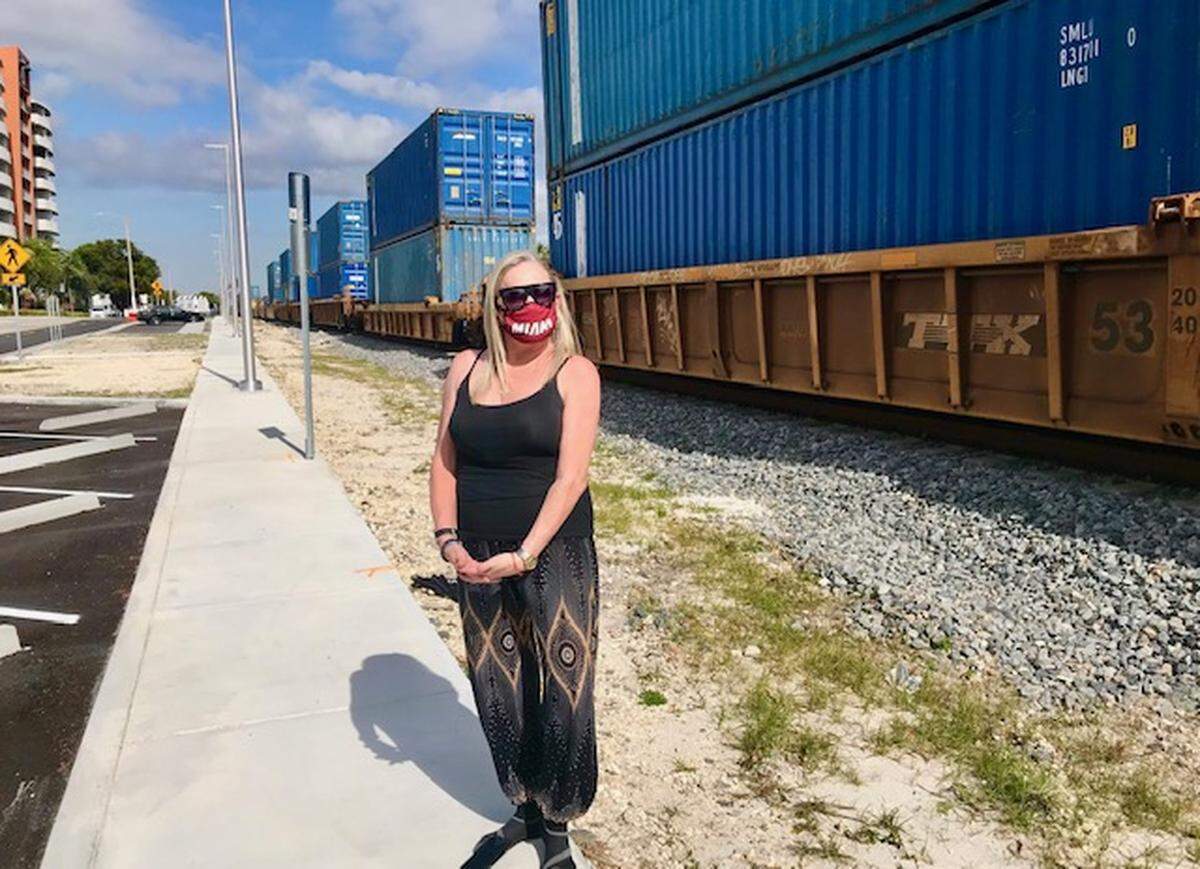
Jacobsen is also concerned that the orange safety netting separating sidewalk from the FEC railroad tracks was removed and no fence was erected.
“If you’re walking along here with a little child or a dog you better hold on tight,” she yelled as a freight train rumbled by.
The project poses lots of questions: Who designed the plans? Did the contractors do the work properly? Who inspected and approved it? How much did it cost?
The city’s Resilience and Public Works Department didn’t provide those details when asked but said the two concrete poles, which it insisted “are not in traffic lanes but immediately adjacent” will be relocated “as part of an ongoing Miami Parking Authority project to create permanent on-street parking for the area.
“FPL has now selected a contractor and work removing and relocating the now-barricaded poles is expected to begin” within 10 days, the city said in an email.
As for the protuberant wooden pole at the acid-trip intersection for at least a year? That has not passed inspection, the city said, giving no indication of its fate.
Makes taxpayers wonder, if the city can’t get a four-block piece of Northeast Fourth Avenue right, how will it ever renovate Miami Marine Stadium, restore Olympia Theater, build seawalls, repair and install anti-flooding pumps, fix traffic-choked streets, improve parks, construct bike lanes or finish dozens of other pending infrastructure projects?
“This is the opposite of an improvement. It’s a travesty,” said Jacobsen, who grew up in the neighborhood, one of the oldest in Miami. “Little Haiti deserves better. They’ve just added more ways for accidents to happen. Even the impossible back-in parking will cause accidents. The street is more dangerous than it was before.”
This story was originally published January 28, 2021 at 7:00 AM.