
These political activists aren’t old enough to vote, but they still want to be heard
Sean Greene’s alarm went off extra early last Thursday morning.
As the tone ringing from his iPhone grew increasingly louder, he rolled over to check the time. It was 6:30 a.m. Like many other 17-year-old boys, mornings are difficult for Sean, but he needed to make sure his history notes were done before virtual classes at Coral Reef Senior High started. So, he got up.
He had a lot on his schedule for the day: a World War I quiz in first period, studying Jane Eyre in English class, then there was the community forum with local candidates he wanted to tune in to at lunchtime. In the evening, he had to coordinate volunteers to canvass for his mom’s town council race, and, if time, allowed he might squeeze in some phone banking or college applications.
Adding to all that, on Tuesday Sean was elected as the chair of Miami-Dade County Youth Commission — a program that lets young people participate in county government.
Miami-Dade Youth Commission is filled with high school students like Sean from across the county. They’re bright young people with ideas and visions for the community. They’re part of Generation Z, born after 1996 and native to the digital age, they were raised in the world of social media and immediate information. They’re part of a generation of change-makers like Climate Change activist Greta Thunberg and the Marjory Stoneman Douglas students behind the March for Our Lives movement. But despite their engagement, most of the students involved in the Youth Commission — including Sean — won’t be old enough to cast a ballot on Nov. 3.
Still, the Youth Commission — and other local youth government groups across the region — are finding ways to ensure young people in Miami-Dade County have a voice, even though they’re not yet represented in the electorate.
“I joke with a lot of my friends who didn’t make the November 3 cutoff to turn 18 and vote, ‘Like, man, I wish my parents would have calculated and had me before then,’” Sean said. “It’s absolutely frustrating, but I’ve been able to figure out ways to get around. And although it may not be the ideal way, and I would love to have an ‘I Voted’ sticker coming out of the polls, we gotta do what we gotta do.”
The Youth Commission
Miami-Dade Youth Commission was created by county ordinance in 2011 as part of the vision of former County Commissioner Barbara Jordan. It was founded with the purpose of giving young people an opportunity to get involved with the county government and advise the mayor and Board of County Commissioners about issues young people care about.
Youth Councils aren’t a new concept, varying levels of government around the country have youth councils and advisory boards for young people to participate. On Miami-Dade’s Youth Commission there are two youth commissioners representing each of the county’s 13 districts. After going through an interview process, youth commissioners are appointed by their district’s county commissioner.
At Tuesday’s meeting, high school students from around the county logged on for their third Zoom meeting of the school year. Some turned on their cameras dressed in blazers and collared shirts, others stayed casual in T-shirts patiently waiting for instructions from their liaison from Miami-Dade Juvenile Services Department.
First on the agenda was elections. One by one students read prepared speeches on why they should be elected for executive positions, spewing a laundry list of involvement and accomplishments. After voting, the meeting carried on with their newly appointed offices and Sean leading the way as the officially elected chair.
Alina Sterenfeld, a 17-year-old senior at RASG Hebrew Academy in Miami Beach, is one of the few members of the Youth Commission who attends a private school. She said she joined the Youth Commission because she thought it would be a great way to get involved with her local government.
“There’s so many youth living in Miami-Dade, and our voices aren’t heard,” Alina said. “We have opinions, we have ideas. And our opinions and our ideas, they matter. And usually they’re pretty good.”
Alina said she’s not as involved with politics as she is with fighting for social justice. The Youth Commission, she said, has been a great vehicle to start conversations about issues that matter to her. Last year, she said she partnered with two other youth commissioners to spearhead a project urging the county commissioners and the school board to increase the number of mental health specialists in the school system and launch a mental health awareness campaign.
Alina won’t be old enough to vote on Nov. 3, but she said that hasn’t stopped her from being involved, staying informed and encouraging others to vote. She said last year the Youth Commission ran a campaign to increase civic engagement among the county’s minority immigrant populations.
“We’re trying to tell them that, ‘No, it’s OK, this is what you have to do. This is how you do it. We want your voice heard,’” Alina said. “So while I can’t vote, I’m trying to encourage others to vote.”
A politically engaged younger generation
Jerusha Conner, an education professor at Villanova University with a focus in youth activism and civic engagement, said that Gen Z is more politically and civically involved for it’s age than generations before it were.
According to Conner, Gen Z made up most of the 18-to-24 vote in the 2018 midterms, when turnout was 32% compared to 22% for millennials in 2006, 23% for Gen X in 1990 and 25% for Baby Boomers in 1974.
Conner also pointed to first-time, first-year college students’ reports of participation in political protests. In the ‘60s, the percentages hovered between 16% and 22%. In 2018, it was at 35% and in 2019 it was at 30%, Conner said. She added that freshmen who said they expected to participate in student protests while in college increased from 4% in the ‘60s, to 7% in 1990, and to 11% in 2018 and 2019.
“They are vocal and passionate because they feel that so much is at stake, and they see adults as having abrogated our responsibility to protect them and their future,” Conner said. “They are working to fill a leadership void they believe adults have left.”
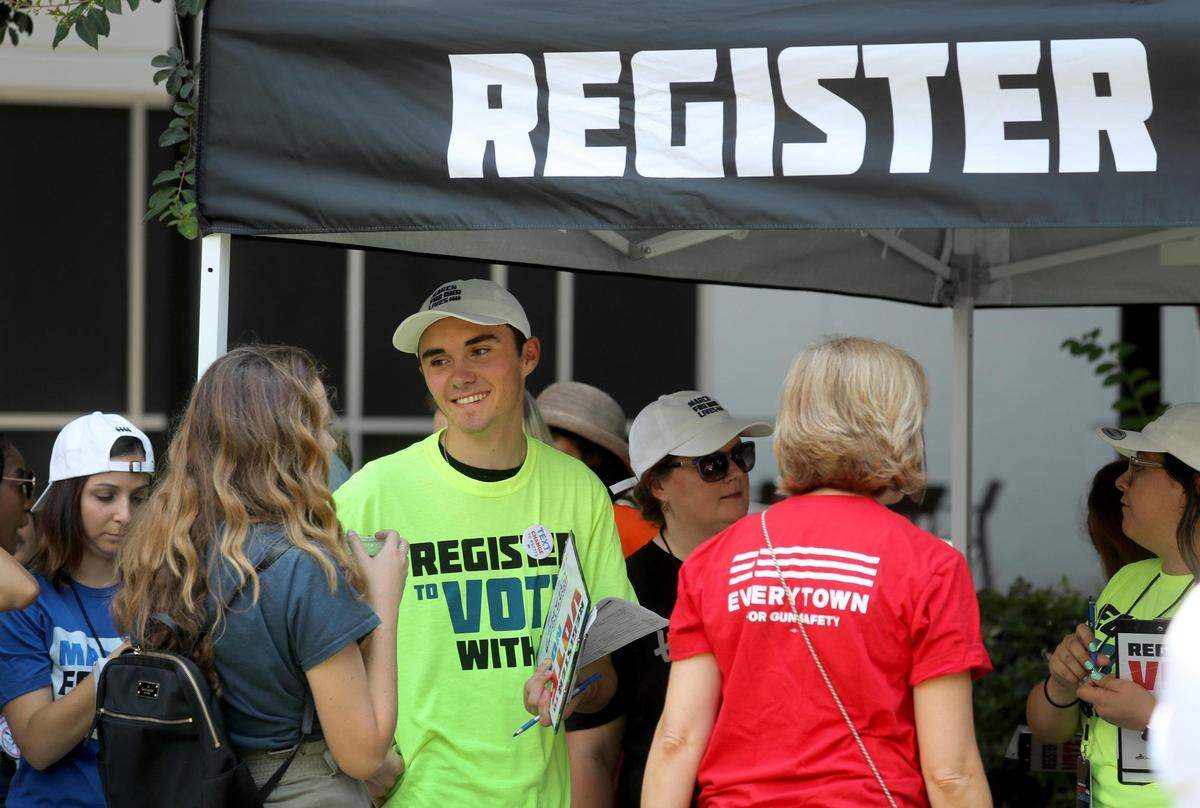
As for those still not old enough to vote, Conner said they’re still getting involved by hitting the streets and persuading others to vote since they can’t.
Putting it into practice
That’s what Sean’s been doing, he’s been on the ground campaigning and canvassing for the candidates he cares about.
In this election cycle he’s focused on supporting his mother, Debbie Waks, who is running for Cutler Bay Town Council and Miami-Dade County mayoral candidate Daniella Levine Cava, who appointed Sean to the Youth Commission.
“I just felt some sort of gratitude that I needed to pay back,” Sean said. “Especially since she really helped me give this voice to District 8 youth. I felt indebted, but also I really agree with her statements.”
Across the county, Joshua Campos, a 16-year-old junior at Hialeah Educational Academy, feels the same way as Sean, except he’s supporting Cava’s opponent, Esteban Bovo. He appointed both Josh and his older brother to the Youth Commission, so when Josh heard Bovo was running for mayor he jumped on board and became a campaign volunteer.
“I was helping him all the way through,” Josh said. “Esteban Bovo is a great man. I take everything he says as a learning lesson. You know, he teaches me so much, and I’m here in the position that I am today because of him.”
No matter where they fall, young people and experts agree that Gen Z is uniquely equipped to get involved because of their relationship with technology and social media.
Melissa Deckman, a Washington College political science professor who is writing a book about Generation Z, gender and political engagement, said that social media has really allowed young people to get involved and have a platform.
“Young people have a voice that they’re using through things like Instagram and TikTok, and organizationally, it’s allowing them to have a bigger presence,” Deckman said. “They’re able to find their people and to coordinate with their people.”
Deckman said that while social media raises awareness and allows for better organization, taking the next step to go to those in power is critical to affecting actual change.
“At the end of the day, you have to convince stakeholders and government officials who are in charge of policy to make changes,” Deckman said. “So just posting and retweeting things on Twitter is not going to be enough to do that.”
That’s how the students in Youth Commission see their role in the community. They’re dedicated to making sure those in power hear what young people in Miami-Dade have to say.
Sofia Rebull, a 17-year-old senior at Coral Gables Senior High, said she doesn’t want to be a politician or public official, she wants to be a doctor and help people. She saw the Miami-Dade Youth Commission as a great way to do that.
“I felt like I was in an environment with people who had similar goals and motivations as me, not in the sense that we all want to be in this career, but we all had a common goal of representing people, and representing the voice of students we knew,” Sofia said.
As for Sean, with the election only weeks away, he still has a lot of doors to knock on and maybe a few college applications to submit.
Miami-Dade Youth Commission members
Officers:
▪ Chair: Sean Greene
▪ Vice Chair: Nakia Alexander
▪ Secretary: Sofia Rebull
▪ Historian: Joshua Campos
▪ Parliamentarian: Cyrah Gale
Commissioners:
▪ District 1: Kenya Handfield and Jaleen Bondieumaitre
▪ District 2: Miltilla Hall and Shelsee Joseph
▪ District 3: Cyrah Gayle and Jahnee Smith
▪ District 4: Alina Sterenfeld and Michelle Kugel
▪ District 5: Sofia Rebull and Carlos Ortega
▪ District 6: Kelly Araujo and Sylvia Rodriguez
▪ District 7: Carlos Aragon and Ilma Turcios
▪ District 8: Sean K. Greene and Kayla Klurman
▪ District 9: Aynsley Sumpter and Nakia Alexander
▪ District 10: Appointees pending
▪ District 11: Frank Ramirez and Ahmed Martinez
▪ District 12: Alejandra Beltran and Edward Cortez
▪ District 13: Joshua Campos and appointee pending
Ex- Officio Appointments:
▪ Miami-Dade County Mayor: Appointee pending
▪ Miami-Dade County Clerk of Courts: Gabriela Martinez
▪ Agenda Coordinator: Leandra Hall
▪ Miami-Dade County Public Schools: Maria Martinez
MDCYC Committee Members:
▪ Isabela Alvarado, District 7
▪ Alexandra N. Ceballos, District 7
▪ Aliya Dhanji, District 1
▪ Jacob Grindstaff, District 1
▪ Adam Latiff, District 9
▪ Jason Monroe Murray, District 1
▪ Nicole Torres, District 7
▪ Isaac Veliz, District 8
▪ Shang Wang, District 8
▪ Kelly Williams-Minniefield, District 7
This story was originally published October 16, 2020 at 6:00 AM.