
Cars line up for hours at the food pantry. How the pandemic ravaged South Florida
Three seasons have passed since COVID-19 first began menacing South Florida and the number of cases has been inching upward as the fall and flu season begin.
More than 800 cars recently lined up before dawn for a Feeding South Florida food distribution at Amelia Earhart Park. Once inside the park, they slowly advanced toward white tents with their hatches and trunks open, ready to receive liquid eggs, cottage cheese, milk, a brick of cheese, yogurt, tomatoes, 10 pounds of potatoes, bananas, cereal, five pounds of rice, black beans, sour cream, diced chicken and apples that many would stretch out to cover meals for an entire week.
“Sometimes we get as many as 1,000 cars, and we regularly turn away 30 to 40 cars because we run out of food,” said Deallo Johnson, a Miami-Dade regional parks manager who was overseeing the food distribution at the Hialeah park. “Sometimes people come on bicycles and scooters for the handicapped and we also have people sitting in their cars waiting at 3 a.m. I’m just grateful we get to help people.”
The park is one of more than 40 locations in South Florida where Feeding South Florida distributes food on a weekly or biweekly basis.
Not only has South Florida been a hot spot for the pandemic, but the metropolitan area’s demographics and economic structure make it particularly vulnerable to the economic ravages of the coronavirus.
South Florida is built on a service economy, highly dependent on tourism, retail and trade with a large number of small businesses that have found it difficult to hang on as people stayed close to home and were wary of travel.
“We do rely a lot on external stimuli, folks coming from elsewhere,” said Paco Vélez, president and CEO of Feeding South Florida. “[The pandemic] has affected almost every industry. Small businesses and entrepreneurs had extended themselves in terms of following their dreams by renting equipment and space. Now they’re really struggling to pay those rents and leases.”
High levels of poverty
Before the pandemic took hold, 13.5 percent of the population in the Miami Metro area, which covers Miami-Dade, Broward and Palm Beach counties, and 15.8 percent of those 65 years and older already were living below the poverty line, according to 2019 estimates from the U.S. Census Bureau. Nationally, 12.3 percent of the population lives in poverty.
For Miami-Dade County alone, the American Community Survey estimated that in 2018, 18 percent of the population was living below the poverty level. The county also has one of the widest income gaps in the nation.
Even before pandemic-related job losses swept away health insurance for some workers, 15.4 percent of the Miami Metro population had no medical coverage, compared to 9.2 percent nationally.
Median household income locally also lags the national average, and an estimated 20.1 percent of Miami Metro households took in less than $25,000 in 2019.
As a result of economic challenges spawned by the COVID-19 pandemic, Florida International University’s Metropolitan Center estimates that 14.4 percent of residents in the Miami Metro area are living in households without enough to eat.
Feeding South Florida ‘overwhelmed’
For Feeding South Florida’s first pandemic-related food distribution in Miami months ago, the nonprofit had planned on distributing meal packages to 500 to 700 families. “More than 3,000 families showed up. We were overwhelmed,” said Vélez.
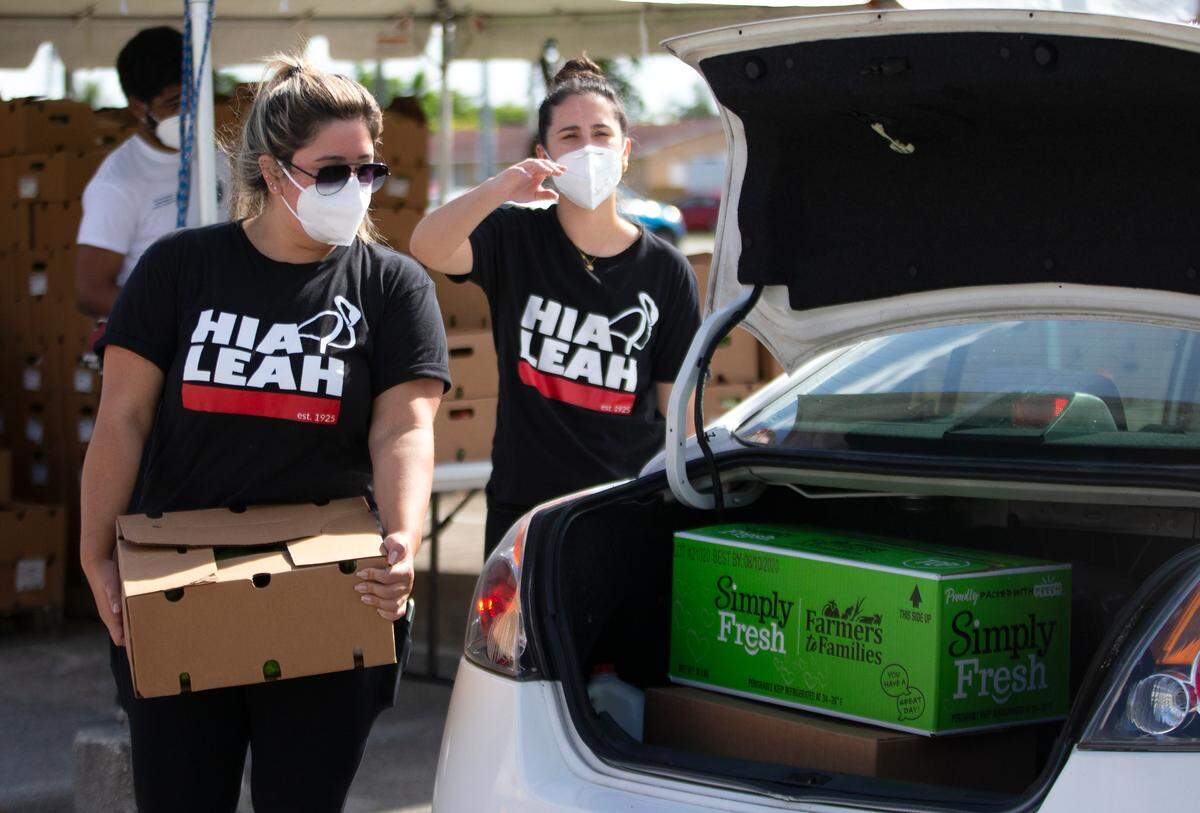
But the food pantry Feeding South Florida quickly adjusted, working with local farmers and companies to meet the needs of hungry families in Miami-Dade, Broward, Palm Beach and Monroe counties.
In the previous fiscal year, Feeding South Florida distributed 61.5 million pounds of food in South Florida. For the fiscal year that ended in June, it distributed 119 million pounds of food, including 60 million pounds from March to June alone.
In recent weeks, Vélez said, the demand for food is “stabilizing somewhat, but it is not going down. We’re still seeing a lot of families that need help.”
During the growing season, Feeding South Florida depended heavily on the generosity of local farmers, but now with fields just planted, Vélez said the nonprofit will have to dip into scarce funds to buy food until crops are once again being harvested.
Vélez said he expects the extra demand for food to persist even after the pandemic begins to subside.
“We have people going back to work, but they still have to make up their rents from maybe three or four months when they weren’t paying. They need to save money for that and still feed their families,” he said.
Big job losses in South Florida
Since the pandemic began, the Metropolitan Center said, more than 256,000 jobs have been lost in South Florida and the region has accounted for 35 percent of the unemployment claims in the state.
Among the hardest-hit sectors: education and health services with 26,400 jobs lost in South Florida between March and August due to the pandemic; retail, where there were 17,200 COVID-related jobs lost; food services and accommodations with 81,200 lost jobs; and the administrative and waste services sector where 22,000 jobs disappeared.
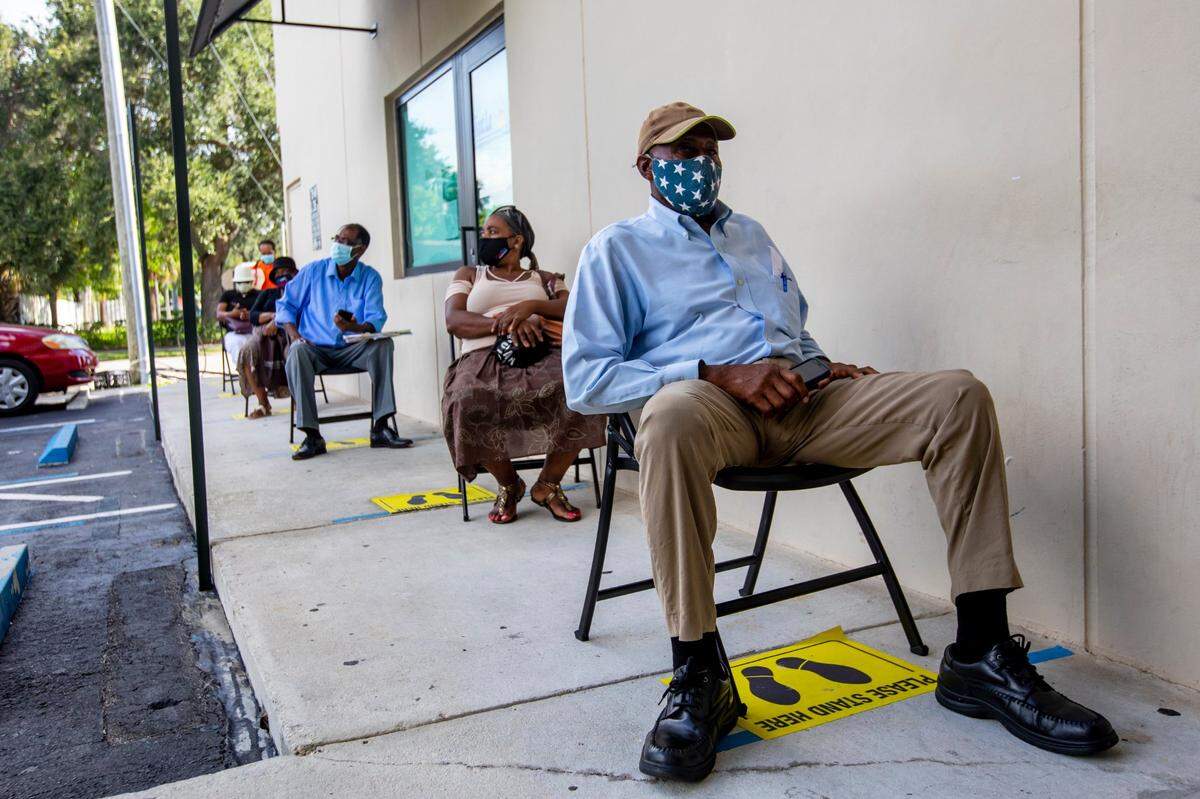
“A lot of these jobs may not come back. The pre-COVID economy was already at a tipping point,” said Ned Murray, associate director of research at the Metropolitan Center. Already, he said, more than double the jobs have been lost than disappeared during the 2008-2010 recession.
In those four sectors alone, 384,654 South Floridians applied for unemployment benefits for the first time between March and August. In September, there were 35,297 new claimants.
“Our understanding is that these numbers can get worse in coming months,” said Murray.
Not included in the statistics are contract, temporary and gig workers. Undocumented immigrants, which number about 450,000 in South Florida, also aren’t eligible to file for state unemployment benefits.
The economic downturn is also impacting Hispanics and Blacks at higher rates.
A nationwide survey by The Commonwealth Fund, a private foundation that seeks to improve the healthcare system, shows that 49 percent of Latino respondents and 38 percent of Black respondents reported they had used up all or most of their savings during the pandemic.
Housing is one of the key issues
Affordable housing is one of the most critical issues. Roughly half of Miami-Dade households rent. With a median sales price for a Miami-Dade home of $425,000 in August, housing costs are also high for many who pay mortgages.
“It’s kind of a double hit. In South Florida, we’re very constrained in terms of land so housing costs are high, and our economy is so dependent on the service sector — restaurants, hotels that have been among the hardest hit,” said Andrea Heuson, a professor of finance at the University of Miami. “People were right on the margin to begin with in terms of housing costs and now they’re losing their jobs as a result of the pandemic.”
Help on mortgages, evictions
A statewide ban on evictions expired on Oct. 1, but a Centers for Disease Control and Prevention order protects renters unable to pay rent due to the pandemic from eviction until Dec. 31.
Catalyst Miami, a social services organization that works to solve the problems of low-wealth Miami-Dade communities, has partnered with the Community Justice Project to help people with legal problems related to evictions.
“While many landlords are good-hearted, not all of them are,” said Carolina Fernandez-Mazzoni, Catalyst’s communications manager. “Threats of eviction have scared some tenants enough that they’ve packed up and moved out.”
“The moratorium on evictions and PPP (Paycheck Protection Program) money forestalled a huge crisis in housing affordability, but there will be dramatic effects in coming months if these programs aren’t renewed,” said UM’s Heuson.
Miami-Dade County offered funds for up to three months of missed rent payments to both tenants and landlords under the federal CARES Act, a $2.2 trillion coronavirus relief package, but the window for applying for those programs is closed. There were also income limits.
The City of Miami has a mortgage assistance program for eligible city homeowners who experienced job or income loss due to the pandemic. It’s open until Nov. 30 or until funds are exhausted. The city’s Eviction Prevention Program, which pays up to $7,000 in rental arrears for eligible renters, is open.
“We’ve known for a long time that we lacked affordable housing in this community,” said Heuson. “Planning on some big affordable housing projects around transit sites started about 18 months ago so this is going to take time. We have long-term issues.”
As a stopgap, CARES Act funds have been used in South Florida for forgiving small business loans, helping arts organizations and veterans, and for funding programs to help restaurant and bar workers, pay for childcare and adult daycare and to aid taxi, jitney and limo drivers.
But political wrangling in Washington makes it unclear when further relief and federal dollars can be expected.
CARES Act dollars also were used to pay for food boxes distributed by Feeding South Florida, but that funding ran out, said Vélez. “That means we will have to purchase more food with our own dollars,” he said. “The best thing now would be for people to offer financial support.”
Organizations helping South Floridians
The United Way of Miami-Dade and the Miami Foundation have been key in distributing CARES Act funds to people in need. They each have started pandemic relief funds and maintain extensive lists of pandemic resources that are helping people throughout South Florida weather the COVID-19 storm.
Catalyst Miami is helping people fill out applications for Medicaid, unemployment assistance, KidCare (health insurance for children), SNAP (food stamps), and TANF (cash assistance for families). They’re also providing financial coaching for those who have lost their jobs and guiding small businesses through applying for small business grants, reviewing contracts for them and offering other technical support.
“We help demystify and simplify processes so people can access the services and programs they need,” said Fernandez-Mazzoni. “These applications are not easy and intuitive in many cases. We explain and guide people through the resources that are available.”
Catalyst Miami helped Shawna Pointville, the chief executive of Excel Kids Academy in Miami Gardens, navigate the state bureaucracy to receive childcare subsidies. During the pandemic, Pointville has incurred extra expenses for personal protective gear and other safety protocols that must be in place to keep the staff and students of the pre-K through fifth grade school safe. Catalyst made sure she was aware of COVID-19-related programs to help small businesses and other state and local lending programs.
Catalyst Miami also started a Rapid Response Fund and distributed $500 each to 150 families and individuals that it had been working with who had lost income due to the pandemic.
“As the pandemic progresses, we want to do more things like this,” said Fernandez-Mazzoni. “If people want to help, donations go a long way.”
How to get help
United Way of Miami-Dade: https://unitedwaymiami.org; 305-646-7000
COVID-19 Resource Center: https://unitedwaymiami.org/coronavirusresources
Catalyst Miami: https://catalystmiami.org
COVID-19 Resource Center: https://www.catalystmiami.org/more_resources_covid
Phone: 305-576-5001
Hotline: 786-527-2580
Email: infor@catalystmiami.org
Feeding South Florida: https://feedingsouthflorida.org
Locator for drive-thru food distribution sites (updated daily):
https://feedingsouthflorida.org/distribution_locator
▪ A $25 donation to Feeding South Florida will provide a boxed Thanksgiving meal for a family of four including a turkey, produce, traditional sides and gravy and dessert mixes. Contributions must be received by Nov. 23 to ensure delivery. To adopt a family, visit: www.feedingsouthflorida.org/donate-now
Phone: 954-518-1818
The Miami Foundation: https://miamifoundation.org/
Phone: 305-371-2711
Email: info@miamifoundation.org
COVID-19 Recovery Resources: https://miamifoundation.org/recoveryresources
Jewish Community Services: 24-hour JCS Helpline Services hotline in English, Spanish, and Creole for assistance with employment, housing, crisis counseling and other needs: Call 211
Contact Miami Whitefield on Twitter @heraldmimi and at mimiwhitefield@gmail.com
This story was originally published November 2, 2020 at 5:00 AM.