
Miami-Dade commissioners to consider naming street after ex-Colombian leader on house arrest
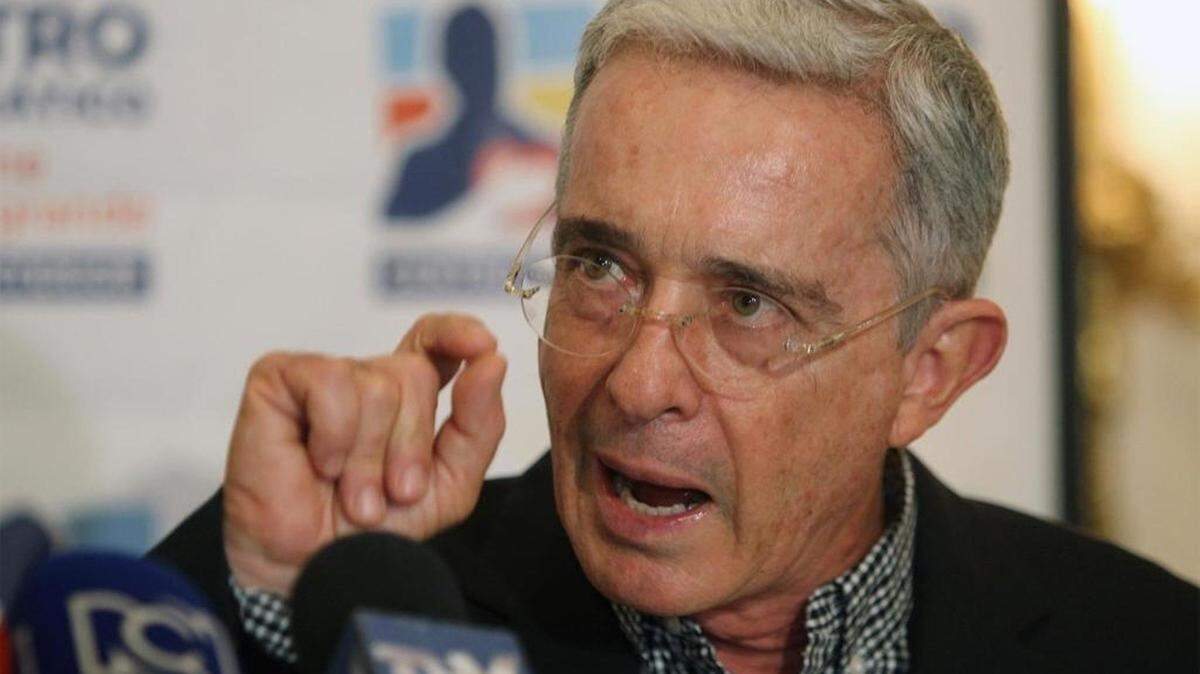
Two Colombian activists exiled in Miami — Fabio Andrade and Jaime Flórez — have been asking a Miami-Dade County commissioner since late last year to “pay tribute” in some way in South Florida to former Colombian President Álvaro Uribe Vélez.
The problem? Since Aug. 4, Uribe has been under house arrest at his home in Montería for alleged fraud and witness-tampering.
Because of this, the proposal to name “Álvaro Uribe Way” a portion of Southwest 117th Avenue, between Bird Road and Coral Way, which was put on the commission’s agenda Tuesday, has become controversial: Colombians are divided between those who support the measure and those who oppose it.
Miami-Dade District 10 Commissioner Javier Souto introduced the proposal on Aug. 8 — four days after Uribe’s arrest. The rest of the Miami-Dade County Commission was scheduled to debate the document on Aug. 31.
But on Wednesday, for some unknown reason, the county’s website labeled the proposal deferred to ”no date certain.”
For the measure to pass, three-fifths of commissioners need to approve it. Then after the vote, it would take effect 10 days later, unless the county mayor, Carlos Gimenez, vetoed it.
Juan David Vélez, representative of the Colombian Senate abroad and a member of the party that Uribe founded — the Democratic Center — said that “democracy allows one to agree or disagree with decisions” but that the majority of Colombians in Miami continue to support Uribe.
Among those who are opposed is Beto Coral of Miami, who is Colombian. As soon as he heard the news, the 33-year-old was frustrated, and he immediately posted a video on his social media from the street to protest the proposal.
“They are about to glorify a person who has more than 280 investigations and processes pending for crimes against humanity. It’s not about political position or ideologies,” Coral told the Herald on Wednesday.
Commissioner and mayoral candidate Esteban ‘Steve’ Bovo, who co-sponsored the bill, told el Nuevo Herald that it was “disheartening” to see what was happening in Colombia, where “the left is taking over institutions” to prosecute Uribe on what he believes are frivolous charges.
“I don’t think the Supreme Court there has any moral high ground here when you have members of the FARC walking around Colombia,” said Bovo, referring to former president Santos granting amnesty to over 7,000 members of the FARC, as part of a peace process, to reintegrate the former members into Colombian society.
Protests planned
Coral added that giving the name of Uribe to the street would be an “offense for those who were victims of violence” during his years in office.
Some online users supported Coral with comments on his video and launched attacks on Miami-Dade commissioner and mayoral candidate Esteban Bovo, who co-sponsored the proposal. Others urged the public to vote for Bovo’s opponent, Daniella Levine Cava, in the Nov. 3 general election.
“This was something we were working on long before” Uribe’s arrest, said Bovo about the measure. He argued that those protesting against it are “probably folks against Uribe” and against “those in Colombia who want to see a more conservative thread of government.”
“But that’s what democracy is all about, they’re more than welcome to demonstrate and protest. Thank God we live in a county that affords that opportunity,” he added.
Those who oppose the proposal have started mobilizing in South Florida. The group Colombian Progressives planned a protest for Friday at 6 p.m. in front of the Miami Government Center, located at 111 NW First St.
Marisol Restrepo, a spokeswoman for that group, said that the main reason she plans to attend the protest is because “it is not fair that a street bears the name of a person who is under house arrest.”
“When they name a street, it is because the person has truly made history. And this man did make history, but in a negative way,” Restrepo said. According to the 50-year-old Colombian who lives in Miami, what the community is seeking is “to unmask what is happening in Colombia and for people to see reality.”
Why name the street after the former president?
Fabio Andrade, the 62-year-old Colombian activist who lobbied elected officials to advance the Uribe Velez tribute, told the Herald that he gave Souto a letter last year requesting the measure on behalf of America’s Community Center, a nonprofit organization that seeks to help Hispanic immigrants in South Florida.
Andrade said that the initiative came about because Uribe had made Colombians in exile proud of their nationality. Before, he said, the image was tainted by drug-related stereotypes. Then in late 2019, he started working to make the tribute a reality.
Commissioner Souto agreed from the beginning, Andrade said, since the majority of Colombians in exile in the United States reside in the county. However, the process was delayed by the search for a street, which needed to be in unincorporated Miami-Dade.
“I think it’s merecido,” said Bovo, using the Spanish word for “earned.” “I think it’s appropriate, to be perfectly honest. ”
Andrade said that although he had been working for months and believes the measure was delayed by the pandemic, the proposal came “at the right time.”
Some Colombians online made comments saying the commission should wait until Uribe’s investigation is done before voting on the proposal. In response to those comments Bovo said that it may be something that commissioner Souto is considering and that Souto was “the driver” and he was just the co-sponsor of the legislation. Souto did not answer requests for comment for this story.
This story was originally published August 26, 2020 at 10:07 PM.
