
Coronavirus debate in Miami-Dade mayor’s race: Candidates spar on schools, closures
In the race for Miami-Dade mayor in 2020, a schools plan now comes down to a blunt question: Should they even open?
At a debate Friday, candidate Alex Penelas was the most blunt in answering that question, saying he considered it too risky for classrooms to reopen next month. “It’s a very difficult decision,” said Penelas, a former two-term county mayor now running for the post again. “But I don’t think we’re prepared.”
The coronavirus pandemic has reshaped politics and upended how the candidates running to replace outgoing Mayor Carlos Gimenez planned to wage their campaigns. It also presents a crisis one of them will likely inherit in November, be it an ongoing fight to contain the virus or merely the economic carnage the response has left behind.
Daniella Levine Cava, one of three sitting county commissioners in the race, used her time at the Town of Miami Lakes debate to highlight her public criticism of Gimenez’s handling of the crisis and her early calls for expanded contact tracing and isolation options.
“I have been looking at this since January, when it was spreading around the world. By March, my hair was on fire,” she told Noticias 23’s Ambrosio Hernandez, the moderator for the city event. “The masking was not taken seriously. The testing not taken seriously. And our tracing program is laughable. I can only say there is nothing about the way it was handled that is like how I would have handled it.”
Commissioner Esteban “Steve” Bovo used a coronavirus answer to deliver a dig to an opponent’s son. Xavier Suarez, a commissioner making second bid for county mayor in 16 years, is the father of Francis Suarez, the Miami mayor who apologized for being photographed without a mask posing with friends at a crowded Miami restaurant on a weekend night, an apparent violation of existing city and county emergency rules.
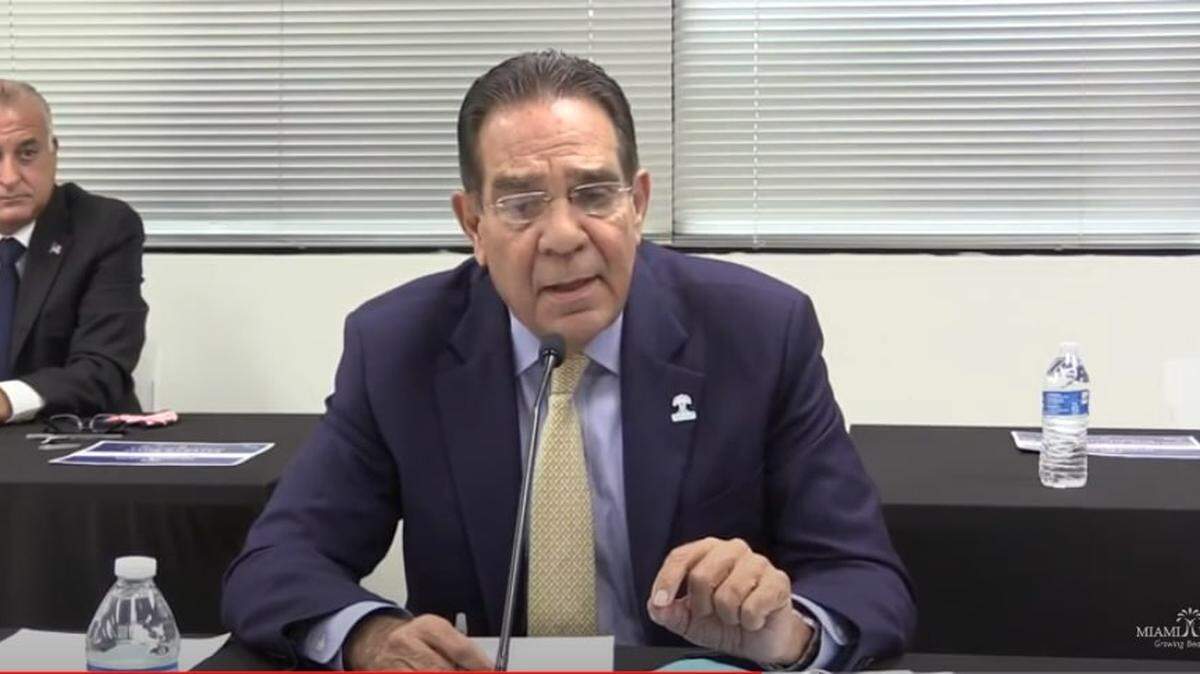
“It does not help when the city mayor of Miami preaches one thing, and then goes out to a bar and celebrates with sparkling bottles of champagne,” Bovo said from his table at the Universidad Ana G. Mendez school in Miami Lakes. Each candidate got a table, and mostly wore masks until it was their turn to address the camera over the Facebook broadcast.
Suarez, a former Miami mayor himself, called his son “the star” for the city, canceling the Ultra Music and Calle Ocho festival before the COVID crisis began in early March with a county state of emergency.
He also praised Gimenez’s two-month closure of non-essential businesses between March and May but criticized the mayor’s announcement in early July that restaurants would have to close again — a planned order the mayor later narrowed to cover indoor dining only.
“I think to a great extent we did the right things in the beginning. We started opening at the right time,” Suarez said. “You never — all of a sudden, without consultation of anyone — then retract what you have done and tell all these shops and all these businesses and all these restaurants that have bought inventory, that you’re going to shut them down.”
Also at the debate was Carlos De Armas, a write-in candidate for the Aug. 16 non-partisan primary for mayor. If no candidate receives more than 50% of the vote, the top two finishers will compete in a November 3 run-off.
De Armas said Miami-Dade failed before COVID-19 even arrived by not being ready. “The government should have a plan in place to fight pandemics,” he said. “We didn’t have that.”
While the school system is governed by its own board, Gimenez and Superintendent Alberto Carvalho said they are meeting on the safest way to conduct classes in the coming months. The next mayor takes office Nov. 17, and could inherit a county government still at the peak of the worst health crisis to hit Miami-Dade in a century.
Asked about school reopening, Suarez didn’t take a position. “I’m glad that we have Carvalho as superintendent.”
Bovo said reopening the economy can’t happen without classrooms, and said staggered schedules and a mix of online learning could help in-person learning return.
“You cannot open your economy unless these schools are equipped and ready,” he said. ”We need to give them the leeway, and not the pressure, to be able to open when they can keep our children safe.”
Levine Cava agreed that the economy can’t “open up” without children attending school. “Only a small percentage of our population can work from home and have their children home-schooled,” she said. “We need to make sure we have safe places so people can go to work. These children are losing out.”
Penelas was the only candidate to say schools shouldn’t reopen in August. He pointed to his own daughter’s entering the third grade as argument for getting schools open again. “She’s been cooped up. She needs that social interaction. It’s difficult,” he said. But “under current conditions, I don’t think we can.”
This story was originally published July 17, 2020 at 7:53 PM.