Beach, Bay Harbor pushed back on jets overhead. They may go to North Miami, Miami Gardens.
South Florida’s airspace is about to get a multimillion-dollar upgrade that could save airlines nearly $16 million in fuel and the environment more than 46 thousand metric tons in carbon a year, and reduce air traffic delays.
But it could damage the quality of life of thousands of Northeast and Northwest Miami-Dade households, critics say.
The program, known as NextGen, is part of a nationwide initiative by the Federal Aviation Administration to modernize air traffic control from a ground-based radar system to a GPS satellite system that will concentrate planes into highway-like lanes.
The plan will affect 21 airports in the state and nine in South Florida — Miami International, Miami Opa-locka Executive, Miami Executive, Palm Beach International, Fort Lauderdale/Hollywood International, Fort Lauderdale Executive, Ocean Reef, Boca Raton and Witham Field in Stuart.
According to the FAA’s environmental assessment study, the South Florida Metroplex plan will not have significant impacts on noise, air quality and the “fabric of the community.”
“We are not shifting noise from one location to another, but rather we are implementing these new capabilities along the backbones of where flights have historically been flying,” Michael O’Hara, head of FAA’s southern region, said at a Miami-Dade County Commission meeting on July 8.
“The entire program has been focused on reducing the noise, not increasing the noise,” added Lester Sola, the CEO at Miami International Airport.
However, residents living under one of the new condensed departure paths argue the agency’s study fails to recognize the impact on them.
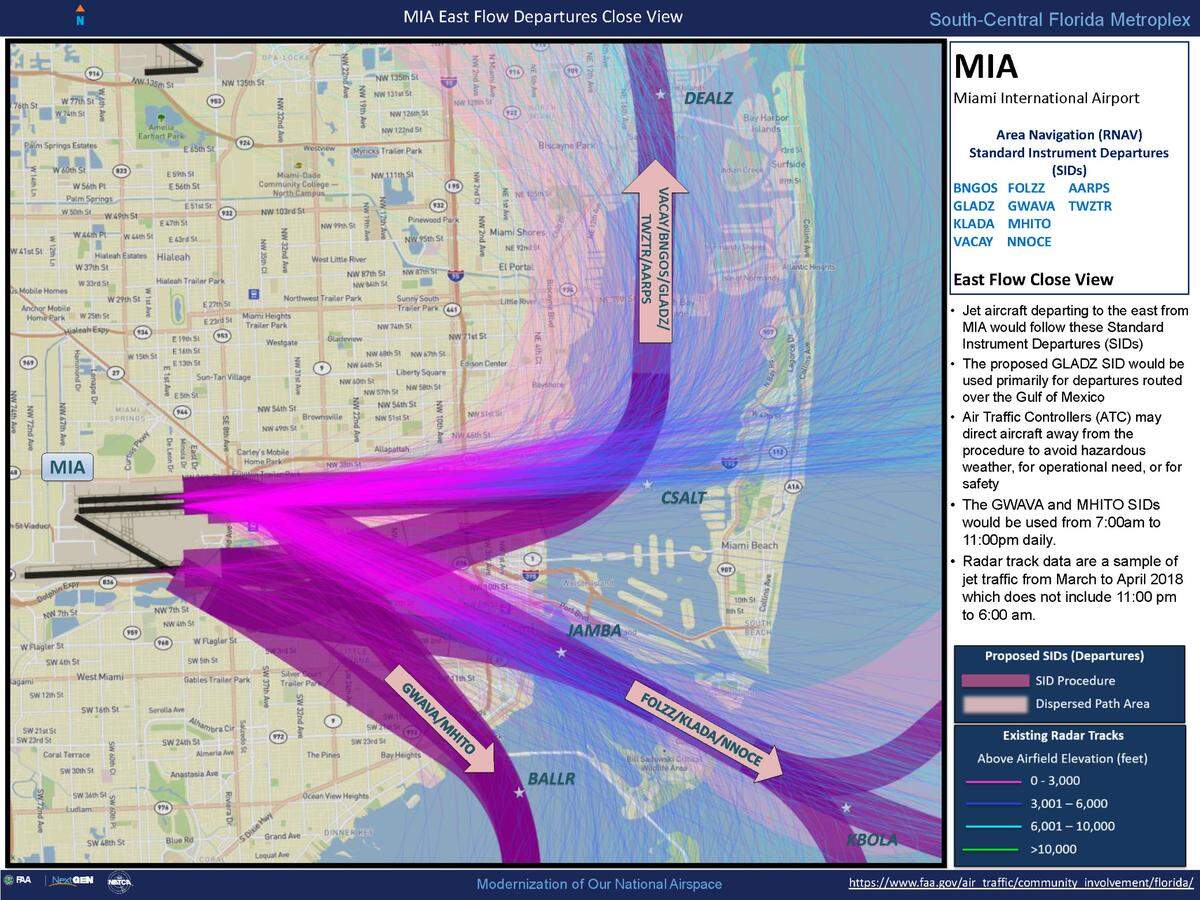
Under the plan, about 65 percent of flight departures from MIA that previously spread out on parallel paths from Miami Beach to Miami Shores would be diverted to a slender corridor that crosses North Bay Village and moves north over Biscayne Park, North Miami Beach, North Miami and Miami Gardens.
“The FAA responses were misleading at best, and outright misrepresentations at worse,” North Miami resident Christopher Robinson wrote to Miami-Dade commissioners.
Residents say the plan has driven many to shut themselves indoors, and would generate unbearable noise and air pollution when it’s implemented in full in 2021.
“It’s almost as if there are two Miamis: a Miami for the rich and well-to-do, and a Miami for the people that are just getting by,” Rep. Frederica Wilson, the Democratic House representative that represents this area, said Monday. “I am distraught that the federal government chose to show this in such an ugly manner, that they would actually alter flight plans over a low-income district at the request of the very wealthy.”
Lobbying by Beach, Bay Harbor Islands
The FAA has received more than 800 comments since May and will continue to accept comments on its website until Friday.
The FAA granted a deadline extension after Wilson, a member of the House Committee on Transportation and Infrastructure, hosted a call with committee members, O’Hara and representatives from MIA on July 7. Wilson also said she asked the FAA to move flight paths over the ocean.
The FAA has said flying over the ocean would require aircraft to fly at lower altitudes, create traffic congestion and jeopardize pilots and passengers.
But some contend the coastal communities have influenced the FAA.
The plan is “better for air traffic controllers. It’s better for airlines ‘cause they save a dime per person. And it’s better for the wealthy white neighborhoods. Meanwhile, it puts all the airplanes — and the traffic, the noise and the danger — over minority, low-income areas in North Miami, North Miami Beach, Miami Gardens, pockets of El Portal and Biscayne Park,” said Karen DeLeon, who lives near Biscayne Park.
While Miami Beach and Bay Harbor Islands sent representatives to Washington to lobby for moving jets away from their cities, DeLeon said the FAA has been ignoring her community: “This is capitalism at its worst.”
Miami Beach Mayor Dan Gelber cited economic reasons for his city’s actions.
“We advocated to move flights so that they were more in industrial areas than in residential and in primary tourism areas, which is what I believe happened,” he said.
“I think it’s a good thing not just for our residents but (because) we are the center of economic activity to the region and so it would just make sense that these flight paths be (moved).”
Bay Harbor Islands Vice Mayor Joshua Fuller said he went to Washington in October when the FAA was conducting hearings, and met with FAA representatives, Republican Sen. Marco Rubio and Democratic Rep. Debbie Wasserman Schultz, who represents parts of Broward and northeast Miami-Dade.
On March 9, Fuller “reported great news from the Federal Aviation Administration... (and) announced that the Town was successful in their efforts and the FAA will not be changing the patterns for over 50 years. There will be no impact to the Town,” according to a town council meeting transcript.
While the FAA did not confirm meeting with Gelber and Fuller, a spokesperson for the agency said the FAA “reviewed all recommendations ... In some cases, we were able to make changes, but in other cases we were unable to accommodate recommendations that we did not deem consistent with the FAA’s mission to provide the safest, most efficient aerospace system in the world.”
The Democratic Chair of the House Committee on Transportation, Oregon Rep. Peter DeFazio, will review the FAA’s decision-making process at Wilson’s request, she said. DeFazio’s office did not respond to the Herald on the matter.
This is not the first time the FAA has changed flight paths due to political pressure. A Sun Sentinel analysis of flight paths conducted in 2017 found that when President Donald Trump visited his Mar-a-Lago estate in Palm Beach, the skies over Palm Beach County cleared “dramatically” while air traffic intensified north of the airport.
Condensed paths
Residents are especially troubled by departure routes that converge on a point known as “DEALZ’’ set by the FAA over Keystone Islands in North Miami and Biscayne Park. They say the more concentrated routes are already active.
“It’s like thunder. The planes just come right down over them,” Wilson said, after her staff witnessed the noise at a Keystone Point homeowners’ meeting.
The FAA’s O’Hara stressed in the meeting that the noise residents are experiencing is unchanged from previous years.
“I can assure you that this project has not been implemented,” O’Hara said. “There can be impacts like east flow, west flow, wind-driven, weather. There can be things like that. There can even be changes in traffic patterns and traffic volume, but the procedures in the Miami area have not changed in recent years.”
Miami-Dade County Commissioner Sally Heyman, a Democrat representing North Miami, North Miami Beach, Biscayne Park, plus Bay Harbor Islands and Sunny Isles Beach, supports the project, condemning those participating in an “organized effort with multiple cities… to oppose [the] projected plans” with false information.
However, an analysis of two FAA Preferred Routes databases released by the FAA in June 2019 and May 2020 suggests that air traffic paths were intentionally condensed over North Miami, Biscayne Park and Miami Gardens in the past year.
In 2019, just 10 percent of departures from Miami International followed two recommended flight paths known as “Hedly 2” and “Winco 2,” which cross over the neighborhoods along the lines of the Metroplex flight paths.
But in 2020, the FAA was recommending to air traffic controllers that they shift more than half of all departure traffic to those paths.
The FAA did not comment on the changes and stressed that “aircraft(s) have overflown those areas [North Miami and Biscayne Park] for many years.”
Roaring jets
Gail Corenblum, 76, from North Miami’s Keystone Islands, said the noise wakes her up at 4:25 every morning.
Jose Hernandez, 44, a North Miami resident who lives near Corenblum, said his 3-month-old daughter “jolts every time she hears a plane.”
“It’s already unlivable and they’ve been operating at about 15 to 20 percent capacity because of COVID,” said Mike Eaton, a North Miami resident who is leading a Facebook group protesting the plan.
On most days, Eaton hears more than 120 jets over his home in Sans Souci, about a mile inland from Biscayne Bay. The rumble begins around 6 a.m., slows down around lunchtime and then fires up in late afternoon until midnight.
According to a noise measurement tool built by the FAA, the noise Eaton is experiencing does not meet the agency threshold to qualify for mitigation.
Dr. Cindy Christiansen, a statistician at Boston University, says that’s because the metric the FAA is using to detect noise pollution — Day-Night Average Sound Level or DNL— is flawed.
“It doesn’t capture what people hear on the ground,” said Christiansen, who authored a report on June 24 recommending alternative noise metrics to the FAA. “It’s removing time from the equation and collapsing entire noise events into seconds. So if you have 500 planes flying over your head, the DNL metric interprets that noise as 500 seconds of disturbance.”
The FAA also set an unreasonable threshold for “significant impact” to guarantee that each of its Metroplex projects across the country would pass their environmental assessments, said Christiansen.
A study Christiansen conducted near Eaton’s home found that to raise his current noise DNL from 48.86 to the “significant” FAA threshold of 65, he would have to hear 47 times the number of planes he hears daily.
That’s more than 5,500 planes in one day, based on Christiansen’s calculations.
In promoting a program for supersonic aircraft, the FAA undermined its own measuring system in August 2019 by stating that “it would take 80 daytime (sonic) booms — a noise provoked by an aircraft traveling faster than the speed of sound, that by the FAA’s own calculations sounds like an active garbage disposal — per day in a single location to raise ambient DNL from 63.5 to 65.”
In 2019, Congress required the FAA to evaluate alternative noise metrics to DNL. The agency released a report in April concluding that DNL “continues to best serve the three goals of reporting human response to sound equitably across communities” and dismissing alternatives.
The agency said it will review Christiansen’s analysis.
Christiansen saw the effects a Metroplex can have when the FAA implemented the program in Boston between 2014 and 2015.
Residents in areas where the FAA found “no significant impact,” had to sleep in their cars in public parking lots during peak air traffic times in late afternoons and evenings, Christiansen recalled.
Boston — like Phoenix, San Francisco, Los Angeles, Culver City, Calif., Washington, D.C., and Maryland — has since sued the FAA over increases in noise caused by local metroplexes, according to the New York Times.
Phoenix’s lawsuit resulted in the reversal of flight paths in 2017, the Times reported. In Denver, the FAA listened to a resident’s suggestion to move a flight path farther south rather than crossing over a sparsely populated but historic county, according to the Denver Post.
But seven of the FAA’s 12 Metroplex projects were completed despite community concerns.
Meanwhile, Eaton said he can no longer eat breakfast on his white-tiled patio, as it’s covered in black soot from plane exhaust.
Unless the FAA changes its plan, Eaton, who moved from New York City in 2014 to experience “an outdoor lifestyle,” said his family “will probably end up moving, which is so disheartening because we just rebuilt our house.”
“It’s just maddening,” he noted.
Said the FAA’s O’Hara: “Public feedback is important to us and we continue to receive comments on the project, and will be considering those and reviewing those as we work toward an environmental decision on the project.”
How to comment on the FAA’s plan
Comments can be submitted on the FAA Community Engagement website at https://www.faa.gov/air_traffic/community_involvement/florida/, emailed to 9-AJO-MIA-FL-Metroplex-Comments@faa.gov
Mailed to: South-Central Florida Metroplex Draft EA Federal Aviation Administration Eastern Service Center — Operations Support Group, 1701 Columbia Avenue, College Park, GA 30337
This story was originally published July 17, 2020 at 6:00 AM.