In Miami-Dade, dueling rallies in support of Black Lives Matter and President Trump
Peaceful protests in support of the Black Lives Matter movement and President Donald Trump were held simultaneously around Miami-Dade on Sunday, a literal manifestation of the deep schism that has divided the country after the death of George Floyd at the hands of Minnesota police.
The events drew hundreds of people on different sides of ideological fences.
In downtown Miami, crowds started gathering at 2 p.m. at the Torch of Friendship for a religious protest. Pastor Carl Johnson of the 93rd Street Community Baptist Church, one of the organizers of the event, said pastors throughout Miami-Dade as well as Broward County were participating in the peaceful gathering as a sign of unity.
“It’s not just one culture,” Johnson said. “It’s all cultures and faiths coming together unified for a proper, peaceful protest. This has never been seen in Miami-Dade at this level.
“And you’re going to hear me talk about a purposeful plan, because you can’t just have a protest and no plan. We can push forward to make our society better when it comes to racism. Bottom line: Racism is hatred. Racism is intolerance toward another culture.”
Johnson laid out a three-pronged plan that “God will honor” and includes legislation, civilian investigation panels of police actions and a push for voter registration in minority communities.
Another speaker, Pastor Rich Wilkerson of the VOUS church in Miami, told the crowd he was having his morning Cheerios when God spoke to him.
“He asked me what would I want to do? And I said ‘I think I’d like to go march with my brothers and sisters,’” Wilkerson said “That’s what I want to do.”
Johnson laid out a three-pronged plan that “God will honor” and includes legislation, civilian investigation panels of police actions and a push for voter registration in minority communities.
“We have a marvelous state attorney that is going [to help this] happen,” Johnson said, referring to Miami-Dade State Attorney Katherine Fernandez Rundle, who was in attendance alongside Commissioner Daniella Levine Cava and former Miami-Dade County Mayor Alex Penelas, both of whom are running for the Miami-Dade County Mayor post in November.
Sybrina Fulton, candidate for a seat on the Miami-Dade County Commission and mother of the late Trayvon Martin, the 17-year-old killed by George Zimmerman in Sanford, Florida, in 2012, was also present at the Torch of Friendship on Sunday to lend her support.
“I’ve traveled the nation for other protests, but I can’t protest just for other places,” said Fulton, who is running for a seat on the Miami-Dade County Commission. “I have to protest here in my own community as well. So I stand with everybody across the nation that is standing with George Floyd, that is standing with Breona Taylor, with Ahmaud Arbery, with the Trayvon Martins, the Tamir Rices, the Michael Browns, the Jordan Davises, and the Dante Hamiltons of the world. I stand with them and I just need to be here.”
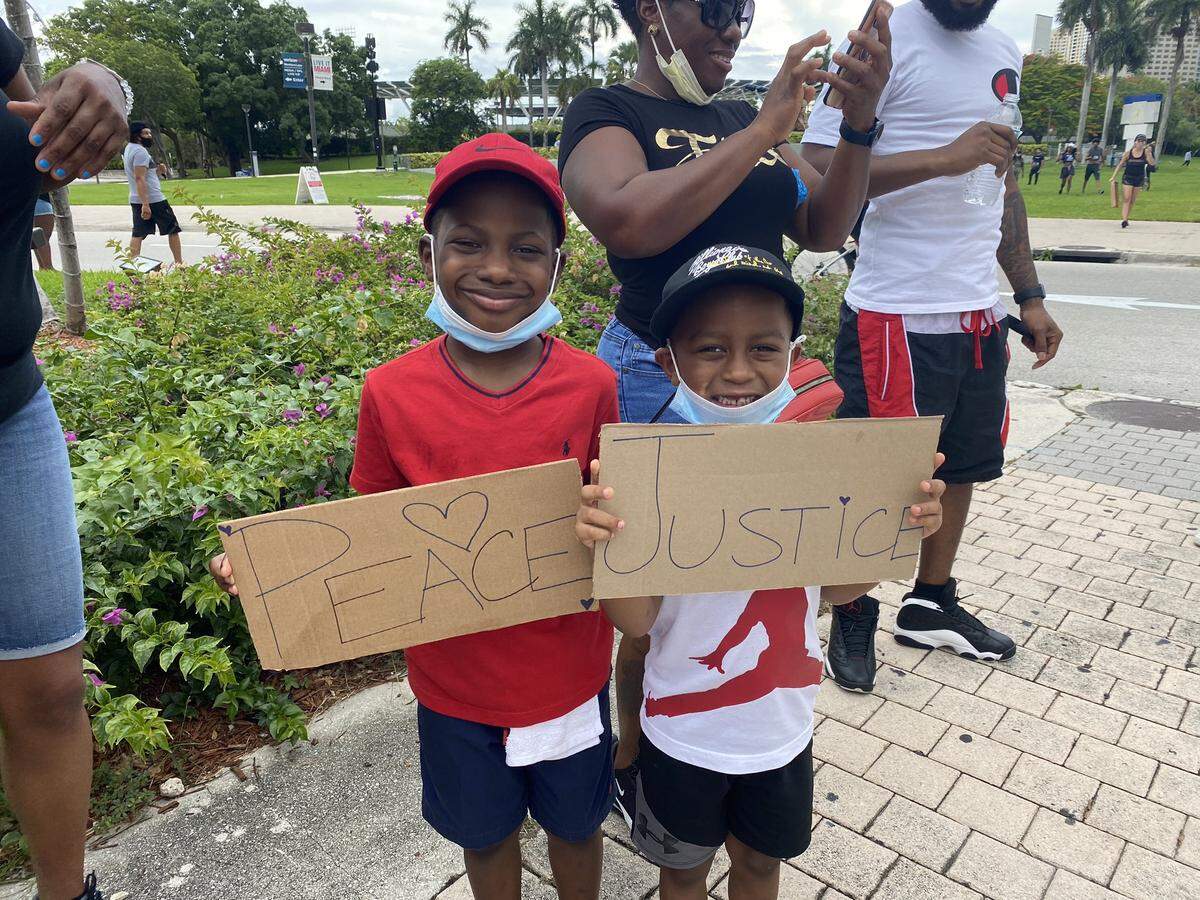
Castera Pierre, 47, of Miami, brought his three kids and one grandson, ranging in age from five to 14, to the protest despite the potential for unrest because he said it is important for live through this moment.
“We’ve been going through the same systematic thing over and over again,” Pierre said. “It ain’t that Black Lives Matter. All lives matter. But one group can’t be superior over the group. We all have to be able to live in peace. But what we’re going through tells us that we’re better than you.
“That’s what I’m trying to teach my kids. My parents’ parents went through this and my parents went through this and now we’re going through this. I know this protest is probably too big for them to understand. But they’re seeing it and they’re feeling it. And when they wake up tomorrow they will have questions and start asking ‘What’s going on?’ I’ve been going through that myself. Even though right now the [violence] is televised, we’re still going through the same thing. They’re telling us it is what it is. That hurts.”
Roy Ordóñez, brother of the late Frank Ordóñez, the UPS driver killed in a police shootout in Dec. 2019, held up a banner showing the face of his brother, George Floyd and Lester Machado, who was killed by Hialeah police in Oct. 2017.
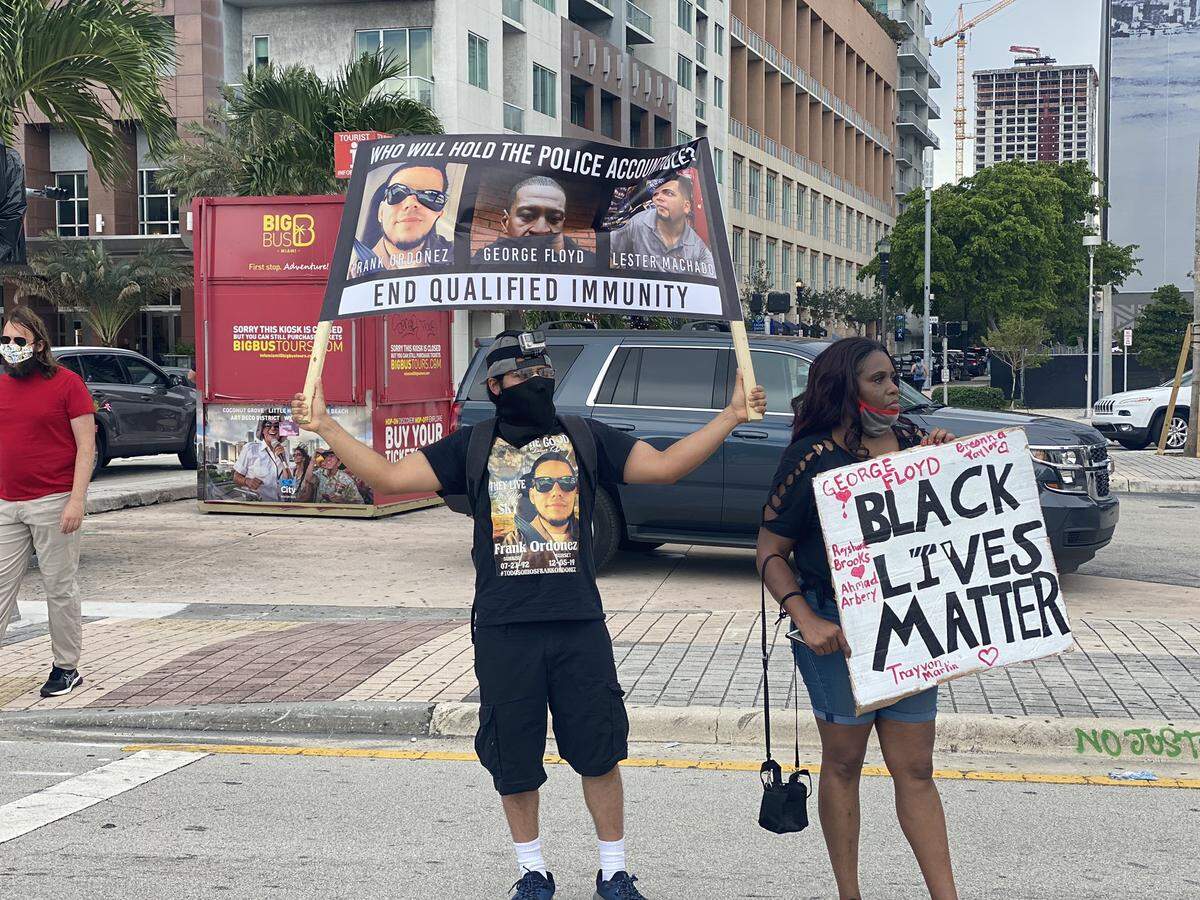
“My brother was killed by the police when he was at work,” he said. “They killed him unjustly and riddled the car with bullets. Instead of de-escalating the situation, the police escalated it and it led to his death. Nestor Machado was killed the same way.
“It’s important to do so, because it’s not just Hispanics being killed. It’s Blacks being killed. We’re all being killed. If we don’t do something and protest, things are not going to change and we’re all going to die.”
Rallying in support of Trump
More than 100 supporters of President Donald Trump gathered along Northwest 154th Street in Miami Lakes Sunday afternoon, waving large American flags, raising “all lives matter” banners and planting Trump 2020 signs in the grass as an almost constant stream of cars honked their horns in support for several hours.
The protest began before 2 p.m. at the same location — at the intersection of 79th Court — as a Black Lives Matter protest held last Sunday that drew the ire of many residents in the conservative, majority white-Hispanic town in northwest Miami-Dade.
“Four more years! Four more years!” the protesters chanted.
The event was organized in response to nationwide civil unrest over the police killing of George Floyd in Minneapolis, which has led to calls to overhaul policing in America and to address systemic racism.
“Is our turn now!” Homero Cruz, a longtime Miami Lakes resident, posted on Facebook on Tuesday as he promoted the event.
“Police lives also matter,” Hialeah resident Missy Montecelo told the Miami Herald. “All lives matter. Not just Black people.”
Miami-Dade police set up cones to block off the entrance to Northwest 79th Court, as they did for last weekend’s protest in the same spot. Several police cars were stationed in the area but officers had little interaction with the protesters.
A South Miami resident, Bobby Francis, sold pro-Trump shirts, hats and flags at a table alongside the event.
Maria Martinez, one of the event’s organizers, addressed the crowd over a loudspeaker. She condemned the killing of Floyd but suggested victims of police brutality are usually at fault.
“At the end of the day it comes down to this: Do what is right, respect authority, stay out of trouble, don’t commit crimes, never resist the police, and you will be okay,” Martinez said.
Martinez also decried the Black Lives Matter movement’s support of the LGBTQ community, saying the group “wants to dismantle the biblical definition of family.”
“They champion the celebration of homosexuality,” she said. “Black Lives Matter touts gender confusion, and let’s be clear: There’s only two genders.”
The crowd cheered in agreement, and they did again when Martinez noted that Sunday is President Donald Trump’s birthday.
Ariel Martinez, the husband of Maria Martinez and co-founder of a group called Cubans4Trump, helped organize the rally.
One elected official, Virginia Gardens Councilman Jorge Arce, attended the protest. Speaking in Spanish, he encouraged everyone to vote in the upcoming election before he led the crowd in a chant: “Four more years, four more years!”
Tensions rose when a local couple, Paola and Jeffrey Batic, walked into the crowd carrying a sign that said “Black Voices Matter.”
The protesters circled around them, screaming and calling them communists. Four or five Miami-Dade police officers arrived moments later, leading the couple across the street and away from the crowd.
“Comunistas! Comunistas!” the protesters shouted at them.
Jeffrey Batic told the Miami Herald a woman poked him with an American flag, and that several men stood chest-to-chest with him, but that he wasn’t hurt. He said the officers told him he was going to “get jumped” if he stayed, and led him and his wife away for their own safety.
“They post online, ‘all lives matter,’ but you see how poorly they treated me,” he said of the protesters. “There’s no speaking with them.“
The protest wrapped up around 5 p.m. after more than three hours of nonstop chanting and honking.
Some protesters showed hostility toward a Miami Herald photographer, giving her the middle finger and calling her a communist. Police officers instructed reporters to walk across the street to get away from the crowd.
Law and order rally
Just a few yards away from the religious protest against police brutality at the Torch of Friendship, a “Law and Order” rally organized in front of Bayfront Park drew a mix of Cuban and Venezuelan exiles holding flags from their countries, as well as other supporters of President Donald Trump. They said they were showing up to celebrate Trump’s birthday and defend law enforcement.
The group was led in part by Evelio Medina, 56, who works with the Miami-Brickell Chamber of Commerce. Last week, Medina held a press conference saying he was upset by the defacing of the Christopher Columbus statue and violent protesting. Nearly all massive protests in Miami over the past two weeks have been peaceful.
“I only wanted myself to come. This is beautiful, to do this just in a couple of days,” said Medina about the demonstration’s turnout of about 80 people. Across the park, over a dozen yachts and boats with Trump and U.S. flags played songs like “God Bless America” and “The Star-Spangled Banner” on loop. Boats from the Miami and Miami-Dade police made special appearances and waved at the crowd, which was shouting “Trump! Police! USA!”
Dozens of Miami police officers on bikes paraded through the crowd of demonstrators, thanking them.
“Now, it’s coming to defunding the police. The thin line between anarchy and freedom is the police. You can’t call 9-1-1 Dunkin Donuts. For law and order, you gotta have a system in place,” Medina said of the protesters demanding justice for victims of police brutality.
On Sunday, three Hispanic men, who identified themselves as members of the Proud Boys, an organization that the Southern Poverty Law Center has previously labeled as a hate group, guarded the Columbus statue. In front of them were about 40 anti-police brutality protesters who had their fists raised and kept silent.
The group of protesters marched briefly through the crowd of pro-Trump demonstrators. Both groups had a brief confrontation and the demonstrators left.
At the beach
Earlier on Sunday, Miami Beach saw its biggest protest since the nationwide unrest over the police killing of George Floyd began more than two weeks ago.
Around 100 people gathered at 10 a.m. in South Pointe Park near South Beach, brought together by the organizing efforts of 13-year-old Egyptia Green. The rising eighth-grader at Ransom Everglades School was also the driving force behind the first protest in Miami Beach in response to Floyd’s death on Tuesday, which drew about two dozen people.
“It’s really nice to have more people,” Green said Sunday. “One time is not enough. They’re treating us so horribly sometimes I can break into tears.”
The protesters, escorted by Miami Beach police, marched from the park to Ocean Drive, passing by tourists in swimsuits and patrons on a Starbucks patio who took video with their phones.
They chanted “Black lives matter” and “no justice, no peace” before stopping at the intersection of Fifth Street — where the main tourist strip of Ocean Drive is blocked off to cars — to kneel silently for 8 minutes, 46 seconds. That’s how long Minneapolis police officer Derek Chauvin kept his knee on Floyd’s neck, sparking a wave of protests and calls to overhaul policing in the United States.
As the protesters kneeled silently, a man running past them yelled “all lives matter,” and said the group was being “disrespectful.” Protesters yelled back and booed in response.
The man, Bernard O’Donnell, told the Miami Herald he is a police officer in a municipality in Palm Beach County, declining to say which one. He said he’s on vacation in South Beach.
“I don’t represent the individual who put us in this situation because I wasn’t trained to do that,” O’Donnell said of Chauvin. “When I see somebody kneeling like that, it’s not supporting the police department, military and just in general [supporting] our life.“
In Miami Beach, where about 4% of residents are Black compared to 17% across Miami-Dade County, policing tactics against Black spring breakers have been decried as racist by the Miami-Dade chapter of the NAACP. During spring break in March, Miami Beach officers tackled one spring breaker, punched two others and grabbed a young woman by the throat when she had already fallen onto Ocean Drive following a collision with an officer.
Before the protesters stopped to kneel, several of them were disrupted by multiple eggs that appeared to come from the second or third floor of an apartment building along Ocean Drive and landed on the street near the sidewalk, splattering on the ground next to the protesters as they marched.
No one appeared to get hit directly, but a police officer said a report had been filed and that police were trying to determine who threw the eggs. They appeared to fall from the balcony of 401 Ocean Dr. near Fourth Street.
Miami Beach police spokesman Ernesto Rodriguez said a report wasn’t immediately available.
He said a female was seen on the building’s balcony but that no one saw her throwing the eggs. “That’s the only information we have at this point,” he said.
The group marched on and the protest wrapped up shortly after the moment of silence for Floyd. The protesters cheered for Green as she stood in front of the crowd and her mother, Bridjette Hoilett-Green, thanked them all for coming.
Local students Leandra Hall, 17, and her brother Maceo Hall, 13, sat on the ground near Fifth Street strumming guitars. Leandra sang Bob Marley’s “Redemption Song” and others sang along.
Christian Garcia, a 46-year-old South Beach resident who attended the protest with his husband Michael Baersch, said they wanted to show support for the young people protesting and to Black residents of South Florida.
“It’s local because we have a significant Black community here in Miami that has always been marginalized in terms of where they’re forced to live, in terms of the resources available to them,” said Garcia, noting that he is a first-generation Latino whose parents came to the United States from Costa Rica. “Why is my life any better or more important than a Black life?”
This story was originally published June 14, 2020 at 12:52 PM.