They high-fived police officers, but these young Black men still have their concerns
Last time Justyn Guerra was this close to so many police officers, people were marching amid clouds of tear gas and burning squad cars in downtown Miami, protesting the murder of George Floyd.
Guerra, 19, was violating the curfew imposed by Miami-Dade County Mayor Carlos Gimenez at that May 30 protest and he was afraid he might be arrested or get hurt.
Two weeks later, Guerra remembered the confrontation as he and a couple dozen of his friends sat in the stands of Hard Rock Stadium watching about 200 South Florida law enforcement officers assemble on the field for the 27th Annual Police & Youth Conference. This time, Guerra said, the police were on his side.
“Things are changing for good,” said Guerra, a first-year student from Broward at Florida Agricultural and Mechanical University in Tallahassee.
Guerra is a seven-year member of the 5000 Role Models Project — a Miami-Dade nonprofit that Rep. Frederica Wilson, a former educator turned Congresswoman, founded in the 1990s to build rapport among young Black males and law enforcement. The conference is one of the organization’s key events.
“This event shows that they are trying to understand us,” he said.
After watching the videotape of Floyd’s killing by former Minneapolis Police Officer Derek Chauvin, many Black youths at the conference say they’ve lost some trust in the police. Still, many of the students and officers at the conference said they are committed to restoring that trust.
“He (Chauvin) pushed policing back a few decades just by that one action, so it’s completely understandable that [kids have lost trust in the police],” said Miami-Dade County Association of Chiefs of Police and Miami Beach Police Major David De La Espriella, who spoke at the conference. “We’re still committed to building bonds and trying to make sure that they (youths) realize that the police are here to help and not hurt.”
At the conference, held June 11, about 100 students between the ages of nine and 19 wearing black masks with the 5000 Role Models of Excellence logo, white shirts and red ties and the law enforcement officers gathered at the stadium in Miami Gardens to start a dialogue and show support.
That evening, Wilson said every police chief in South Florida was at the conference and knelt for 8 minutes and 46 seconds — the same length of time Chauvin knelt on Floyd’s neck on May 25, leading to his death.
Wilson called the commemoration by the police chiefs “a miracle,” unprecedented in Miami or in any other U.S. city.

With three family members serving in uniform in Miami and Atlanta, Guerra said he trusts law enforcement more than most Black teenagers.
“But there are still some officers that don’t have the best interest of the community” at heart, he said. Sitting in the stands around him, three of his peers nodded.
Many said they have been participating in recent protests across Miami-Dade and using social media to spread awareness of police brutality.
Some, like Guerra, have been attending virtual town hall meetings and writing to policymakers to demand the demilitarization of the police and the ban of some dangerous law enforcement practices like chokeholds.
Efforts by police reform and civil rights advocates like Guerra have yielded results. Miami-Dade Police Director Alfredo “Freddy” Ramirez announced at the conference that “there will never be a chokehold application again” in the county.
Ramirez’s announcement was met with universal applause. But the students said the ban is not enough and demanded the police “rewrite the books” by enforcing better officer training and revising protocols to avoid deaths like Floyd’s.
Some students said local governments should reevaluate police management and funding and propose new solutions to prevent police brutality.
“There has always been something missing,’’ American Senior High student Dewayne C. Martin said in a speech after Ramirez’s announcement. “One hundred and 57 years ago when our president declared that slaves would be free. Fifty-seven years ago when King had a dream. And 15 days ago when George Floyd was killed. Rather than sit idly by, we have a collective obligation to question the conditions that caused them to occur.”
Mike Pierre, a 17-year-old rising senior at Alonzo & Tracy Mourning Senior High School in North Miami and a member of the 5000 Role Models since third grade, said events like the conference are meaningless if law enforcement and city administrators don’t take “real action.”
Pierre said he’s been experiencing “very negative” feelings toward law enforcement since the protests began.
“It (the police) just doesn’t sit well with me, I don’t know... I think they’re just being fake about it,” Pierre said about the officers who showed up at the conference “to build a bridge” toward Black youths.
But Pierre noted that police are not “all bad,” remembering a Black male police officer he met at a 5000 Role Models event two months ago who inspired him and his friends to “get our stuff together and really look forward to the future.”
Many teens at the conference said the 5000 Role Models Project has helped them relate to officers, giving them opportunities throughout the year to meet with them informally, ask questions and role play de-escalation techniques.
“We know that there’s this tension between Black boys and the police, and this tension has existed since slavery,” Wilson told the students assembled at the stadium. “Our goal is to ease that tension… Within my heart, I truly believe that the law enforcement officers in this city, in this county, care about you.”
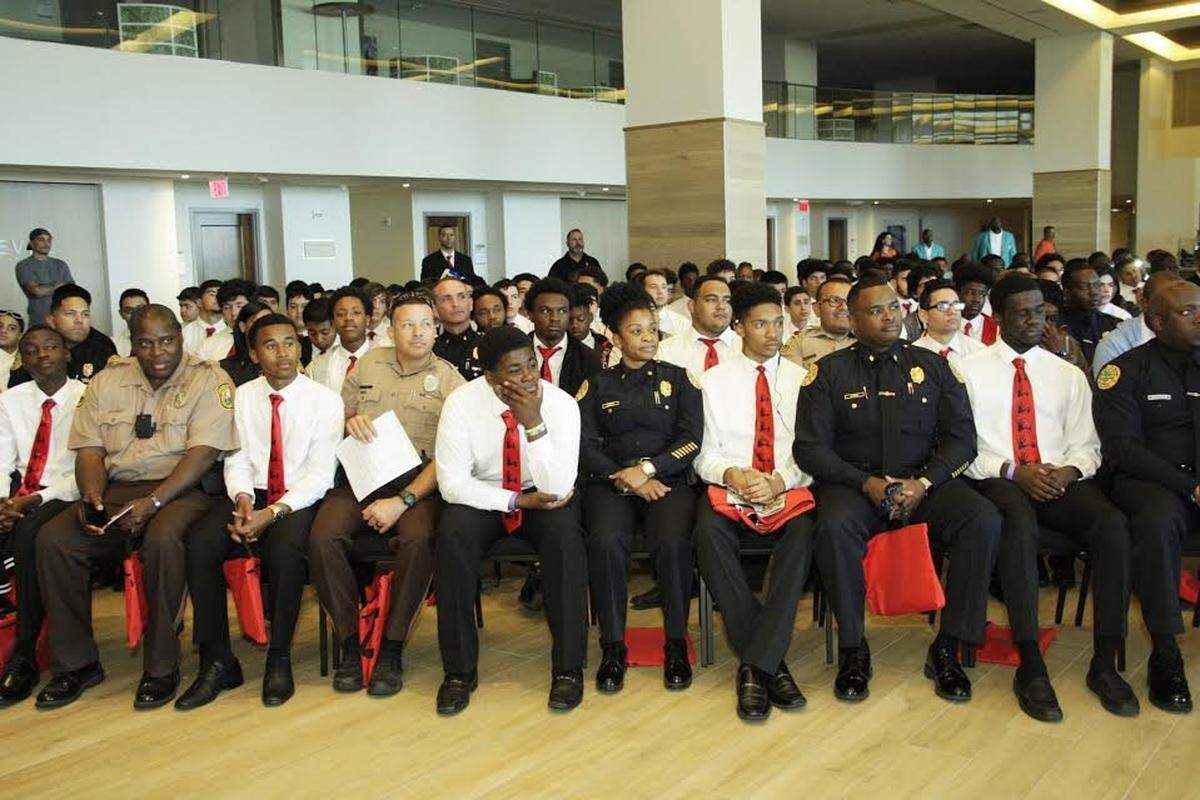
James Tyrone Hilton, 5000 Role Models site director at William H. Turner Technical Arts High School in northwest Miami-Dade, said anyone who attends a Police and Youth Conference will see that care and respect for themselves.
“You’re going to see them (students and officers) embracing. We can’t really embrace today because of COVID, but you’re going to see them show love to each other,” Hilton said.
As Hilton predicted, Miami Beach High graduate Arthur Morgan and Hialeah-Miami Lakes High graduate Oliver Felipe, who had called for more police accountability and described recent events as “outlandish,” were doing just that — fist-bumping and high-fiving Lauderhill Police Department Deputy Chief Timothy Belcher Sr. before the conference.
Thanks to Belcher, Morgan and Felipe said they understand “the action of one person and his mistakes shouldn’t take judgment of the whole police community.”
A former Miami-Dade County Public Schools teacher who grew up in Brownsville in northwest Miami-Dade, Belcher remembered how, when he was a young child, several officers hit a Black suspect in the head until he bled during a police chase in front of his home.
Morgan, who was raised by his grandparents in West Little River, said Belcher has “filled a gap” serving almost as a parental figure in the past year.
Belcher said he became a police officer to drive police reform and give Black youths a chance “to walk away [from an encounter with police] without having a gunshot wound in your back.”
He believes law enforcement officers in minority communities should engage with kids on the street, rolling down their windows and giving youths the respect they expect to get in return.
“And before you know it, your name is spread across the community as being one of the good ones,” he said.
Some law enforcement officers, however, had different ideas.
Indian Creek Village Captain Chris McDonald and Chief of Police Clark Maher said their department had proven over 45 years of service that they “are not the bad guys” and that it was now the kids’ job to come forward.
“It’s important for them to believe in us and trust us, to not compromise our safety as well,” said Maher, emphasizing that while police violence is not “virtually absent” from the state of Florida, the percentage of service calls that result in police brutality are “like 0.001 percent.”
Since 2015, Florida police officers have shot and killed 350 people, according to a Washington Post database. Eighteen of them were Black and unarmed, including Mycael Johnson, 31, and Barry Gedeus, 27, who were fatally shot in Tallahassee and Fort Lauderdale, respectively, in March 2020.
“If we look at it here in Dade County, or just in Broward County, I would agree with them,” Belcher said about McDonald and Maher’s comments. But state and national statistics raise important concerns that police departments and officers should not underestimate, Belcher added.
While most students said they have not felt threatened by police officers in Miami-Dade, some said law enforcement has negatively impacted their communities in other ways.
Brandon Martinez, 18, a Coral Gables High graduate who was participating in the conference for the third consecutive year, said law enforcement agencies are taking away funds to support social services such as education.
“I want to give more money to the school and less money to the police,” said Martinez. “(Mine) is a good school, but we ran out of toilet paper once. And you see everything that’s been going on in Minneapolis. They have tanks. Why do cops need tanks?”
Martinez, who previously had “no problem” with the police, said the events of the past two weeks have taken a toll on his mental health and made him reconsider his views of law enforcement.
But, while Martinez said he felt “anxious” about being “surrounded” by law enforcement at the stadium, he said that the Youth and Police Conference was an essential first step for him to overcome his anxieties, and for students and police officers to “see each other, know each other, know that we are all people.”
After the event, De La Espriella, the Miami Beach police major, echoed Martinez’s sentiment.
“I grew up in Hialeah, you know. I’m Hispanic, I’m white. I don’t have the same experience as a kid that may have grown up in Overtown. So, sometimes I’ll have to work that much harder to build that trust,” De La Espriella said.
But “when you start talking to these kids, you start to see these similarities, that they are not that different. We’re not different at all.”
This story was originally published June 19, 2020 at 6:00 AM.