
Across race and party lines, Miami-Dade residents say transit, housing, climate matter
When voters head to the polls in August for primaries for a new Miami-Dade County mayor and at least five new county commissioners, two-thirds of them say they will base their decisions, in part, on whether candidates have a “specific solution” to reduce carbon emissions and address sea level rise.
That includes 77% of Democrats, 52% of Republicans and 67% of independents, as well as 75% of black voters, 49% of white voters and 67% of Hispanic voters.
That’s according to the results of a survey released Monday by the nonprofit Miami Foundation, which asked 600 registered voters in the county and 200 non-voters about their priorities ahead of the most significant county election cycle in recent memory.
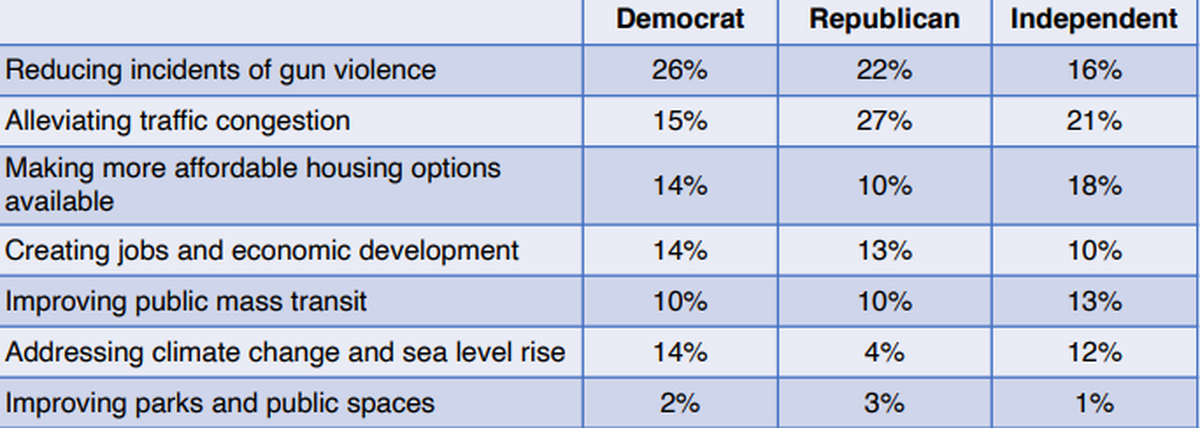
As term limits kick in for the first time for several county seats — including for mayor, where Carlos Gimenez is on his way out and nine candidates are running to replace him — the survey results suggest that residents’ top priorities are similar across racial and political party lines.
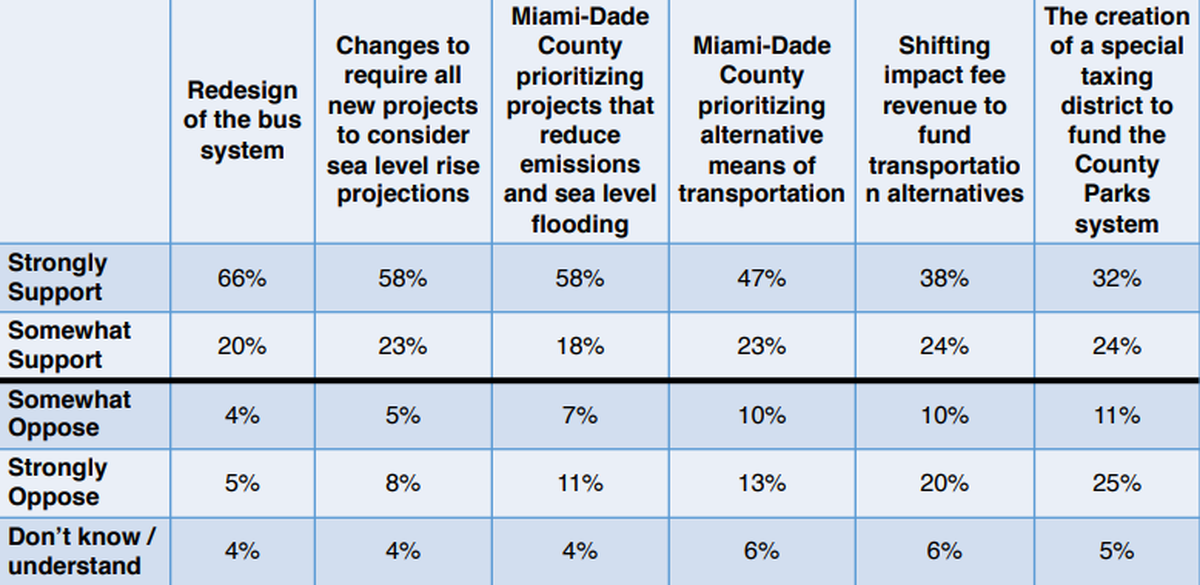
Eighty-eight percent of the residents surveyed said it’s either very important or somewhat important to them to improve public mass transit. Two-thirds said they “strongly support” a redesign of the county’s bus system.
“The survey findings tell a story of a united citizenry that supports mobility, climate resilience and other policy solutions, regardless of party affiliation, ethnic background or race,” Loren Parra, the director of public affairs for the Miami Foundation, said in a statement.
The survey, conducted via phone by the consulting firm Bendixen & Amandi International, also asked residents to identify their number one priority for the county among several options. The most frequent answer: reducing incidents of gun violence, which was cited by 22% of respondents. Twenty-one percent said alleviating traffic is most important.
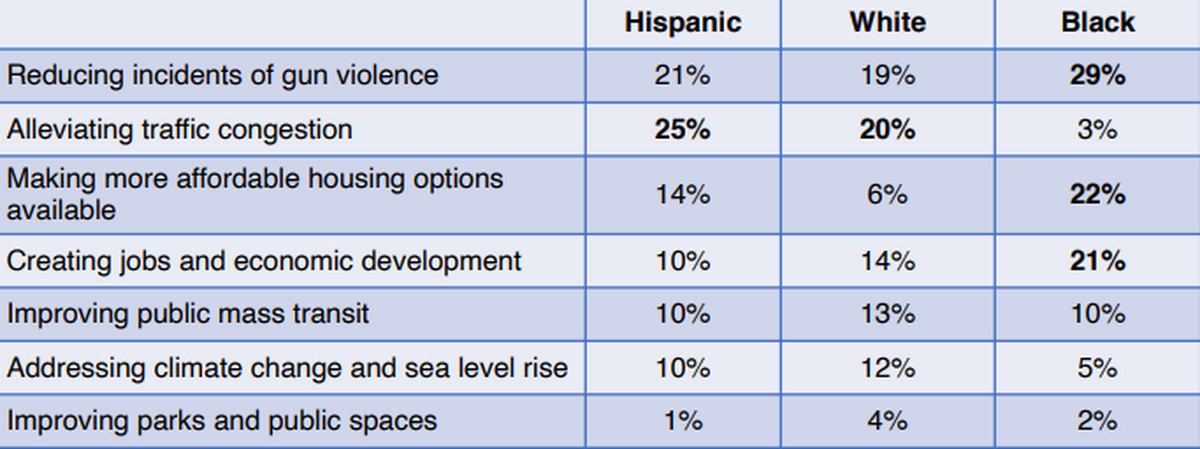
A higher percentage of black respondents than white or Hispanic respondents emphasized gun violence, affordable housing, and jobs and economic development. Alleviating traffic congestion, meanwhile, was the top priority for 25% of Hispanic respondents and 20% of white respondents, but just 3% of black respondents.
But Fernand Amandi, the president of Bendixen & Amandi, said the polling broadly points to a county that is engaged on a wide range of issues at a key moment for the region’s political future. Having polled residents in the county for the past two decades, he said, one or two key issues usually stand out as the primary focus.
In this election, though, public transit, affordable housing, gun violence, living wages and climate change all seem to be on people’s minds.
“The community is clearly calling for leadership and engagement on a series of issues that they recognize as important to the future of Miami-Dade County,” Amandi said. “Given that there’s going to be an opportunity to ... establish a new generation of leadership at the County Commission and in the mayor’s office, I think people are suggesting they see the importance of the time we’re in to get these things done.”
Amandi said his firm used county voter rolls to randomly dial the phone numbers of registered voters until 600 people had been surveyed. The firm also performed random digit dialing of phone numbers countywide to survey 200 non-voters.
The firm asked respondents a series of questions about whether certain issues are important to them, in some cases asking them to state whether they strongly support, somewhat support, somewhat oppose or strongly oppose a given policy proposal — such as “changes to require all new projects to consider sea level rise projections.”
The pollsters did not ask residents what they might be willing to pay to enact the changes.
The survey was conducted ahead of a series of seven candidate forums that the Miami Foundation is hosting before the Aug. 18 primary. The first will feature county mayoral candidates at the University of Miami’s Newman Alumni Center on March 26.
The Miami Herald is one of several community partners organizing the forums.
In addition to the mayoral race, incumbents have been term-limited for County Commission in Districts 1, 3, 7, 9 and 13.
“Through the candidate forums, we seek to enhance civic engagement at the local level with the candidates who will ultimately have the highest impact on our day-to-day lives come Election Day: the Miami-Dade County mayor and the Miami-Dade County Board of Commissioners,” said Parra, the Miami Foundation public affairs director.