
Candidates for Miami-Dade mayor pledge support for elderly residents, but what’s next?
Miami-Dade has special taxes for transportation, hospital care, libraries, youth services, tourism, and homeless programs. Will a tax for helping older residents come next?
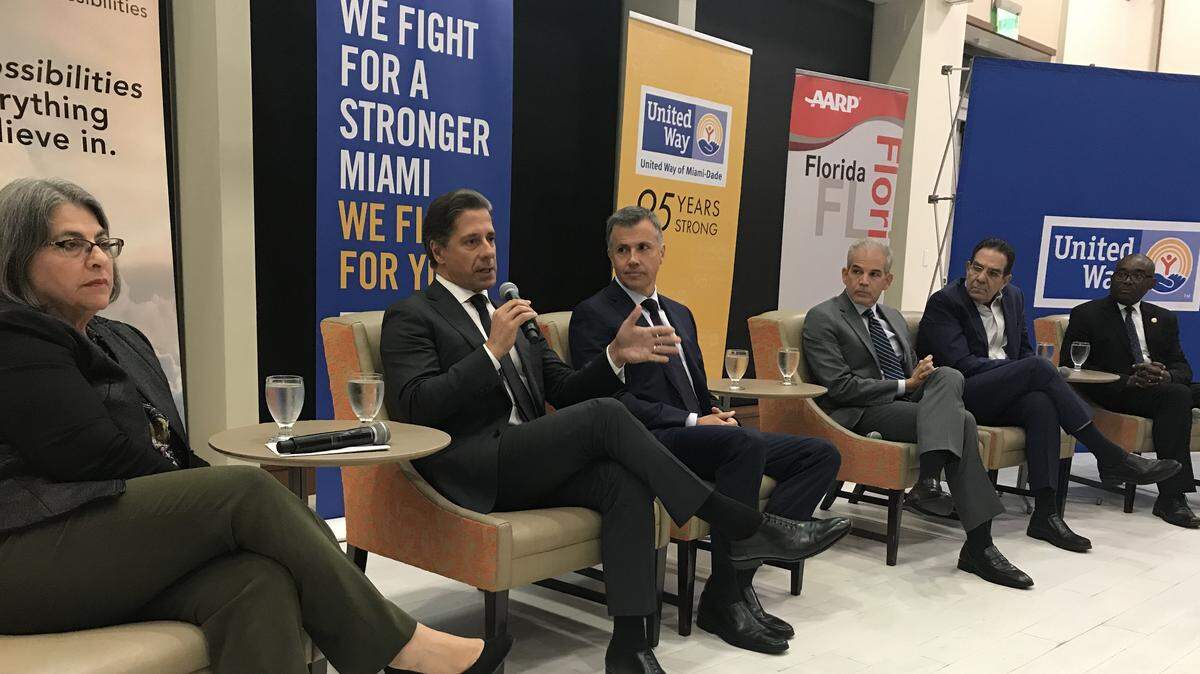
Five of the leading candidates for mayor joined the current mayor and Miami-Dade’s schools chief Tuesday night for a United Way forum dedicated to the needs of older residents. Alex Penelas, a former mayor running for the office again, urged organizers to mobilize public concern over the elderly in the same way he focused attention on youth needs ahead of voters approving the “Children’s Trust” tax in 2002.
“With the full plate the county has right now, if you expect issues affecting our aging population to be in the forefront, it ain’t gonna happen. I’m going to be frank,” said Penelas, who left office in 2004 and now is running to succeed a term-limited Carlos Gimenez in 2020. “But if the community brings the issue to us ... then government, I think, will bring the resources.”
The event at the University of Miami was the latest effort by the nonprofit United Way to bring more government attention to the needs of older residents, a campaign that has included polling and one-on-one meetings with candidates ahead of the 2018 primaries. A United Way executive on Tuesday declined to say whether voters were polled on the issue of a new tax for elderly programs, but suggested the survey showed support for that kind of step.
“We asked a lot of different questions. We did not want the focus to be on that [a tax]. but let me just say voters in our community made it clear they want something to be done ,” said Linda Schotthoefer, the vice president at United Way who coordinates the work of the Older Adult Advocacy Task Force. “And they’re ready to consider some very significant steps forward.”
The latest installment of the effort brought together three county commissioners running for mayor in 2020 — Daniella Levine Cava, Jean Monestime and Xavier Suarez — along with fellow candidate Juan Zapata, who stepped down from his commission seat in 2016.
Joining them and Penelas on the panel was Alberto Carvalho, a Miami-Dade schools superintendent who’s often mentioned as a potential mayoral contender but insists he’s sticking with his current post for 2020. Gimenez was not a panelist, but gave introductory remarks. Noting the concentration of mayoral candidates, he said: “I don’t think I’ve ever been in a room with so many people who want to be me.”
Esteban “Steve” Bovo, the only other officeholder or former officeholder running for mayor, was invited but traveling during the event. Organizers said other elected officials declined invitations as well.
Carvalho, who led voter campaigns to raise school taxes to fund teacher salaries and construction, urged the crowd gathered at UM’s Newman Alumni Center to rally political support for their cause, and not settle for weak leadership from elected officials.
“If the bus is not moving in the right direction, don’t blame the transmission. Don’t blame the engine. Certainly don’t blame the passenger. Blame the driver,” Carvalho said. “If politics itself is broken, you need to change the leadership. And demand more.”
With Penelas and others highlighting the need for partnerships with the private sector, Carvalho emphasized the unique power government has to tackle big problems. “It’s not going to be the private sector that’s going to willingly lower your healthcare costs,” he said. “I am often tired of individuals diminishing the role and importance of government. That’s how we teach children, that’s how we clothe the fragile, that’s how we care for the indigent.”
Levine Cava, a one-time social worker, charity executive and lawyer, said the community needs to do more for elderly residents.
“The numbers make it very clear that our resources are misplaced. We are not doing what we need to do to provide the dignity and the care that all of us need as we age and age in place,” she said. Later, she added: “It’s often debated whether county government is responsible for social services. I think county government is responsible for the welfare of our people. I don’t think the county should shy away from that.”
No participant called for a new tax to expand Miami-Dade elderly programs, such as home care and neighborhood meal centers or comedores, a favorite campaign stop for local politicians seeking the elderly Hispanic vote. Monestime, a real estate broker and former teacher who got his start washing floors after immigrating from Haiti as a teen, said he’s ready to consider options for helping elderly residents.
“I’m here today not just to talk about the issues, but to listen as well,” he said.
Suarez, a lawyer and former Miami mayor, said Miami-Dade could help by reducing broader problems, such as an unreliable transit system and a shortage of affordable housing. He suggested the county could provide homeowners tax relief by boosting the tax bills of office complexes, apartment buildings and retail properties.
“Let’s figure out how to tax the commercial real estate a little bit more,” he said. “And not so much the residential.”
Zapata, a consultant who cited frustration with county inaction when he abandoned his reelection bid in 2016 for the commission, warned against letting new programs obscure a lack of improvements for elderly residents.
“In Miami, we go to the comedores and we campaign. And we talk a good game. We start initiatives and policies. But do we ever measure them?” he asked. “If we don’t make sure that’s moving the needle, we won’t make progress.”
This story was originally published December 11, 2019 at 10:47 AM.