
Pressure growing to extend Tri-Rail into Miami neighborhoods with new stations

Tri-Rail’s delayed arrival into downtown Miami may be a year away, but there’s an expanding effort to bring the commuter trains to other neighborhoods north of the city.
While Tri-Rail hasn’t even begun the talks needed to negotiate a track agreement for the private corridor owned by the Brightline rail company in Northeast Miami-Dade, that sort of costly, complicated arrangement isn’t needed for stations closer to downtown.
Brightline granted Tri-Rail access to tracks south of about Northwest 73rd Street under a 2015 agreement to bring the tax-funded commuter trains into Brightline’s existing downtown station, said Brightline executive Jose Gonzalez.
While the company has some veto power on where Tri-Rail depots can go along the new route to downtown, the deal limits Brightline’s ability to reject a station plan. “All we can say is engineering-wise, you need this or that,” Gonzalez said.
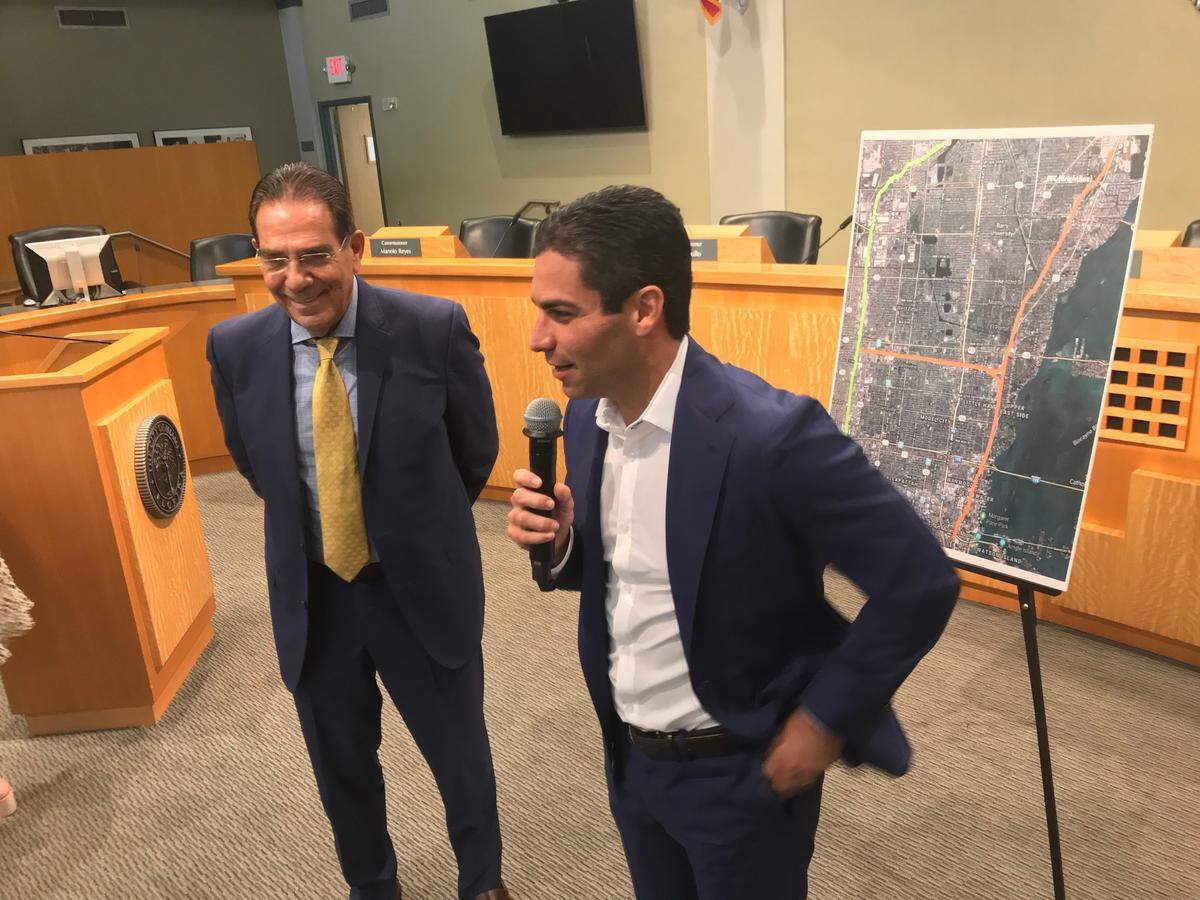
On Friday, Miami Mayor Francis Suarez and his father, Miami-Dade Commissioner Xavier Suarez, convened a meeting at City Hall that saw several Tri-Rail sites pitched as winners.
David Polinsky is an advocate for a Wynwood business group pushing to bring a Tri-Rail station to that neighborhood along the Brightline tracks. He said that the tracks currently cut off some of the neighborhood and pitched a Tri-Rail station off Northwest 29h Street as a chance to bridge the two areas. “Today the train tracks are an obstacle,” he said. ‘There’s a tremendous amount of unrealized potential around this area. I think that a train station could unleash that potential.”
Neil Fairman, a partner in the $1 billion Magic City development in Little Haiti south of 64th Street, said the project has already designed a Tri-Rail station at one of its buildings in hope of getting the nod from the agency. “This area will employ 7,000 people,” he said. “We’re very anxious to be able to put a stop there.”
Miami-Dade’s Transportation Planning Organization is already pursuing funding for a temporary wooden Tri-Rail platform in the Midtown area, which is bordered by 34th Street on the north. Aileen Boucle, the agency’s director, said the idea was to give Tri-Rail a second stop once the downtown Miami station opened. The platform idea could be dropped if Tri-Rail had other options. “We would defer to the permanent station,” she said.
The potential stops a few miles north of Miami fall short of the 15 mile “Coastal Link” to Aventura envisioned for Tri-Rail when Miami and Miami-Dade agreed to help fund a $70 million platform for Tri-Rail trains at Brightline’s Miami Central downtown station. Tri-Rail trains were supposed to be there two years ago, but delays in Brightline implementing new federally required safety systems on the tracks have delayed the Tri-Rail opening until the fall of 2020.
To head to Aventura and then north through Broward and Palm Beach, Tri-Rail must reach an access agreement with Brightline to use the tracks north of the Miami connector. Brightline, which plans to bring the Virgin brand to its trains next year, hasn’t begun talks with Tri-Rail on that potential agreement, which could require tens of millions of dollars in access fees.
It also would require Brightline to invite a competing rail line alongside its for-profit tracks at a time when the company is showing interest in the commuter market. Last month, Brightline secured a deal with Miami-Dade for $76 million in transportation-tax dollars to build a Brightline station next to the Aventura Mall.
At City Hall, Tri-Rail director Steven Abrams said his agency is eager for those negotiations but that Brightline and its parent, Florida East Coast Industries, haven’t shown interest in them.
“We would love to negotiate access on that corridor,” he said.
Gonzalez, a senior vice president at Florida East Coast, said there needs to be a sense of how Tri-Rail could afford the new rail line and handle the logistics before starting those talks. “It’s not about FECI,” he said. “Where’s the money coming from?”
Brightline only required a single $1 million payment for access to the new Miami connector, Gonzalez said, and no negotiations are really needed for stations closer to downtown. Xavier Suarez, the county commissioner who’s also running for Miami-Dade mayor in 2020, highlighted Tri-Rail’s position in his remarks opening Friday’s meeting.
He described an agreement that gives Tri-Rail “rights to use that line” and propose a viable number of stations north of Miami, subject to Brightline approval. “Consent to that cannot be unreasonably withheld,” he said.
The meeting saw Suarez, a former Miami mayor himself, and his son, the city’s current mayor, sharing the floor before an audience of about 40 people. Both sit on the board of the Transportation Planning Organization, and are barred by Florida’s Sunshine law from privately discussing topics that could come before that organization. The meeting was posted as a public discussion between the father and son.
Francis Suarez said with so much existing density and planned construction along the Brightline corridor, it made sense to create more train stops for Tri-Rail. He said it’s encouraging to see competition for sites willing to build their own stations to accommodate the trains.
“The will is there,” he said.
This story was originally published November 2, 2019 at 6:00 AM.