
Planes always flew low. Then came the day a cargo jet crashed onto a busy Miami street
Dozens and dozens of times a day, low-flying planes pass over the businesses near Miami International Airport. But on this fateful one, tragedy fell from the sky.
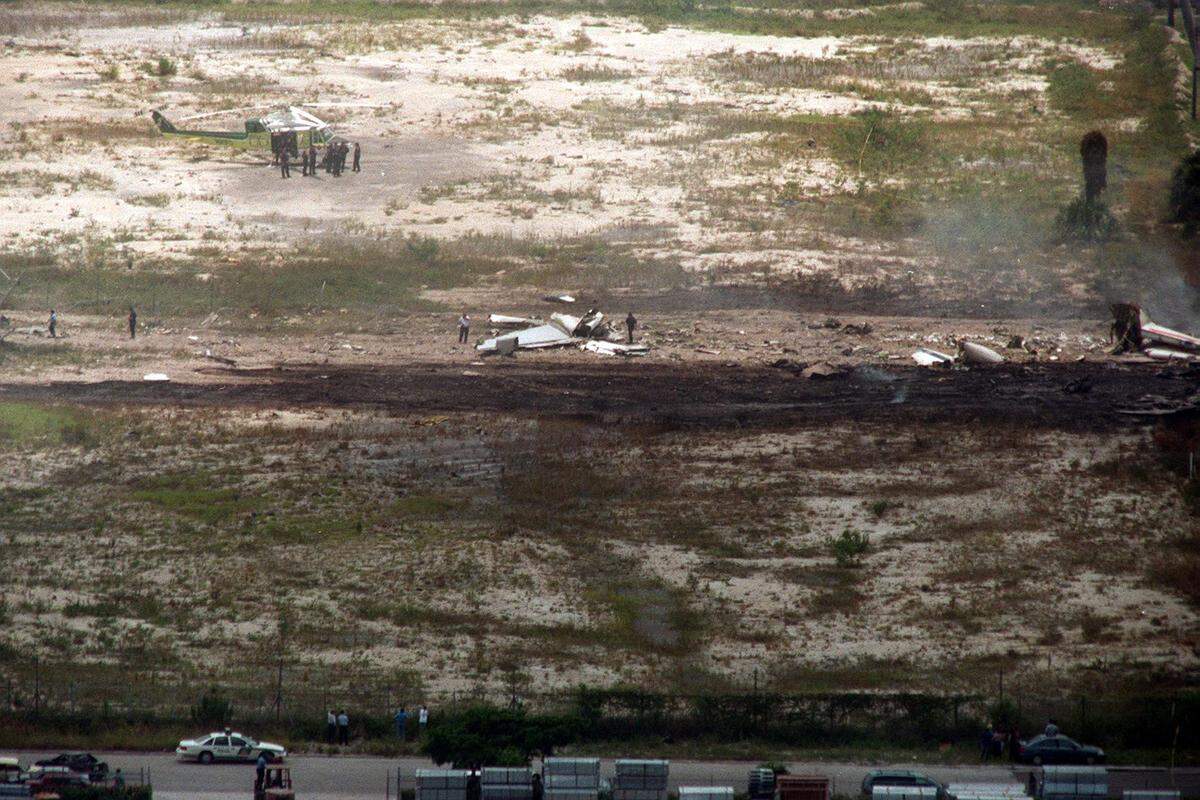
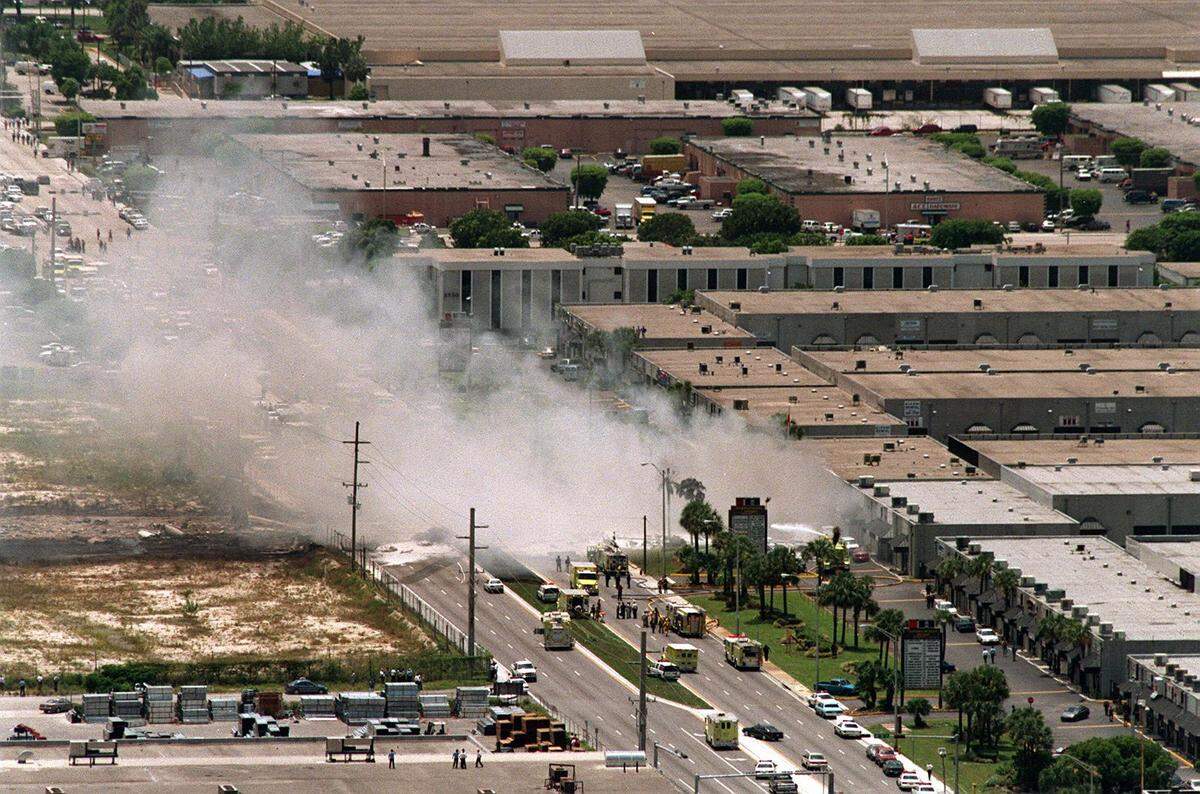
A Fine Air cargo plane, which had just taken off from Miami for the Dominican Republic, crashed into a field in August 1997 and skidded across the road. The flaming wreckage came to rest amid an industrial warehouse district.
The crash killed five people, four on the plane and one on the ground. But despite that toll, it could have been worse, with drivers on the road and workers in the buildings.
Here is a look back at the crash of the DC-8 from the original coverage in the Miami Herald archives.
TRAGEDY NEAR THE AIRPORT
Published Aug. 8, 1997
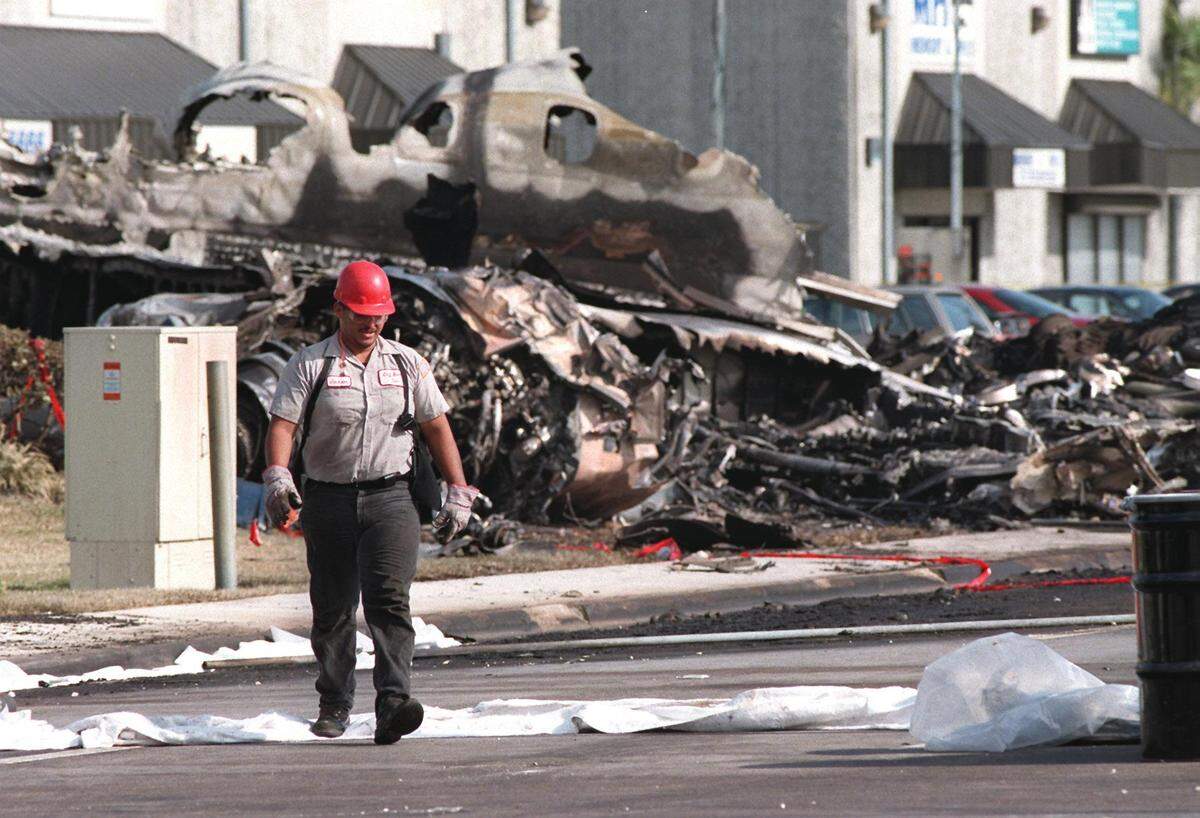
A plane loaded with nearly 88,000 pounds of pants-parts crashed after takeoff from Miami International Airport on Thursday, bounced in an open field, exploded into a fireball, fell apart, skidded across four lanes of a busy highway and a car-filled parking lot. Its nose came to rest inside a computer store.
The toll was tragic but confined to those aboard: the pilot, the co-pilot, a flight engineer and a security guard aboard a Fine Air DC-8 bound for Santo Domingo, Dominican Republic.
With no other deaths confirmed, it may end up being called the miracle on 72nd Avenue.
“He was a hero — a hero for diverting that crash from more casualties,” Metro-Dade Mayor Alex Penelas said of the pilot. “This community owes a big debt to that man.”
In an escape bordering on the miraculous, the crash somehow spared motorists on Milam Dairy Road and terrified workers in a bustling industrial warehouse district west of the airport.
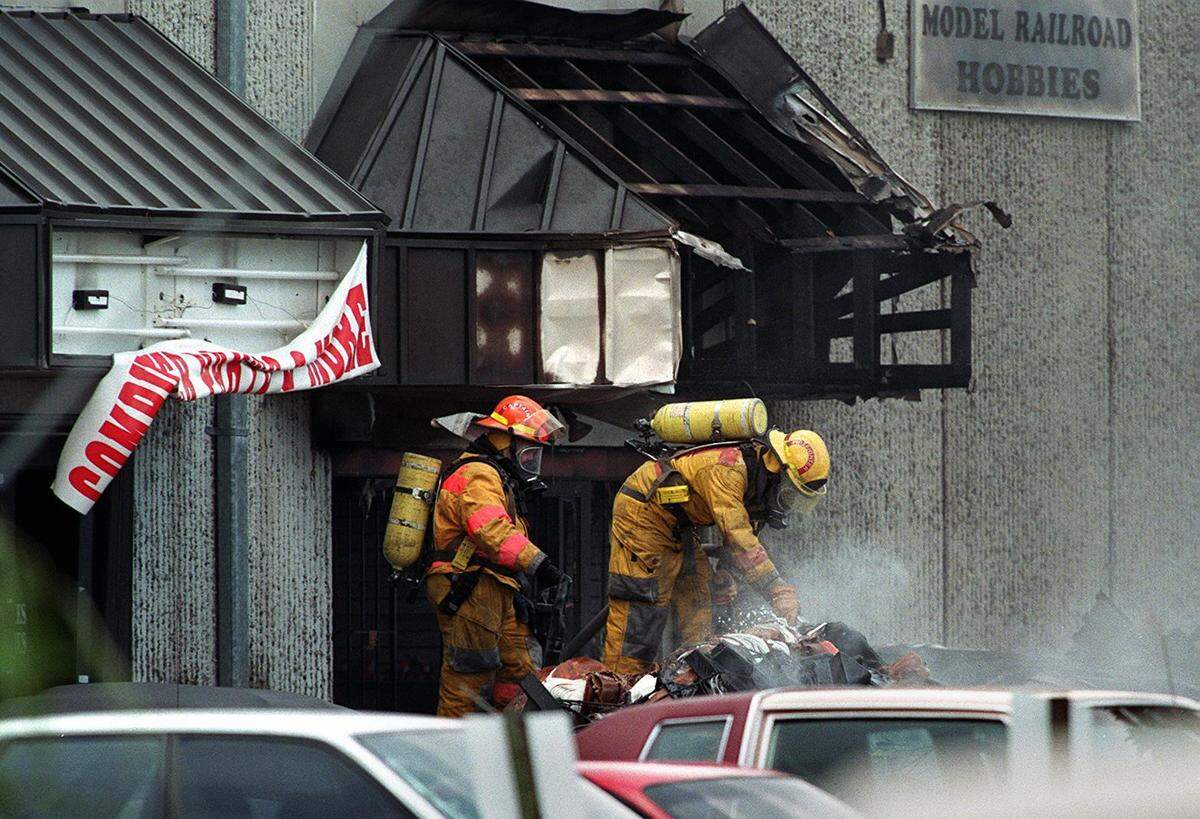
Part of the turbine came straight through the front window of Hexium Computer, one of several businesses destroyed in the International Airport Center mall.
“The flames were coming down around us. I don’t know how I didn’t get burned,” said Joseph Rodriguez, the computer store’s owner. Employees fled through the hole the engine left.
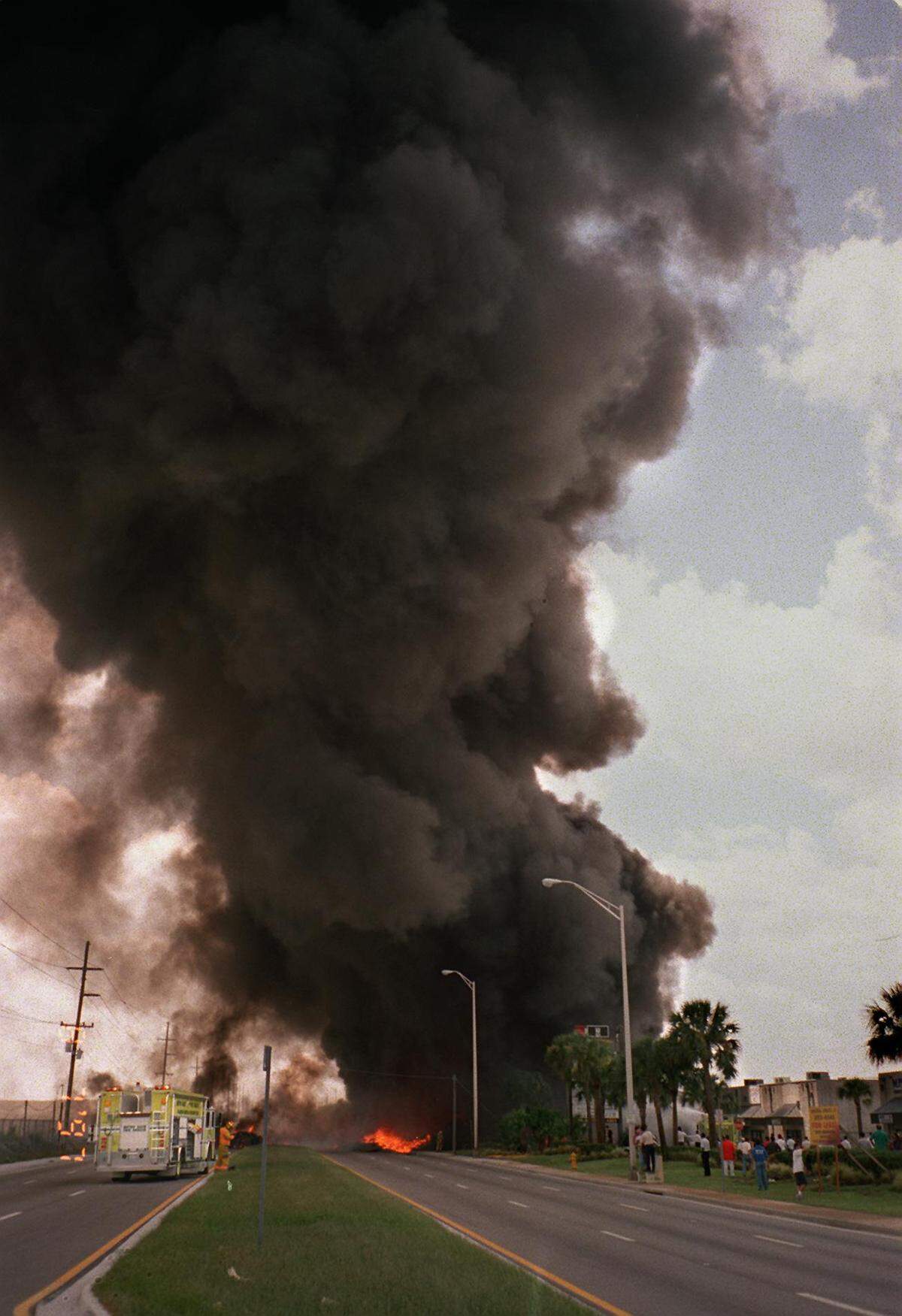
It was like a scene from a big-budget action film come to life: frightened workers sprinted for cover. Huge chunks of flaming fuselage fell across a six-lane thoroughfare, bursting into fireballs one by one. Debris scattered cars like toys in front of the strip mall along Milam Dairy Road at Northwest 28th Street, and ripped into the front of the building like shrapnel.
The crash brought home a terrifying reality: Miami International, once located on the fringes of Miami, is now smack dab in the middle of one of the busiest business districts in Dade.
One saving grace: Many workers were at lunch. “This was a tragic crash, a terrible incident in our community. However, we indeed were very lucky,” Penelas said. “This could’ve been a much worse incident.”
Rafael Curaezma was one of those who escaped. He was leaving his office in Techno-Corp., getting into his BMW to leave for lunch. Then he heard explosions overhead.
“I said, ‘That plane’s going down,’ so I started running. I’m running for my life,” he said. “I knew I had to get to the back of the warehouses because that was my only shelter. I look back, and the plane’s exploding right after me.
“If I had stayed where I was I would have been dead.”
The 30-year-old DC-8 had 18 mechanical problems reported to the Federal Aviation Administration since 1994. The plane has had at least three problem takeoffs in the past two years -- two of them out of Miami.
In September 1995, noise and vibration forced the plane to return and land at MIA. In June 1996, the aircraft lost hydraulic pressure at takeoff and had to return.
In another incident last month, the plane landed at Miami with such force that it cracked one of the struts on the plane’s right side.
Fine Air Flight 101 had a flight crew of three plus a security guard aboard, airport officials said. Dead were the pilot Pat Thompson, 42, of Homestead, a former Marine who had been flying for 23 years, and co-pilot Steven Petrosky, 26. The others were not immediately identified.
The plane was carrying a load of unsewn men’s denim jeans to Santo Domingo, where they would be sewn and flown back to the United States, according to Michael Sheehan, spokesman for U.S. Customs.
It wasn’t clear whether that exceeded the plane’s maximum capacity, or whether the load contributed to the crash.
No determination of the cause has been made, though several witnesses reported seeing flames and smoke coming from the plane’s far-right engine.
An eight-person crew from the National Transportation Safety Board flew to Miami from Washington on Thursday. Both of the plane’s so-called black boxes, in-flight data recorders, were recovered.
“There’s a lot of speculation as to what it could have been. It very well could have been pilot error, or it could have been a problem with this particular aircraft,” said airport spokeswoman Lauren Gail Stover.
Charles Petrosky, 57, of Califon, N.J., confirmed that his son Steven was the co-pilot on the flight.
Charles Petrosky said he had visited South Florida in July and that his son had mentioned safety concerns at Fine Air.
“Steven said it wasn’t the safest air line around,” said Charles Petrosky. “He said some of the pilots were talking of getting together and doing something about it.”
The elder Petrosky said he did not know what had come of that idea. But industry consultants said Fine Air — although it had a troubled past — was a solidly run cargo airline. These operations typically use older planes, they said.
“It’s a well-run airline,” said Miami aviation consultant Bob Booth.
The plane went down tail first at 12:34 p.m. over the heads of thousands of workers in the the industrial neighborhood crammed with computer stores, floral shops and warehouses.
Witness after witness told the same story: They heard two or three loud bangs overhead. They stopped and looked up and saw the plane’s wings wobble first right, then left, with the far right engine spitting smoke and fire.
They said the airplane took off but did not get above the highest Florida Power & Light lines along the west side of the airport. The plane appeared to go between the lowest and highest FPL lines.
Witnesses saw the plane stall, with its tail at a sickening, nearly vertical angle before it went down.
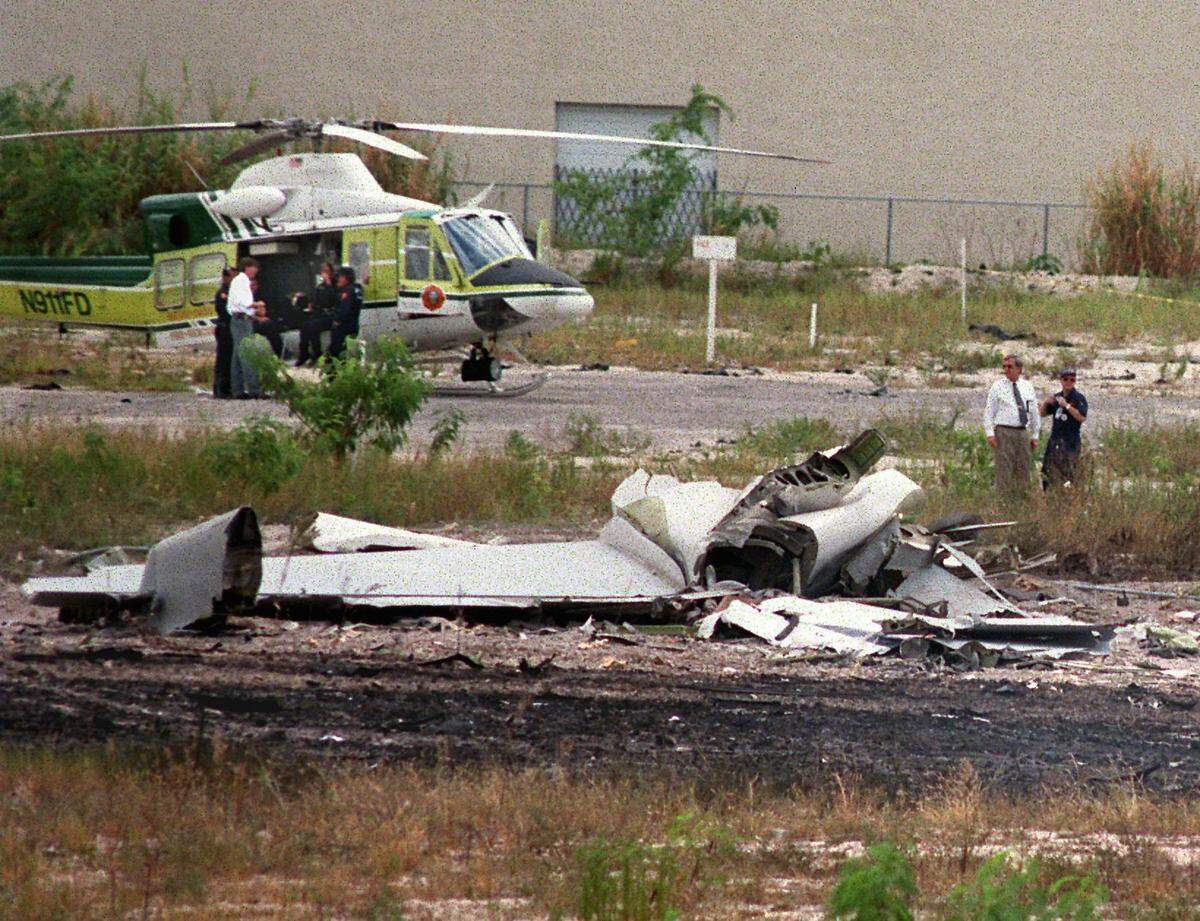
The tail hit in a vacant lot on the east side of Milam Dairy Road, sandwiched between a warehouse for Eagle Brands on the north and the V&F Center warehouse on the south. It hit a chain-link fence and dragged it across Milam Dairy Road.
The aircraft kept moving, skidding, belly to the ground, its fuselage coming apart from rear to front in sequence, each one bursting into flame as it hit.
“It started breaking up in pieces, and each piece that hit the ground ignited. Bam, bam bam. When it hit the ground, I felt the flame,” said John Hope, a corrections worker.
Workers in the stores went to the windows and saw the flaming cockpit coming.
“Everybody was yelling, ‘Run! Run! Run!’ “ said Mildred Marquez, who fled from Asian Sources Computer. “We didn’t know it was an airplane. We were going crazy. We thought we were all going to die.”
In the northbound lanes, two jet engines fell off, burning. A wing was severed on the grassy median strip, more pieces landing in the southbound lanes. The plane’s nose, on fire end to end, landed on the other side of the street and slammed through the front of Hexium, the computer store.
The offices were relatively empty at lunch hour. People in the parking lot ran for cover, and the few people left in the stores took cover in the backs of their buildings.
Rick Barocas, owner of a dive shop named the Florida Frogman, 2852 NW 72nd Ave., was trapped in his office with another employee when the plane crashed near his building.
“I got up and walked to our one window and right as I walked out, a ball of fire passed in front of the window,” Barocas said. “I could feel the heat through the glass.”
“This is unbelievable. I cannot believe anybody survived this thing.”
A few doors down at the strip mall management office, employee Angel Ralat and mall owner Bruce Fish heard the sound of a plane losing power and walked to the front of the business. Fish saw a fireball coming their way, grabbed Ralat and ran inside.
Ralat saw people climbing over cargo that had fallen directly in front the glass of Hobbies Trains. He ran back and helped pull four people to safety.
The storefront, gaping and charred, looked like someone had taken a bulldozer and pushed flaming cars inside.
On Milam Dairy Road, there was chaos. Dozens of fire engines pumped foam over the roadway and the burning buildings. Eastbound traffic on the Dolphin Expressway backed up for seven miles, all the way to Interstate 95.
But the airport continued to function nearly as normal, with only minimal flight delays.
Aviation experts said the crash sounded like a classic case of engine failure.
“Sounds like took off at a pretty steep angle, lost an engine and stalled,” said Mary Schiavo, former inspector general of the U.S. Department of Transportation, who is now teaching public administration at Ohio State University in Columbus.
“I’m troubled by the witness reports that say it seemed to shoot straight up, which means it was taking off at a very sharp angle. That can cause to plane to stall, particularly if you lose an engine.
“Technically, you’re supposed to lose an engine and still be able to fly,” she said.
Since 1994, Fine Air has ranked as the largest all-cargo carrier at MIA, with 450 employees and a fleet of 15 DC-8 freighter aircraft serving South and Central America and the Carribbean.
Fine Air’s predecessor company, Agro Air, had a series of safety problems with federal regulators. In two of the most serious incidents, two Agro planes with foreign registry had to make emergency returns to Miami after engines failed.
The company paid a $350,000 fine to the U.S. Department of Transportation in 1991. Now, though, experts said Fine Air has improved dramatically. The crash came one day after the airline went public in a stock sale.
“Talk about bad timing,” said Stuart Klaskin, an aviation consultant and partner in Coral Gables-based Klaskin Kushner & Co.
A FATAL STALL?
Published Aug. 8, 1997
But the loss of two engines at takeoff — when an airplane is most vulnerable?
“If you lose two engines, forget it,” said Wayne Williams, an aviation safety expert from Plantation.
In addition, many witnesses heard loud “popping” sounds before impact. DC-8 experts said those noises — the aviation equivalent of automobile backfires — almost certainly were the sounds of engine compressors failing and stalling.
Jet engines rely on a steady stream of air. As the DC-8’s nose pitched up and its tail dropped, that stream was interrupted, causing less air to enter the engines and pass under the wings, experts said.
“It sounds like the plane just stalled,” said Bill Waldock, an aerodynamic expert at Embry Riddle’s campus in Prescott, Ariz. “You have a loss of lift on the wings caused by an air speed that is too slow and an angle of attack that is too high.”
Spohrer, the witness, said the plane’s nose was pointed upward at a 15-degree angle even as it was losing altitude. At takeoff, a DC-8 should be rising at a 10-degree angle.
“When an airplane is like that, in effect it’s falling,” Spohrer said. “It’s not cartwheeling, it’s not tumbling end over end. It’s just sinking in.”
What could have caused one or more engines to catch fire? Accident investigators will need some time to determine that.
But Williams and other aviation experts said the most likely causes were a defective engine blade or a broken fuel line.
Jet engines contain hundred of individual blades that form a turbine. If one shatters and rips through an engine, failure is certain and a fire is very likely, the experts said.
“It may have had an uncontained engine failure, where the engine explodes and parts go flying through the aircraft,” Schiavo said.
Other factors that could have contributed to the demise of Flight 101:
▪ The heat, measured at around 90 degrees at the time of the crash. In general, the thrust required for takeoff increases as the temperature rises. An engine failure, obviously, reduces thrust.
▪ The cargo. Metro-Dade Mayor Alex Penelas said the DC-8 was carrying about 88,000 pounds of textiles to the Dominican Republic. The DC-8 typically can carry a payload of up to 86,000 pounds -- or even more if it doesn’t completely fill its fuel tanks, according to DC-8 experts.
The amount of fuel aboard the plane as it rolled down runway 27-Right at Miami International Airport could not be determined late Thursday.
In any event, DC-8 experts said the 30-year-old plane, first used by Miami-based Eastern Airlines, was shouldering a heavy load.
Furthermore, if the plane was improperly loaded or the cargo shifted, the craft could become tail heavy, further complicating the crew’s efforts to save the plane and themselves.
“We need to know how the cargo was anchored,” said Vernon Grose, a former NTSB official.
“Did it shift at all and contribute to the stall or was the engine failure enough to account for the stall? If it shifted and changed the center of gravity in the airplane, that could be an issue.”
CLOSE CALL
Published Aug. 8, 1997
Almost any time besides lunch, the International Airport Center’s parking lot on busy Milam Dairy Road is congested with trucks, vans and cars, all converging to make pickups and deliveries to some 20 computer and cargo companies there.
Tenants and other frequent visitors to the center are thanking God the DC-8 that crunched and slid to the very doorsteps of businesses did so during the noon hour.
“I think we got very lucky,” said Gabriel Menocal, a broker for the nearby DiGiacomo Group, who was showing offices at the center when the cargo plane crashed. “Normally, that street and parking lot are jammed. I think lunch saved lives.”
Lunch primarily happens on 36th Street to the north, where fast-food restaurants abound. Or in the back rooms of the businesses.
Among those just biting into a sandwich when the crash occurred was the industrial center’s owner Bruce Fish, whose office was three doors down from ground zero.
Fish is a veteran of the Naval Air Reserves. He said he recognized the sound of an airplane engine in distress and moved toward the front window to see. “I saw the plane hit and skid, and a fireball coming at me,” said Fish, who had a burn mark on the side of his face.
If the plane had crashed earlier in the morning, or in late afternoon, scores of people would have been outside, involved in what the businesses there call the usual Thursday rush.
“The freight forwarders are really busy then, getting ready for the big Friday shipments,” Menocal said.
Some tenants generously describe the International Airport Center as a landmark of Miami’s “Silicon Valley,” a hub of Dade’s computer distribution industry, but it’s really more of a plain jane.
Painted forgettable beige and made of fireproof concrete, the 14-year-old center is a low-rise, work-intensive, in-and-out place you wouldn’t look twice at while driving past.
Most of the businesses are shipping-related, not retail — with the exception of a Florida Frogman dive shop and a Hobbies Trains store. The only memorable features are an ambience of internationalism — with such company names as Asian Sources and Oke Kawo Aiye Inc. — extreme busy-ness and the constant roar of planes low overhead.
Since 1983, when investor Fish built it, the center has prospered from Miami International Airport’s expanding role in shipping. By 2000, the airport is expected to be the world’s largest cargo handler.
All that has attracted tenants that include Team Air Express, Manray Express Systems, Hexium Computer Corp., Tech Computer, Gilbert Technology, Dynatec Trade Corp. and Hi Syn Freight Forwarders.
Until now, there have been no complaints, said brothers Ali and Nader Moztarzadeh, brothers and partners of B.E.K. International, a computer distribution company, who were in their offices when the plane came down.
Ali Moztarzadeh said Dade’s burgeoning computer distribution industry “started on this strip,” and his company has been happy to be a part of that, but the air crash was something he had always feared.
“So many planes coming over day after day, I always dreaded something like this,” he said. “I heard the loud bang when the plane hit the street, and I said, ‘This is my worst nightmare coming true.’ “
Even before Thursday’s accident, Moztarzadeh said his company had considered moving -- as some other companies there have, largely due to the congestion and competition from other newer industrial parks.
“We’re a growing organization and we just need more space,” he said. “Still, there are real advantages here. This center has the logistics for moving commodities very quickly.”
Thursday evening, though, he was only trying to wind down enough to get some sleep.
“I just feel very lucky,” he said. “Noon was not our busy time.”

THE INQUIRY
Published Aug. 9, 1997
The Federal Aviation Administration announced Friday it has recommended suspension of 29 Fine Air pilots for flying overweighted planes into high-altitude South American cities.
Investigators also discovered two more bodies near the twisted, blackened wreckage of the cargo plane that tore a fiery path through a Miami business district one day earlier.
Though investigators had hoped that no one on the ground had been killed, the discovery of one of the bodies inside a charred car indicated that the four people on the plane were not the only ones who died when the plane’s shattered and burning fuselage slid across a busy street next to the airport and onto the doorsteps of small businesses and shops.
Maria Alvarez, 26, had reported her husband of four years missing immediately after the midday crash. Renato Alvarez had been driving their new car and bringing lunch to her office, directly in the plane’s path. By late Friday, she had all but lost hope.
“When they lift that plane, I believe they will start finding bodies,” she said.
Her husband, she said, could be identified by his plain gold wedding band. “He has a ring just like mine,” she said tearfully. “Maybe that will help.”
The three crew members killed were identified as Capt. Pat Thompson, First Officer Steven Petrosky and Flight Engineer Glen Millington. A fourth person on the plane, a security guard, has not been named. Police said the body of the man found in a car was so badly burned it could not be readily identified.
A team of 25 investigators from the National Transportation Safety Board launched its inquiry into the cause of the crash and explosion of the DC-8, loaded with fabric for Levi’s dress slacks bound for Santo Domingo.
Investigators with the safety board said an initial readout of the cockpit recorder showed that the ground proximity alarm went off shortly before impact. They will begin today to evaluate training procedures for air crews and pilots, inspect the company’s records, interview pilots and check the cargo’s weight.
The FAA’s proposal of 60- to 90-day suspensions of 29 Fine Air pilots was not initially linked to the Miami crash. The pilots were accused of improperly flying company DC-8s into high-altitude airports in South America. The alleged violations were discovered during a routine safety audit earlier this year.
The accusations involve about half of the cargo company’s pilots -- but not the crew of the plane that crashed into the heavily trafficked area just west of Miami International Airport seconds after take-off at midday Thursday.
Safety board Chairman Jim Hall, arriving in Miami, said investigators were “looking at engine maintenance records, structures, human performance, witnesses, aircraft performance. They have more work to do.”
At the crash site, investigators marked off a grid covering each bit of debris, to methodically study the wreckage in an inch-by-inch examination, while in Washington, additional investigators were analyzing the cockpit voice recorder and flight data recorder.
“Both were in very good shape and had pretty good data on them,” said technician Vince Giuliana in Washington.
Though the cause of the crash is yet unknown, industry experts and former Fine Air pilots say the cargo airline routinely overloaded its planes, and exceeded safe weight loads.
The FAA’s recommendations further underscore those allegations: Weeks before the crash, the FAA had proposed suspending the certificates of the 29 pilots for violating rules related to the weight of planes flying in and out of Bogota, Colombia, and Quito, Ecuador.
Every flight has certain landing and take-off limitations, which depend on three uncontrollable factors — altitude, temperature and barometric pressure — and just one factor that the pilot has authority over: weight.
“It means they’re putting more cargo in the aircraft they they should, so if there is an emergency like an engine failure, the aircraft performance is not guaranteed and the aircraft cannot fly,” said Tim Forte, university flight safety officer at Embry Riddle Aeronautical University in Daytona Beach, and former safety director at the National Transportation Safety Board and a former FAA executive.
“There was obvious speculation that that’s what occurred in Miami but we need to let the investigation take it’s course,” Forte said. “It may uncover any number of other things.”
The FAA sent letters to the 29 pilots on June 18 and July 8, after the violations were uncovered during “surveillance,” FAA spokeswoman Kathleen Bergen said.
The pilots involved in Thursday’s crash were not among the 29 pilots cited, she said. The proposals are still pending, and could take months or even a year to go through the FAA’s legal process.
This story was originally published July 26, 2019 at 8:53 AM.