Miami commission meeting unravels amid tensions over Little Haiti mega-development
.JPG "A conceptual rendering depicts the Northeast Third Avenue entrance of the Magic City Innovation District development in Miami’s Little Haiti neighborhood.")
A heated Miami Commission hearing on a massive and controversial real-estate development that has raised fears of accelerated gentrification in Little Haiti dissolved into chaos early Friday, when chairman Ken Russell invoked a rarely used rule to postpone a vote, then abruptly ended the meeting as other commissioners determined to approve the project began arguing volubly.
The unusual denouement followed an often-intense, four-hour public hearing at City Hall that began Thursday and stretched past midnight. A long line of critics and supporters of the $1 billion Magic City Innovation District made impassioned pleas for and against it, with some arguing it would spell the end of Little Haiti and others welcoming the jobs and substantial private investment in the neighborhood it entails.
At the outset, Commissioner Keon Hardemon sprung a surprise by announcing he had negotiated a deal with the developers that would have them contribute $31 million in cash towards undefined “community benefits” in Little Haiti.
Hardemon said the contribution could underwrite construction of affordable housing in the neighborhood, one of the city’s poorest. Little Haiti has seen significant displacement of residents and businesses as redevelopment moves north from Midtown Miami and the Design District and west from a resurgent Biscayne Boulevard.
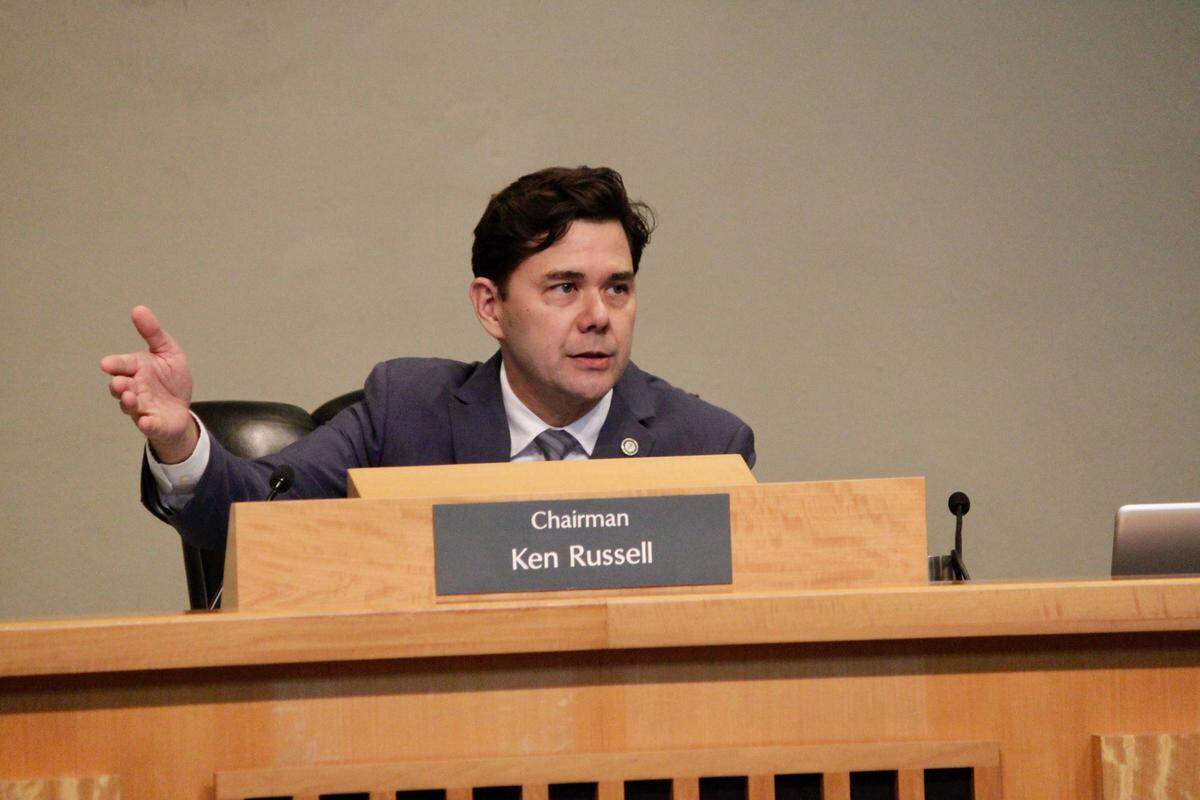
Russell, while praising the proffered contribution as having “great potential,” raised questions about the last-minute agreement and said he was not ready to vote on it because details remained unclear. He then invoked a “five-day rule” that allows a single commissioner to put off consideration of a matter when proposed amendments are filed less than five days before a scheduled vote.
After several minutes of increasingly contentious back and forth, it became clear Russell was not backing down. After about 10 minutes of discord, Russell banged his gavel, declaring the meeting adjourned on a technicality, and walked out of the City Hall commission chamber. The chairman can adjourn a commission meeting that extends beyond 10 p.m. if there’s not unanimous agreement to continue.
Hardemon, whose district includes Little Haiti, stood up and, waving his arms, began shouting his objections to the chairman’s use of the rule. Hardemon and Commissioner Joe Carollo accused Russell of acting like “a dictator” and imposing “one-man rule,” respectively, while arguing that Russell had misused his authority.
Plainclothes police working for the sergeant-at-arms fanned across the front of the commission dais while project opponents in the packed house began jeering Hardemon, who responded by pointing his arm at them and repeatedly shouting “Leave! Leave! Leave!” At least two audience members were led out by police, though no one was arrested. When a staffer attempted to physically cool down Hardemon, the commissioner erupted: “Get your hands off me!”
A few minutes later, a notably calmer Hardemon unsuccessfully tried to persuade the remaining three other commissioners to vote to approve the Magic City Innovation District anyway, arguing that Russell had “abused” his authority in invoking the five-day rule and adjourning the meeting. But Carollo noted that doing so could prompt legal challenges, potentially delaying approval even more.
Instead, Carollo and Hardemon, joined by commissioners Manolo Reyes and Willy Gort, voted to bring the project proposal back to the commission on March 14. Though it’s unclear whether that vote was valid, any commissioner or the city manager can ask that the item be placed on a meeting agenda.
The one thing that was clear at the end of the night was that the project has the votes for approval on a first reading. Russell suggested that he, too, might vote favorably once he better understands the agreement Hardemon reached with the developers.
Carollo said after the meeting he was ready to vote “yes,” but cautioned that doesn’t mean it will be clear sailing for the Magic City developers on a second and final vote. He suggested there might be room for further negotiation with the developers before that.
“From first to second reading, that’s a big jump,” he said.
Among the questions sure to come up is precisely what the impact of the new offer by the developers would be. Hardemon said the money, to be doled out in phases as the project is built over a period of 15 years, would go into a trust to be governed by a new appointed board that would decide how to spend it. He suggested the money could be combined with lots the city owns in Little Haiti to build affordable housing.
During the hearing, though, several critics of the project questioned the significance of the $31 million figure, noting that the agreement allowed the developers also to withdraw a commitment to fund or build 550 affordable and workforce housing units, most of them within the Magic City district. Some noted that $31 million would not buy that much in the way of new housing, and that the developers were already committed to contributing some $13 million in public benefits under the original development agreement they proposed.
Russell cited those discrepancies among the uncertainties he said merited a delay. He said he had not picked up on the change in the developers’ affordable housing commitment on quickly scanning a fat agreement document handed to commissioners by the developers’ attorney, Neisen Kasdin, as the hearing opened.
“We’re on first reading, and we don’t know what we’re doing,” Russell said, adding later: “It could be so good if we get it right.”
Hardemon insisted on a vote, and made what seemed to be a motion for approval, which was seconded by Reyes, when Russell announced he was invoking the five-day rule. Hardemon, after first contending he had not made a motion for approval, then tried to argue, with the backing of other commissioners, that they still could vote on the original proposal on the agenda on first reading, without the $31 million agreement. The agreement would then be added as an amendment for the second reading.
Russell would not budge. He alluded to an earlier vote, also after a contentious, hours-long hearing, in which he failed to get a second on zoning measures he sponsored to help curb overscaled homes in Coconut Grove. Russell was forced to indefinitely postpone amendments to special rules meant to protect the Grove’s look and feel when other commissioners raised questions about its details and impact, saying they were not ready to vote on a first reading.
“It’s been made very clear to me by this commission today how we feel about first reading, and where we go with things where we don’t set balls in motion when we don’t know what we’re dealing with,” Russell said.
After the Magic City hearing, Carollo suggested Russell pulled the plug on the vote because he was upset about the lack of support from fellow commissioners for the Grove matter.
“He alienated his four colleagues for no reason at all,” Carollo said. “I’ve never seen anything like it in 40 years.”
Hardemon called Russell’s shutting down of the hearing “distasteful” in an interview later on Friday.
Russell defended his handling of the hearing, saying the commission should be consistent in approaching zoning questions with similar ramifications.
“The parallel between the two is, if such scrutiny is needed to get past first reading for a development issue affecting gentrification in Coconut Grove, the bare minimum of that scrutiny should be allowed for something in Little Haiti,” he said in an interview Friday.
Russell also insisted he invoked the five-day rule for the benefit of the public who had not seen the amended proposal before Thursday night.
“It’s too often that our reputation is led by dark shadows and backroom meetings and the sense that we’re not being open and transparent,” he said. “So why let that happen when it doesn’t have to?”
He said he adjourned the meeting with some key and potentially also controversial items remaining because it was well past midnight, tempers were flaring and commissioners’ focus diminishing, and many members of the public who had been waiting to speak on those matters had left by then.
The deferral was the third for the Magic City proposal, which would spread out across 17 acres and seven city blocks in Little Haiti with a combination of commercial and residential development and towers as tall as 25 stories. The Magic City proposal calls for commission approval of a Special Area Plan (or SAP), an increasingly controversial category in the city’s Miami 21 zoning ordinance that allows owners of more than nine contiguous acres to build more than is normally allowed in exchange for providing public benefits such as parks, infrastructure improvements or affordable housing.
The City Commission is considering rewriting the rules for Special Area Plans later this year to increase public benefit requirements amid complaints that the mammoth developments they encourage are bringing outscaled, intrusive development to city neighborhoods.
In November, Hardemon led a charge to defer the initial vote on Magic City, arguing that backers had not conducted proper community outreach with the residents of Little Haiti or proffered sufficient community benefits. Since then, he said Thursday, he sought input on a wish list from community leaders and insisted that developers listen to their pitches and respond.
The $31 million represents an improvement over what the developers had previously committed to because it guarantees the cash up front as the project is built, with no restrictions on its use, Hardemon said in an interview after the hearing. Before, the affordable and workforce housing requirement would have been triggered only if the developer decided to pursue increased density for the project. The commissioner said he would have liked to extract more, but was unsuccessful.
“You only get what they will give you,” Hardemon said. “We could say ‘no’ to the SAP, and then one one gets anything,” he said.
The trio of Miami-based real estate firms behind the Magic City Innovation District — Plaza Equity Partners, Dragon Global and Metro 1 — argue their project will be an economic boon to the impoverished Little Haiti neighborhood, which has a poverty rate of 46 percent and has seen little private investment in decades. The project would be built on the vacant site of the Magic City trailer park and on surrounding blocks that are home to deteriorated warehouses. It would also renovate and incorporate a couple of historic buildings.
The economic promise and the $31 million proffer brought support for the project on Thursday night from the Unite union’s Local 355, noted Little Haiti activist Gepsie Metellus and the Rev. Reggie Jean-Mary, pastor of Notre Dame D’Haiti Catholic Church, among others, though the enthusiasm was more full-throated from some than from others.
Metellus called the plan “the best that we could do at this point” after what she described as “many difficult conversations” with the developers.
But members of a coalition led by activist Marleine Bastien, director of the Little Haiti-based Family Action Network Movement, blasted the Magic City plan, saying it’s so large it will end up raising rents and housing costs and forcing out longtime residents in the surrounding neighborhood.
“This could represent the end of what we know as Little Haiti,” said Maria Rodriguez, an immigration advocate who has worked with many Little Haiti families. “This development is tearing this community apart.”
Critics questioned why the city has not conducted studies on the project’s impact or potential for displacement. Others said they don’t trust the $31 million will go to help the neighborhood, even as some called it a drop in the bucket compared to the community’s needs. One activist, Gilbert Placeres of Engage Miami, called the figure “a rounding error” in the developers’ budget and said it won’t begin to make up for the gigantic project’s disruption.
“An SAP is not supposed to be a get-out-of-zoning-free card,” Placeres said.
Another veteran Little Haiti activist, Leonie Hermantin, called for a moratorium on Special Area Plans until the rules can be fixed. But she said displacement of people who rent homes and places of business in the neighborhood began long before Magic City came along and will continue to increase whether or not the project is approved.
“Gentrification will continue to affect our community even before one brick is laid” for Magic City, she said.
This story was originally published March 1, 2019 at 6:54 PM.