
Voters refused to expand Miami mayor’s power. He might be politically weaker now.
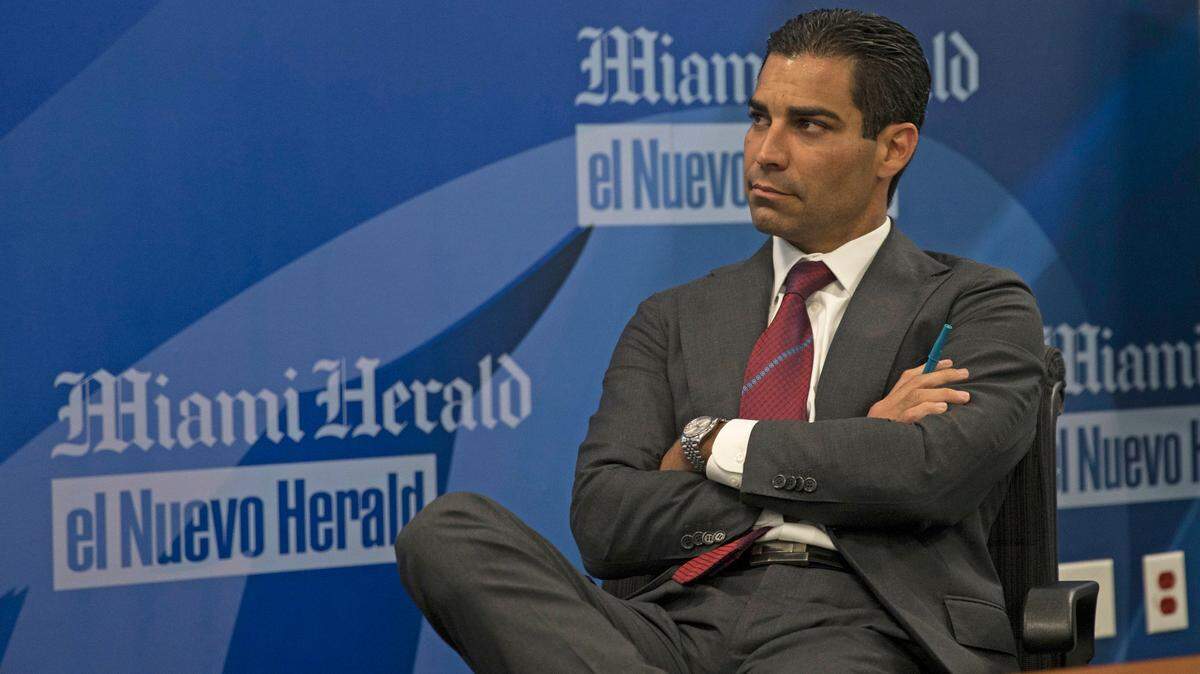
Miami Mayor Francis Suarez might’ve woken up Wednesday with less political clout than he has ever had.
On Election Day, voters roundly rejected his bid to expand the responsibilities of a position that is largely ceremonial.
As Suarez sought to become a “strong mayor,” two city commissioners and Miami-Dade Mayor Carlos Gimenez openly blasted his campaign. They branded his efforts to become the city’s top administrator as a power grab disguised as an accountability measure.
Suarez also took heat from fellow Republicans on Tuesday when he told the Miami Herald he had voted for Democratic gubernatorial candidate Andrew Gillum. One of the most powerful Republicans in Florida, incoming state House Speaker Jose Oliva, called him “tragically ignorant” in a tweet reacting to the revelation.
In both cases, Suarez gambled his political capital and lost some of it. That could hurt the 41-year-old real-estate attorney as he tries to stitch together votes to approve new infrastructure, housing, and cultural projects — including a new stadium for Miami’s Major League Soccer team.
“Suarez made two losing bets for this election, and they have the possibility of significantly decreasing his political power,” said Sean Foreman, a Barry University political-science professor.
Suarez disagrees. Miami’s other two ballot questions — which he supported — passed: a deal to lease public waterfront land to developers in exchange for a new city administration building and initial terms for a soccer stadium/commercial complex for David Beckham’s new MLS team (though that plan is running into its own problems).
“Look, politics ebbs and flows every day. You don’t win every single political endeavor you’re involved with,” Suarez said.
Indeed, he has unsuccessfully tried to change Miami’s government into a strong-mayor system before. During his eight years as a commissioner, he twice failed to convince commissioners to put the question to a public vote.
But Tuesday did mark a milestone. He has successfully run for elected office three times with little to no real competition. One year after Suarez swept into the office with 85 percent of the vote, Tuesday was the first time that voters rebuffed Suarez at the ballot box.
And they were emphatic. About 64 percent voted against the strong-mayor proposal. No recounts here.
“While Francis Suarez is full of charisma, if he can’t get people to follow where he wants to lead, then his leadership is ineffective,” Foreman said.
On paper, Suarez has very little power to begin with. He can act as chairman of the City Commission, a responsibility that he chooses to pass along to a chairman whom he appoints. But he has no vote, and he can’t give orders to his appointed city manger, Emilio Gonzalez, or any of Gonzalez’s more than 4,000 municipal employees. Suarez can fire Gonzalez, but the commission can, too. Or it can overrule the mayor.
So Suarez’s chief weapon is the power of persuasion that he can wield from the bully pulpit. Some of his biggest critics are commissioners whom he needs to sway to get anything done.
Manolo Reyes, who holds Suarez’s old commission seat, said the vote represented a clear mandate that the current government structure works and the people don’t want “one single person to have absolute power.” Joe Carollo loudly campaigned against the measure, firing off attack ads that accused Suarez of wanting to become a “dictator-mayor.” Both he and Gimenez mailed ads showing pictures of Suarez’s newly purchased $1.4 million home in Coconut Grove, suggesting the mayor sought a pay raise so he could afford mortgage payments.
On Wednesday, Carollo dismissed Suarez’s desire to bring back a new strong-mayor plan later on.
“The voters clearly spoke,” he said.
With three years left in his term, Suarez said a key agenda item is the rolling out of projects funded by the Miami Forever Bond, a voter-approved plan to borrow $400 million for anti-flooding work, park improvements, and new affordable-housing projects. The first round of work is expected to be announced before the end of the year.
If Suarez wants to have a role in the approval of those projects, he’ll need to have influence with the five commissioners who hold the power with their votes. If the city negotiates a lease for the Beckham soccer complex, the agreement needs four of five commission votes for approval. But two commissioners, including Reyes, have already said they oppose the deal. To shepherd the proposal into a reality, Suarez will need to do some convincing.
Other projects he wants to see come to fruition: restoration of the Miami Marine Stadium and rent subsidies for tenants struggling to make ends meet.
Despite the sharp disagreements over the strong-mayor idea, Suarez remains an optimist.
“I have good relationships with the commissioners,” he said. “It’s something I will continue to emphasize. That’s my job. My obligation is to find consensus.”
The fallout might extend beyond city limits. After revealing his vote for Gillum, Suarez might have trouble lobbying the majority-Republican Legislature on state funding for local projects.
He certainly flexed his political muscle with his strong-mayor campaign. Through the election season, Suarez spent a good deal of time and about $3 million in political contributions to champion the change — a remarkable sum to support a ballot measure.
Along the way, he was continuously met with resistance ranging from staunch opposition to casual criticism. Carollo unsuccessfully sued to block the referendum, though that was less surprising than the skepticism over whether Suarez was prepared to juggle running the city with his job as a real-estate attorney at Greenspoon Marder.
It was a new dynamic for Suarez, who has avoided making enemies and has a reputation for being a genial politician with a skill for consensus-building.
“You’re not ready for this,” said a man who called into a Radio Caracol 1260AM program where Suarez was promoting his proposal Monday afternoon, before Election Day. In Spanish, the man advised the mayor: “Hold off on the ambition for a little while. Keep working for the city, and then later you can become a strong mayor.”
The caller seemed to capture at least part of the pushback against Suarez’s plan: The politician should learn to walk in the mayor’s shoes before running.
“You have to learn from these situations, without a doubt. You have to grow,” Suarez said. “But I’m excited about the next three years.”
Jesse Manzano-Plaza, a political adviser who helped orchestrate the strong-mayor campaign, said it’s easy to consider the election a loss for Suarez, but time might look more kindly on his standing because he supported two measures that did pass.
“If these other projects are realized the way they’ve been presented, I think we’re going to look back at this and say, ‘Wow, look what he accomplished in his first year,’ ” said Manzano-Plaza, who works at consulting firm LSN Partners, which lobbied on behalf of the developer backing the waterfront land-lease deal.
Others in City Hall are happy to move beyond election season. Reyes believes the city will run better without the political distractions.
“Many of the city’s needs have been put on hold by the administration pending [the strong-mayor] vote, and now it’s time to stop the games, come together, and get to work on increasing efficiency, security, and quality of life for the residents of Miami,” he said.
This story was originally published November 9, 2018 at 7:15 AM.