
‘I am not in the wrong body, but in the perfect one’: Hispanic trans woman leads LGBTQ board
As a transgender woman, Aiyana Angeni González has had the rare privilege of choosing her name as an adult.
Aiyana means “eternally blooming” and Angeni means “spirit” — the names are often claimed to be derived from Native American languages. Those words reflect how González feels at 54: fulfilled.
“Every day I face a world without a mask, without a lie, and I do it as a realized person. That joy springs from within; it is not based on the objective world, but on the subjective world,” González told the Herald.
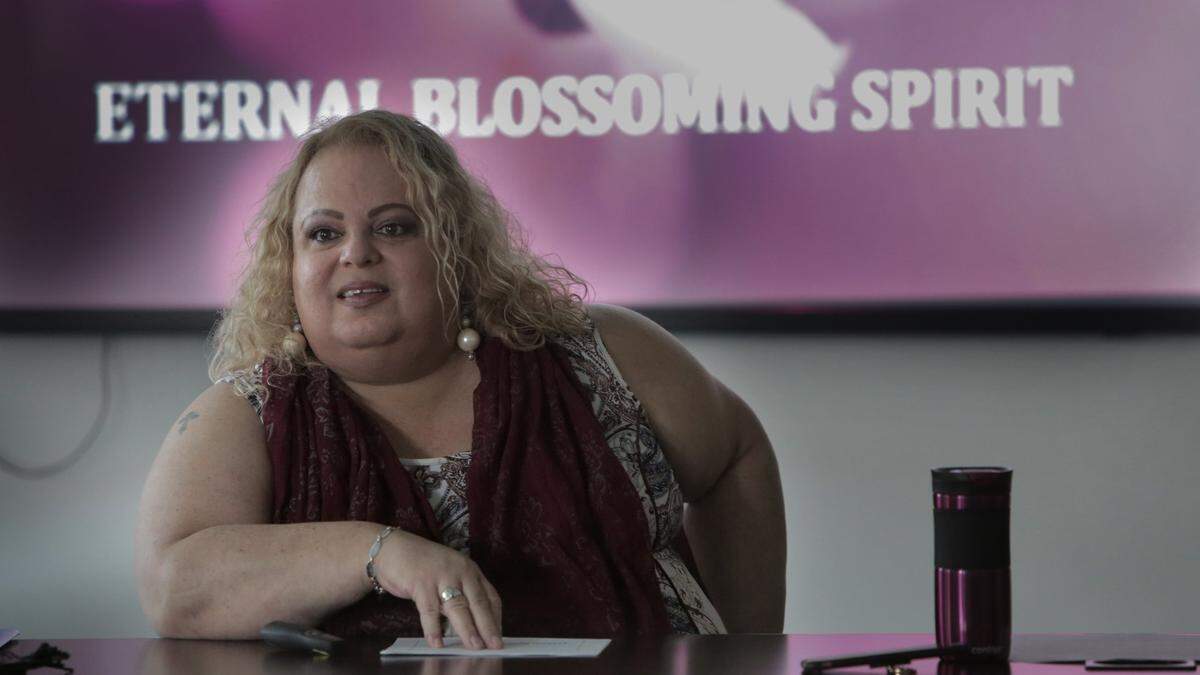
In addition to being a transgender woman, González is an aunt, a sister, and an excellent student who has recently graduated from Barry University with a major in social work and who’s on track to earn her master’s degree later this year. She is also a community activist, having served on the Miami-Dade County Advisory Board for LGBTQ Affairs since November, and is now the first transgender woman to chair it.
But her path to accepting herself as a transgender woman, which she began when she was 38, has not been easy.
“Being transgender and reaching the moment of acceptance represents many nights of darkness. It is not saying: ‘I want to change my blouse and I go to the closet,’’’ González said. “It is a change at such a profound level that those who are not trans do not understand it.” She indicated that she had received considerable psychological and spiritual therapy to achieve that change.
González also decided to receive hormone treatment, which can have unpredictable results and long-term effects. She weighed the risks with the help of her doctor.
“I said to myself: ‘ I am going to trust that the universe knows more than I do, and that my body will respond how it has to. I am not going to have expectations, but I am going to take responsibility,” she recalled about deciding to undergo the treatment.
Etiquette to refer to trans people
González points out that when she has an important relationship on a social level, she often shares that she is a transgender woman. Same goes for possible romantic relationships: When the situation arises, she’s upfront, and then sees what develops.
González also shared that the etiquette to address trans people indicates that you must call them by the name of their choice — not their birth name — and also use the pronouns corresponding to the gender they have chosen. It is also not correct to ask a trans person if she has had a sex change operation, because this is a private detail that she does not have to share.
“What psychology shows is that gender exists in the mind, not between the legs. When you receive therapy, it is to accept what you have always been, not what you have lived,“ González said.
She further noted that it’s inappropriate to use the phrase “you were born in the wrong body.”
“I was born in this body, determined by science as a man, but I have a conscience and a soul that tells me that I am a woman. I’m not in the wrong body; I’m in the perfect body for me,“ González said.
González never self-identified as a man and remembers that she never liked going to the barbershops because she could not bear the way in which some men referred to women.
Trans youth more vulnerable during pandemic
These days, Gónzalez cares for the most vulnerable people, who live in difficult situations and isolation due to the coronavirus pandemic. Those people include victims of abuse; the elderly, especially those who are lonely or whose memory loss may be aggravated; and children and young people who are undergoing a process of acceptance of their gender but who are otherwise unsupported. “For a child or young person who is in a home where there is no support, having to be at home all day is very hard. It can cause a delay and an interruption that is not normal in that human being,” González said. “They are living a process of questioning, of anxiety, of sadness, of so many questions.”
González also recognized that on many occasions, it is not that families don’t want to support trans youth: Rather, those youths are not understood. Parents generally don’t know how to deal with worry and fear that their children will be rejected or victims of violence, she said.
“I would say to trans youth or anyone: ‘Remember that you are the eye of the storm, and in the eye of the storm there is perfection, peace and tranquility. All that is spinning outside is storm. No, don’t focus on that, focus on your center, “ González advised. “It was working that center that I learned to be who I am and I got the peace of life that I have.”
As an activist, González points out that not all trans or gay youth have to face violence: Parents can be better educated and informed so that they understand what their children are experiencing.
In her case, she did face violence when she was 24 years old and identified as a young gay man. González was beaten along with other friends when leaving a party.
González also had a “stormy” relationship with her father who never accepted her as a gay man. However, in the last stage of her father’s life, they achieved an understanding and he did accept her as a transgender woman.
“We reached such a deep love and such a high level of respect that when I heard the news of his death, I cried with joy because he left knowing that I adored him. For me, that was a blessing,” she said.
Rights to be obtained for transgenders
One of the most far-reaching legal decisions in the battle for equal rights. occurred in June — which is LGBT Pride Month. On the 15th, the Supreme Court determined that the federal laws that protect against labor discrimination based on the gender of people also protect people based on their sexual orientation.
“Today I can go to bed with the certainty that nobody can prevent me from working because I am trans,” González said. “Last week, they could have said to my face: ‘You are trans and we did not allow that,’ and they would have thrown me out and I would not have had any type of protection under the law.”
However, the defense of rights for the LGBTQ community still has a ways to go, she said.
González calls for more respect for the Black transgender community, which has been subjected to acts of violence on numerous occasions. In late May, for instance, a police officer fatally shot Tony McDade — a trans man — in Tallahassee. This sparked protests in support of Black Trans Lives Matter.
“This is a population doubly marginalized for being Black and trans. It is sad that many of these cases are not considered hate crimes by the police and the law,” said González, emphasizing the protection gap that exists for transgender Black people.
Aid resources for the trans community
Counsel & Connect: Offers all kinds of counseling for those who identify as LGBTQ. There are groups for trans people of different ages and for their parents. 6850 Coral Way, Ste 501, (786) 346-0877.
Aqua Foundation For Women: Helps women who identify themselves as LBTQ, with scholarships for studies, volunteer opportunities, job fairs. They have an annual conference for trans and gender nonbinary (which do not fit into the traditional categories of female or male gender).
TransLatin @ Coalition: An organization that advocates for the rights and needs of transgender immigrants living in the United States. https://www.translatinacoalition.org/
This story was originally published July 1, 2020 at 12:00 AM with the headline "‘I am not in the wrong body, but in the perfect one’: Hispanic trans woman leads LGBTQ board."
