
Can a $100,000 robot help fight COVID? The Key West airport now has one to zap the germs
Starting Friday, Monroe County’s new $100,000 robot that emits ultraviolet light will begin autonomously disinfecting the inside of Key West International Airport after hours.
At nearly six feet tall and more than 300 pounds, the new arrival is made by UVD Robots. The company says Key West is among the first airports in the nation to acquire one, according to the Monroe County Tourist Development Council.
On its website, the Key West airport says it’s the first Florida airport to have “a new autonomous robot that eradicates 99.9% of pathogens (inclusive of COVID-19), and disinfects the air using ultraviolet technology.”
UVD says its robots were designed for hospitals, hotels, cruise ships and malls, along with airports.
Richard Strickland, Monroe County’s director of airports, said the robot will bolster the Key West airport’s protection practices during the coronavirus pandemic.
Those include human-powered disinfection, and requiring and providing masks for all personnel and passengers.
“Passengers should know that as they travel to Key West International Airport and utilize the facilities here, we’ve made every effort possible against COVID-19 to protect passengers’ safety,” Strickland said. “And now, with the ultraviolet light robot that we have here, we’ll be able to step that up even another notch.”
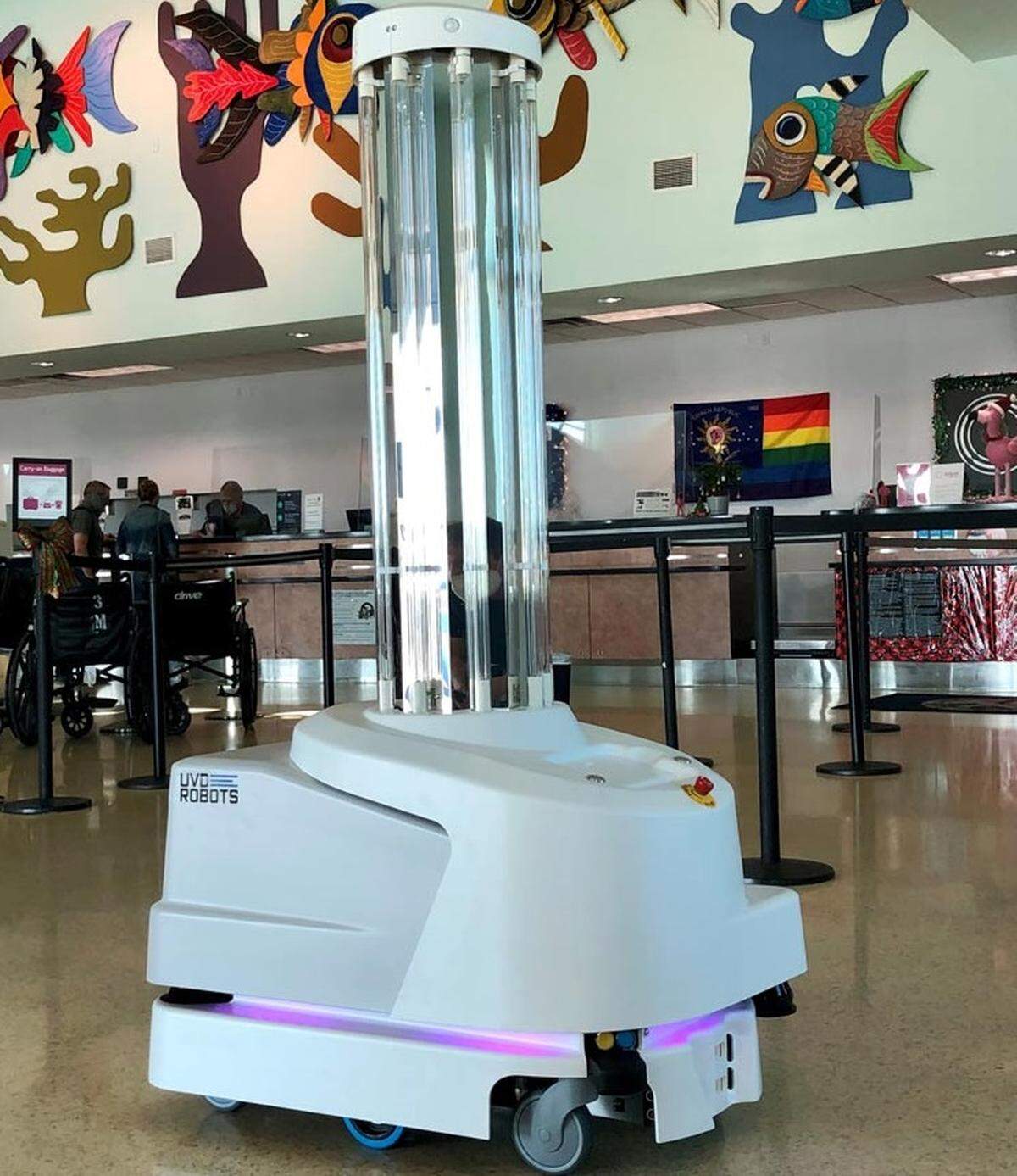
The county bought the robot from IP Program in Tampa.
Airport officials said the robot can disinfect the entire airport’s interior spaces in about 2 1/2 hours. It will make the rounds once nightly after the airport closes and there aren’t people around, said county spokeswoman Kristen Livengood.
Studies show that ultraviolet light can kill COVID-19 in the air and disinfect surfaces, according to the University of Pennsylvania, but nothing shows it can prevent infection.
“They’re not a miracle cure so we still need to do the dry cleanup and the wet cleanup,” said Jim Malley, a professor of civil and environmental engineering at the University of New Hampshire who has spent 40 years in public health engineering. “The robot is a nice additional barrier. We’ve built one ourselves and done research in the classrooms.”
Malley said the UV disinfecting robots have been around for about 15 years and brought about by a large movement to reduce healthcare-acquired infections.
“There’s been an explosion of use since mid-March,” Malley said.
The UV robot is one step in sanitizing, he said.
“If you put a robot in a dirty bathroom, it’s not going to work very well,” Malley said.
Once programmed, the UVD robot can move about on its own, with its progress monitored by an operator with a tablet, the tourist council said.
And the developers say it can even find its own docking station when it needs recharging.
This story was originally published December 15, 2020 at 4:00 PM.
%20Cropped%20(1).jpg)