
The day a killer hurricane wiped out parts of the Florida Keys, and what happened next
The Labor Day Hurricane of 1935 blasted into Islamorada late at night on Sept. 2. A giant tidal surge, 18 or more feet high, swept across the Keys, and 408 people were killed — 256 of them military veterans who were building the Overseas Highway beside the Overseas Railway.
Here is a look back through the Miami Herald and FLKeysNews archives on a storm like no other.
The day the Keys washed away
Published Sept. 1, 1985
Labor Day, Sept. 2, 1935. Five miles offshore, J.A. Duncan, the lighthouse keeper at Alligator Reef, finished supper and looked up to see a wave the size of a nine-story building rolling toward him. The monster swelled to 136 feet, slapped the lighthouse’s great glass face unimaginably far into the night air and roared over Hawk’s Channel toward the Florida Keys.
No one knew what was coming.
Not Duncan, the sturdy light keeper, or Bernard Russell, the Islamorada postmaster’s son, or Elizabeth Bradford, a young Miami bride who cut short her Labor Day weekend, fearing “a little storm.”
Not Ernest Hemingway in Key West, or City Editor Hartley of The Miami Tribune, who pulled Mussolini and the New Deal off the front page and cried to his copy boys, “Get me the weather maps!”
Not the conductor of Old 447, who was backing the Florida East Coast Railway train down the Overseas Railroad to pick up 683 World War I veterans whom President Franklin Delano Roosevelt had sent to the Keys to build bridges.
And certainly not Miss Charlotte Evans of Philadelphia, aboard the great luxury liner S.S. Dixie bound from New York to New Orleans, who wrote to her mother the cruise was “monotonous, and I’ll be glad to get off.”
No one could know that the “little storm” that swirled listlessly off the Bahamas 30 hours earlier would crush the Depression-weary fishing towns of Islamorada and Tavernier as the fiercest hurricane ever to land in the Western World. The Great Labor Day Hurricane of 1935 decimated the 400 pioneer families who struggled to make a living on the 18-mile ribbon of coral islands that are the Upper Keys. Conchs who had confidently weathered hurricanes in 1894, 1906 and 1909 found themselves “at the mercy of the Lord,” as one said. On the Monday that the storm hit, a paroled Sing Sing jewel thief was arrested in The Biltmore Hotel in Coral Gables. G-Men were experimenting with a strange new invention, the lie-detector machine. Labor chiefs hailed FDR’s “new social and economic order.” Swimmer Buster Crabbe was featured in smoking ads, saying, “Camels Don’t Get Your Wind.” Forlorn lover Margie Stanley, 35, crying, “I have fallen in love with the wrong man,” swallowed a fatal dose of poison in a Miami hotel room. Labor marched, an “inspirational sight,” in wind and rain in downtown Miami. It was no day for business or recreation, folks said. “It was,” a newspaper concluded, “a fine day to catch up with the reading.”
Then “hell in the form of a hurricane” came ashore in Islamorada at 8 p.m., in screaming blackness, with 250 miles per hour winds that twisted steel, the strongest hurricane winds ever in the United States. A sucking pressure made men feel as if their heads were about to explode, plunging barometers to the lowest reading -- 26.35 -- ever recorded by the U.S. Weather Service. (Normal barometric pressure is 30.) A tidal surge 50 miles wide and 18 feet high, with 10-foot waves breaking on top, scoured the islands for an hour. It was the highest tidal surge in Florida history.
The only “Level 5” hurricane in U.S. history, except Camille in Mississippi in 1969, the storm caused five times as many deaths as Camille.
The aftermath in Islamorada was so horrible that Ernest Hemingway, one of the rescue workers, vowed he would never describe it in a book, and never did. Fifty years later, officials at the National Hurricane Center in Coral Gables still study the storm and pray this “meteorological nightmare” never happens again.
The storm lifted the Conchs’ simple wooden houses, drowned them in the tops of palm trees, hammered their automobiles into the ground like thumbtacks, flung railroad cars like bombs, filled the sea with an indiscriminate mix of man and wood and land. More than 500 people, possibly 1,000, died.
Thirty years later, workers dredging for a construction project in the Keys dug up an automobile, with 1935 California license plates, with five skeletons inside, victims of the hurricane.
In mid-August 1935, a massive area of thunderstorms swept through the interior of Africa and out to sea. What was brewing, says National Hurricane Center chief Neil Frank 50 years later, was “the worst meteorological nightmare imaginable,” no easier to forecast today than in 1935. “And it could happen again.”
On Saturday, Aug. 31, 1935, the Miami weather bureau, relying on reports from ships, first reported a small tropical disturbance inching east of the Bahamas, 450 miles southeast of Miami.
Through the next day and night, forecasters said the disturbance was moving east of Cuba and a threat only to ships. Scant word reached the Keys and no evacuation order was given.
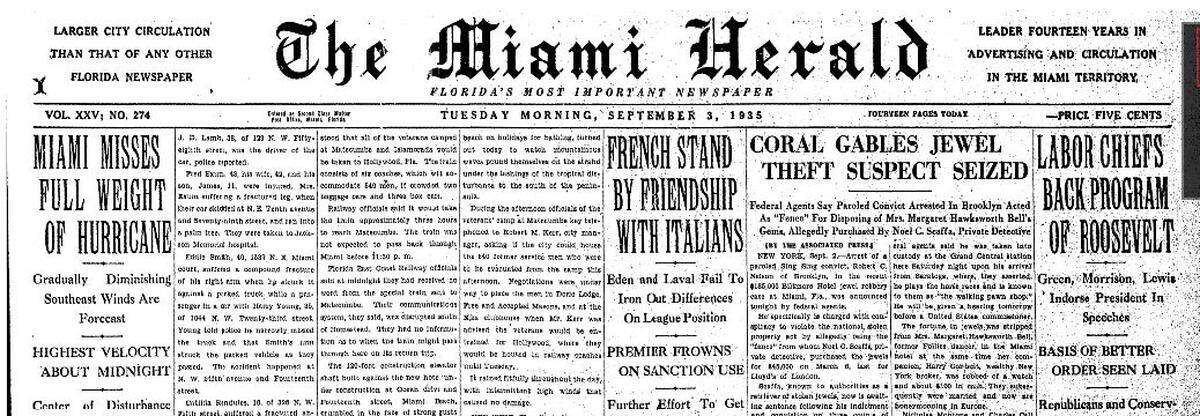
As the storm approached, Fort Lauderdale residents watched mountainous waves crash on the beach. Cities all the way to Belle Glade, 75 miles north of Miami, braced. In Cuba, 3,000 residents of the flooded town of Isabela de Sagua wandered the streets of other towns in tatters, and the Belen observatory said the hurricane was traveling slowly, but with terrific force.
In the city room of The Miami Tribune, editors huddled over weather maps. Wind and rain were lashing Miami. “The barometer was taking a nosedive . . . yet the Miami weather bureau kept insisting that the storm was somewhere east of Cuba and no threat,” an editor explained in a story. “Somehow it just doesn’t add up.
“By Monday afternoon, (Sept. 2) it was evident, even to the copy boys, that a he-man hurricane was knocking on Florida’s back door.”
The word never reached the Keys.
At 4 p.m. Monday, as the sky darkened, Tavernier charter boat captain Cliff Carpenter rushed over to the Tavern Store, where H.G. McKenzie, who developed Tavernier, owned the town’s only phone.
“I said, ‘Mac, we are gonna get a blow,’ “ recalls Carpenter, now 81 and still living in Tavernier.
“Mac said, ‘I just talked to the weather bureau, and they said we had no worry . . . I got to my house and you should have heard the roof snappin’ and crackin’ and poppin’ like a rifle.”
On Upper and Lower Matecumbe Keys, panic was beginning to spread in the veterans’ camps. Their train to safety was hours late. Dozens huddled in Carlton Bradford Jr’s. general store. Bradford, whose wife and father had fled to Miami Beach the day before, was on the phone, saying, “I’m sorry, Dad, I won’t be able to make it,” when the store’s roof opened like a can.
“Get out of here, men! It’s falling apart,” he yelled.
In the Russell family hurricane shelter nearby, Bernard Russell “held my sister and her little boy as we started to go, and the wind tore us apart. I never saw them again.”
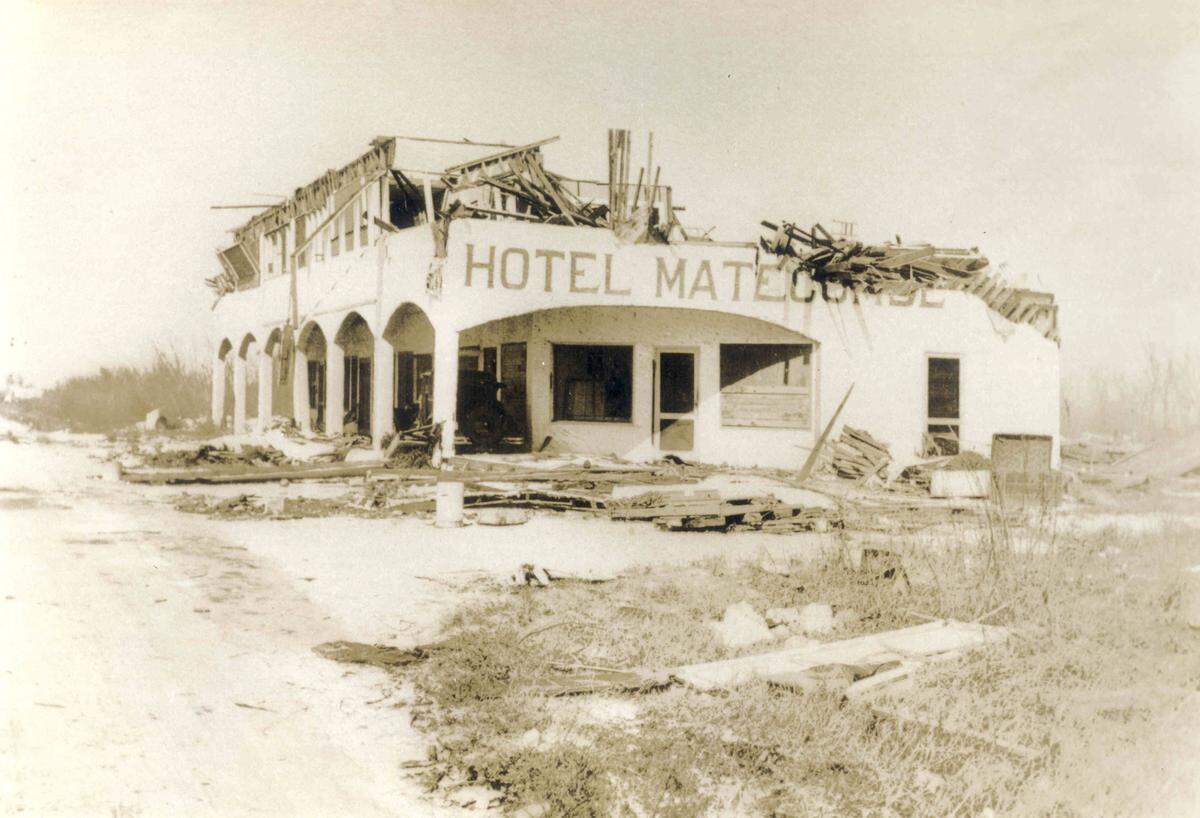
The Matecumbe Keys were leveled “as if a mowing machine had passed over them,” The Herald reported. Thirty-foot waves swept frame houses, a hospital, a stone quarry plant, 63 of 64 buildings, hundreds of veterans far out into the ocean. A water tank blew apart. “I would rather face machine gun fire again,” said veteran George Senison. The Caribbee Colony Hotel, founded by Coral Gables pioneer George Merrick, and 22 of its guests were “swept out of existence.”
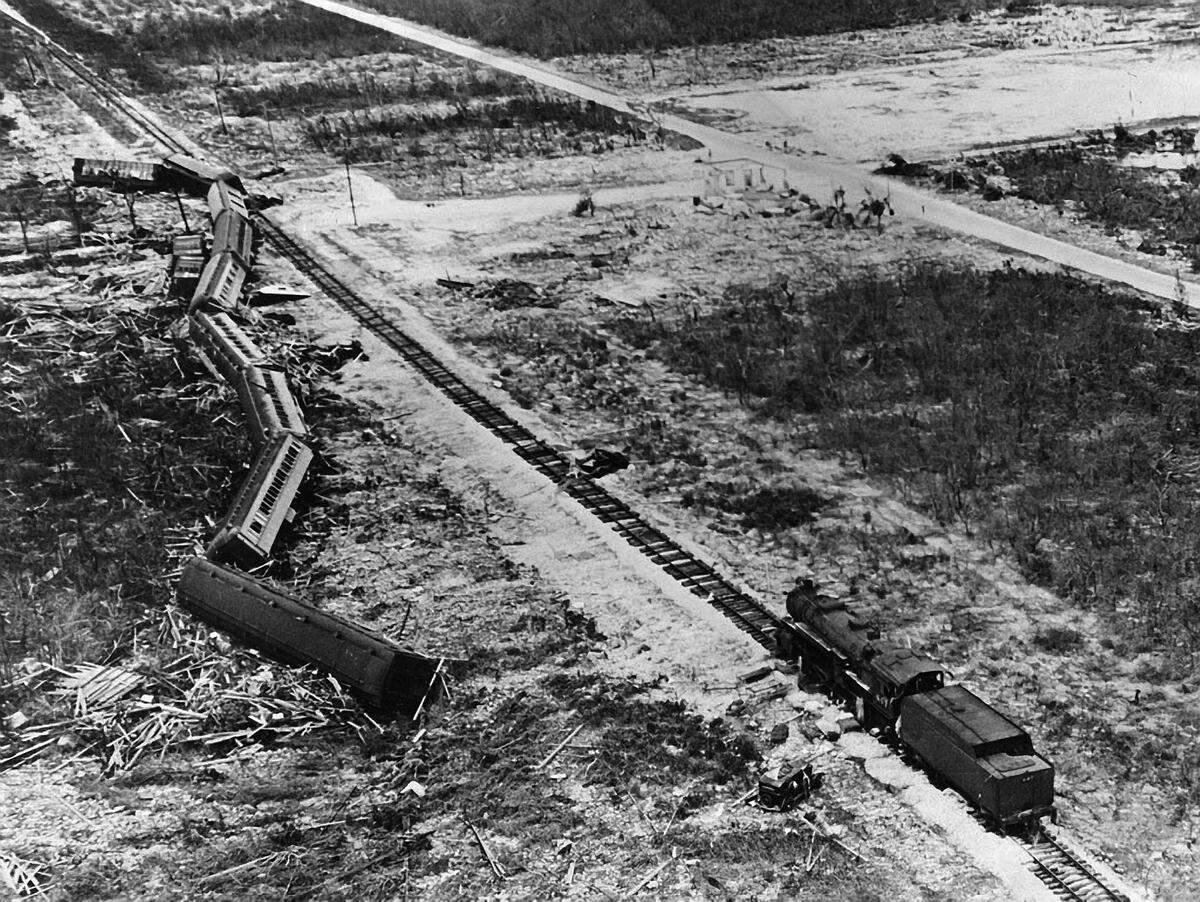
At 8:20 p.m., as the veterans’ train finally arrived, the train station exploded. The ocean surged, throwing the train’s six coach cars, two baggage cars and three box cars carrying 50 tons of cement off the track like toys. The box cars flew 400 feet, reducing wooden houses to “incredible shambles,” reporters said.
Forty-two miles of railroad bed were washed out to sea and miles of track were twisted like spaghetti. Henry Flagler’s Overseas Railroad, which had connected Miami to Key West for 23 years, would never run again.
At 9:30 p.m. on Tavernier, “houses began to float from their foundations,” a Herald reporter wrote later, “eerily slow at first, then with a whoosh! and a roar that took them off into the night on the wings of the hurricane.”
At the Long Key fishing camp author Zane Grey made famous, manager J.E. Duane and 20 other men huddled in the camp’s last cottage. Suddenly the sky was clear, the stars shining bright and a light breeze blowing, as the eye of the hurricane passed over. Half an hour later, the barometer fell and fell -- to 26.35. “I put my flashlight out on the sea and could see walls of water which seemed many feet high,” Duane said then. Blown toward sea, he was caught in a coconut palm’s broken fronds and knocked out.
Four hours later, at 2:25 a.m., he came to, clinging to a palm tree 20 feet above ground. The waters were gone. Winds still roared. Lightning lit the sky. The cottage, blown to sea with 20 men inside, had blown back, and everyone was safe inside.
On Plantation Key, more than 10 miles north, not a single house was standing.
On Islamorada, nothing was left but John Russell’s coral rock post office, smashed in two as if with a hammer.
From Cuba to Nova Scotia, great ships were blown off course. Off Islamorada, the Danish freighter Leise Maersk was grounded on the reef.
From Miami to Tampa, winds tore down power lines, streets were flooded, acres of citrus damaged.
In Naples, the landmark Naples fishing pier was half destroyed.
In Miami, the tabloid Tribune set out in a frenzy to cover the storm, but as City Editor Hartley sent reporters into the hurricane, Miami went black, and the Tribune’s presses went dead. Hartley packed editors, reporters, pressmen, printers off to the The Fort Lauderdale Daily News, which promised to print the paper.
Minutes later, Hartley bent his ear to naval reserve radio: The 445-foot Morgan liner S.S. Dixie, with 372 passengers aboard, was crippled on French Reef, 60 miles south of Miami, and being pounded by 50-foot waves.
Hartley barked commands. Virgil Pierson, a sportswriter and “amateur athlete of note,” ran out the door, and made a flying leap aboard the rescue tug Carrabasett as it pulled from the docks.
On Windly Key, 60 miles south of Miami, reporters and rescue workers were stopped for more than a day Tuesday at Snake Creek. The bridge that once spanned the creek was gone. A band of storm refugees across the gap on Plantation Key shouted into the wind, begging for medical aid and help. They said more than 35 had died. As the waters calmed, rescuers in boats reached the survivors.
News of the full horror of Islamorada had not reached the mainland.
On Wednesday, Sept. 4, at Islamorada, the ocean was as calm as a lake in a light morning breeze. The sun was shining. A gentle rain provided survivors with drinking water.
Reporters who reached the scene were numb: miles of debris and desolation, bedsteads, battered cars all about, hundreds of the injured and dying, a man stripped by the wind of all his clothes, 39 veterans stacked like cordwood, bodies in the trees, babies and children flung to dozens of islands miles out in Florida Bay, so much death that observers were benumbed.
“And yet the sea was so smooth, and quiet!” a reporter marveled.
Beside houses crushed to splinters, dinner plates lay unbroken. A parrot chirped in a delicate cage. Inside a house floating in Florida Bay, a boy petted a kitten. Captain Carpenter’s Tavernier home, where he lives today, was still standing.
Ignoring dangerous winds, Elizabeth Bradford, 25, found the only pilot who would take her from Miami Beach back to the Keys to look for her husband. The plane crash landed in mangroves.
The next day, Wednesday, the plane flew again and she found her dazed husband, Elizabeth Bradford Turnent, 75, recalled last week from her South Miami home. He had survived with a veteran and a dog in an automobile inside a tin shack.
The veteran who had pushed Carlson Bradford Jr. out of the way to be the first out the door lay with a two-by-four blown through his torso. He had lain there a day and a half, and he was still alive, serene-looking.
“It’s the darndest thing, Doc,” he said to his rescuer. “Like a doll stuck with a pin.”
The doctor withdrew the beam, and the man died like a light going out.
The greatest tragedy of all hit the Russells. Fifty of the 61 descendants of John Russell died. Bernard Russell, now 67 and still a resident of Islamorada, lost his mother, grandmother, sisters, cousins, uncles, aunts, and all their nieces and nephews. Thirty Russells were blown to sea, their bodies never found. Thirty Russells were buried in Miami in mass graves at Woodlawn Cemetery, cremated on the islands where the winds had left them or burned on the great funeral pyres that clouded Islamorada.
One of Bernard Russell’s nieces was blown to sea clinging to her baby. They found her body in Cape Sable, a beach 40 miles across Florida Bay on the mainland’s western tip, still clinging to the baby. There were track marks where they had crawled out of the ocean, alive, to die of exposure.
In Tavernier, Miami undertakers led by W.L. Philbrick began to identify the dead.
The lost soldiers
Published May 31, 2015
Just inside Woodlawn Cemetery off busy Eighth Street, across from an AutoNation Nissan dealership, a granite monument marks the final resting place of 79 U.S. soldiers buried in a mass grave after one of the worst hurricanes to ever strike U.S. shores.
The marker, erected by a Miami American Legion Post, is dedicated to “our comrades . . . lest we forget.”
Yet that’s what has happened in the nearly 80 years since the 1935 Labor Day Hurricane struck the Florida Keys. No marker names the fallen, buried in five narrow trenches overlooking a road and a trailer park. Only five have headstones. More flags fly over the AutoNation than at the vets’ grave.
At the time, their deaths were a national humiliation - soldiers sent to a mosquito-infested rock during hurricane season to work for the government only to be abandoned once the inevitable storm arrived.
“Ignorance has never been accepted as an excuse for murder or for manslaughter,” Ernest Hemingway wrote in the days after the storm, when no one could explain why American soldiers on American soil were left waiting for a rescue that never occurred.
With yet another hurricane season starting Monday, the Labor Day storm serves as a reminder of the nightmare power of a Category 5 storm. The looming anniversary may be the last significant milepost for the storm’s few remaining survivors. And for two aging vets wrestling with Washington and military bureaucracy to recognize the dead, it might also finally mark the end of a frustrating effort to honor men mistreated not once, but twice, by the country they served.
“To me it’s a scandal,” said Richard Bareford, a retired U.S. Army major who lives in New Jersey and joined Upper Keys historian Jerry Wilkinson in the fight to obtain individual grave markers. “This was a great tragedy. But the story isn’t over yet.”
The vets, from World War I and the Spanish-American War, had been part of about 43,000 marchers who camped in Washington, D.C., three years earlier to protest Depression-era wage cuts. After Congress failed to help, President Herbert Hoover ordered the camps closed.
“Hoover used Army guys with bayonets to chase soldiers out of Washington, and that didn’t play very well,” said Thomas Neil Knowles, a Key West conch and author of Category 5, a history of the 1935 storm.
President Franklin Roosevelt tried to fix the problem when he took office in March 1933 by putting the men to work in the Civilian Conservation Corps. When the economy began showing signs of recovery, many vets headed home. But some - written off as hopeless hobos by many but likely suffering combat-related disorders - returned to Washington to resume protesting. Faced with another showdown, Roosevelt persuaded Florida and two other states to reopen work camps.
By late summer 1935, about 700 soldiers were in the upper Keys building a highway bridge to link Lower Matecumbe and Fiesta Key, and open the hardscrabble Upper Keys to the flow of tourism filling coffers in Key West.
Outside the grocery, the post office and train depot - little else existed at the time - the vets were a foreign presence not always welcomed by locals.
“They were living on the fringe,” said author Les Standiford, a Florida International University professor whose 2002 history Last Train to Paradise detailed the harrowing attempt to rescue the vets.
Alma Pinder Dalton, 91, who lived at the end of Beach Road in Islamorada, where the upscale Moorings Village resort was built in the late 1980s, remembers her parents warned her to steer clear of the men, living in camps on Lower Matecumbe and Windley Key.
“Most of them drank a lot and you weren’t allowed to have anything to do with them,” said Pinder, who still lives nearby.
Long before radar and televisions and satellites, predicting hurricanes was a hit-and-miss science. Forecasters relied on barometers, telegraph cables and “an awful lot on ships at seas,” said Neal Dorst, a National Oceanic and Atmospheric Administration meteorologist and historian. Advisories and warnings came from faraway Washington and forecasters frequently grappled with what Dorst called the “lost hurricane problem” when ships fled and information dried up.
Late on Aug. 29, meteorologists in San Juan first detected the brewing storm east of the island. They predicted it would strike Cuba on Labor Day four days later. But when Monday arrived, there were no squalls, no radical drop in barometric pressure. At 10 a.m., a Pan Am plane making a run from Key West to Havana spotted storm clouds far north of where the storm should have been.
An American barnstormer in Cuba training pilots volunteered to check out the storm and got close enough to provide an ominous warning: The storm looked to be churning straight for the ribbon of islands unfurling from the Florida mainland.
When Labor Day 1935 arrived windy in the upper Keys, it gave little hint of what was to come. A 9:30 a.m. advisory, Knowles reported, had the storm making a slow westerly trek 200 miles due east of Havana with “shifting gales and probably winds near hurricane force over a small area.”
“Nobody knew,” said Everett Albury, who was six at the time and living in Tavernier, where the Driftwood Trailer Park now sits. “That was the scary part of the whole thing.”
That morning, he tagged along with his dad on a drive in the family’s Model A. Seemingly out of nowhere, rain pelted the car. In the next hours, the stormed reached record intensity. The barometer dropped to 892 millibars - it’s still the only storm to make landfall below 900 millibars in the Western Hemisphere - and gusts hit an estimated 200 mph. A massive storm surge swept across the islands, knocking tracks off a railroad viaduct 30 feet above sea level. The sea ripped the Albury house off its foundation, setting it afloat and drifting until it struck the raised railroad embankment, where U.S. 1 now sits.
The family had little idea of the horrors that lay farther down the tracks.
With earlier weather bulletins calling for the storm to pass south, Ray Sheldon, a civilian running the camps, had made no plans for the soldiers to evacuate. It wasn’t until 1:30 p.m. that he called for a train, worried by fresh warnings and plunging barometer.
By the time the train got underway, it was 4:25 p.m. After a brief stop in Homestead, the train crossed from the mainland over Jewfish Creek at about 6 p.m. But at Windley Key - a barren island used as a quarry - a thick cable used to hoist rock had swung across the track like a trip wire. While the crew worked in the dark to untangle the wire, minutes passed.
In Upper Matecumbe, the full force of the storm was tumbling ashore. The house where Dalton, then 11 years old, sought shelter with her family disintegrated.
“It just flew apart and we was all thrown out in the water. All of us,” she said.
An uncle, who had been ill, struggled to hold on to Dalton but finally had to let go. After pushing her onto floating debris, “he told me to fight for myself. I found Mother and Sister and was with them the rest of the night.”
Sand mixed with the rain and wind, scouring the shattered landscape and those left clinging to trees and debris. The faces of some of the dead were simply sanded away, Standiford wrote in his book. The living did what they could.
“Everybody who kept their back to the rain, their ears had scabs on them,” Dalton said. “It peeled the skin off, the rain was so bad.
”Historians know the eye of the hurricane probably passed the area about 8:10 p.m. when the lighthouse keepers at Alligator Reef reported a sudden end to the wind. In his book, Standiford described a massive tidal wave striking the train - about 50 feet from the Islamorada station near Snake Creek - and knocking all but the engine off the tracks, dousing the engine boiler and turning the cars into coffins.
“Panicked men flailed blindly, their limbs tangling with those of others clawing just as wildly in return,” he wrote. “As best we know, no one drowns with dignity.”
Farther south, the veteran camps - the closest settlements to where the eye passed over Long Key - simply washed away as sustained 185 mph winds hammered the flimsy tents. Soldiers later recounted lashing themselves to trees or hanging on to railway tracks. Some sought cover in trenches where rock for the highway bridge had been quarried, only to drown when the storm surge filled them.
“In the dark, if they knew what was going on five feet away from them, they were lucky,” said Wilkinson, who has spent four decades compiling documents and thousands of photos for an online museum for the Historical Preservation Society of the Upper Keys.
Of the 695 vets still working in the camps, which had run out of money and were expected to close in two weeks, 257 were confirmed dead. Another 228 civilians died in the storm.
The ravaged landscape quickly turned gruesome. Bodies were tangled in mangroves. Some washed across Florida Bay to Cape Sable. When Hemingway arrived by boat from Key West three days later, he found corpses floating in the ferry slip at Lower Matecumbe.
“You found them everywhere and in the sun all of them were beginning to be too big for their blue jeans and jackets that they could never fill when they were on the bum and hungry,” Hemingway wrote at the time.
Outrage quickly spread across the country.
Roosevelt ordered the vets returned to Arlington for burial. But in the hot, humid weather, bodies rotted quickly. Knowles said FBI experts sent to help identify the dead had trouble even finding fingerprints - the skin on corpse fingertips kept slipping off. The crew of a Coast Guard cutter that retrieved 75 bodies and stashed them on its top deck later reported sharks banging against the hull, attracted by the leaking bodies, Knowles wrote.
Hastily built coffins did little to contain the smell. Hoping to speed burial, the government purchased 110 plots at Woodlawn cemetery in Miami, Wilkinson said. But the sickening conditions in the Keys - authorities increasingly worried about the spread of disease -prompted the decision to burn many of the bodies.
That decision, for a country still troubled by the gruesome combat of World War I, only caused more outrage.
“It became a national thing,” Knowles said. “They’re burning the bodies of World War I vets down in the Keys. They tried to give them some kind of burial rite with an honor guard that would play at the pyres. But bodies found . . . out in Florida Bay, they’d just burn them right there.”
In the end, a massive service - accounts put attendance at 20,000 - was held at Miami’s Bayfront Park after 81 vets, nine civilians and 19 unidentified bodies were buried at Woodlawn in wooden caskets lined with copper, by Bareford’s count.
Anger over the failed rescue sparked a congressional hearing that remains a frank reminder of how powerless government can be in the face of a monster storm. After an initial report blamed God, a lengthier probe concluded three Florida officials acted negligently. The American Legion also investigated, blaming the deaths on “inefficiency, indifference, and ignorance.”
The congressional hearing lasted more than a month, but came to the same conclusion as the initial investigation: God, not man, betrayed the soldiers.
“Sometimes there are catastrophes that are simply accidents,” Standiford said. “I think this was one of them.”
Today, a granite marker - Bareford believes it went up in 1936 or 1937 - is the only official sign of who is buried in Woodlawn’s northeast corner. Flat headstones, probably placed by families, identify five soldiers. Two bodies were exhumed and buried elsewhere.
But 74 others, identified in the Veterans Administration documents with last names like Beganski, Stone, McGuire and even a Kjar - lie in a state no more distinct than the dirt that surrounds them.
Bareford has written repeatedly to VA officials, appealing to have the graves marked but finding his efforts tangled in a bureaucratic rule change.
For decades, anyone with knowledge of a soldier’s grave could petition the VA for a marker. The rule successfully allowed for hundreds of Civil War graves to be marked, Bareford said. But over the years, disputes arose over what the agency calls an “emblem of faith” - the religious icon etched into markers. Sometimes families fought over whether the emblem should be a Star of David or a cross. Some started requesting Wiccan symbols or emblems for Scientology, he said.
In 2009, the VA changed its rule to allow only direct descendents to apply for markers.
“In trying to solve one problem, they created another one,” Bareford said. “That brought everything to a screeching halt.”
Last spring, the agency began again revising rules to allow cemetery directors to make such requests. While the rules are still being reviewed, the VA in May 2014 agreed to allow Woodlawn to make an application. But Woodlawn director Gabriel Romanach hit another roadblock: Cemetery lawyers told him he could not place markers on plots owned by somebody else. American Legion Post 29 owned the plot, and Romanach had trouble contacting its commander.
This spring he finally got permission, and he said last week that he is working hard to identify the plots and put in the application.
“It’s no fault of anyone,’‘ he said. “It’s just the way the forms were created.”
In the meantime, Wilkinson said he still receives inquiries from families asking if a relative might be among those buried. At 86, he worries time for him to get markers on the long-neglected graves may be running out.
One day last month, he walked around the granite monument with a legal description he obtained from the 1936 congressional hearings, pointing to where he thought trenches were dug and bodies buried, mystified that after all these years, soldiers forsaken in life remained forgotten in death.
“I could spend the rest of the day here,” he said, “trying to figure out the politics of what they did.”
On Sept. 2, 1935, the most intense storm to ever strike U.S. shores hit the Florida Keys, crossing Long Key. Fierce 185 mph winds extended about 20 miles, killing 485 people, including 257 veterans stationed at three camps.
Deadly deluge
Published Aug. 31, 1997
Every Labor Day, Bernard Russell brings a bougainvillea wreath to the middle of the Overseas Highway and says a prayer for those who made it their final resting place.
He retells his story at the Hurricane Monument, a coral rock crypt where countless bodies were cremated and buried after the 1935 hurricane. Stories of his 50 aunts, brothers and uncles dying in their own lime groves.
Of losing his grip on the hand of his sister in the wind and never seeing her again. Of being one of 11 surviving Russells to pick up the pieces of their wood-frame home and start over.
His story, and the stories of nine others will be broadcast throughout South Florida in a half-hour documentary called Hurricane ‘35 - The Deadly Deluge .
Shot on Upper Matecumbe by New Jersey-based Miles Associates, the film details one of only two Category 5 storms known to have hit the continental United States. The storm obliterated the Upper Keys settlement and the railroad that had started to bring a small but bustling tourist industry.
With bits of insight from local historian Jerry Wilkinson, the film begins detailing hurricane preparation in the days before Doppler radar and Bryan Norcross. The Conchs knew it was coming because the barometer plummeted so fast it looked like a clock ticking.
“My Uncle Preston and Daddy said it was going to be a bad one,” Lucy Park Schooley says in Hurricane ‘35 . “And when it hit, that night, we found out how bad.”
The survivors, members of the pioneer Russell, Parker and Pinder clans and two others, recount that night from wooden chairs in their Islamorada back yards and from the pews of the Methodist church they helped rebuild after the hurricane.
With a chilling exactness and pain eased by time, they lend perspective to their loss. They recount the wind that could peel the skin off the back of your ears, and houses exploding like matchsticks. The Russells, who thought they’d found refuge in their packing house that had withstood two other storms, watched it crumble.
Jimmy Woods, a retired turtle hunter who fillets fish at Whale Harbor, remembers trying to escape with his baby sister.
“When I came out of the house with her, something hit her and crushed her right against the side of my head. And she was dead. She was killed instantly,” he says in the documentary. “And it just crushed the whole side of my face.”
Others like Clarence Alexander scurried. He had to abandon his first hideout to make room for white residents. But that shelter blew apart immediately afterward, and black and white ended up huddling together in an abandoned railway car, he says.
The days after didn’t bring much relief, with mounds of bodies stacked by the railroad bed and hanging in the mangroves -- a looming health hazard. The official death toll, record books say, was 408.
Every year, writers, news crews and the curious seek the survivors out like oracles. And every year Bernard Russell prepares the shrinking list of survivors that remain in the Upper Keys. At last count it was between 12 and 15, he said.
So many have died. Others moved away. But Russell said he and his family wouldn’t think of leaving.
“I asked my Dad, ‘What are we going to do? Where we going to go?’ He said, ‘Son, the only thing that you and I own today is a little bit of property in the Keys. That’s the only thing we’ve got. Everything else is gone.’ And he says: ‘We go back and make the best. We start over,’ “ Russell recalls. “And that’s what we had to do.”
This story was originally published August 31, 2020 at 12:53 PM.