He has a degree. But in South Florida’s job market, he’ll take ‘anything’

He clutches a red folder containing a stack of resumes with both hands. Four people stand in line ahead of Camron Drummond, all waiting to pitch themselves to the man at the booth.
It’s mid-morning on a late June Tuesday, and Drummond, 24 and jobless, is in Amerant Bank Arena, home of the Florida Panthers and, for today, the Job News South Florida Job Fair.
Some 40 “exhibitors” have turned out to meet with the hundreds of South Florida jobseekers looping their way around the stadium’s first-floor concourse.
Past the Army and the Navy, the Florida Department of Corrections, Sherwin-Williams Paints and assorted local police departments, Drummond edges into line at a table advertising cybersecurity certification programs.
No matter that he graduated in December with a degree in computer science from Alabama State University or that his resume shows three years of IT internship experience. Drummond needs work, and he’s open to whatever will either pay him money or enhance his hireability.
A player and aspiring maker of video games, Drummond was naturally drawn to computer science when he rolled into Montgomery in the fall of 2020. Plus, in those days, comp sci majors entered the labor market with unrivaled job security, pay and working conditions. An average computer science major graduating in 2020 could expect to earn at least $67,000, according to the National Association of Colleges and Employers. Learn to code, everyone was saying.

ChatGPT came online in Drummond’s third year of college, soon after he declared his major. Since, employment rates for early-career workers in the most AI-exposed occupations — including computer programming and other IT jobs that Camron spent the last half-decade studying to fill — have dropped nearly 20%, according to a Stanford study published late last year.
And in the fall, the unemployment rate for 20- to 24-year-olds hit 9.2%, the highest since COVID. Those like Camron, who find themselves in extended unemployment at the dawn of their working lives, risk losing the training and connections that could make or break their careers and their financial futures.
“Anything IT,” Drummond says of his ideal job. He quickly laughs, his eyes looking anywhere else, and broadens his options. “Literally anything.”
And at this point, he really means anything. Drummond has to start paying back $20,000 in federal student loans soon. He’s been working DoorDash — three hours in the morning, four at night — to make ends meet, but pulling $300 a week won’t cut it for long.
He spends the rest of his day at home, his brother’s place, applying to jobs — hundreds of jobs, easily, since graduating, he estimates. He’s heard back from six, and three were nos. The furthest he’s gotten was to the final stage of a customer service gig with a budget airline and then — ghosted.
“I thought I was going to get [a job] pretty quick, honestly, because I got a bachelor’s in computer science,” Drummond recalls thinking as his graduation neared. “When I stepped into the real world, it hit me like a truck.”
But he’s still standing — now at the front of the line. The opportunity, if he can call it that, is nebulous, but who knows which handshake might butterfly-effect him into a job.
Odds are not this one, but he extends his hand all the same, smiling at the man behind the certification program booth as he expounds on his resume.
Thank-yous, another handshake and Drummond is wading back into the stream of wanting workers; the void he left at the line’s head has already been filled.
“He said that the computer science degree … that people aren’t really doing computer science anymore,” Drummond reports of the conversation. “It did get to me for a second.” He draws a breath and chuckles softly. And on he trudges, past whatever booths remain.
He stops at none of them. His eyes don’t seem to register them, or anything in particular.
“I really just believe in time and the process,” he declares eventually, then pushes through the stadium’s exit.
Overhead it’s raining, but in the distance the sky is blue.
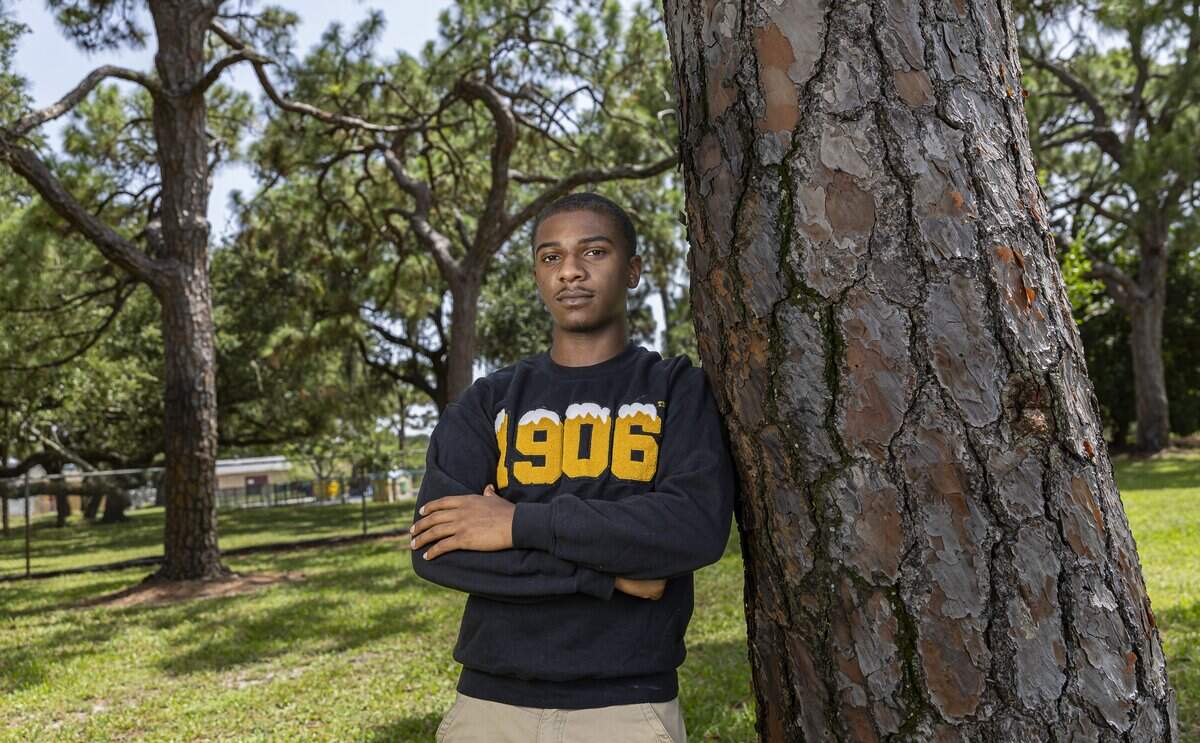
Eleven days after the job fair, Drummond got his first offer, a position a friend recommended he apply to. “I was ecstatic,” he says. “Now I can make some money.”
He’ll be working in customer service at a car rental company, making a little over $18 an hour. Though it’s not IT, he’s hopeful that time and process will bring him back to tech somewhere down the line.
But that’s for then.
For now, this is anything.
This story was produced with financial support from supporters including The Green Family Foundation Trust and Ken O’Keefe, in partnership with Journalism Funding Partners. The Miami Herald maintains full editorial control of this work.