
How South Florida LGBTQ museum got federal funding to tell gay general’s story
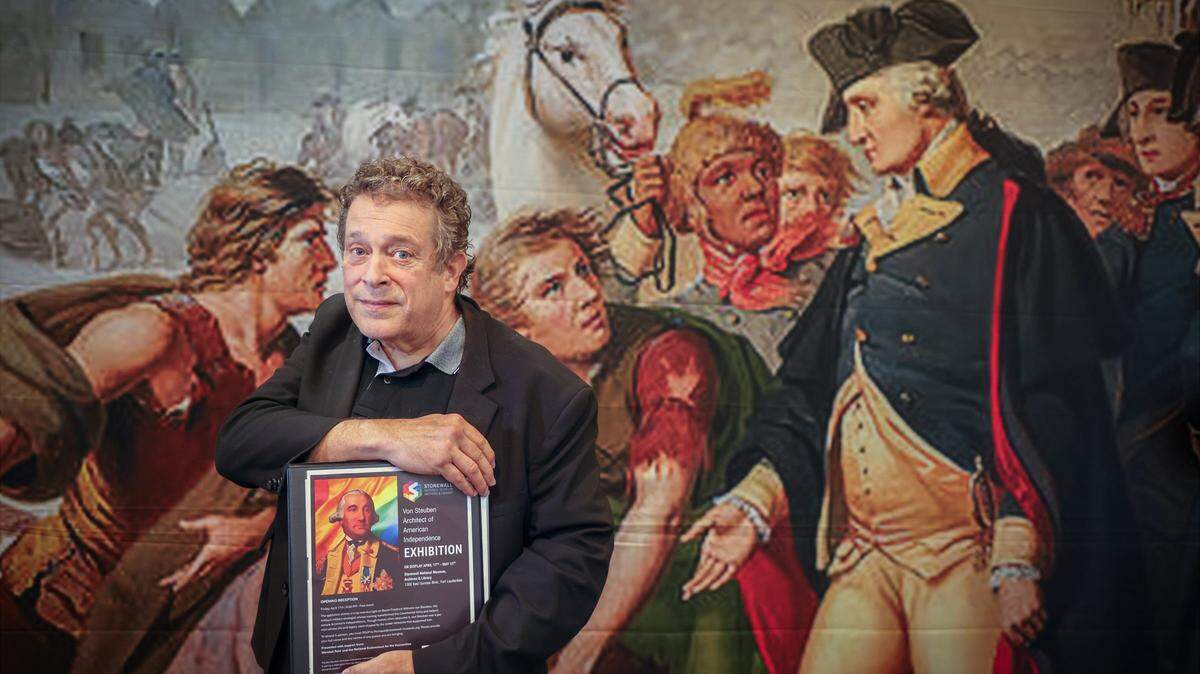
The Stonewall National Museum, Archives & Library did not expect any federal funding after President Donald Trump took office. After all, said LGBTQ museum president and CEO Robert Kesten, staff from a federal agency told him “we need not apply.”
But in February, the Fort Lauderdale-based museum got updated communication from the National Endowment of the Arts: if the museum did apply for a federal grant, it should be for a project related to the 250th anniversary of the United States’ independence.
“OK, they’re telling us that they’re not interested, but there is Baron von Steuben,” Kesten said. He’s referring to Prussian-born army officer Friedrich Wilhelm August Heinrich Ferdinand Freiherr von Steuben, a pivotal figure in the Revolutionary War considered to be a father of the U.S. Army.
And, many historians believe, he was gay.
The museum staff submitted a proposal for an exhibition highlighting the military leader to the National Endowment of the Humanities. Much to their surprise, the museum received a $25,000 matched grant. The exhibition “Von Steuben: Architect of American Independence” is now a reality.
“When the acceptance came through, we asked ourselves several times, ‘Do they know what they’re doing?’” Kesten said. “We reached out to them, and they said yes. So we were thrilled, truly amazed, and immediately started getting to work on it.”
Now on view until May 15, the exhibition tells the life story and accomplishments of a crucial yet little-known figure in American (and LGBTQ) history. Had it not been for von Steuben, the American army didn’t stand a chance against the British, Kesten said.
“If you don’t know everybody’s story then you really don’t know history,” said Kesten, a historian himself. “If you don’t know von Steuben’s story, then you don’t know how we won the Revolutionary War.”
From Prussia to Paris to Valley Forge
Valley Forge. Winter. 1778. General George Washington rode out of the encampment on his white stallion to personally greet a volunteer — a highly unusual thing for him to do. But Baron von Steuben’s reputation preceded him.
“They couldn’t wait for him to arrive,” Kesten said, gesturing to an image of a snowy Valley Forge at the museum.
One solider, according to U.S. National Park Service, said seeing von Steuben at the encampment was like witnessing “the ancient fabled God of War … he seemed to me a perfect personification of Mars. The trappings of his horse, the enormous holsters of his pistols, his large size, and his strikingly martial aspect, all seemed to favor the idea.”
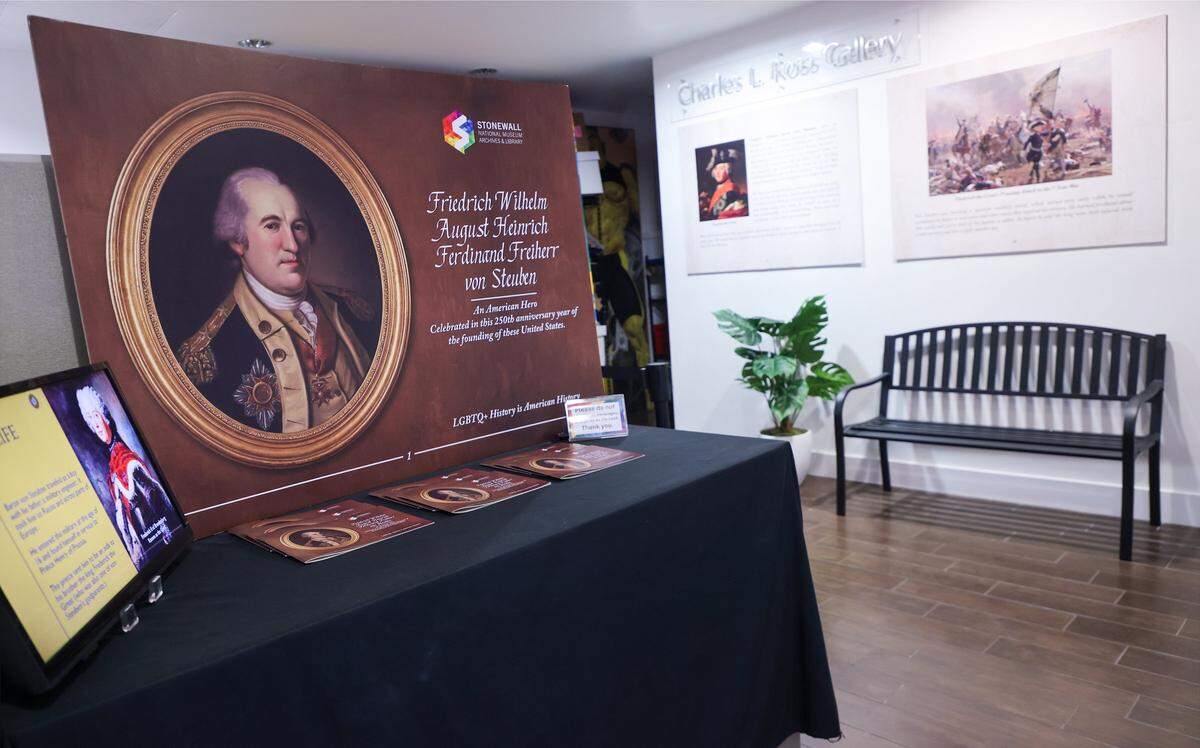
Von Steuben was shocked by what he saw at Valley Forge. Untrained soldiers were shoeless and wore tattered clothes. The latrines were right next to the food. They were more likely to die of starvation and disease than actual war. They didn’t even know how to march.
With his expertise, von Steuben completely reorganized the army and boosted morale. Though Washington is revered today, his position was extremely fragile at the time, Kesten said, gesturing at an image of a painting of von Steuben and Washington. He was losing badly, but von Steuben turned everything around.
Von Steuben managed to do all of this speaking no English. He’d bark orders in French, which an interpreter translated into English.
“They started to feel like a force to be reckoned with,” Kesten said. “By the time spring rolled around and they met the British, they were able to defend themselves. They were able to make progress, they were able to chase the British.”
But before he transformed the Continental Army, Kesten said, von Steuben was a man on the run in Europe.
The Stonewall exhibition lays out the twisting tale. Born in 1730 under the reign of King Frederick the Great of Prussia, von Steuben was the son of a prominent military engineer. Though von Steuben wasn’t born into nobility, the king was his godfather and he served with the king’s brother in the military. Eventually, a lesser prince granted him the title of baron.
Von Steuben’s military career, intelligence and connection to the royal family elevated him into elite circles. Though homosexuality was illegal in Europe, members of the aristocracy were free to enjoy homosexual relationships, Kesten said, and von Steuben was no different.
In 1777, he was summoned to Paris to meet with American revolutionaries, including Benjamin Franklin. At first, von Steuben wasn’t interested and left. But someone powerful wanted von Steuben arrested, Kesten said. He was accused of abusing boys, a charge that went unproven but sullied his reputation in Europe.
“He had made some enemies because he made progress and other people did not,” Kesten said. “There was a lot of confusion as to what his real title was and who he was. Therefore, the jealousy persisted.”
He returned to Paris and met with Franklin, who most likely knew of von Steuben’s rumored homosexuality, historians say. But his war expertise was far more important. The Americans made sure to get von Steuben safely out of Europe.
‘Unmistakably one of us’
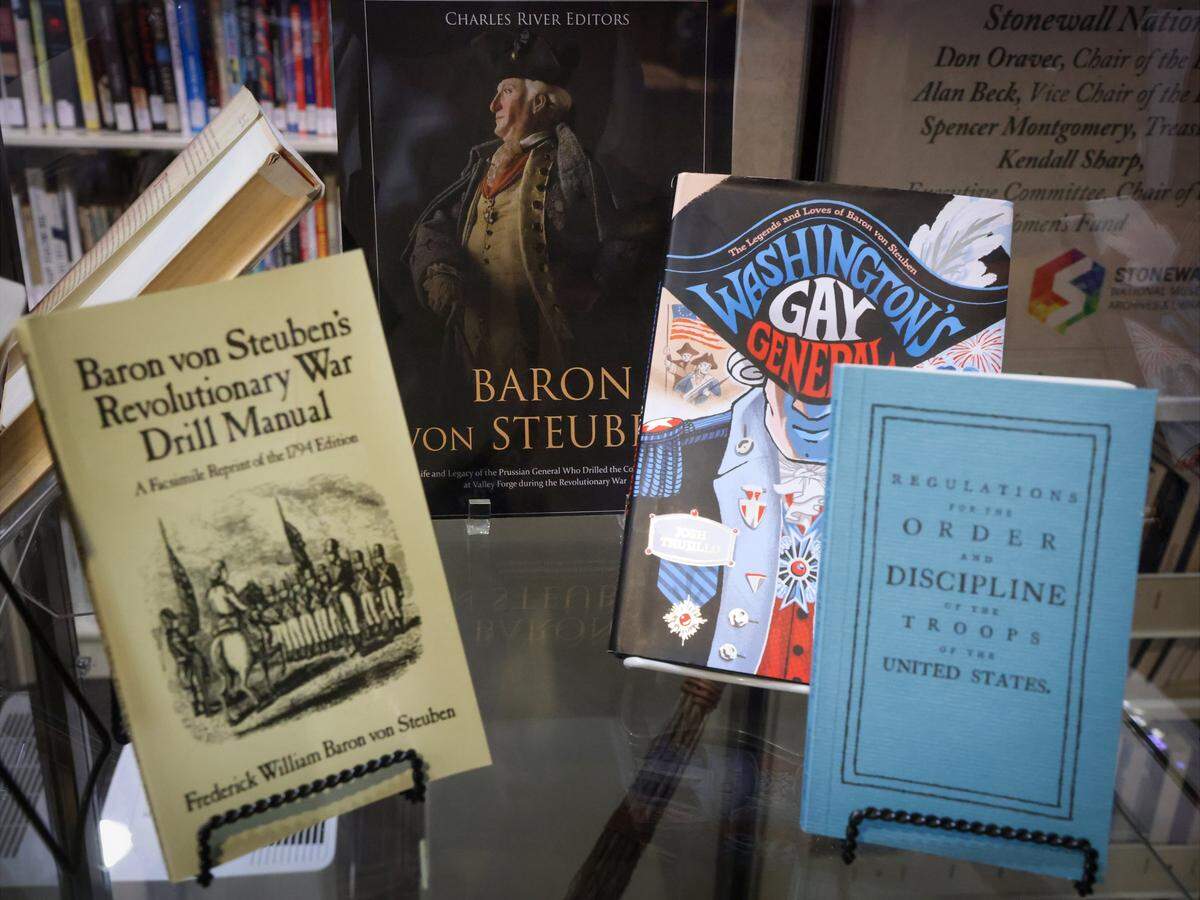
Kesten curated a cabinet of books on display at the exhibition. Von Steuben wrote the army training manual “Regulations for the Order and Discipline of the Troops of the United States,” also known as the “blue book.” Elements of Steuben’s writings for the army are still used today.
Excerpts of the blue book, images of important battlefields and a replica of a Revolutionary War musket line the walls and bookshelves of the museum. Next to the blue book is a copy of the 2023 graphic novel “Washington’s Gay General: The Legends and Loves of Baron von Steuben,” written by author Josh Trujillo and illustrated by Levi Hastings.
Trujillo, a writer who works on comic book franchises, said the novel has taken on “a second life as part of this American 250th celebration.” A few years ago, as he was promoting a fictional Revolutionary War-era romance he wrote with Hastings, fans encouraged them to write a comic about von Steuben, who he had never heard of.
While researching von Steuben for the book, Trujillo said he was struck by the “little bits of personality” he found. Von Steuben was obsessed with his dog Azor, had a “flair for style” and even insisted on having his own military medals made. Martha Washington once described von Steuben as “family,” he said.
“I don’t even know if it was an open secret. As I say in the book, our concept of romance and marriage and love are so different now than they were about 250 years ago, it’s impossible to put some of our labels onto these characters,” Trujillo said. “But if you look at him with a queer lens, he’s unmistakably one of us.”
Von Steuben never married or had children. Instead, he legally adopted young men he had close relationships with, which meant they inherited his belongings when he died. At the exhibition, images of his tomb in New York and a statue of him in Washington D.C. are on display.
“He died without very much, but there are bridges, there are roadways, there are counties, there are schools, there are many, many things named after him, and yet most people don’t know why,” Kesten said. “Which is too bad.”
An immigrant story
Kesten acknowledges that the exhibitions’ themes may ruffle feathers of the anti-DEI White House.
Early last year, NPR reported, the National Endowment for the Arts, the NEH’s sister agency, announced on its website that it was eliminating a DEI funding program and prioritizing projects celebrating the 250th anniversary. Trump’s push against DEI trickled down to the private-sector, as corporate sponsors pulled support from local LGBTQ organizations, including Stonewall. And in 2024, arts and culture organizations across Florida struggled to stay afloat after Gov. Ron DeSantis vetoed all state art grants.
When asked how he thinks the Trump administration would feel about federal money funding the Stonewall museum’s exhibition, Kesten shrugged. He pointed to an image on display at the museum of an ICE agent arresting someone.
“It’s hard to believe they would be happy about that picture,” Kesten said. “But it is important to point out that if von Steuben came today, it is very likely he could be met with that, and that would be a tragedy.”
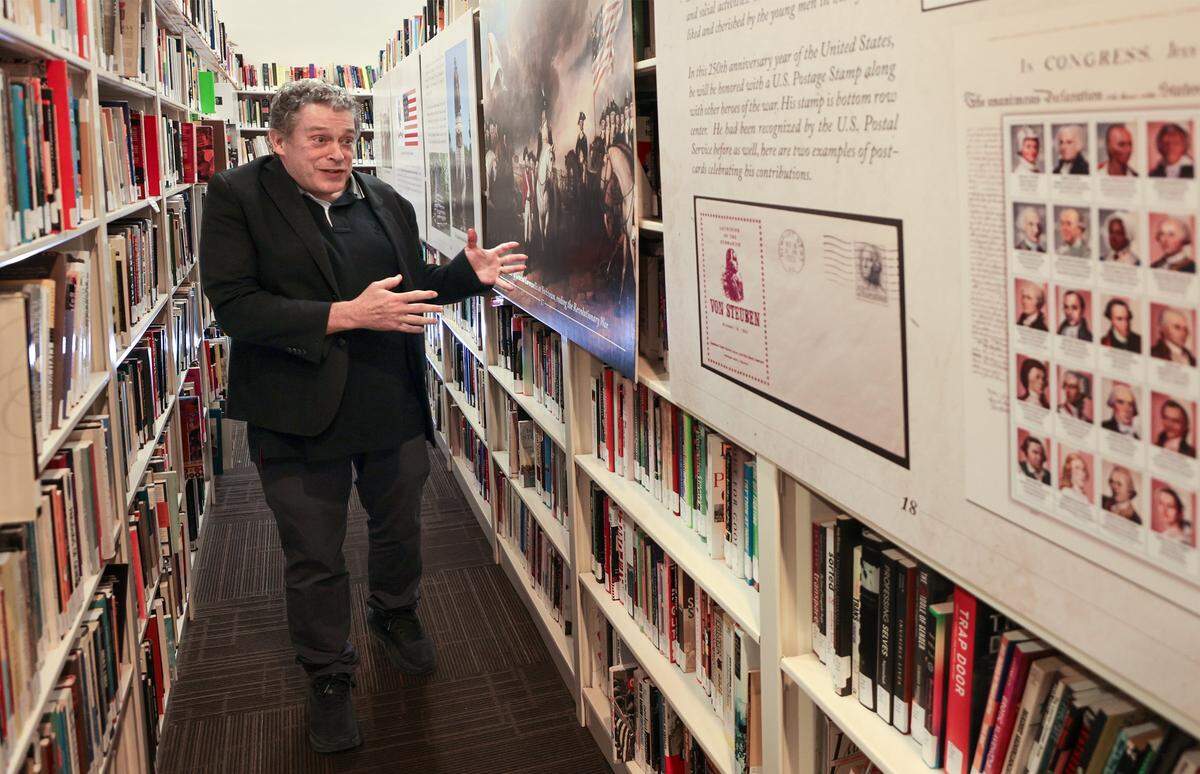
The exhibition, which certainly celebrates America’s independence from tyranny, aims to connect von Steuben’s immigration story to the story of immigrants in the U.S. today. And after a short stint in Fort Lauderdale, Kesten said the exhibition will travel to other parts of the country. The Stonewall museum is in talks museums and institutions in Atlanta, San Francisco, North Carolina and Philadelphia to share Steuben’s story with more Americans.
“Here you have a gay man coming from overseas who spoke no English and basically had no money when he arrived here,” Kesten said. “What would happen to him today if he arrived on America’s shores?”
One sign at the exhibition acknowledges the National Endowment for the Humanities funding. It reads: “Any views, findings, conclusions, or recommendations expressed in this exhibition do not necessarily represent those of the National Endowment for the Humanities.”
If you go
What: “Von Steuben: Architect of American Independence”
When: On view until May 15
Where: Stonewall National Museum, Archives & Library, 1300 E Sunrise Blvd, Fort Lauderdale
Info: Free entry. Go to www.stonewall-museum.org for more information.
This story was originally published April 28, 2026 at 4:30 AM.