Coast Guard to ‘surge assets’ to South Florida to comply with Trump’s executive order
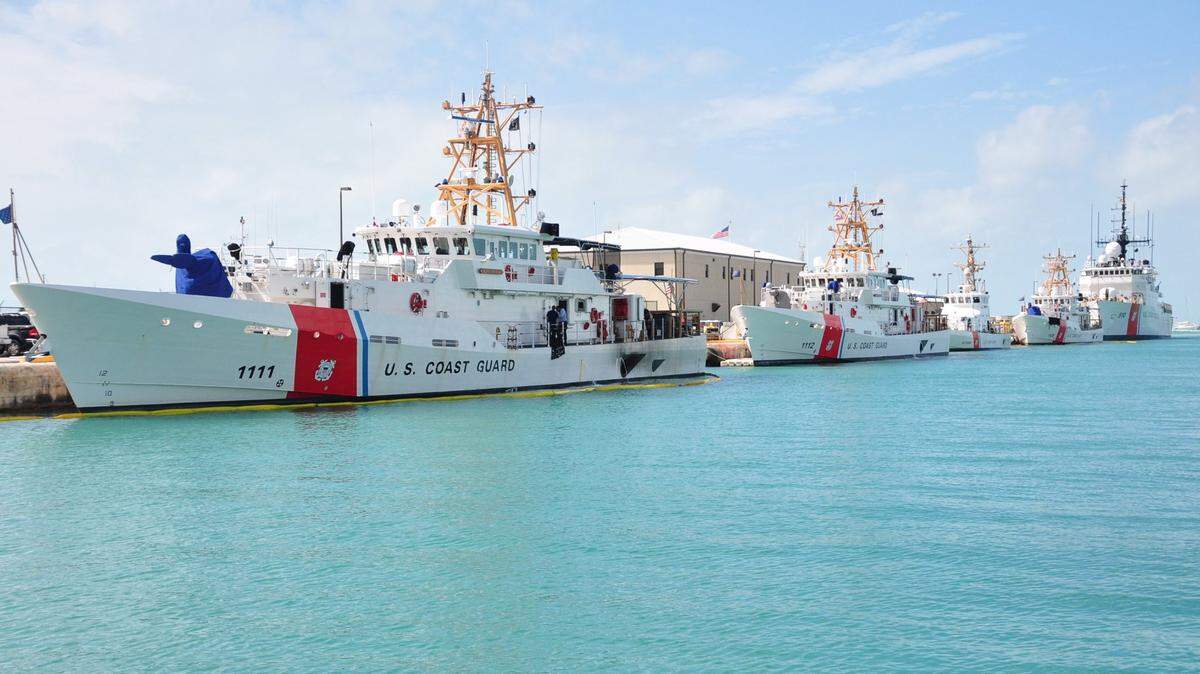
The U.S. Coast Guard said it will be surging ships, boats and aircraft to South Florida and other areas of the country to bolster anti-maritime migration efforts to comply with President Donald Trump’s executive order to use the nation’s military to defend the border.
The Tuesday night announcement comes the same day the acting Secretary of Homeland Security Benjamine Huffman fired Adm. Linda Fagan as commandant of the Coast Guard, which is responsible for maritime security. Fagan was not only the first woman to lead the Coast Guard, but also the first woman in uniform to head any branch of the country’s armed forces.
Although the Coast Guard is a military branch, it falls under the command of Homeland Security since it’s also a federal law enforcement agency.
Adm. Kevin Lunday, acting commandant, released a statement Tuesday noting the decision to flood South Florida and other U.S. maritime borders with more Coast Guard members and assets is in adherence with Trump’s executive order on border security.
The Coast Guard declined to answer specific questions from the Herald Wednesday about how many personnel and assets are already assigned to South Florida and Puerto Rico and how many more are expected.
“We are unable to provide specific details on the number of personnel and their exact locations to ensure operational security and the safety of out crews; however, we remain fully operational and committed to the mission,” a spokesperson said in an email.
Increased presence in the Florida Straits
Lunday said he has directed the agency’s operational commanders to surge “cutters, aircraft, boats and deployable specialized forces” to the Florida Straits “to deter and prevent a maritime mass migration from Haiti and/or Cuba.”
Other areas of the U.S. and its territories that will see an increased Coast Guard presence, per the announcement, are the maritime border between the Bahamas and Florida, Alaska, Hawaii, Guam, the Commonwealth of the Northern Mariana Islands, American Samoa, Puerto Rico and the U.S. Virgin Islands.
The Coast Guard will also be sending personnel and assets to the southwest maritime border between Texas and Mexico in the Gulf of Mexico and the Pacific Ocean, reads the announcement, which refers to the Gulf of Mexico as “the Gulf of America” — renamed by Trump in another executive order Monday.
Lunday also directed the Coast Guard to support U.S. Customs and Border Protection’s anti-migrant efforts in maritime areas of the southwest U.S. border.
On Wednesday, the Trump administration said it was sending an additional 1,500 regular military troops to the southwest border. White House Press Secretary Karoline Leavitt did not detail what the troops would be doing, but told reporters in Washington, that their deployment was part of Trump’s direction to the Department of Defense “to make homeland security a core mission of the agency.”
Migration from Cuba, Haiti has slowed
Maritime migration from both Cuba and Haiti has slowed significantly since both the state of Florida and the Biden administration deployed increased forces to South Florida and the Keys after a surge in landings in late 2022 and early 2023 overwhelmed local law enforcement.
So many people from Cuba were arriving during that time that the federal government was forced to close Dry Tortugas National Park, located about 70 miles from Key West, in January 2023. About 300 people from Cuba had landed at the park in the weeks following New Year’s Day of that year.
However, after Florida National Guard soldiers, Florida Highway Patrol troopers and Florida Fish and Wildlife and Conservation Commission officers — as well as more Coast Guard and Customs personnel sent by the federal government — began to bolster patrols in the Keys, arrivals slowed precipitously.
Concern over rising sea migrations after Trump drops land program
Another major contributing factor to the drop in maritime migration to South Florida was the Biden administration’s announcement in January 2023 that anyone caught trying to come to the U.S. illegally by sea would be banned from entering the country for five years. The rule was put in place as part of a new two-year humanitarian parole program the administration launched for nationals of Cuba, Haiti, Nicaragua and Venezuela.
To be eligible, applicants needed to have a financial sponsor in the U.S., pass background checks and apply using a new application known as CBP One. On Monday, Trump shut down the app, effectively ending the humanitarian parole and its legal pathway, which admitted 30,000 migrants a month into the U.S. for temporary stay.
The CBP One program also allowed asylum-seekers arriving at the U.S. southern border to request an appointment for consideration to enter the U.S. The Trump’s administration discontinuation of CBP One on Monday has led to worries that maritime migration attempts will once more increase now that migrants have one less legal means to enter the country.
“I think Gov. DeSantis, who is trying to rally the Legislature to deal with immigration, might be concerned about that,” Sebastian A. Arcos, interim director of the Cuban Research Institute at Florida International University, said in an email to the Herald. “Already the Cuban regime is muttering veiled threats about a potential ‘significant increase in migratory flows from Cuba to the U.S.,’ according to [Cuban President Miguel Diaz-Canel’s] tweets.
“There is little doubt the Cubans will try to do it again — it has always worked for them,” Arcos said. “It all depends on the new administration sending a firm and credible message of deterrence.”
While migrant boats are still being stopped along the Florida Straits, arrivals on land went from an almost daily occurrence to barely one per month.
Haitian migrant arrivals also increased significantly between 2022 and 2023, but less frequently, albeit in larger boats and groups than those coming from Cuba. However, despite ongoing turmoil and increased violence from armed gangs, maritime migration from Haiti to South Florida has also dropped significantly.
READ MORE: 1 dead, several wounded in Haiti after armed gangs target consular corp armored vehicles
The last large arrival of Haitians in South Florida was when a sailboat carrying about 120 people arrived in Key West in June.
This is a developing story and will be updated as more information becomes available.
This story was originally published January 21, 2025 at 9:39 PM.