
A Black family’s fight to get their beach back highlights an ugly chapter of American history | Opinion
.JPG "A rose is placed on a monument on Bruce’s Beach in Manhattan Beach, Calif., Wednesday, July 20, 2022. Los Angeles County officials on Wednesday presented the deed to prime California oceanfront property to heirs of a Black couple who built a beach resort for African Americans but were harassed and finally stripped of the land nearly a century ago. The event marked the final step in a complex effort to address the long-ago wrong suffered by Charles and Willa Bruce.")
I watched the news last Wednesday (July 20) as the certificate of ownership for that beachfront land near Los Angeles, California, that was once owned by Willa and Charles Bruce was turned over to their great-grandchild Anthony Bruce. It was a bittersweet moment. Even for me.
As I watched the news, I thought about so many other similar situations, some that never made the news, where the properties of Blacks had been taken away by whites — just because. I thought about the hundreds of Blacks who often died whenever it was decided that they shouldn’t be partakers of the American Dream.
In 1912, with the Emancipation Proclamation less than 60 years old, Willa and Charles Bruce had the audacity to believe the American Dream and purchased land in Manhattan Beach, in Los Angeles County. It was a place where they could grow, where they could raise their family and prosper. Or so they thought.
The sale went well. And later, in 1920, the couple purchased another plot of land, making them the owners of two plots stretching along the strand in Manhattan Beach.
At a time when America was segregated in every way, Bruce’s Beach became a haven for Black families in the Los Angeles area. The Bruces had turned the seaside property into a thriving resort that welcomed Blacks from other parts of the country as well as from the county as it gained popularity.
Bruce’s Beach was, indeed, a success story. Soon, other Blacks bought property nearby in Manhattan Beach and built homes there. But while Blacks basked in their success, it was short-lived.
Some jealous White residents in the surrounding community began harassing the Blacks living there. And in 1924, the trouble that had brewed for a few years boiled over. After a petition from white real estate agents and other civic leaders, the Manhattan Beach City Council voted to condemn Bruce’s Beach and the surrounding area through eminent domain to build a park. The park was never built. Today, the world knows that the real reason behind the “eminent domain’’ process was racism.
Bruce’s Beach was near a predominantly White community. So it had to go. And in 1929, the court awarded Bruce’s Beach, and all the Black-owned property on Manhattan Beach, to the city. The Bruce family and all the other Blacks in Manhattan Beach had no choice but to move, and their properties were immediately demolished.
.JPG "RacialInjusticeCaliforniaBeach (4).JPG")
Thinking of this story and the plight of the people it affected, I am reminded of other neighborhoods where Blacks were uprooted from their homes in the name of eminent domain. Black communities like the Overtown area, once a thriving community where Blacks own their own businesses; where black doctors and dentists and lawyers had their own offices. And where there were Black hotels and restaurants. Overtown was also home to the Sunlight Beauty School, which provided training and jobs for countless women and men. It was home to Perry’s Florist and The Miami Times and to historic churches, all serving the Black community.
Then, one day eminent domain came to town, bringing with it the construction of the Interstate 95 highway.
I don’t recall any violence in the upheaval of Blacks like there was in Rosewood, Florida, and with the massacre of Blacks in the “Black Wall Street” of Tulsa, Oklahoma, where those once Black-owned communities were wiped out by racist hate and where many Black residents were killed. But Interstate-95 cut a jagged line through our neighborhood, disrupting our history and traditions. It left a scar that has never really healed.
And while the stories of Rosewood and the Tulsa Massacre were kept silent for many years, some survivors lived to talk. Now, many years later, their stories have helped to shed light on some of the darkest times in our American history.
Rosewood’s tragic history
What happened to Rosewood is one of the stories that came to light in recent years. Settled by Blacks and whites in 1845, the tiny North Florida town existed pretty peacefully for that period in American history. Kept afloat by its cedar trees — they enabled pencil factories, which provided income for many residents — Rosewood soon became an all-Black town when the cedar-tree population became so scant that white families began moving to nearby Sumner.
By the early 1920s, Rosewood’s population was about 300 and was made up entirely of Blacks except for the white family that owned the general store. The town’s peace and tranquility came to an abrupt end on the night of Jan. 1, 1923. That’s when Fannie Taylor, a white woman, claimed she was assaulted by a Black man and, as they say, all hell broke loose.
A white vigilante mob led by Taylor’s husband and the Ku Klux Klan from Sumner destroyed the town, killing many of its Black residents. Those who escaped remained almost silent about their plight for many years. I suppose it was too painful a memory.
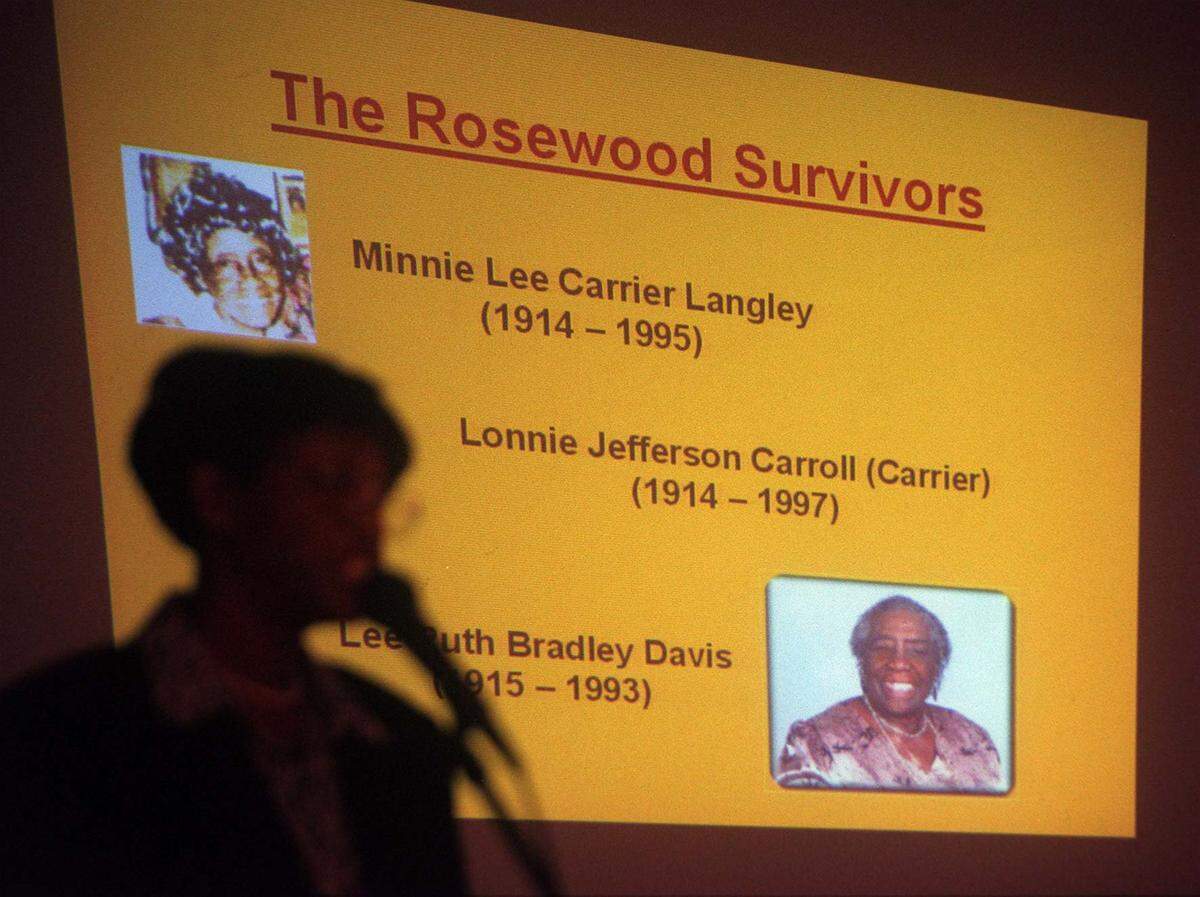
By then, in 1982, stories of Rosewood started to surface when survivors Minnie Lee, Mitchell Langley and LeRutha Bradley told their story to Ed Bradlye on television’s “60 Minutes.” The women described running through the Levy County swamps, on that day nearly 60 years earlier, to board the escape train owned by two white brothers, William and John Bryce.
About that time, Gary Moore, a St. Petersburg Times reporter, got wind of the story and dug into Rosewood’s history, writing a series of stories about the town’s fate.
Later, survivors of the massacre, who were then in their 80s and 90s and led by Rosewood descendant Arnett Doctor, demanded restitution from Florida. Their efforts led to the passage of a bill awarding them $2 million and the creation of an education fund for Rosewood descendants.
Jealousy, racism destroyed communities
The story of Rosewood, of the Tulsa Massacre, and of all the land stolen from Native Americans simply because of racism, greed and hate came to my mind as I watched the latest news about Bruce’s Beach and its return to its rightful owners — which had a happy, though somewhat bittersweet ending: The Bruce family got their land back. The descendants of Rosewood and Tulsa, however, did not.
On July 20, Anthony Bruce, great-grandson of Willa and Charles Bruce, was handed a certificate of ownership to the property. It was the first time, or one of the first times, that the government had returned lands to Blacks that had been wrongfully taken.
.JPG "RacialInjusticeCaliforniaBeach (3).JPG")
During the ceremony, Los Angeles County Supervisor Janice Hahn said, “Today we are sending a message to every government in this nation confronted with the same challenge: This work is no longer unprecedented.” Hahn had started the legislation and legal process to transfer the property back to its rightful owners.
How many other stories like this have gone uncovered throughout our history, I wonder? Maybe they’re not as dramatic — maybe involving a tiny plot of land here, or a small farm there, that was snatched away from its Black or Native American owners. But the stories of Rosewood, Tulsa and Bruce’s Beach had this in common: Their demise was the result of the ugly jealousy and racism that has soaked into the seams of America since the country’s inception.
While that kind of destruction lies dormant now, if we Americans aren’t careful, it can rise up again. We, the justice-and-peace-loving people of America, must remain vigilant because hate never sleeps. It continues to thrive wherever people allow it to creep into their lives, uprooting families — and even the very democracy that we know and love.
Bea L. Hines cane be reached at bea.hines@gmail.com.
This story was originally published July 22, 2022 at 11:20 AM.