
Memory athlete (and UM instructor) aims to break a world record
A University of Miami computer science instructor who’s one of the planet’s experts on competitive feats of memory hopes to be recognized as a world record holder.
Last Saturday, he may have achieved that — in a UM pool.
Meet Nelson Dellis, who has won the USA Memory Championship a record five times — most recently in October, in Orlando. He also is a “Grandmaster of Memory,” a grand title awarded by the World Memory Sports Council to memory athletes, as they’re called, who’ve achieved milestones in international competition.
In the USA Memory competition, which is held in a different location each year, challengers come from across the country to perform tasks such as memorizing random numbers from a piece of paper in a set amount of time, or memorizing an unpublished poem as fast as possible.
Dellis, 37, has been a memory-training coach for Mark Cuban, Maria Shriver and other high-profile people. He has spoken about memory training in appearances on nationally broadcast shows such as “Today” and in the Netflix documentary “Memory Games.”
And he also has done impressive things outside the “memory” field. Dellis, a Gulliver Prep high school graduate, has a bachelor’s in physics and a master’s in computer science, both from UM. He is a mountaineer who has scaled Mount Everest, Alaska’s Mount McKinley, and others famously daunting peaks. He is also an author, speaker, You-Tube channel proprietor and consultant.
Dellis reached just about every big goal he set. But one lingered: to break a Guinness World Record.
On Nov. 13, during Alzheimer’s Awareness Month, Dellis thinks he finally did that. It was during an event sponsored by Mind Lab Pro, a nootropic supplement that may help boost memory and for which Dellis is a spokesman.
In the pool
A dozen spectators and media members gathered at the Olympic-size outdoor pool at the Whitten University Center to watch. Miami native Alex Cruz, a professional poker player, randomly and thoroughly shuffled the deck of waterproof cards that Dellis would use.
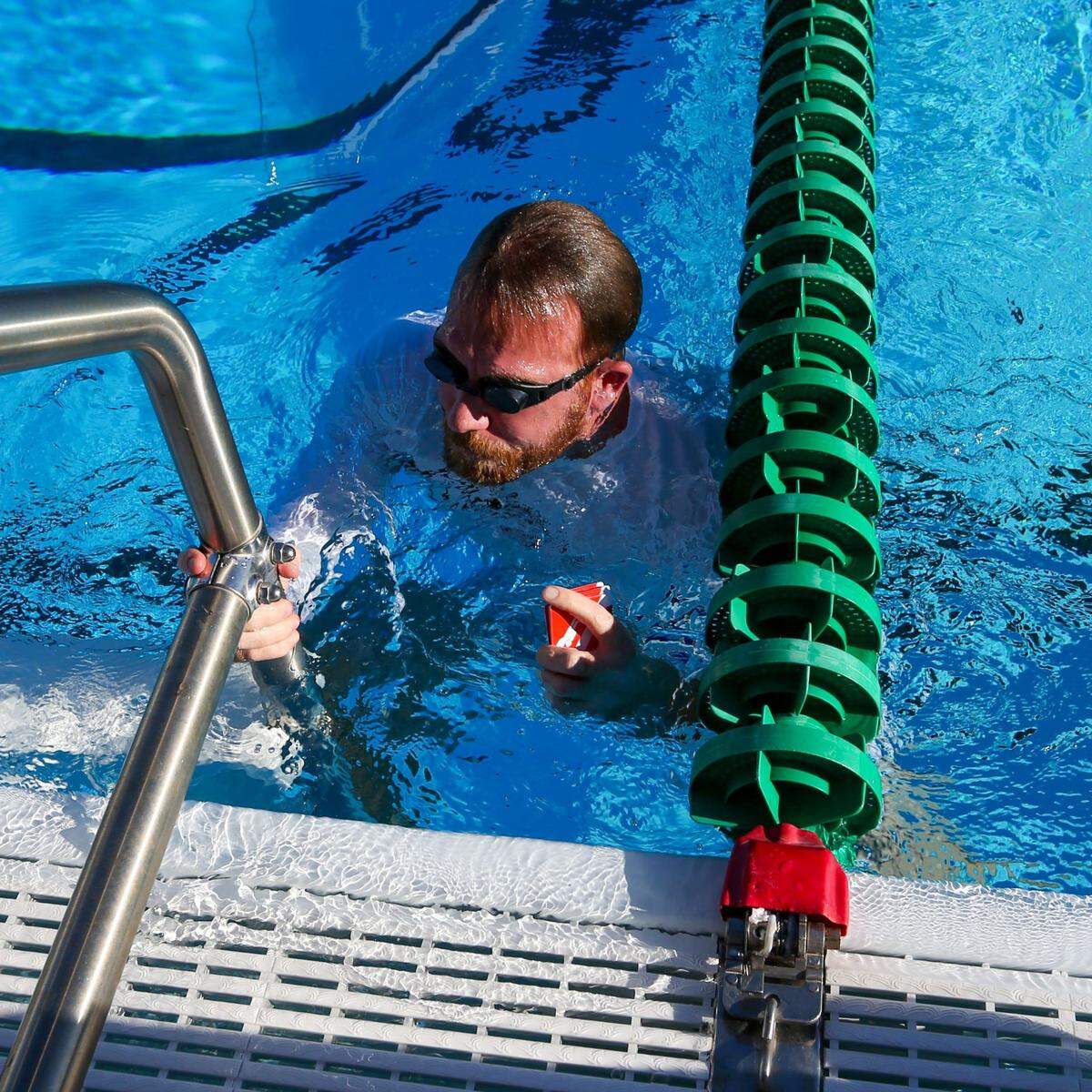
Then the very fit and very tall — 6-foot-6 — Dellis stepped into the deep center part of the pool and took a deep breath. For this feat, he needed to be submerged while standing straight.
Dellis reached up to take the deck from Cruz, memorized the placement of the cards in it, then handed it back to Cruz.
He climbed the pool’s stairs, pausing for a moment to consolidate what he had just seen.
And then he seated himself at a nearby table. His task: to reorganize the cards in a second deck in the same order as the deck he had just seen under water. The official timing of the event began.
Dellis shuffled the deck in two minutes, 22 seconds.
According to Guinness, the previous record of 3:42 was set in 2019 in New Delhi, India — by Sanchit Sharma, a Deloitte, India employee.
Two other witnesses — Elvis Vasquez of Miami and Will McQueen of Naples — checked to make sure Dellis had shuffled the deck correctly.
“I feel amazing,” Dellis said afterward. “I have never done a Guinness world record before... it feels really good.”
Dellis also tried to break a second record on Saturday, but it didn’t go nearly as well. The challenge: How many cards could he memorize in one breath? He was trying for 72, about a deck and a half.
He made about five attempts. He came close on his last try — he got 71, “but I made one tiny mistake, so it didn’t count.”
Even so, Dellis is cofident he’ll be in the record books.
Dellis had hired a crew to film the event, and the footage will go to the London-based Guinness World Records organization, who’ll review it, make sure it’s authentic, and then decide whether to validate and certify the results.
Alzheimer Awareness Month
Dellis’ event at UM was held during Alzheimer’s Awareness Month: He became interested in memory competitions years ago, in his early 20s, after watching his grandmother struggle with the disease.
“It’s hard to watch,” Dellis said. After watching his grandmother get sick and eventually succumb to Alzheimer’s in 2009, he wanted to know what he could do to avoid the same fate. “When she passed away…it was this whole moment in my life…what happened to her could happen to me when I get older, and I wanted to do anything I could do now to help me later on.”
He found that many top memory competitors were not, in fact, born with great memories.
“It is kind of like becoming a marathon runner, or a piano player,” Dellis said. “You take lessons... then you practice.”
The preeminent technique that competitors use to memorize things is called a memory palace.
The technique works by thinking of a physical location that you are familiar with, such as your house. Then in each room you envision one of the things you are trying to remember.
The example Dellis uses on his YouTube page is a grocery list. An individual envisions a banana in their living room, then in the next room the next item on their grocery list, etc. The idea is, the brain is remembering the layout of a house rather than random objects.
“At first you might think… why would I do this weird kind of thinking of stuff?” Dellis said. “It actually helps tremendously. And it takes advantage of things that our brains are better at remembering, than just like, the random abstract data.”
Dellis feels the event, with its emphasis on fitness as well as remembering things, also shows how you can improve your memory.
“We can take care of our memories through exercise,” he said. “Ultimately, that is what this was about.” that physical fitness fitness.