
Sea of Black women motorcycle riders ensures spirit of pioneer lives on | Opinion
The women bikers came roaring down Interstate I-95. Black women, some 200 strong. Motors blaring and screaming sirens escorting the bikers as they exited at Northwest 27th Avenue in Miami Gardens.
The atmosphere was filled with excitement. The women bikers headed south on Northwest 27th Avenue, to Northwest 152nd Street, then west to the late Bessie B. Stringfield’s former home at 2400 NW 152nd Terr., where she lived from 1952 until her death in February of 1993.
It was an impressive sight, I tell you. A sea of Black women bikers, from throughout the U.S. all dressed in matching blue T-shirts, had gathered at Daytona Beach the night before for the four-hour-long trip. It was The Eighth Annual Bessie Stringfield All Female Ride — “The Last Ride” to honor Stringfield, who was dubbed “Miami’s Motorcycle Queen.”
According to Lynn Wigfall, historian of the Bessie Stringfield All Female Ride Committee, the event was founded by Tameka (a k a Kurvez) Singleton in 2014, with Wigfall as the co-founder, when Singleton was inspired to organize the first ride with five other women riders. Singleton said at the time that she wanted the ride to reflect “Ms. Bessie’s love for the open road.”
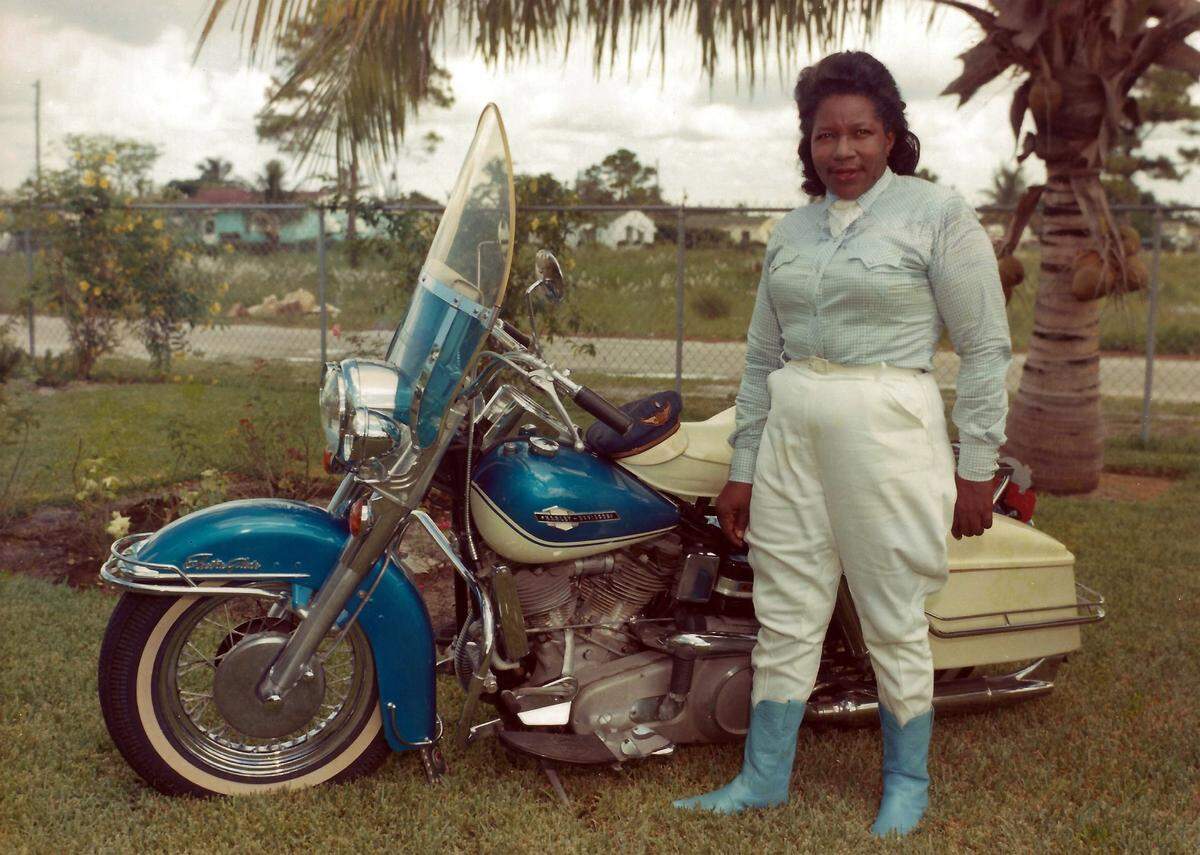
Since its organization, the ride has taken the women bikers around the country, and includes a 48-state ride that was completed in less than 10 days. The ride in Florida on Aug. 20, which continued on to Key West, was the eighth and final year for the Bessie Stringfield All-Female Ride.
I was invited to the event by the committee because I wrote a story about Stringfield in 1981. Until then, Stringfield, who was not a person to blow her own horn, was known mainly by her fellow bikers (mostly men), and in the local community at large, as the woman motorcycle rider. In her heyday, she was a woman to be reckoned with.
But by the time I met her and put her story out, Stringfield had slowed down her biking days. The long cross-country trips as a sole biker were over. She was, after all, in her 70’s when I did the article.
But while I was the person who did the local article, it was author and journalist Ann Ferrar who actually put Stringfield on the map, so to speak, when she wrote about her in her 1996 book, “Hear Me Roar,” which is about women bikers. Ferrar and Stringfield became as close as biological relatives and were close until Stringfield’s death. Ferrar is writing a book solely on Stringfield’s life.
On the morning of “The Last Ride,” I arrived at the site about an hour before the bikers in order to get a good parking place. I didn’t recognize Stringfield’s old home. The house is now owned by Aida Rivero, a sweet-spirited Hispanic woman who doesn’t speak much English, but was so proud to be a part of the celebration for Stringfield that she had her own T-shirt made, proclaiming Stringfield Miami’s Motorcycle Queen. She smilingly offered to give me a tour of the refurbished house. The front door that used to face Northwest 24th Avenue now faces Northwest 152nd Street. Inside the modest home was a newly laid tile floor and tasteful furniture. The kitchen had been upgraded, and there was central air conditioning.
.JPG "image_6483441 (4).JPG")
After a tour of the newly renovated house, I went back outside and chatted with Metris Batts, a member of the nonprofit Sunshine Divas Excelling in Motion (They call themselves D.I.M.E.S), a local chapter of women bikers. They were busy putting up canopies to ward off the hot sun, and setting out chairs for the ceremony and unveiling of the sign in the front yard, proclaiming Stringfield as “Miami’s Motorcycle Queen.” Later, during a ceremony that included greetings from Florida Reps. James Bush III, Dist. 109, and Felicia Robinson, Dist. 102, I was given the honor to do the unveiling of the sign that will have a permanent place in the yard of Stringfield’s former home.
I tried to imagine how Stringfield would take all the hoopla being done in her honor. I could imagine her shrugging her shoulders and flashing a sly smile.
While Stringfield was a free spirit and couldn’t be harnessed, she wasn’t one to call attention to herself. The attention just happened because of who she was and how she lived. Her bike gave her the freedom and independence she craved even during the darkest days of segregation, when life was bleak for Blacks. I still shudder to think what could have happened to her as she traveled alone cross country on her bike. But she rode on, unafraid. And by doing so, she paved the way for hundreds of other Black girls and young women, who all wanted to be just like her.
So as I sat in my car, the air conditioner blasting out cool air to keep me comfortable until time for the ceremony, I thought back to the first time I saw Stringfield. I was 9; the year was 1947. And it was Orange Blossom Classic time in Black Miami, which was a three-day holiday for us Blacks. It was like carnival time.
We dressed in our finest to attend the football game in the Orange Bowl Stadium, when the team from Florida A&M College (now Florida A&M University) would play the football team of another Negro college. It was the only time Blacks were allowed to use the Orange Bowl until 1954, when the teams from Booker T. Washington High School and Dorsey High School battled each other in what we dubbed the Turkey Day Classic because it was played on Thanksgiving Day.
Although the festivities started on Friday, with partying and celebrations and homecoming parties for the visiting college students, the really big day was Saturday. It started with the Orange Blossom Parade, featuring the mighty Marching 100 — the band from FAMC — and the bands and majorettes from the four local high schools, and from Fort Lauderdale and West Palm Beach. There were decorated floats with the reigning high school queens and a float carrying Miss FAMC.
The Orange Blossom Parade was where I first laid eyes on Bessie Stringfield.
Momma got me, and my brother Adam, up early to get dressed so we could get a good seat on the curb at Northwest Ninth Street and Second Avenue (The Strip, as the avenue was called back then). Blocks away, I could hear the roar of motorcycles. The parade was on its way! And I could hear the cheers of the delighted crowd as the fast-stepping FAMC marching band put on its usual show.
The roar of the motorcycles got closer. I stood up to get a better look and saw about eight motorcyclists as they made their way down the avenue blocks ahead of the marching band, signaling the start of the parade.
That’s when I saw her. The lone woman maneuvering her bike down the avenue, handling it like it was alive, and trained to yield to her beck-and-call. I was awe-struck.
It would be 34 years before I would see her again — in 1981 when I interviewed her for a Lifestyle piece for The Miami Herald Neighbors section.
I last saw Stringfield about a year before her death, after she bought a new bike. She was about to be honored at the American Heritage Motorcycle Museum in Ohio as a part of an exhibit on women bikers. As she proudly showed me her shiny new bike, she asked me to wait until she got back from her latest honor to be interviewed. I agreed. I never got to interview her, though. She died before we got around to it. She was 82.
Stringfield’s spirit lives on through the efforts of Diane Fredel-Weis and Beth Hubbard, producers of a documentary on Stringfield’s life entitled “Nice Girls Don’t Ride,” and Ferrar’s book about Stringfield is due to be published in the near future.
Bea L. Hines can be reached at bea.hines@gmail.com.