
A golden experience: 3 Girl Scouts’ award-winning projects stoke their passion for service
A plan to save sea turtles. A campaign to increase accessibility to feminine hygiene products. Teaching kids in underserved communities coding, robotics and other STEM skills.
These were among the 19 projects by Girl Scouts in Miami-Dade and Monroe that were recognized with the organization’s highest award for service projects.
The Gold Award caps a yearlong project and commitment to the values developed through Girl Scouts — the most important one being service to the community.
“I think any girl can earn the Gold Award,” said Lori Ross, director of Girl Experience for the Girl Scouts of Tropical Florida. “It’s a matter of taking something that [she] is passionate about and figuring out exactly what changes she wants to see in her community.”
Girls who want to earn the award must submit a proposal outlining what issue they are addressing, the steps they will take, and how the project will remain sustainable. While all of the girls who successfully complete their project earn the award, only a small fraction of the 2.5 million Girl Scouts nationwide — 5 percent — reach that milestone.
“Being a Girl Scout has made me want to become a lifelong philanthropist in the sense that I love the work that we’ve always done in helping the community,” Maya Baker said, 18, of Highland Lakes and a member of Troop 460. She’s is one of three teens from Girl Scouts of Tropical Florida to win the Gold Award. “Even if I am graduating now, it’s something that I always want to keep in my life, because it’s just an amazing experience.”
Here’s a look at the work by Maya, as well as by two other young women from Girl Scouts of Tropical Florida, that won them the coveted award. While each project is different, all of the recipients said they used skills they gained from Girl Scouts.
Leandra Hall: A PASSION FOR TECH

“I would say that the Gold Award is the big culmination of my girl scout career, because everyone aspires to be a Gold Award Girl Scout,” said Leandra Hall, an 18-year-old Senior at MAST Academy on Key Biscayne. “And so it wasn’t necessarily just getting the award, but it was how this closed my Girl Scout career.” Leandra, from Miami Beach, has been a Girl Scout for 12 years. Her troop leader is Marice Cohn Band.
For Leandra, the path that led to her Gold Award began when she was 13. As a Cadette Girl Scout at Troop 1239, she began working on a project to obtain the Silver Award — which Scouts have to win before they can apply to compete for the Gold.
Leandra began to guest-lecture at Camp Honey Shine about the fundamentals of computer science and robotics. The summer camp for girls ages 8-18 from underserved communities was founded by Tracy Mourning. She won the Silver Award, and then decided that for the Gold Award, she wanted to create her own educational program.
“I didn’t want to do a kind of basic service project, [like] selling cookies. I wanted to do something different, and I wanted to do something that was very meaningful to me. So I was kind of thinking about it on my stairwell. And I thought about my previous experience with coding and robotics — how I was fortunate enough that I was exposed to computer science that I was like, hey there’s something I want to address: the lack of minorities and lack of women in STEM.”
In 2019, she founded AfroTechie. She and partnered with BotsForAll, which helps start robotics clubs in Miami Dade schools, and CodeFeverMiami, which hosts after-school robotics programs, to create summer and fall afterschool coding and robotics camps for teach children ages 11-14 in underserved communities.
The fall program, which was hosted at the Branch Virrick Park Library in Coconut Grove, ran through the month of October, and Leandra taught along with an assistant instructor provided by CodeFeverMiami. The program in Overtown was hosted in a co-working space called Space Called Tribe, and it ran for about five weeks; Leandra was the sole instructor.
“It was very disheartening to see the opportunity gap and the access gap between students who can participate in STEM and those who didn’t,” Leandra said of her experience teaching.
“We had identified a need In the community that there is a desert in terms of STEM programs that were accessible to these kids,” Leandra said. “In addition to schools lacking the resources and funds needed to have upper level math or science classes, or to have STEM Camps, some of the kids I was meeting had no interest and no real opinion regarding science or math because someone had told them it wasn’t fun.
“My goal was to change their perception and perhaps get them to even consider pursuing STEM as a career, and many of them changed their ideas regarding STEM. Some even are interested in pursuing STEM in high school and college.”
Leandra said Rob Gordon, the director for BotsForAll, and Kimberley McDowell, the Program Manager for CodeFeverMiami, were the biggest helpers in the creation of her project.
Last week, Leandra won a Silver Knight Award in the vocational technical category, which in part acknowledged her work creating AfroTechie.
She will attend Spelman College in Atlanta to major in computer science and theater. She also wants to continue her work in exposing underserved communities to STEM.
“The work obviously isn’t over yet,” she said. “Even though I did something within my own community, it was only one out of several other communities across the country, so it definitely encouraged me to keep going and keep working at it.”
Maya Baker: PROMOTING MENSTRUAL HEALTH

Maya Baker’s project, “Periodically: Flowing Freely,” seeks to increase accessibility to feminine hygiene products and to spread awareness about the issue.
She partnered with Key Club in several high schools, including her own — MAST at FIU — to collect over 4,500 feminine hygiene products like tampons, pads, and wipes as well as over 200 handwritten cards with encouraging messages. She and volunteers from Key Club put all of these together in individual packages and delivered them to the Lotus House, a shelter for women and youth experiencing homelessness.
“I always knew that there was this issue that you hear about in the news. There are constantly things you hear about how women don’t have access to pads, tampons, and all these hygiene products. But you hear about [these issues] and you don’t really see them in person,” Maya said.
Maya saw the problem when she was driving in Biscayne Boulevard and passed a woman who was panhandling in the street with period stains on her pants. Later, a coworker at her lifeguarding job told Maya that she wanted to quit because she did not know how to take care of her period while at work.
Maya said that the objective of her project was to destigmatize the problem so that women are not afraid to talk about their experiences and to provide the knowledge that young girls often never receive about their bodies.
“Nobody really teaches you what to do when you’re little and sometimes your parents aren’t as supportive, [or] know what to do or what to tell you. It’s not something that you don’t learn in schools ever. It was just really shocking to me [and I thought about] what can I do to help fix that as much as I can.”
She said that she heard about the Gold Award through her high school teacher and after attending an interest meeting at the Office of Girl Scouts of Tropical South Florida, she decided to begin her project.
“It was seeing that other girls had been able to actually put projects together that incentivized me,” Maya said.
Maya said her most influential helper was her project advisor, Diana Ragbeer Murray, co-chair of World’s Greatest Babies in Miami-Dade, who helped Maya put the concept together.
Maya will attend the University of Florida in the fall and major in molecular science, molecular biology and cell science, and minor in women’s studies.
She said that speaking to gynecologists for her project taught her more about a field she had always felt passionate about.
“I think it’s been amazing,” Maya said. “It’s really pushed me to want to pursue this more than ever.”
Alice Apostolakos: STUDYING SEA TURTLES
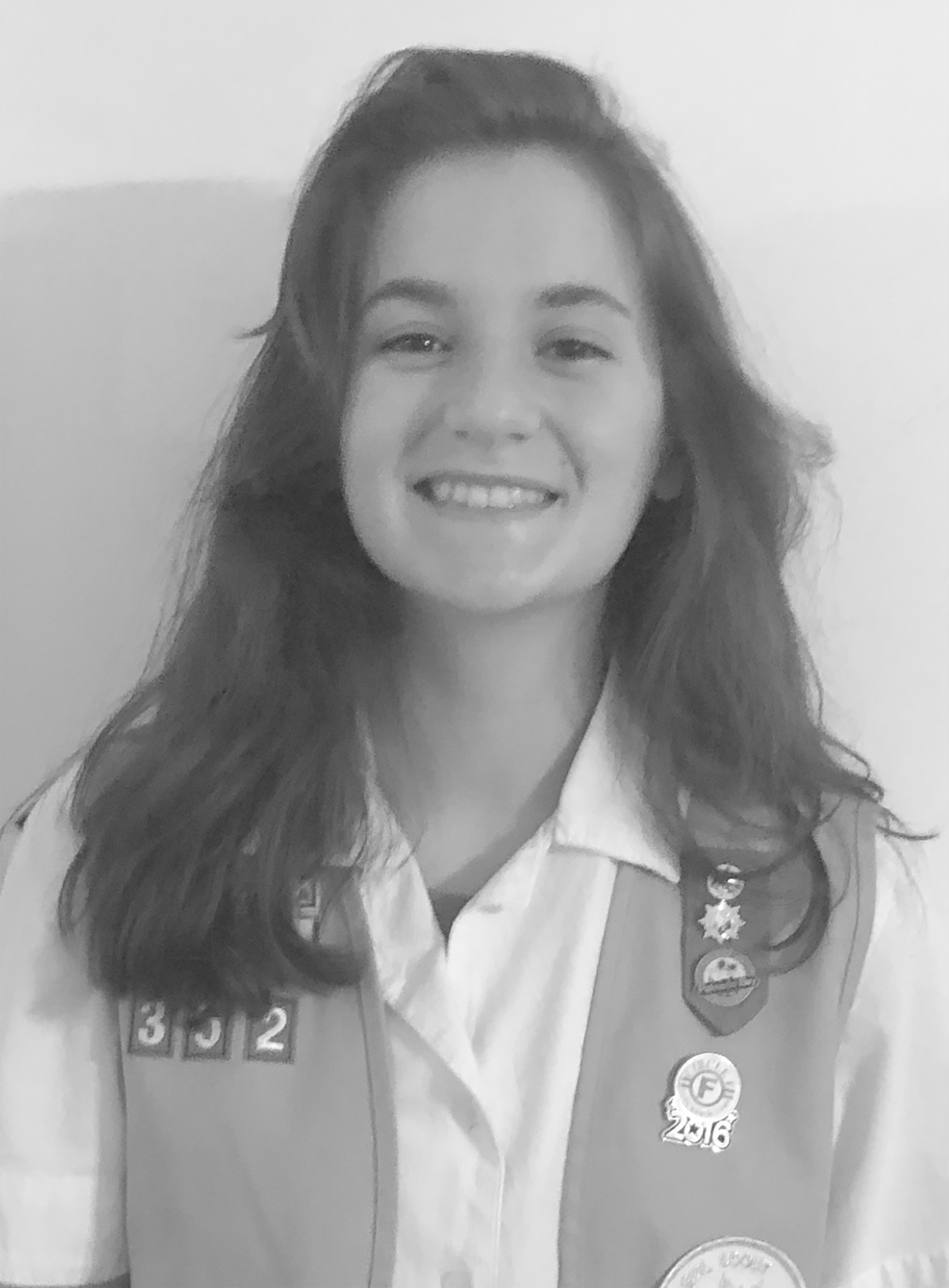
Alice Apostolakos, 17, from Palmetto Bay, is a junior at Miami Palmetto Senior High and a Girl Scout from Troop 352, whose leader is Kimberly Gonzalez. She was also motivated by the Gold Award to create a project of her own, and was brainstorming ideas with her troop when someone brought up the idea of the game “Operation,” where people can conduct a mock operation on human bodies and learn about anatomy.
“There’s been a lot of news coverage on sea turtles and how plastic pollution affects them — how a lot of them are dying now because of the threat to their habitat,” Alice said. “I was thinking, what if you got a sea turtle and it was an operation game on a sea turtle? For some reason that stuck.” Alice partnered with Deering Estate, a historic house of early preservationist Charles Deering, and 3-D engineer Roger Salgado to create a model of a sea turtle that she planned to use in a presentation at the annual Seafood Festival held at Deering Estate.
“Deering Estate had put on presentations about sea turtles, but the problem was that they had to capture a real-life turtle in order to do that, and I thought, ‘OK, well they’re already on the brink of extinction,” Alice said. “The model I created eliminated the need to actually dissect a real turtle, and it’s something that can be reused, it can be moved everywhere.”
She also created a 15-minute animated video to visually demonstrate the damage plastic pollution can cause throughout a sea turtle’s body. She downloaded a free version of the editing software Davinci Resolve Pro 16 and taught herself how to use it.
A week before the date, the festival was postponed and later canceled due to COVID. But Alice said that both the 3-D model and the video improved as a result: “During the pandemic, there was online school but mostly, I spent my days just sort of at home doing nothing, and I’m not a person who can just sit idly, my brain is always turning. So my project sort of gave me a purpose to do something.”
The model and video are at the Deering Estate.
“I think that that whole element of having to change it gave me the confidence that just because something changes or something unexpected happens, it doesn’t mean that it’s all ruined. It may actually be an open door for something even better.”
Alice said the most influential person in her project was 3-D engineer Salgado, who worked with her to create the model and donated the parts.
Alice is a junior, and doesn’t know where she is going to college yet. But she said that her project opened up marine conservation as a potential career path: “If I could further help causes that I was passionate about and spoke to me and I could offer whatever technical skills I could... I would be totally into that.”