
FIU student who helped organize a Black Lives Matter protest hopes to keep momentum going
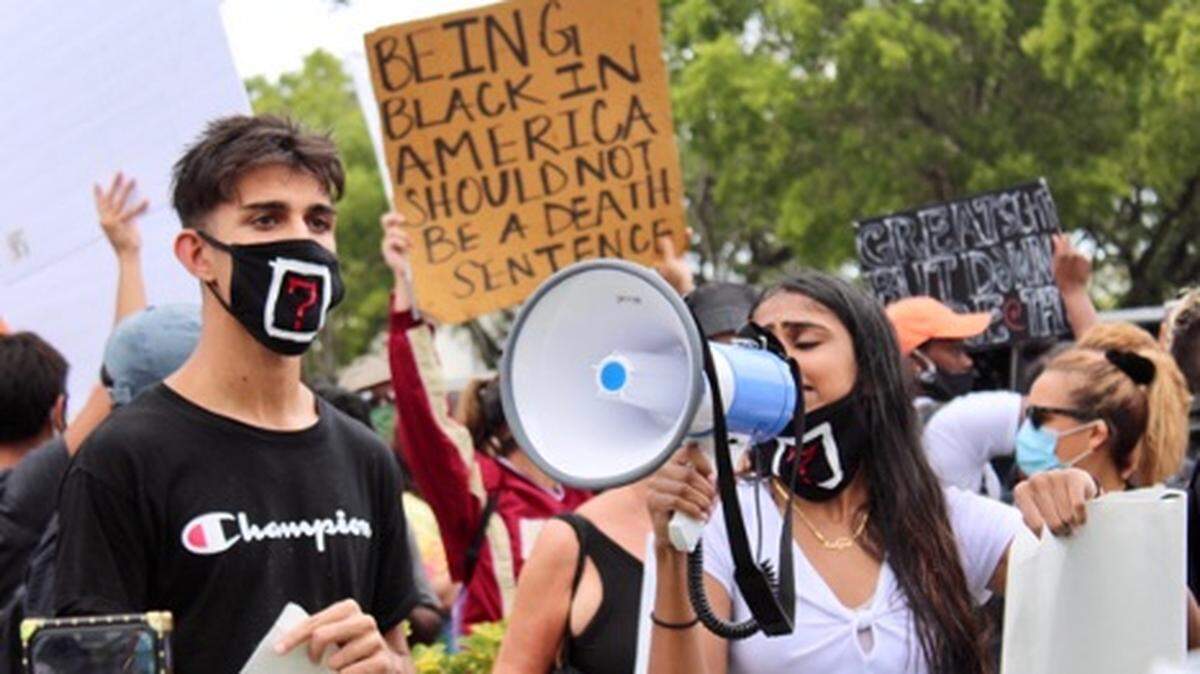
Mahek Manjiani, 19, is of Pakistani descent, born in America, and a university student at Florida International University. Her 17-year-old cousin, Shayan Shivji, is still in high school. Both are Muslim. Outraged and concerned about the treatment of black people by police, the two organized a rally in Coral Springs on June 2 and now are trying to keep the momentum going with citywide projects.
The peaceful protest, which was organized in just four days, was a response to the killing of George Floyd by a police officer during an arrest on May 25 in Minneapolis. To organize the June 2 rally, Manjiani and Shivji had to work late into the night. More than 500 people took part in the protest, according to the Coral Springs Police Department.
“It truly came together because of sleepless nights, phone calls, posting on social media, promoting, and much planning,” said Manjiani, a pre-med student who’ll be a junior at FIU in the fall. “I realized no one was speaking up in our hometown of Coral Springs. After our protest, about three or four more happened. It’s a chain reaction. We just have to show we have a voice.”
Recently, Manjiani and Shivji met with Mayor Scott J. Brook about creating an art gallery that would display the stories of police brutality victims. The outpouring of support they received from the community still shocks them.
“They were all in with us and supported us,” Manjiani said.
On the day of the demonstration, they had about 75 cases of water and over 750 masks. They also received the support of the city commission, pastors, youth activists, and organizations like the Martin Luther King Association and the Black Lives Matter Alliance of Broward.
“After the busiest days of our lives, we managed to hold a completely peaceful protest with over 500 people and many city officials,” Shivji said
The two began as activists after the Marjory Stoneman Douglas High School shooting back in 2018. Manjiani’s two older brothers attended the school. One of them was there during the violence, when a lone gunman killed 17 people.
The two joined a March for Our Lives rally a few weeks later.
“Seeing how the youth came together and used their voices inspired us to also speak up,” Manjiani said. “I’ve always been vocal about gun laws, but the Black Lives Matter movement truly sparked me.”
Shivji said the idea for the Black Lives Matter protest came when his cousin, Manjiani, brought it up after seeing everything was happening so far from them.
They didn’t comprehend the magnitude of their mission until the protest happened. It reminded them that, as youth, they have a voice.
“We’re born into society believing that equality is the norm,” Shivji said. “But we soon grow up to see the real injustices that many mentors and teachers try to disregard.”
Such activism is the result of things being swept under the rug for too long, said Phillip Carter, a sociolinguistics scholar and director of the Center for the Humanities in an Urban Environment at Florida International University. Kids observe that events don’t correspond to the storylines they’ve been told about people’s goodness and equity.
“People are aware of their environment, their conditions, and are often aware of moments of hypocrisy in society,” Carter said. “They’re often able to, as children and adolescents, make observations about the structures of society and understand the discrepancies.”
And as young adults, their activism is fueled because they’re energetic and enthusiastic about understanding how society works. They often want to make it better.
For Manjiani, as both a woman and a Muslim, injustice is all too familiar. Growing up, kids would mock her religion, and she would often get called a “terrorist.”
“I have faced racism and stereotyping the most. We know how it is to be treated unfairly,” Manjiani said. “Now, I’ve accepted my religion and I’m proud to say I’m a Muslim. I’ve been through the bullying, and black lives are bullied every day just because of their skin color.”
Being a victim of racism is what, essentially, pushed her to rally for the black community. Both Manjiani and Shivji became passionate about fighting the injustice that they, too, have faced.
“Racism should not be allowed nor a question to fight about,” Manjiani said. “A change is needed, and it’s for humanity. We need to ally with our black community and speak up for their rights, so they are treated equally just like everyone else.”
They have also been receiving messages from other youth asking them how they were able to put everything together. “It makes me feel the proudest because we truly did inspire them,” she said.
This story was originally published June 19, 2020 at 6:00 AM.