
R. Fred Lewis, Supreme Court justice and champion for disadvantaged, has died
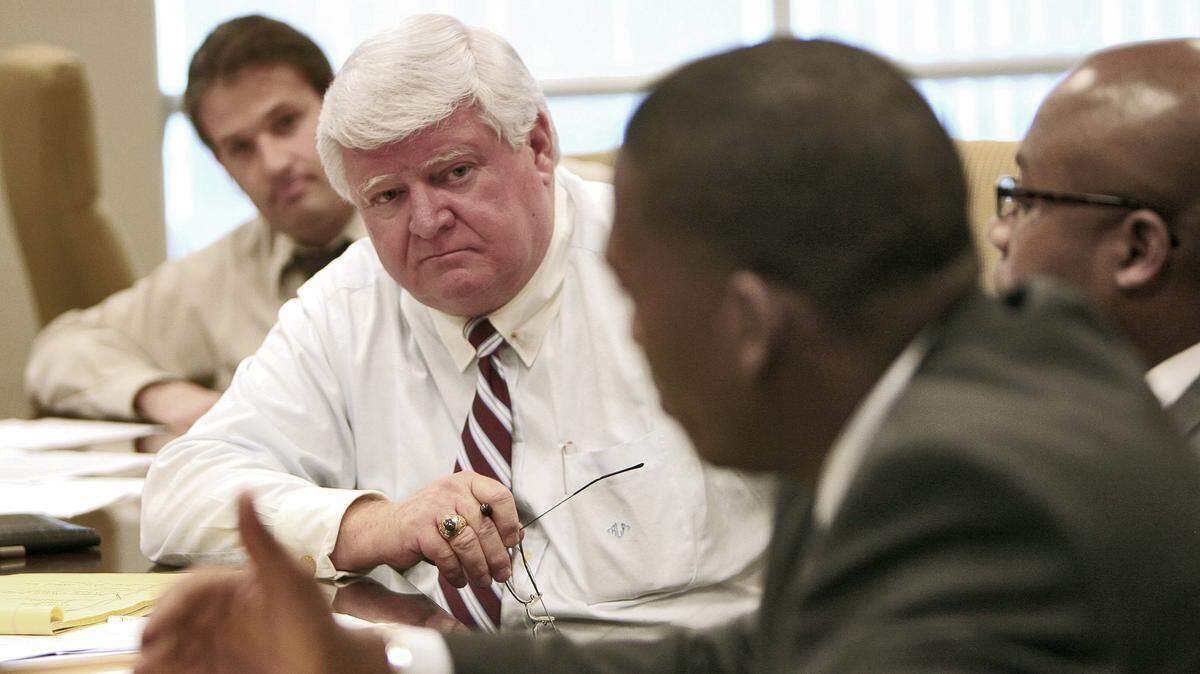
R. Fred Lewis, one of the last liberal lions of the Florida Supreme Court, whose youth as a coal miner’s son and devotion to a daughter born with severe disabilities engendered an abiding concern for the unpowerful and unprotected, died on Tuesday, May 26. He was 78.
Lewis was appointed by then-Gov. Lawton Chiles in 1998 and served as chief justice from 2006 to 2008. He retired from the court in 2019, and began a teaching career at Florida Southern College, his alma mater, where he also oversaw what he considered his crowning achievement, the Justice Teaching initiative, a curriculum for school children that encouraged civic and legal engagement.
During his tenure on the state’s highest court, Lewis saw it as his duty to reform legal practices and barriers that prevented people with special needs from accessing services and protections that other Floridians took for granted. He assembled a task force that surveyed courthouses throughout Florida to identify structures and practices that impeded access to justice for people with disabilities. He convened the first commission to improve the treatment of people with mental illness within the court system.
Retired Justice Harry Lee Anstead, who served with Lewis during some of the Supreme Court’s most tumultuous times, said the two men became dear friends “on and off the court” — including the tennis court, where they competed for years. He called his friend remarkable, “for his character and passion for justice.”
When Lewis was named chief justice in 2006, he hung a sign at the entrance to the court that read, roughly, “Tell us how we can move the cause of justice forward through the issues in your case,” Anstead recalls.
“Every lawyer present for oral arguments that day couldn’t avoid reading that sign,” said Anstead. It invited litigants to view their appearance before the seven justices as an avenue toward something higher, something meaningful. “It was an approach that extended to both the mundane, like an automobile accident, and to the possibility of the death penalty being imposed.”
“Great leaders know only one way to lead,” Anstead said, “and that’s by example. Without that, nobody would have the credibility to preach about high standards and justice.”
Lewis “sustained a terrible fall” last week, breaking his spine — “an injury from which he was unable to recover,” his family said.
A Supreme Court spokesman said Lewis will lie in state within the Florida Supreme Court rotunda from 11 a.m. to 1 p.m. on June 11. Chief Justice Carlos Muñiz will give remarks as members of the court “will ceremonially receive the body.”
Lewis cut an unlikely path to the highest court. Born in the mountain town of Beckley, West Virginia, much of Lewis’ family worked in the coal mines. Initially, sports were his ticket out. Blessed with an imposing stature and athleticism, Lewis attended Florida Southern College, a private Methodist school in Lakeland, on a combined athletic and academic scholarship, playing basketball and baseball, and serving as president of his sophomore, junior and senior classes. He was the first in his family to earn a college degree.
He enrolled in the University of Miami’s law school, also under scholarship, in 1969, graduating third in his class. He remained in Miami to practice law, working in defense of insurance companies, and later as an appellate lawyer who represented both industry and those who believed they were harmed by it.
He kept a jar of coal on his desk, and a lithograph of a coal miner on his wall while a partner at his Miami law firm, Kuvin, Lewis, Restani and Stettin. When introduced as a new justice by Chiles in 1998, he said his proudest moment was on behalf of a woman seeking stem cell treatment for breast cancer. His victory over Blue Cross/Blue Shield allowed 30 other women to be treated with the procedure without filing suit.
Lindsay Lewis, the younger of Fred and Judy Lewis’ two daughters, was born with a rare genetic disorder that left her deaf, nearly blind, and suffering from a constellation of other serious disabilities. She sat in a wheelchair next to him during the press conference in which Chiles introduced him.
“He understands the struggles, difficulties and challenges that many citizens face every day,” Chiles said at the media conference.
When Lewis applied for the open seat on the court, he wrote: “I have learned to transform the suffocating stares and ridiculing comments due to my daughter’s abnormal behavior into an understanding by others of her human condition.”
“We have learned together to appreciate art work and music through the touch of our fingers and the positioning of our faces against the source of the sound,” he added. “Her human spirit has taught me more about life than I ever thought possible.”
As Chiles’ general counsel, Dan Stengle submitted Lewis’ name to the governor as one of five candidates for the court’s vacant seat. Faced with a tough decision, Chiles vacillated. “I think you wanted to appoint Fred Lewis since you interviewed him,” he said he told the governor. “His authenticity. His humility,” Stengle said. “There was just a connection.”
The appointment was one of Chiles’ final acts in office before his death. “Chiles put him on the Supreme Court and he had not even been a judge.” The appointment was virtually unheard of, Stengle said.
Friends and family members said Lewis brought a bit of Beckley, West Virginia, with him to the high court. But his children were never far away. Lindsay Lewis frequently accompanied her dad to Florida Bar gatherings and other appearances, and he introduced her proudly when lawyers and others approached to shake his hand.
Lewis was unapologetic about his efforts to use the courts as a vehicle for improving the lives of ordinary Floridians, and especially those who struggled.
He encountered an exhibition of photographs by abused and neglected children in foster care — the kids were given Polaroid cameras and encouraged to explore their feelings through art — and arranged for the photos to be displayed at the Supreme Court rotunda in 2003. Some of the youths were flown to the Capital to view their work.
Steven Leifman, who served as a Miami-Dade County judge for 30 years, said Lewis altered the trajectory of his life when, in 2007, he asked Leifman to oversee a Supreme Court commission on the treatment of Floridians with mental illness in the court system. “He changed my whole career,” Leifman said.
“He was one of the first jurists who recognized that the criminal system had become the mental health and substance abuse system in America,” Leifman said. After studying the issue for three years, the commission released a damning report that led to changes in the way people with psychiatric disorders are treated in the court system. “Many of those things became a model for the country.”
In 2004, justices struck down “Terri’s Law,” a measure passed by the Legislature enabling then-Gov. Jeb Bush to order the reinsertion of a feeding tube that had sustained Terri Schiavo, a Pinellas County woman whom a trial court had determined was in a vegetative state. A succession of hearings pitted Schiavo’s husband against her parents, who were desperate to keep her alive in hope she would recover.
The case gained national attention, fractured Florida, and greatly troubled Lewis, “because of his love for his own daughter,” whose disabilities had been so devastating, said retired Justice Barbara Pariente. “But in the end he joined with the unanimous court.”
Lewis considered his greatest legacy to be the Justice Teaching initiative, a program that trained educators across the state to teach legal principles as part of a broader civics curriculum. “He was very critical that the state did not do a good enough job of teaching kids about civics,” said Michael Genden, who served as a Miami-Dade Circuit judge for 24 years. Genden, who became close with Lewis in law school, flew to Tallahassee for six years to work with the program.
Lewis oversaw workshops with school kids himself, traveling to schools in his free time, staging mock trials and handing out copies of legal documents, like the Constitution.
“He was a human being first, and a lawyer second,” said Genden, who remained friends with the justice since law school.
Lewis’ dedication to Floridians living on the margins endeared him to many, but it was also a source of enormous friction with conservatives in the state, who put a target on him and his philosophical kindreds on the courts as they ascended to power.
In 2012, a political action committee funded by billionaire brothers from Kansas, Charles and David Koch, backed a secretive campaign to remove Lewis and two other justices from the court via a merit retention vote. The three were retained for another six years, but the justices called the period a stressful attack on the independence of the judiciary.
“We went around the state talking about the importance of a fair and impartial judiciary, not beholden to special interests,” Pariente recalls. “We shared a belief in the importance of protecting individual rights.”
Though the Supreme Court had been trending toward a conservative majority for several years, the mandatory retirement of liberal justices Lewis, Pariente and Peggy Quince in January 2019 enabled Gov. Ron DeSantis to put a libertarian-leaning stamp on the court that is expected to endure for a generation or longer.
Only Justice Jorge Labarga, a South Floridian like Lewis and Pariente, remains of a liberal core that helped shape law and policy in the state for decades. Their departure and replacement engendered a philosophical shift that reversed long-settled law, making it easier, for example, for trial judges to discard a jury’s verdict and issue a “summary judgement” from the bench. Business groups applauded that opinion. Lawyers for plaintiffs called it an affront.
The new court also shifted away from more stringent protections for condemned inmates, discarding a legal requirement that death sentences be imposed only upon a unanimous jury vote, and that they be reviewed to ensure they are not disproportionate.
The ideological rupture from previous courts has been most apparent in the development of a new framework of laws governing the state’s near-abolition of abortion.
But it wasn’t politics that energized Lewis, his friends and colleagues say. It was his concern for the plight of others. “Regardless of his elevated position, he never lost the common touch – or his understanding of the needs of those who weren’t as fortunate as he was,” said Stengle.
Lewis is survived by his wife of 57 years, Judy Lewis; his daughter, Elle Anderson; his son-in-law, Clarke Anderson; and grandchildren Ellison and Evans Anderson. Lindsay predeceased her father in March 2012.
This story was originally published May 31, 2026 at 5:30 AM.