
Ex-Rep. Rivera’s lawyer punches away at feds’ star witness in foreign-agent trial
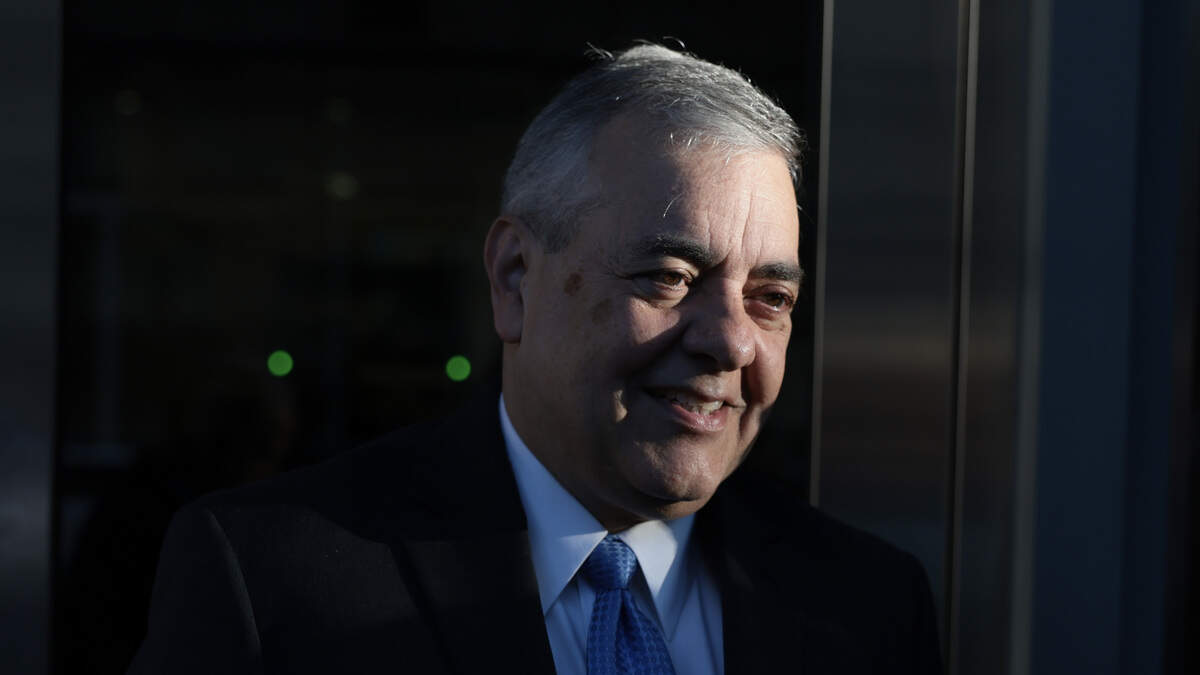
Ed Shohat, a top South Florida criminal defense attorney, took a split second to slam the U.S. government’s star witness at the trial of his client, former Miami-Dade Congressman David Rivera.
Shohat zeroed in on Hugo Perera’s testimony Thursday, saying he regretted “one thousand percent” ever becoming Rivera’s partner on a $50 million contract with the U.S. subsidiary of Venezuela’s national oil company. Perera also said he would not return his $5 million cut for making introductions that sealed Rivera’s astonishing deal with the socialist government of President Nicolás Maduro.
“You said you regret this decision ... but you’re keeping the $5 million payment,” Shohat said at the beginning of his cross-examination in Miami federal court.
“He didn’t ask for it,” Perera said, referring to Rivera, before the 12-person jury.
The courtroom exchange highlighted the inherent friction in the government’s case, which charges Rivera and political consultant Esther Nuhfer with conspiring against the United States and failing to register as foreign agents for Venezuela while they lobbied U.S. politicians and officials to “normalize” relations with Maduro’s government in 2017 and 2018.
Perera, who became partners with them and a wealthy Venezuelan businessman on the $50 million contract, was not charged along with them. Instead, Perera, after receiving a grand jury subpoena more than five years ago, chose to flip on them and got to keep his multimillion-dollar commission on the Venezuelan deal, a remarkable outcome for the Miami real estate developer with a cocaine-trafficking conviction in the late 1990s.
READ MORE: He’s the star witness against Rivera. He helped him land $50M Venezuelan deal
On cross-examination, Shohat pivoted to his defense, asking Perera a series of questions about how Rivera and Nuhfer were not trying to normalize diplomatic relations with the Venezuelan government but instead seeking to remove Maduro from power. Shohat focused on the pair’s effort to persuade Maduro to hold democratic elections that would allow an opposition leader to replace him as president. Maduro, in turn, wanted to prevent U.S. sanctions against him and other senior officials.
In particular, Shohat asked Perera about a trip that he took along with Rivera, Texas Congressman Pete Sessions and others to meet with Maduro in early April 2018 at the Venezuelan estate of Raúl Gorrín, the owner of a Caracas TV station, who helped coordinate the “back channel” diplomatic gathering. Gorrín had met Rivera through Perera in Miami, where Gorrín and Perera owned homes on the exclusive Fisher Island. Nuhfer was the one who had introduced Perera to Rivera. All four became secret partners in Rivera’s consulting contract with Venezuela’s U.S. oil subsidiary, PDV USA.
Perera testified on Thursday that the purpose of meeting with Maduro in Caracas was to “improve relations between the two countries,” including a plan to have Sessions deliver a letter from then-President Donald Trump to Maduro and have the congressman deliver a letter from the Venezuelan president to Trump. But Perera also emphasized that Maduro wanted U.S. oil behemoth Exxon to return to Venezuela, where its assets had been seized by his predecessor, the late President Hugo Chávez.
Shohat then asked Perera how the U. S. government was going to improve relations with Venezuela.
Perera testified that he remembered generally, but not specifically. “This was long ago, and I forget certain things,” he said, adding that he’s 66 years old and takes pills for his high blood pressure.
And with that aside comment, Shohat pounced, accusing Perera of suddenly having a memory lapse after testifying as a cooperating government witness without any problems for two full days.
“There are things I remember, and there are things I don’t,” Perera said, testifying through a Spanish interpreter.
Shohat pivoted to the previous year, when Rivera, Nuhfer, Perera, Gorrín and others met in July 2017 with Florida Sen. Marco Rubio at a hotel in Washington, D.C., to discuss the political crisis in Venezuela.
Through questioning, Shohat tried to show that the participants were staunch anti-communists who wanted Maduro ousted from office in Venezuela and were not interested in normalizing relations with his government.
“What I remember is they wanted them to have free and fair elections,” Perera testified.
Shohat continued to confront Perera, seeking to show inconsistencies between his testimony and his statements to FBI agents during four meetings in 2020 and 2021 — before Rivera and Nuhfer were indicted in late 2022. Shohat pointed out in front of the jury that Perera’s defense lawyer recently made 82 revisions in his FBI statements.
“I’ve only told you the truth and what I have remembered,” Perera testified. “I have always said the same from the very first day to the end.”
As prosecutors objected to Shohat’s line of questioning, U.S. District Judge Melissa Damian told the defense lawyer that he could ask the witness what he knows but could not refer specifically to his FBI statements.
Then, Shohat punched even harder, but this time at Perera’s criminal history.
Perera left his native Cuba for Spain as a 10-year-old boy, then later moved to New York as a teen and eventually to Miami. In his 20s, he said he operated a frozen-vegetable packing business in Guatemala, where he became involved with the Cali Cartel, the world’s largest drug-trafficking organization in the 1980s and ‘90s. The cartel used his business to ship cocaine hidden inside packages of frozen vegetables to the United States.
After moving back to Miami, Perera pleaded guilty in the mid-1990s to cocaine trafficking and tax-fraud charges in the massive drug-smuggling case against the Colombian cartel and was sentenced to eight years in prison. Perera also turned over $3.75 million from his illicit profits that he had kept in a Swiss bank under an account known as the Broccoli Foundation, according to court records.
“Yes, I committed those crimes, I was incarcerated, and I returned all the money,” Perera testified on Thursday. “I was 27 years old. I‘m not saying it was good what I did. But I paid for my crime.”
After his prison term, Perera made a spectacular rebound as a real estate developer in Miami, building high-rise apartments and condos. He also invested in a Miami-Dade farm that produced mamey, a tropical fruit, and opened a restaurant called Caramelo in Coral Gables in the mid-2000s.
There, Perera met Nuhfer, the Miami political fundraiser, who a decade later introduced her to Rivera. Perera then introduced Rivera to his Fisher Island neighbor, Gorrín, who was close to Maduro and his foreign minister, Delcy Rodríguez. Through those connections, Rivera’s business, Interamerican Consulting, signed the $50 million contract with the U.S. subsidiary of Venezuela’s oil company, PDV USA, in March 2017.
Rivera cut side deals with Nuhfer, Perera and Gorrín, with each of the four partners agreeing to receive 25% of the proceeds. The contract was ostensibly meant to promote the refinery business of the Venezuelan oil subsidiary, PDV USA, operating as Houston-based Citgo.
But prosecutors Roger Cruz and Harold Schimkat say the deal provided cover for the foursome as they tried to “normalize” relations between the United States and Venezuela during a period of political turmoil, economic collapse and human rights violations under the Maduro regime. At the time, Maduro and other senior officials were being threatened with sanctions that would cripple them and their country.
The U.S. oil subsidiary ended up paying Rivera’s firm a total of $20 million in 2017 before firing him for doing little work on promoting Citgo’s refinery interests in the U.S. as well as trying to bring Exxon back to Venezuela.
After landing the contract, Rivera paid about $5 million to Perera and about $4 million each to Nuhfer and Gorrín for their roles in helping put the players and deal together with the top Venezuelan officials.
Gorrín ultimately informed Rivera and Nuhfer that Maduro “refused to agree to hold free and fair elections in Venezuela in exchange for reconciliation with the United States,” according to their indictment.
In early January, U.S. military forces seized Maduro and his wife, Cilia Flores, from a compound in Caracas and brought them to the United States to face drug-trafficking charges in New York.
Gorrín is wanted by U.S. authorities on two federal indictments in Miami charging him with foreign corruption and money laundering. And three sources recently told the Miami Herald that Gorrín is being held in a notorious Venezuelan prison known as La Tumba — The Tomb.