Hostile takeover or righteous claim? Historic Miami church at center of tangled legal dispute
One morning in October of 2023, Miami police were called to remove a “squatter” who had, or so the ecclesiastical complainants claimed, taken up illegal residence in one of South Florida’s oldest Christian Orthodox churches, housed in a well-preserved 1927 mansion a few blocks from East Little Havana’s Calle Ocho.
The alleged interloper was actually the church’s resident ordained deacon, Georgios Zervos, who was cuffed and — amid his protests that he legally lived in an apartment on the property — hauled away when officers found an old warrant, which turned out to be invalid, for his arrest.
But that wasn’t the strangest thing that happened that day at Saints Peter & Paul Russian Orthodox Greek Catholic Church, a 70-year-old congregation that for nearly three years has been mired in a bitter legal conflict with an Orthodox diocesan body over control of its landmark property, once the grand home of Miami’s first mayor.
Sts. Peter & Paul parish leaders, alerted by Zervos via cellphone as he was taken away, logged into the church’s security cameras just in time to see a pair of high officials from the other party in the dispute, the Orthodox Church in America, or OCA, drive up in a white cargo van with a locksmith.
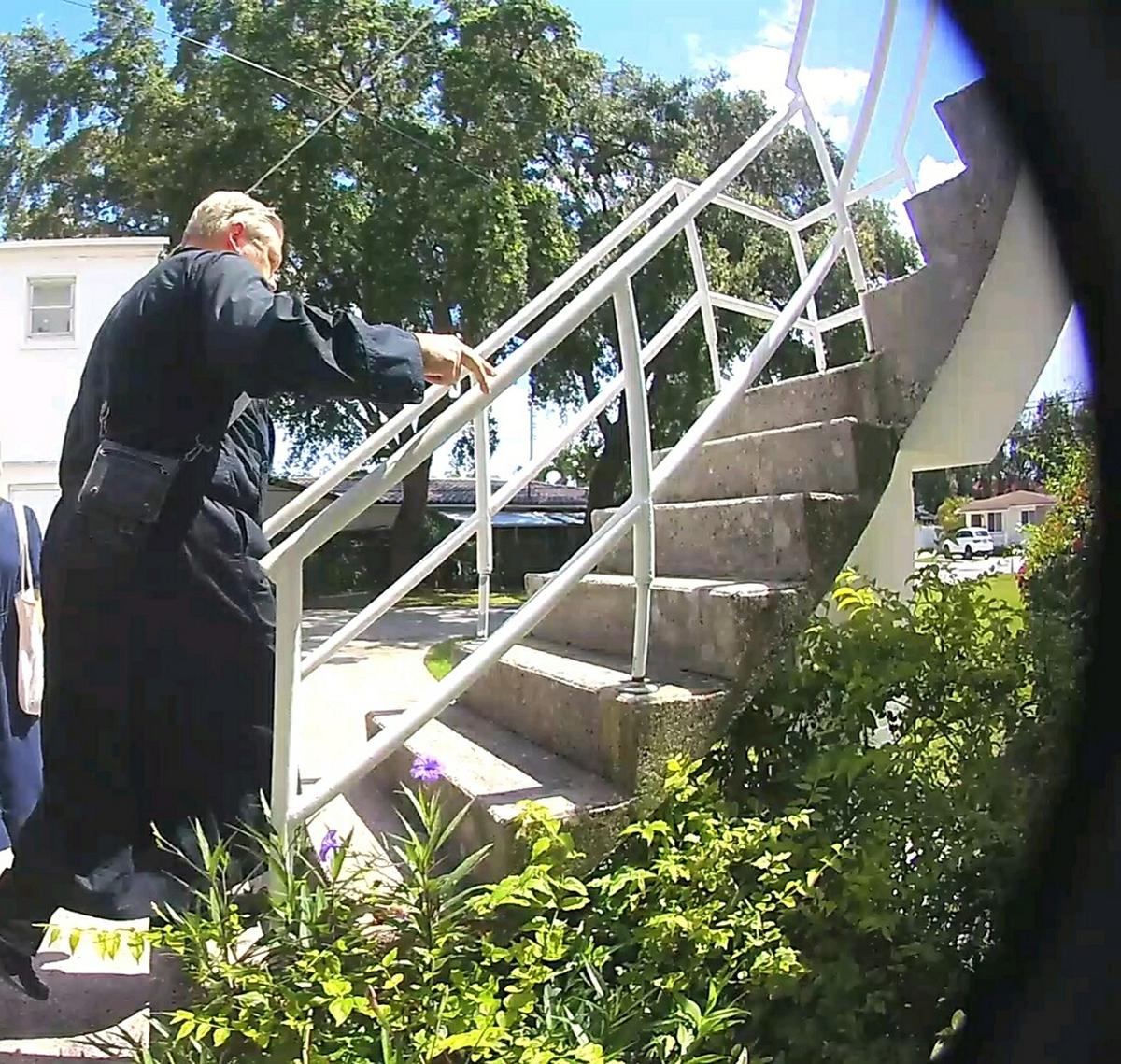
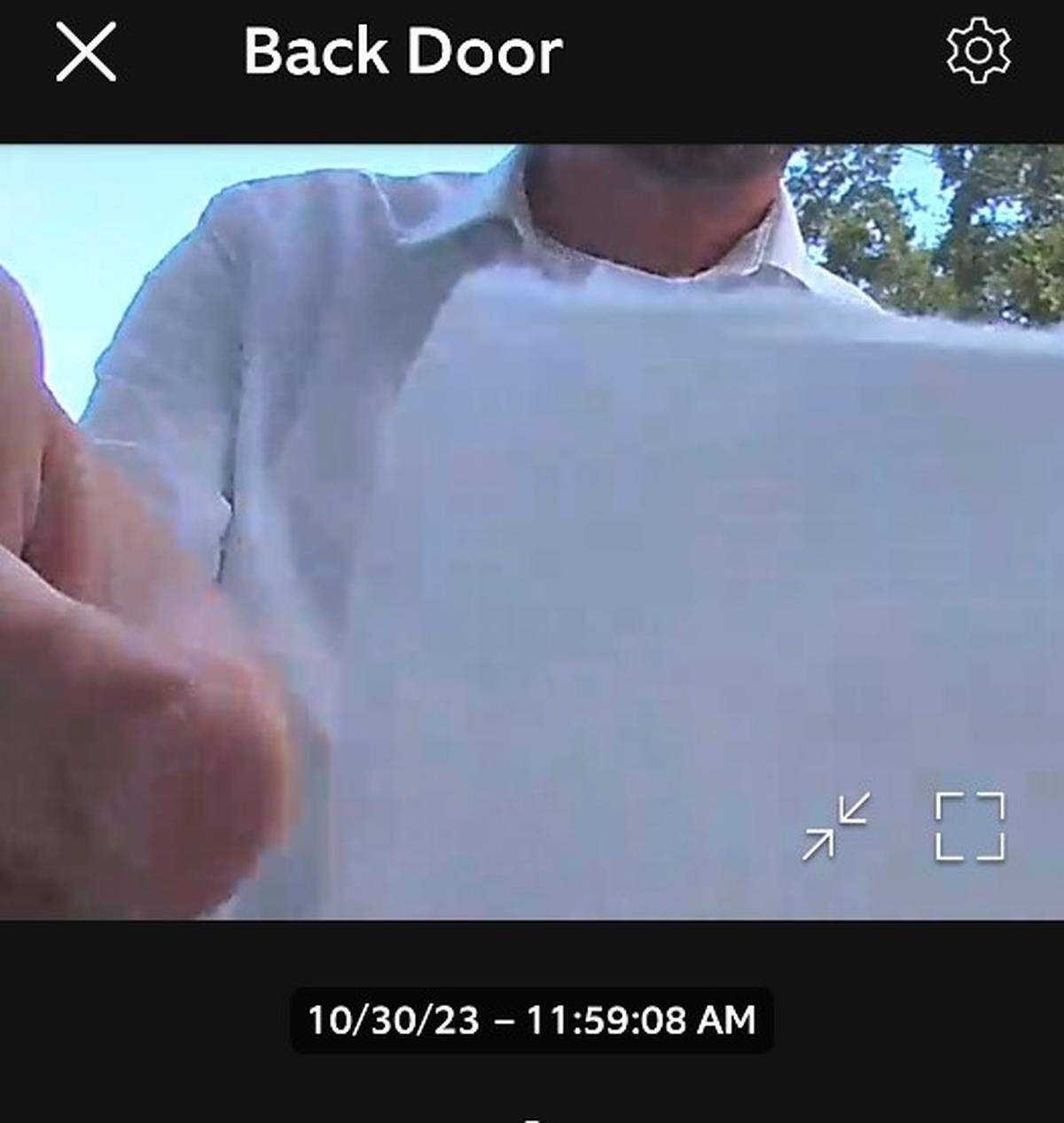
As astonished parish leaders watched through the building’s Ring cameras, the two priests from South Carolina, who bore the traditional beards of Orthodox clergy but on that day eschewed their customary long cassocks for ordinary civilian togs, discussed with police having Zervos’ car towed, took photographs of the property, then tried the doors before one of the clergymen spotted a camera and taped paper over its lens.
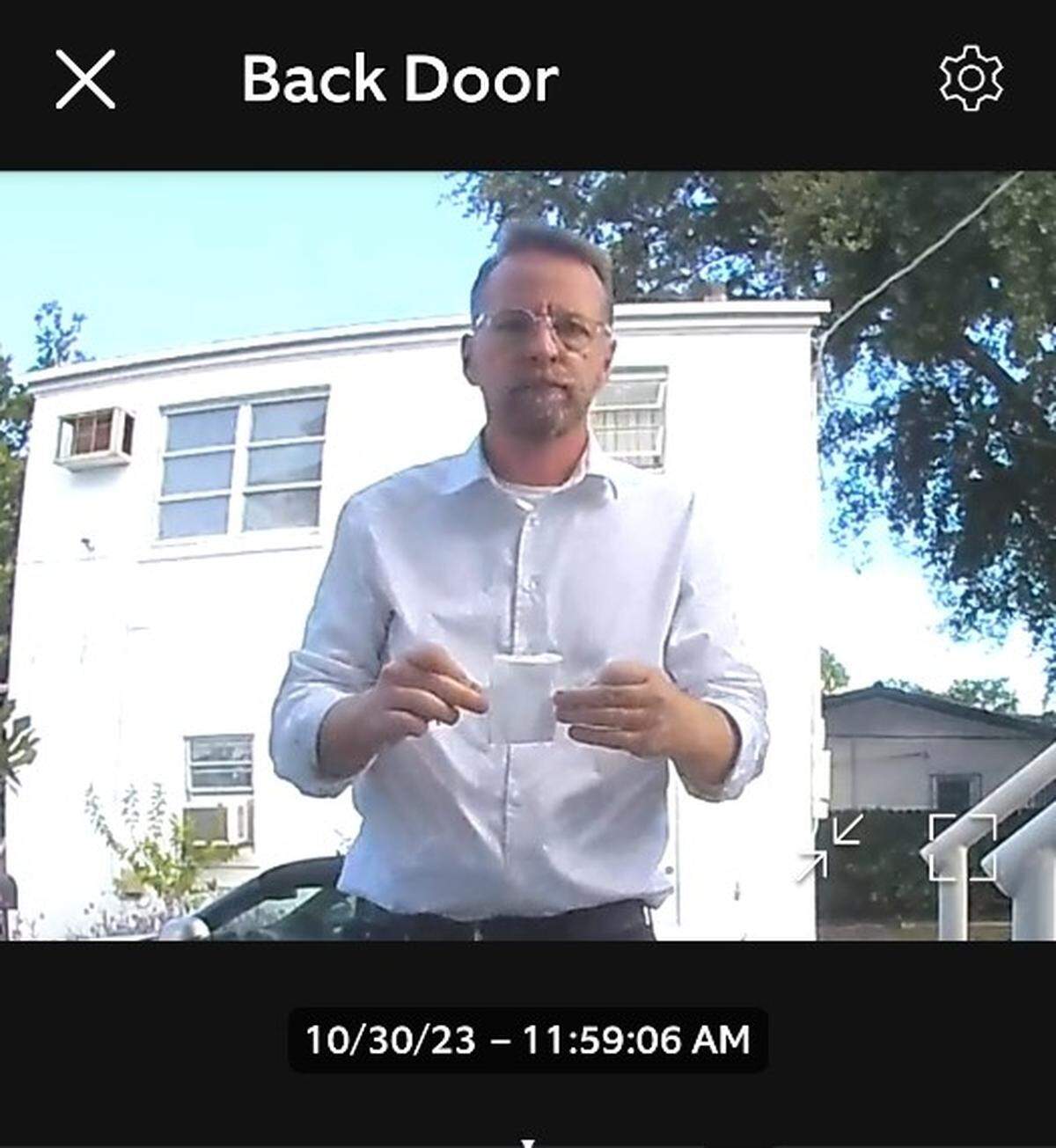
The imbroglio, recorded on the body cameras of half a dozen responding city of Miami officers and documented in two incident reports, ended after police, realizing the warrant for Zervos was void, quickly brought him back to the church. Then it got even more confusing.
Another officer, called by parish leaders, showed up to question the two priests, both officials of the OCA’s Diocese of the South, the Rev. Marcus Burch and the Rev. Peter Robichau, who claimed their organizationhad state records showing it had full legal control of the property — though that was in dispute.
The two priests agreed to leave only after prolonged discussions among parish leaders, attorneys on cellphone calls and puzzled police officers. One cop told the priests they risked getting arrested for trespassing after Sts. Peter & Paul officials also producedrecords showing the parish nonprofit corporation was the actual owner of the property..
But that was hardly the end of what is a complex dispute at the murky confluence of religion and law. It has led to dueling lawsuits, mutual public recriminations and accusations of un-Christian behavior and the excommunication of longtime parish leaders by the OCA. It has also spawned allegations in the civil lawsuits of fraud and diversion of parish funds leveled by each side against the other. No criminal charges have been filed against anyone.
Making matters even more convoluted, a rival jurisdictional body, the Russian Orthodox Church in America, has publicly supported the Sts. Peter & Paul leadership, contending in a letter to a Miami-Dade judge handling the court dispute that the OCA has disseminated “false claims” about its own authority, infringed on the religious freedom of parishioners and is “inappropriately using excommunication as an intimidation tactic.”
Last week, Circuit Court Judge Lisa Walsh sided with Burch, Robichau and the OCA, the largest of three Russian Orthodox ecclesiastical bodies in the United States. She summarily ended the dueling lawsuits and ordered parish leaders to turn over the keys to the property to the OCA, a decision that puts at risk not just the future of the parish, one of the first Christian Orthodox congregations in South Florida, but also that of its historic and valuable home, a piece of overlooked Miami history.
On Monday, however, Walsh put the whole thing on hold, granting a request by parish leaders Priscilla Rivera, Randy and Susan Homyk, and the deacon, Zervos, to stay her own order pending their appeal to the Third District Court of Appeal in Miami.
A tangled history of conflicts
The tangled case echoes the long, confusing and often conflict-ridden history of Christian Orthodox churches and denominations in the United States since at least the Bolshevik revolution in 1917, which splintered Russian Orthodox authorities into rival jurisdictional groups that have over the decades since frequently fought over control of congregations and property, one expert says.
Those battles within and between Orthodox denominations highlight a gray area in American law between the Constitutional separation of church and state, under which judges tend to defer to church authorities on hierarchical church matters, and U.S. law that allows anyone to establish and own a church independently, said Andrew Walsh, former associate director of the Greenberg Center for the Study of Religious Life at Trinity College in Connecticut.
“There is just endless feuding between these groups over property and who is going to control what,” said Walsh, who has written extensively about financial scandals that have occurred in the past involving the OCA. “These battles are common. There has been a relentless history of legal struggles. It’s a muddle.
“I feel sorry for everyone involved,” Walsh said.
Before issuing the stay, Judge Walsh had endorsed the OCA’s argument that its longstanding religious ties with Sts. Peter & Paul give its bishops broad authority to seize control of church property — even though publicrecords show the parish nonprofit corporation has owned the building since the 1950s, when the OCA did not yet exist.
Parish leaders say they have always managed its finances independently of any ecclesiastical body and have no financial or legal ties to the OCA.
The judge, whose ruling largely adopted proposed orders written by the OCA’s attorneys — a common practice in civil courts — cited the Constitutional separation of church and state and some legal precedents in a little-known corner of U.S. jurisprudence related to previous battles within Orthodox denominations.
After initially setting a March 20 trial date, she dismissed the suit by Sts. Peter & Paul members, concluding that courts are precluded from intervening in what she characterized as an internal church dispute. She also summarily ruled on OCA’s suit in favor of the diocesan group’s often-aggressive takeover attempt, which included two tries at entering the locked church building that werecaptured on security cameras and involved Miami police.
In their motion for summary judgment, the OCA leaders charge Sts. Peter & Paul leaders and Zervos with muddying the legal waters to improperly retain control of their parish in defiance of hierarchical authority. They argue the conflict is over church authority, not property.
“Make no mistake: defendants seek to sow confusion about the tenets of Orthodox faith to avoid summary judgment. But courts have a way of resolving such issues without wading into the confusion and entanglement with religion that defendants invite,” the OCA motion reads.
The motion also contains allegations against deacon Zervos and parish leaders that the Sts. Peter & Paul parishioners say are flatly false, includingan unfounded claim that the deacon has a criminal record and was once sentenced to 30 days in jail.
Robichau and OCA priest Rev. Joseph Lucas, who led the diocese’s first effort to take control of the church property, said they weren’t authorized to speak on behalf of the diocese and referred the Herald to an OCA attorney, Seattle-based Peter Talevich. Talevich supplied copies of court documents to the Herald but said in an email that he could not comment on the record, citing ongoing litigation.
Parish leaders feel betrayed
Stunned parish leaders, who had sued the OCA over what they contend were its illicit attempts to take control of Sts. Peter & Paul, say they feel betrayed by the legal system and Orthodox clergy they once trusted.
They contend the clash with the OCA is about property rights, not religious matters. But they say that Judge Walsh picked select precedents to sidestep a complex, sensitive matter without allowing them to make their case or considering contrary court precedents that allow judges to sort out religious from financial matters. The orders she signed, they allege, contain errors and misrepresentations cited by the judge as “undisputed facts.”
“It’s totally unbelievable,” said Susan Homyk, a 27-year Sts. Peter & Paul member and parishleader, after the judge’s ruling. “It is doubtful that she has even heard any of our arguments or read any of them. She’s just going by what they said ... We’ve been silenced.”
For Homyk and her husband Randy, the loss is especially personal. Both have long been active members and serve on the elected parish governing council, and they say they contributed thousands of dollars from their own pockets to help sustain the small parish and recruit a new priest from Ukraine. That last effort appears to have sparked the conflict with the OCA after years of friendly if — according to the Homyks and Deacon Zervos at least — arm’s-length relations with a diocese based 1,300 miles away in Dallas.
Alleging disobedience, among other claimed doctrinal infractions, the OCA excommunicated the Homyks and longtime parish council leader Rivera. Zervos, the trio’s ally, was suspended as a Russian Orthodox deacon (he says he now has the blessing of the Greek Orthodox denomination). The dispute has divided the congregation, which has been left without a priest and lost much of its already small membership.
Fate of first mayor’s mansion?
It has also raised questions about the fate of the nearly century-old estate the parish occupies at 1411 SW 11th Street, in the early Miami suburb of Shenandoah. The stately mansion was built by Miami’s now nearly forgotten first mayor, John Riley, a businessman who served four years following the city’s incorporation in 1896.
Riley’s family occupied the house, designed by noted architect Martin Luther Hampton in a neo-Classical style, until they sold it in 1954 to the fledgling Sts. Peter and Paul congregation, founded to provide a religious home for the city’s growing Christian Orthodox adherents after World War II.
Gentrification has significantly raised property values in Shenandoah, at one point regarded as part of the larger Little Havana enclave. The property, which includes a separate garage with an apartment over it, is now conservatively assessed by Miami-Dade’s property appraiser at a market value exceeding $2.6 million. The congregation’s non-profit corporation paid off the mortgage in 1960 and has owned the property free and clear since then, deeds and other records show.
The Homyks and Zervos say they fear the OCA will dissolve the congregation and sell the property for redevelopment given its large lot. In an attempt to safeguard the house, the Sts. Peter & Paul leaders have submitted a pending application to the city, written by Miami history blogger Casey Piket and paid for by Dade Heritage Trust, for designation as a historic landmark.
In a court filing on Monday, Robichau said the OCA “does not plan to lease or sell” the property. “Instead, the Diocese plans to embark on the hopeful yet significant task of facilitating the restoration of religious services at the parish to those members who have been excluded from worship because of the dispute at the parish.“
An effort in Miami to avoid historic infighting
Susan Homyk says the parish sought from its founding in 1951 to operate independently precisely because of the long history of infighting among Orthodox congregations. That’s reflected in its by-laws, the nonprofit corporation that controls its property and bank accounts and legal opinions it obtained in the 1950s to ensure its legal independence, she said.
The parishioners contend they have never formally, financially or legally, been part of the OCA, which was formed in the 1970s, long after the church’s founding, or of any other ecclesiastic body. The OCA has never contributed financially to the church’s operation, they note.
“The congregation was set up very differently, precisely to avoid what we’re going through now,” Homyk said. “We’ve put our money, our time, our elbow grease, our talents, everything into this, making sure we we had enough funds to pay the priest, making sure the priest was well taken care of. Making sure that anybody who walked in the door felt welcomed.”
The problem for Sts. Peter & Paul, said Trinity expert Walsh, is that Orthodox church bodies typically do not recognize the independence of parishes, and courts have generally deferred to that argument. Individual Orthodox churches have sought to maintain their independence over the decades as Orthodox jurisdictions shifted or jockeyed for influence, mostly unsuccessfully, he said.
“This claim of independence doesn’t hold much water with the Orthodox,” Walsh said. “But it holds water with U.S. law. The complication is there is no such thing as an independent Orthodox church, from the Orthodox point of view. To claim that Orthodox identity, you have to be under jurisdictions of a bishop or group of bishops.”
The first Orthodox churches in North America were established as missionary operations in Alaska by Russia, which owned the territory, in the late 18th Century before spreading to California, New York and the Midwest as waves of immigrants from Greece and Eastern Europe settled across the country.
But the Russian revolution threw the Russian Orthodox denomination into chaos as American churches fought for control amid shifting alliances, eventually splitting from the mother church. Subsidies from Russia stopped, resulting in financial crises and decades of disputes over property, Walsh, the academic, said.
When a group of Miami Orthodox followers formed Sts. Peter & Paul in 1954, they took a name to appeal to different strands of the faith, including Greek, Russian and Eastern Rite Catholic, reflecting the diversity of immigrants arriving after World War II. But they received approval from a bishop, known as the Metropolitan Leonty, from a U.S. Russian Orthodox group linked to the church in Russia.
That group was supplanted by the OCA in 1970after the church’s head in Russia granted the body its independence. OCA contends it’s the sole legitimate successor to the old organization, and thus retains authority over Sts. Peter & Paul but the parishioners say OCA’s legitimacy has been a subject of disagreement within the Orthodox community.
In fact, in its letter to Walsh, posted in the court docket last Friday, the rival and far smaller Russian Orthodox Church body, ROICA, also claims succession from Metropolitan Leonty and explicitly backs the independence argument by Sts. Peter & Paul’s leaders. The letter asks Judge Walsh to dismiss the OCA’s lawsuit.
“The parish in question was established as an independently controlled corporation with an affiliation to the Russian Orthodox faith well before the OCA’s legal existence,”
“It is our position that the corporate entity in question has the right to decide which orthodox jurisdictional hierarchy to affiliate for its worship and at the same time the right to decide the control and corporate governance without any hierarchical interference,” reads the letter signed by ROICA’s Nevada-based chancellor, the Rev. John Haydukovich.
Since its formation, Trinity’s Walsh noted, the OCA has been shrinking and has in recent years been struggling to shore up its finances. The OCA has been recovering from extensive financial scandals in 2008 in which most of its bishops were implicated in the squandering and diversion of millions of dollars in organization funds over years and forced to resign. Today the state of its finances remains “poor,” Walsh said, and depends on small, scattered parishes it has been trying to exert more control over.
“The OCA is trying to create self-sustaining, self-supported operations and tying up loose ends,” Walsh said. “It sounds like the diocese is playinghardball with these guys.”
The voluminous court record shows that Sts. Peter & Paul and its leaders maintained close and friendly religious ties with the OCA after its creation. Rivera and Randy Homyk attended OCA national conferences, and its bishops provided necessary permission for services and other religious activities. So did other Russian orthodox bishops, Zervos says.
They say the OCA also at times helped the parish identify and recruit priests, though they say the congregation paid their salaries, not the OCA. The only record filed in court indicating financial support from OCA was a $7,000 contribution from funds raised to help its local churches make repairs after Hurricane Wilma in 2005.
But Sts. Peter and Paul leaders also insist that parish founders deliberately sought to maintain its formal and financial independence.
2022: Relationship begins to sour
That relationship seemed to work until the middle of 2022, when Sts. Peter & Paul and OCA came to loggerheads over the parish’s attempt, with OCA help, to recruit a young, full-time priest from Ukraine. The congregation had stabilized after years of shrinking, boosted by the growing appeal of Orthodoxy’s religiously conservative rites and beliefs, and by the establishment of a religious outreach mission targeting the surrounding Hispanic community.
The Homyks say they personally footed a substantial portion of the $20,000 cost of obtaining immigration visas, moving and travel for the Rev. Olekseii Rukavista, his wife and two young children. The process took five years, delayed first by the COVID 19 pandemic and then by the Russian invasion of Ukraine.
But just as the Rev. Rukavista was set finally to arrive, friction emerged over the residency of the deacon, Zervos, who is not paid a salary, at the church.
Zervos, who works for a medical services company and is a certified lacrosse and soccer referee, had come to Miami in 2017 and says he become personally friendly with OCA priests in other parishes, including Christ the Saviour Orthodox Cathedral in Miami Lakes, where he assisted the pastor, the Rev. Joseph Lucas, during services. He says he also drove the Ohio-based Bishop of the OCA, the Rev. Alexander Golitzin, on his visits to South Florida.
Zervos said it was Lucas and other OCA figures who sent him to help at Sts. Peter & Paul, which had lost its resident caretaker and whose elderly priest needed assistance. As deacon at the church, where at different times he rented the apartment over the garage or the clerical residence on the mansion’s second floor,Zervos assisted with services, attended to visitors and parishioners, and looked after the property.
But now Lucas, at the time an OCA dean serving as its local representative, and other OCA officials began raising objections, noting that Zervos belonged to a different Orthodox denomination and claiming it was inappropriate for the deacon to live at the property with the new priest and his family. Lucas and others also claimed in court pleadings that Zervos refused to accede to a background check. Zervos maintains he has undergone and cleared numerous background reviews to serve in his religious capacity and also as a compliance officer for soccer organizations.
At the end of 2022, the OCA told Zervos to leave— something Rivera and Homyks say the group had no authority to do. Because Zervos holds a long-term lease to reside on church property,they said, it would require an eviction order from a court to get him out.
Zervos said the actions were “retaliation” because he was backing parish leaders in the growing conflict.
The Ukrainian priest never arrived at the parish. After landing in South Florida at the end of2022, the Homyks and Zervos say the OCA reassigned the Rev. Rukavista to Jacksonville, where he still serves today.
Within months, the OCA officials ordered Randy Homyk removed from the parish council and the governing body dissolved, a power the parish leaders said they never had and had never previously tried to exercise.
Changing state records and locks
In May of 2023, learning that their former priest had turned over a set of keys to church property to the OCA, parish leaders had the locks changed. It wouldn’t be the last time that happened.
Unbeknownst to Homyk and parish leaders, the parish lawsuit claims, the OCA officials also filed to change something else — state corporate records.
Taking advantage of a glaring loophole in Florida’s Sunbiz corporate registration system that allowed anyone to alter an online corporate registration without official validation or review, the new filing that same month removed Randy Homyk and Rivera from the parish nonprofit corporate registry as officers. It replaced them with Lucas and the two South Carolina priests, Burch and Robichau. They also appended the term “Orthodox Church in America” to the corporation name.
Following an investigation by the Sarasota-Herald Tribune, the Florida Legislature had enacted reforms earlier in 2023 to close the commonly abused loophole and require passwords and verification of identities for making changes to Sunbiz documents — but the new system was not yet in place at the time.
Alarmed by the OCA’s actions, Susan Homyk said, her husband Randy, the longtime parish treasurer, transferred most of its funds to a new account for safekeeping, leaving a small balance to cover due autopayments. Shortly after, according to the parish legal claims, OCA officials used the amended Sunbiz registration to withdraw the remaining $2,600 at a Wells Fargo branch, then closed the accounts.
The parish leaders subsequently put the Sunbiz registration back under their names.
What followed was a months-long struggle for the actual keys to the church.
On May 30, 2023, when no one was at the church, security cameras caught an unlikely scene: Lucas, in full dark cassock, showed up in broad daylight, accompanied by a locksmith who changed the locks on the church doors and mailbox. Lucas then left the property.
Later that day, when Rivera noticed an alert from the security system, parish leaders called Miami police, regained entry and changed the locks again, police bodycam video shows.
Denied access, the OCA in June called an off-site meeting to inform parishioners of their plans. The OCA told parish members, gathered at St. George Antiochian Orthodox Cathedral in Coral Gables, that Sts. Peter & Paul was closed and there would be no further services, and advised them to go elsewhere for worship, according to a letter from the Dallas-based OCA diocese. Zervos and Susan Homyk also say the OCA instructed the keeper of the parish website, a church member, to lock out council leaders and post that the parish had been closed indefinitely.
The church and its outreach mission are still carrying on with partial services, led by Zervos, as well as Bible study, weddings and baptisms.
But the consequences for the parish have been devastating, Susan Homyk said. “A lot of the people stopped coming, okay? A few stayed for a little while, and then eventually they stopped coming.”
Excommunications come down
To protect the parish from what they regard as a hostile takeover by the OCA, the Homyks say, they also took some drastic steps. Realizing that the OCA intended to take over the parish, they created a separate charitable foundation that they hoped to transfer the church property deed to. As legitimate and longtime corporate officers, they say, it’s something they believe they had a full legal right to do.
In response, the OCA excommunicated all foundation officers, an action usually reserved for grave doctrinal infractions. The OCA reinstated three parishioners who had joined the foundation after they resigned as officers and sent letters of repentance, according to an email exchange between OCA officials and former parishioners provided to The Herald.
At the end of October, the OCA then dispatched Burch and Robichau, the OCA priests and officials, from their South Carolina churches to attempt once again to take control the church property — the encounter that brought out nine police officers.
Zervos, released after police realized the arrest warrant had been canceled because an old charge against the deacon stemming from an altercation at an anti-abortion protest had been dropped, remained in residence at the church. Rivera and the Homyks held onto the church and its keys.
Both sides file lawsuits
That November, both sides went to court, suing and countersuing each other.
In court filings, the OCA priests contend that once the church council was dissolved, the Homyks and their supporters had no right to change corporate documents or locks, transfer the church deed or create a new foundation to run it, and suggest the dissidents had absconded with remaining parish funds of around $72,000.
“As a result of defendants’ actions, worship at the Parish has ceased and a Parish community with nearly 70 years’ history of worship at the same location has been destroyed,” an OCA pleading reads.
In her order, Judge Walsh said evidence presented by the OCA of its religious ties to Sts. Peter & Paul was sufficient to effectively grant them control over the parish property, dismissing its claims to independence.
But the longtime parish leaders say it’s the OCA officials who acted improperly
“Maybe they believe they own the property, but they still broke in without a court order,” Susan Homyk said. “They still took over our bank account. I’m sorry, but what honest person covers cameras? Who does that?”
They argue the judge’s ruling, if it stands, will have ramifications for other churches and denominations., opening the door for ecclesiastical authorities to seize control of parochial properties without the possibility of a challenge.
Zervos said the fight has tested his faith in the OCA leadership.
“Its a black mark on the church. It doesn’t reflect the faith. It doesn’t reflect what the faith is truly about. It’s heartbreaking,” he said. “These are people who I considered brother clergy.”
This story was produced with financial support from Trish and Dan Bell and from donors comprising the South Florida Jewish and Muslim Communities, in partnership with Journalism Funding Partners. The Miami Herald maintains full editorial control of this work.
This story was originally published March 13, 2025 at 5:30 AM.