From the Herald archives: Magical thinking in a time of grief, talking to Joan Didion
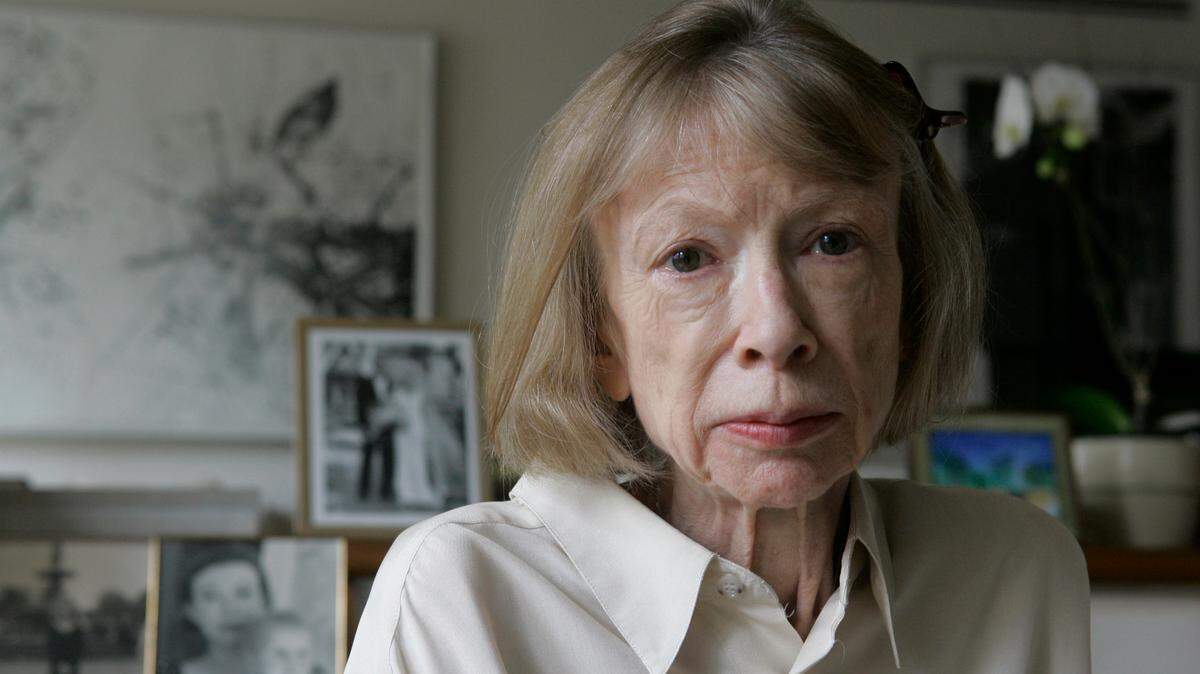
This story was previously published in the Miami Herald on Nov. 6, 2005. In 1987, she published a book about immigration and exile called Miami. Didion died Thursday in New York.
Joan Didion has always used words to feel her way through the world, thoughts flowing from brain to fingertips as she typed her way to clarity and understanding.
So when writing failed to offer solace now, at the worst time of her life, she found herself unmoored and unarmed, a woman caught in a tidal wave of transition.
Her famous writer husband had died without warning, collapsing at the dinner table. Her daughter had been gravely ill and would later die, too. Faced with the unbearable, Didion did what Didion has always done: She sat down and wrote to try to make sense of the senseless.
And couldn’t.
“There was a sense of discovery writing it,” she says, with carefully distilled words, “but no sense of resolution.”
For Didion — icon of nonfiction writing, practitioner of confessional-style journalism, believer in precise language as a medium to experience the world — writing The Year of Magical Thinking was terrible new territory.
“I was not controlled,” she says, as though admitting an embarrassing lapse. “I try to be.”
Controlling the grief, for Didion, meant “figuring it out, working it through, trying to face it. I needed to put it into words and have the words make sense.”
Now she’s written the book. The words do make sense. But death, she discovered, still doesn’t.
The Year of Magical Thinking is a memoir of life with her husband, the writer John Gregory Dunne, and their extraordinary partnership of writing and loving and parenting that covered 40 years until his death in 2003. But even more, it is a meditation on the overwhelming nature of grief, which strips away artifice and rips away the illusion of control. Compounding its emotional blow is the knowledge that after the book’s completion, her daughter Quintana Roo also died, in August at age 39.
The death is not included in the book, and it is something that Didion can barely bring herself to talk about publicly.
“I’m sure there’s going to be a period of simply coming to terms — with Quintana,” she says, her speech filled with gaps and hesitations. “I expect when I finish this period, one thing I have to figure out when I’m traveling is what to do next. I put a lot of faith in hotel rooms for that kind of thinking. I don’t have a thought yet about what I will do next because I spent the summer in the hospital with Quintana.”
She won’t write about her daughter’s death, she said. “No. I can’t imagine what form it would take.”
She pauses. “Although I couldn’t imagine writing about John either. But with Quintana, that wasn’t part of our deal. It would be a violation.”
Her daughter did read The Year of Magical Thinking, though, Didion says. Quintana had been unconscious when her father collapsed and died, and Didion had the awful task of explaining it all to her when she wakened. The book offered much more detail than Quintana had known before.
“She thought it was fine. She doesn’t — didn’t — like reading our work.” Didion stops for a painful second, struggling with the past-tense verb, then continues. “She explained that to me once, that it made her uncomfortable. You make a judgment on it, and you don’t want to make that kind of judgment when it comes to your parents.”
Didion, known for being cool and tough, has made a career of directing the public gaze toward issues many would rather not face. But when talking about herself, she has been a mix of self-revelation and guardedness, a quality that has been part of her mystery and her success.
Her dislike of interviews is well known. She parcels out a bit of herself, then draws back. She says her husband once told her that despite her label as a writer of searing self-confession, “he said I only revealed what I wanted people to see,” she says, with a small laugh.
By writing the book and embarking on a tour, she has chosen to talk about her pain, to indulge in introspection, but the conflict between her public and private sides is still ever-present. Despite the brutal precision of her language in the book, her drive to nail things down exactly, she is, in a way, escaping through work.
“It’s easier for me to keep on working,” she says. “I’ve watched people go through grief since John died, and I’ve never seen anyone who didn’t go through some sort of this kind of thinking, magical thinking. You really can’t accept it no matter what the doctor says.”
Her husband’s death has forced her to face up to a part of life — the scary, random part — that she had always managed to bury until then.
“I’ve always been sort of apprehensive about life but I never really got the message. I keep being surprised. I was surprised when John died, and there were about a million signposts for that.”
Her husband, she says, was the person she turned to before anyone else to give her an honest assessment of her work. This one she had to write without him, blind. And worse, the book is about him.
“That was really hard,” she says. “I couldn’t imagine writing a piece he couldn’t read.”
Is this the worst period of her life? There is no pause, this time. “Yes.”
This story was originally published December 23, 2021 at 4:43 PM.