He bilked Medicare, feds say, and buried $2.5 million in pipes under Miami bedroom closet
In the annals of Miami’s Medicare fraud rackets, Jesus Garces’ alleged scheme to rip off millions from the feds’ health insurance program is old school, vintage 2000. He’s accused of billing about $49 million for medical supplies like wheelchairs and walkers that were never delivered to patients.
But what really distinguishes Garces from thousands of other Medicare schemers charged over the years is how authorities say he hid the millions that the government paid out to his chain of durable medical equipment businesses in Miami-Dade County.
Not in an offshore bank account or even under the mattress.
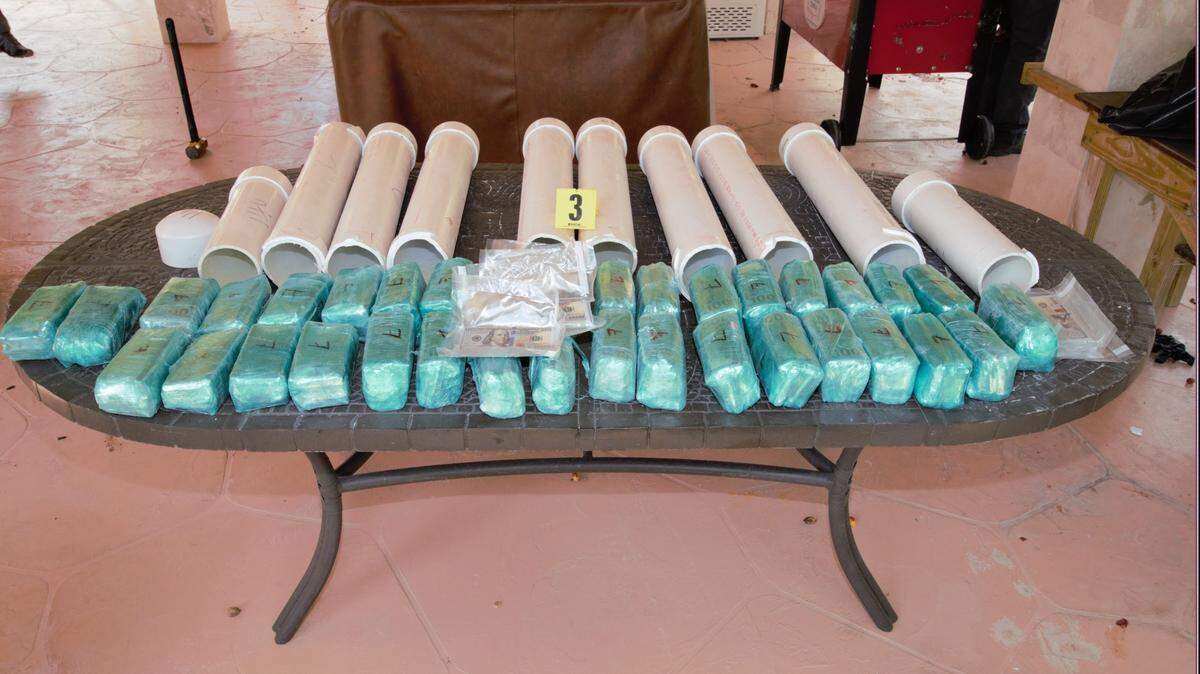
Armed with excavation equipment, federal agents this week uncovered about $2.5 million in cash hidden in PVC pipes buried under the closet floor of one of the bedrooms in Garces’ sprawling home in Southwest Miami-Dade. The money, suspected of coming from illicit Medicare payments, was all in $100 denominations — wrapped in cellophane bundles and tucked inside three-inch white PVC pipes with caps on the ends, authorities said.
Agents also found another $75,000 in a safe at his five-bedroom home with pool. Then, they discovered another $280,000 in a safe at another home linked to him. And, to top it off, they also seized seven Rolex watches.
Garces’ defense attorney, Gustavo Lage, could not be reached for comment Friday.
The U.S. Attorney’s Office confirmed Wednesday’s unusual search at Garces’ home. What sets the seizure apart in the nation’s long-recognized capital of healthcare fraud is that authorities actually found some of the cash from Garces’ alleged scheme. More often, illicit Medicare fraud proceeds are blown on luxury homes, exotic cars and pricey yachts, or some defendants flee with their money to a foreign country, such as the Dominican Republic, Spain and Cuba.
On Wednesday, swarms of agents with Health and Human Services, the FBI, FDIC and Customs and Border Protection, along with Miami-Dade Police, descended on Garces’ home at 2840 SW 128th Ave. and spent much of the day digging up the loot.
Garces was not at home when the agents arrived with a search warrant. Since his arrest in late 2019, Garces has been held at the Federal Detention Center in Miami after a magistrate judge found there was a risk he could flee to Cuba, where he was born in 1971, or to another foreign country.
Garces, 50, has been charged with conspiracy to commit healthcare fraud by filing false claims through his medical equipment businesses to Medicare as well as private insurers, such as Cigna, United Healthcare and Blue Cross Blue Shield. According to an indictment, Garces recruited nominee owners for his businesses and others to cash checks for him from Medicare and the private insurers. His businesses collected at least $14.4 million in fraudulent payments from Medicare and the other insurers between 2017 and 2019, according to the indictment, which was filed by Justice Department prosecutors Alexander Pogozelski and Anne McNamara.
Two of Garces’ co-defendants, Orlando Campa and Vicente Gonzalez, have pleaded guilty to a money laundering conspiracy as part of the main case. Gonzalez was sentenced to two years and four months in prison. Also, five more co-defendants were recently charged in a related money-laundering conspiracy case.
According to a detention order, Garces hired recruits to serve as nominee owners for his medical equipment businesses — BF Distributors, Timely Medical Services, Ortho-Med, Expedited Medical Supplies and Prime Orthopedic Solutions.
“After the defendant [Garces] was done using the nominees, he would send the nominees to Cuba to avoid detection,” Magistrate Judge John J. O’Sullivan wrote in his Dec. 17, 2019, detention order. “The defendant also used multiple money launderers to hide the source of the fraud proceeds.
“These money launderers provided the defendant with large sums of cash,” O’Sullivan wrote, noting that federal investigators found that “Garces received $100,000 in cash per week from one of the money launderers for a two-year period.”
In deciding to detain Garces before trial, scheduled for later this year, O’Sullivan highlighted that Garces was stopped at Miami International Airport on his way to Cuba with about $23,475 in cash. In this instance, Garces decided not to make the trip.
“The defendant travels yearly to Cuba and has a sister who resides there,” the magistrate judge further noted. “The defendant has also traveled to Jamaica, the Bahamas and the Dominican Republic.”
Not only does Garces face more than 30 years in prison if convicted, but prosecutors plan to forfeit all of his Medicare and private insurance payments — including the $3 million uncovered in the PVC pipes and safes at his home and another property this week.
The feds’ cash haul brings to mind another bizarre seizure involving $22 million found in a Miami Lakes’ home — all stashed in buckets above a closet.
Luis Hernandez-Gonzalez ran a Miami indoor gardening supply store favored by marijuana growers from across the nation — some legal, some not. They bought light bulbs, fans and fertilizers with names such as “Bud Candy” and “Big Bud.”
It wasn’t doing business with pot dealers that ultimately landed him in legal trouble — it was how he tried to skirt federal banking regulations. In 2018, a judge sentenced Hernandez-Gonzalez to just over five years in prison for making a series of illegal bank deposits intended to hide his growing fortune from the U.S. government.
This story was originally published March 19, 2021 at 2:03 PM.