By drone or drive-in, Miami is finding religion in a pandemic on the holiest Jewish days
The start of the Jewish High Holidays has traditionally meant hundreds of people packed into a synagogue to celebrate the new year with prayer and song.
COVID-19 has changed that.
Many synagogues have moved to weekly Zoom services to celebrate the Sabbath. Now, they have taken another step. Rabbis are turning to drones and drive-ins, cardboard congregants like those found at baseball games, even socially distant horn-blowing.
It’s all happening as Jews across South Florida prepare to celebrate Rosh Hashana, the Jewish New Year.
The High Holy Days mark the sacred 10-day stretch between Rosh Hashana and Yom Kippur, the Day of Atonement, where Jews reflect on the past year and will prepare to start the Jewish year of 5781 with a clean slate. This year, Rosh Hashana begins at sundown Friday and ends Sunday. Yom Kippur begins at sundown Sept. 27 and ends at sundown Sept. 28.
The holidays are a spiritual time of year for the Jewish faithful. But for synagogues, it’s also a time to attract new members and raise money.
While some rabbis will lead in-person services, others are finding new ways to lead prayer at a time when many are reluctant to gather in large groups, even if it’s for something as important as prayer and reflection during the most important dates on the Jewish calendar.
So, synagogues are getting creative.
For instance, as an alternative to throwing breadcrumbs into a flowing body of water as part of an ancient ritual, synagogues and organizations in South Miami-Dade have teamed up to host the ceremony virtually — with the help of a drone.
An Aventura congregation is taking the High Holy Day services to the big screen and offering a drive-in movie experience.
Others have created “productions,” promising streamed services with interactive options in order to make it feel “as normal as possible.”
“Why is this year different than all other years? We cannot, in good conscience, simply put on services just like we have in years past,” said Temple Beth Am’s Rabbi Rachel Greengrass.
While most Orthodox communities — the most observant Jews who refrain from using technology on the Sabbath and religious holidays — will have socially distanced in-person services, other congregations across South Florida are choosing to rely on the internet or a hybrid approach to the holidays.
Rabbi Fred Klein, executive vice president of the Rabbinical Association of Greater Miami and director of Mishkan Miami, a spiritual support group, said the pandemic has challenged rabbis not to think of why things happen, but rather how people can respond.
“This is the situation we are in, how can we respond in the most powerful way to bring people close to God, bring them close to community, bring them a sense of purpose, resilience right now,” he said. “So while there are obstacles, there are also opportunities for rabbis to re-create and think about how they can connect.”
For Florida International University junior Keren Szmuler, the Jewish holidays have always been a “big deal” in her family. Attending services. Gathering with family for a meal. Seeing people she doesn’t see often. Connecting.
“Services are going to be virtual this year, which is definitely going to be super-interesting,” said the 20-year-old, who is involved in FIU’S Hillel. “We are still going to try to make it as special as possible and appreciate the importance of the holiday.”

A deeper, spiritual connection
Even with the shift to virtual services or smaller gatherings, rabbis say they are sensing a more spiritual connection with the holiday.
“It’s a time of humility and fear,” Temple Beth Am’s Greengrass said. “COVID has certainly put us in this frame of mind. It has asked us to reevaluate how we are living. It’s asked us to let go of so much while reminding us of what really matters.”
Jacob Solomon, president and CEO of the Greater Miami Jewish Federation, said it is important to keep in mind that even though it is not possible for many to be together in person, no one should feel alone.
“Don’t let the fact that it will be different keep you from finding a way to connect with community, to connect with synagogue worship, to connect with each other during the holidays,” he said. “There are literally scores of online opportunities for people to engage in synagogue worship without leaving the safety of their homes.”
In addition to services and activities on the actual holidays, this year the Federation held a series leading up to the holidays dubbed 40 Days 40 Nights. The program included daily educational sessions focusing on reflection and introspection. The federation also held a kosher food drive, offering people bags with apples, challah and other traditional holiday foods.
Groups that reach out to college age students including Base Miami and Hillel have increased their virtual offerings to bring people together, even if it’s through Zoom.
Rabbi Adam Gindea, director of Base Miami, said the focus has been to set up small virtual learning cohorts to “help people in the spiritual quest of what the High Holidays are really about.”
Jon Warech, the director of FIU’s Hillel, said it’s “definitely a challenge trying to re-imagine different things.” In the past, the group has held a comedy night fundraiser called Rosh HaHaha. This year it was virtual.
Solomon said he would encourage people to approach the holidays with an open mind, and not fear.
“We may not be able to change fate, we may not be able to pray away a pandemic. But if we respond with action, with prayer, with repentance, with charity, then we can find meaning regardless of how painfully difficult a particular crisis or hardship is,” he said. “We need to confront the realities that we are dealt with, but we are enjoined to respond to those with behaviors that bring God into the world.”
Bringing the service to the people
Where and how people worship this year will be different.
“Usually, on the Holy Days, the individual comes to the synagogue to gather as a community. This year, the synagogue will go to the individual, bringing prayer and song, messages of hope and healing. We might be physically apart, but definitely spiritually connected,” said Rabbi Marc Philippe of Temple Emanu-El in Miami Beach.
Temple Emanu-El and Chabad of Kendall will offer in-person services, but with seating restrictions and a mask requirement. Temple Emanu-El will also add a live-streaming component. Temple Sinai of North Dade and Temple Judea in Coral Gables will offer livestream services as well.
“After 25 years as a rabbi, knowing I know how to do services, what this has done ... is challenged me to think about what is the High Holy Day experience and how do we invite and encourage our congregants to have that experience in a deeper and more meaningful way,” said Temple Sinai of North Dade Rabbi Alan Litwak.
He said one way they have done it is by using videos and technology to make people feel as if they were in the sanctuary and celebrating with their community.
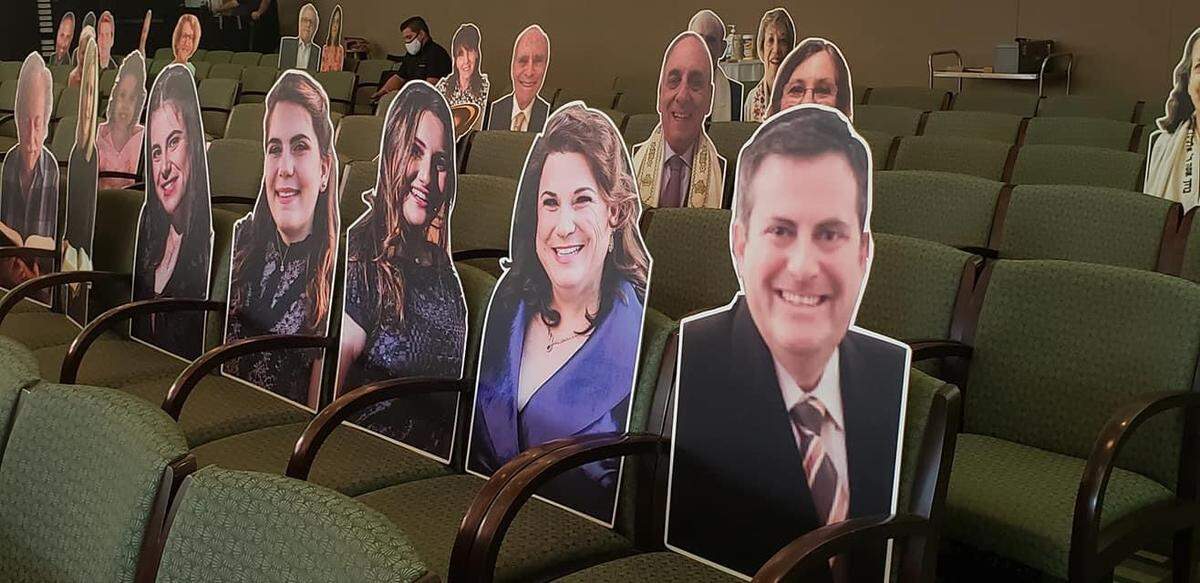
Rabbi Judith Siegal of Temple Judea said one way they have come up with to help both the clergy and the people watching through livestream feel like they are together is by putting cutout pictures of congregants in the chairs, just like at empty baseball stadiums.
“This way people can see themselves in the sanctuary,” she said.
Temple Beth Am is live-streaming. Another, Aventura Turnberry Jewish Center, is offering a High Holy Days Drive-In of three evening services on a 40-foot screen at Dezerland Park in North Miami.
“Along with congregations around the world, we have been thinking creatively about this most significant moment in the Jewish calendar when communities have historically gathered together in the synagogue. Even in this new normal, we still believe it is possible to create meaningful worship experiences in addition to online services,” said Aventura Rabbi Jonathan Berkun in a statement.
“As drive-in movie theaters have made a resurgence, we realized this could be a viable and memorable option for many of our members,” Berkun said.
Still, the rabbis are aware that even with the precautions and creative ideas, many congregants are opting to stay home.
Rabbi Yossi Harlig said Chabad of Kendall, which is not live-streaming, is sending out Rosh Hashana boxes filled with wine, honey, cake and step-by-step manuals on how members and guests can pray at home and prepare holiday foods. Chabad also led a food drive before the holidays as well as Zoom classes on the meaning of the High Holy Days.
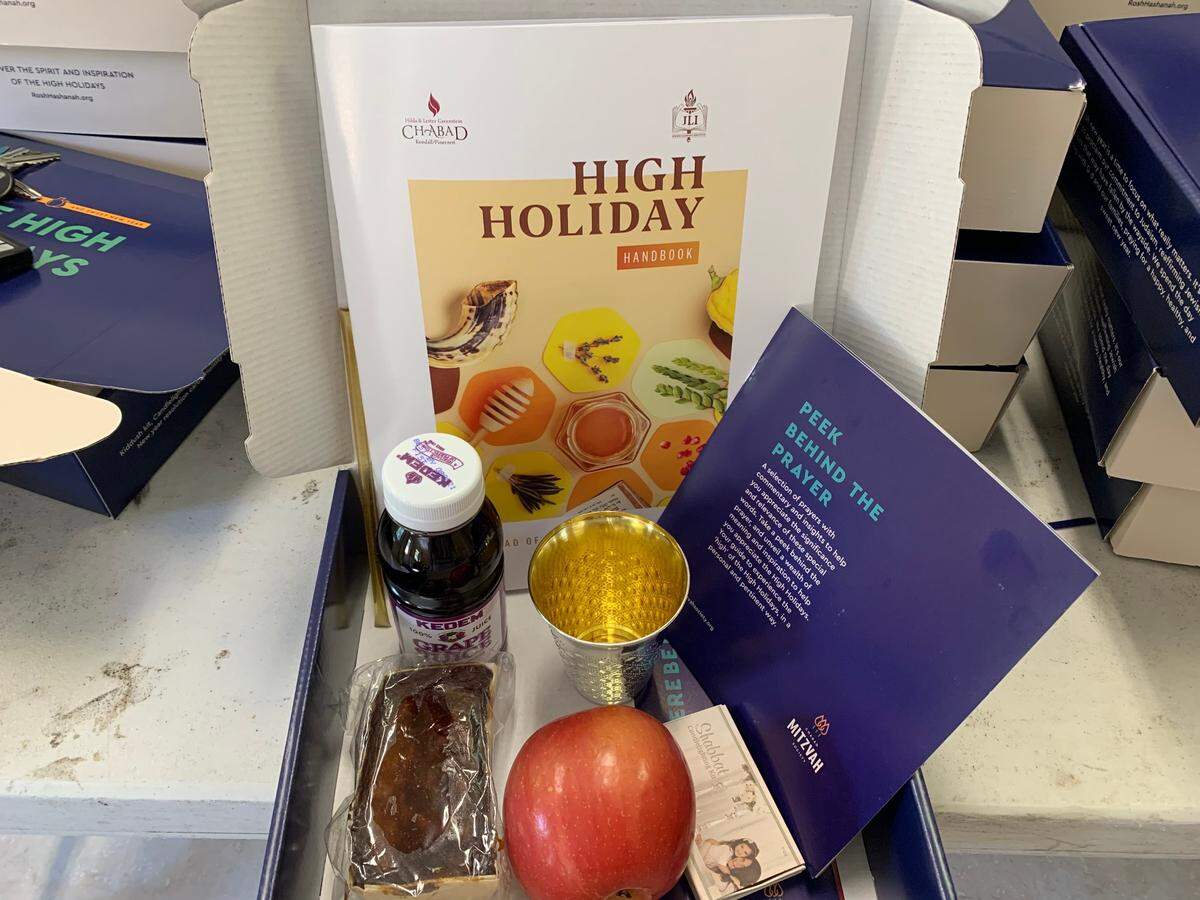
“Now, you have to do it yourself so it’s a more intense, personal holiday this year,” Harlig said. “You can’t sit back and you have to create for yourself — with help from the rabbi — but you can’t rely on just that.”
Adds Temple Emanu-El’s Philippe: “Our theme for the High Holy Days this year is: ‘Physically apart. Spiritually connected.’ As a community, we want to emphasize the importance of our connection with each other and also strengthen our connection with the Divine,” he said in an email.
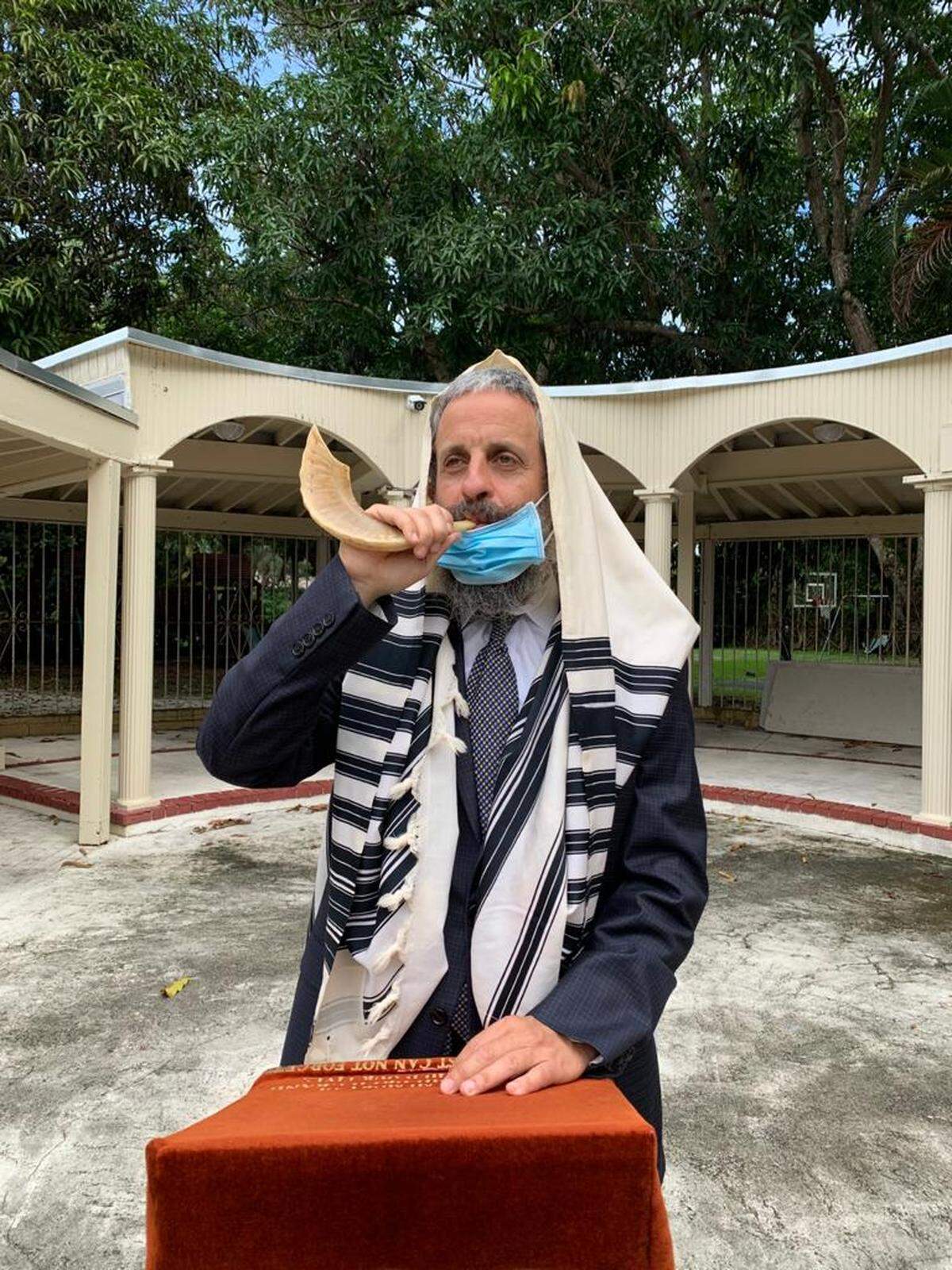
Services will be shorter than in years past and easier to follow, even without a prayer book, he said. The traditional blowing of the shofar will look a bit different, too.
At Chabad, that part of the service will be held outdoors in a tented area. At Temple Sinai of North Dade, the shofar blowing will be done in the parking lot.
Creativity abounds when giving praise and keeping traditions.
Due to COVID-19, the congregants at Temple Emanu-El will all stand outside their homes during Rosh Hashana on Sunday. At exactly 1 p.m., they will all blow the shofar in unison.
Caryn Tanis Borena, spokeswoman for the synagogue, explained the tradition of blowing the shofar: “The shofar was blown at Mount Sinai when the Torah was given [to Moses]. On Rosh Hashana, we blow the shofar to remind us to rededicate ourselves to Torah study, and to remind God of our original commitment and sincerity. It is our tradition.”
Dubbing the event “The Big Blow,” Tanis Borena said members of the temple will blow the shofar from outside their homes in unison as follows: one long, loud blast; three broken blasts; nine broken blasts, and one strong, extra long blast.
“More than ever, the synagogue has to be a refuge, a place of healing, hope and inspiration. There will be inspiring stories and music to create a ... sacred space, wherever you may be,” Philippe said.
Membership drive
The High Holy Days is that time of year when synagogues shore up memberships, sell tickets to services, and draw donations to help stay financially sound. The pandemic poses another challenge.
“This is definitely a concern,” Philippe said. “This is why we are planning services as compelling as possible in order to encourage donations to help the outreach work that we do.”
.jpeg "Image (1).jpeg")
Twist on tradition
But perhaps one of the most creative takes on an ancient ritual is doing it with a drone. Rabbi Dan Horwitz, CEO of the Alper JCC in Kendall, said he wanted to create a new ritual everyone could take part in.
Horwitz said a group of South Miami-Dade synagogues and organizations hired an operator to fly a drone over the Atlantic Ocean on Sunday. Leading up to the flight, people are being asked to submit something they perceive as their shortcoming.
The messages will be written on hydro-degradable paper, loaded onto the drone and dropped into the Atlantic as people watch through a livestream. Traditionally, the ritual is done by tossing pieces of bread into the water.
“Seeing the release of literally hundreds and hundreds of these Post-it sized pieces of hydro-degradable paper with peoples’ shortcomings written down on them is a reminder that everyone is part of a community,” he said. “This will be something larger than ourselves.”
How and where to worship
This is how some synagogues plan to host the holidays.
▪ Chabad of Kendall, 8700 SW 112th St., will host Rosh Hashana and Yom Kippur services indoors and outdoors in shifts, as well as shofar and tashlich by the lake. Seating will be limited, says Rabbi Yossi Harlig, and congregants’ temperatures will be taken as a precaution. Masks are required. You can make reservations at www.chabadofkendall.org.
▪ Temple Emanu-El, 1701 Washington Ave. in Miami Beach, will be open for members who reserve in advance, says Rabbi Marc Philippe. “Masks will have to be worn at all times. Families will sit together but must be 10 feet apart from other people. Restrooms will be disinfected after each use.”
Services will also be livestreamed on the temple’s site and on its Facebook page if worshipers are more comfortable staying at home. For more information, visit www.tesobe.org for log-on details or call the temple at 305-538-2503.
▪ Temple Beth Sholom of Miami Beach will livestream its services — including Evrev, Rosh Hashana, Kol Nidre and Yom Kippur — on its platform and via Facebook Live. Information: www.tbsmb.org/hhdtbs.
Says Rabbi Gayle Pomerantz: “We have re-imagined the High Holy Days to touch people’s lives through music, prayer, inspirational words and virtual gatherings to uplift and heal us in these unprecedented times. Our services will reflect the unique faces and voices of Temple Beth Sholom in song and in prayer.”
▪ Bet Shira Congregation hosts High Holy Days @ Bet Shira virtual services free and open to the community with reservations at www.betshira.org.
“We believe in the year of COVID, when so many are hurting in so many ways, that it is wrong to deprive High Holy Day services to anyone — especially if they cannot financially afford it,” said Bet Shira’s Rabbi Benjamin Herman in a statement.
▪ Temple Israel of Greater Miami hosts High Holy Days services virtually via Zoom. Visit www.templeisrael.net for details.
At 7 p.m. Friday, Sept. 18, Temple Israel will also host a “drive-in” service for its members with Rabbi Amy Morrison and Cantorial Soloist Karen Pincus. Both will lead the Erev Rosh Hashana/Shabbat Ma’ariv service on the steps of the temple’s nearly 100-year-old sanctuary. Cars must have a parking tab provided by the temple to its members as cars park north in the parking lot to face Morrison and Pincus at 137 NE 19th St.
Members should have received a mailing with the drive-in services information. If not, email info@templeisrael.net.
▪ Aventura Turnberry Jewish Center hosts a three-day High Holy Days Drive-In experience on a 40-foot screen at Dezerland Park, 14401 NE 19th Ave., North Miami. Erev Rosh Hashana at 6:30 p.m. Friday, Sept. 18. The second evening of Rosh Hashana conducted in Spanish at 6:45 p.m. Saturday, Sept. 19, and Ne’ilah Yom Kippur Night at 6 p.m. Monday, Sept. 28.
These experiences are included with members’ paid annual commitment, but the center suggests a $50 donation per car and registration is required. Non-members can sign up for $250 at www.atjc.org/event/drive-in.
Information on Aventura’s livestreamed services at www.atjchome.org/high-holy-days-online-services.
▪ Alper Jewish Community Center will hold the drone tashlich at 2:45 p.m. Sunday Sept. 20. The ceremony will be livestreamed on the JCC’s Facebook page and the partnering organizations’ pages. Those participating are: Base Miami, Bet Shira, Beth Am, Beth David, Dor Chadash, FIU Hillel, Greater Miami Jewish Federation, Temple Judea and UM Hillel. To submit a shortcoming, visit bit.ly/miamitashlich.
▪ Temple Sinai of North Dade will stream almost all of its services. For the past month, the synagogue has offered live, digital services, some prerecorded services and opportunities to be together in the sanctuary. The Erev Rosh Hashana service on will go live on the temple’s YouTube page at 5 p.m. Services will begin at 9:30 a.m. with a family service. There will be a Shofar blowing experience at the synagogue open to the public at 3 p.m.
For more information on the syanogue’s services for Rosh Hashana and Yom Kippur, visit https://www.tsnd.org/hhd.
▪ Base Miami is offering a holiday companion to help navigate the High Holy Days. The 22-page guide is full of readings, questions to ponder, and even offers holiday recipes.
▪ Temple Judea in Coral Gables will offer livestream services for Rosh Hashana and Yom Kippur, some of which will be available to the public. Among the temple’s holiday plans for congregants: a scavenger hunt, holiday bag giveaway and a youth service. A virtual tashlich service, second day Rosh Hashana service and a Yom Kippur Yizkor Service will be available to everyone.
▪ Dor Chadesh, 9560 SW 107 Ave., Rosh Hashana services are available on Zoom at 7:30 p.m. Friday and 10 a.m. Saturday. A family service will be conducted live on the synagogue’s Facebook page at 3 p.m. Saturday. There will also be a drive-in shofar experience at 2 p.m. Sunday at the synagogue. For more information, visit www.highholidays2020.org.
For more information visit, https://www.judeagables.org/hhd2020.shofar.
▪ Temple Beth Or’s Reimagined High Holy Days Journey will feature Rosh Hashana and Yom Kippur services, and other programming, via Zoom. Visit bethormiami.com/high-holidays for information on registering and the various events.
Bea Hines, who writes a religion column for the Miami Herald’s Neighbors section, contributed to this report
This story was originally published September 17, 2020 at 7:00 AM.