They’re doctors, teachers, first responders — motherhood in the time of coronavirus
For these women, forgetting about the coronavirus is not an option.
They don’t like the term “hero,” but some go into work these days like it’s their own battlefield, to a hospital or a fire department, armed with face shields and boxes of latex gloves.
They care for families while they often risk the safety of their own. While some have witnessed fragile newborns take their first few breaths of life, others have felt the toll of the COVID-19 pandemic as their patients take their last.
They’re South Florida mothers: teachers, firefighters, police officers, doctors who are witnessing life on the frontlines of the coronavirus crisis.
For Mother’s Day, the Miami Herald spoke to six women about what they’ve lost and gained in motherhood in the era of coronavirus.
Some ‘very rough nights’ in the ICU
Not much will make Dr. Lesley Farquharson flinch as an overnight intensivist in the ICU at the University of Miami Hospital, where she works with the “sickest of the sick.” The work is the same, she says. Just an added three pounds of protective gear.
“It becomes … hot. Hot is probably the easiest word to describe it,” she says.
She admits fear looks a little different these days.
“The thought crosses my mind if I’m at work and a patient starts coughing, and I happen to be right in their face by the time when they start doing that,” says Farquharson, 35. “I’m like, ‘Oh God, Oh God. And then it passes, because I remember, ‘Oh wait you have your N95.’ ... It’s momentary anxiety, not anything that’s crippling.”
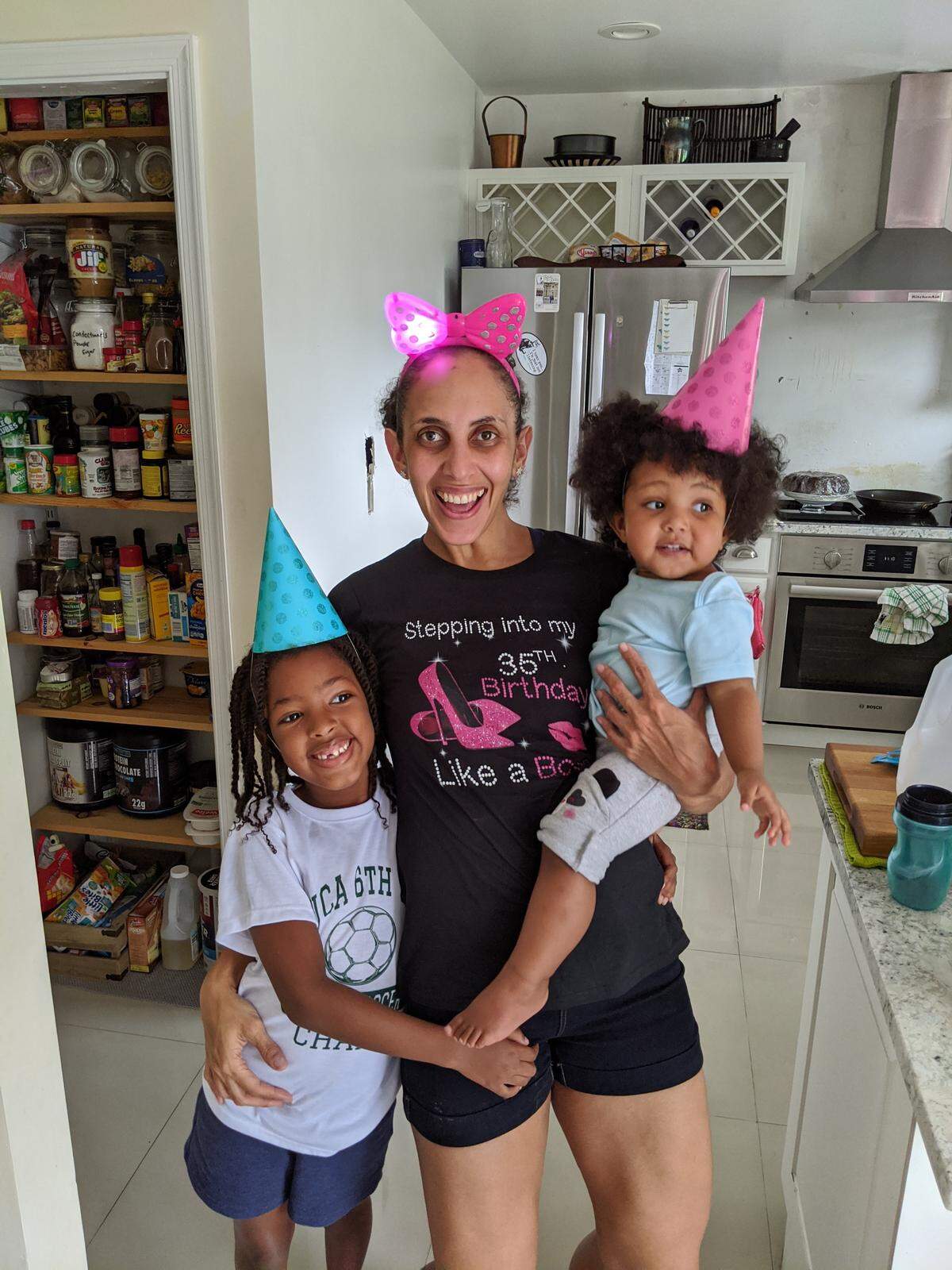
Farquharson has two daughters, 6-year-old Amira and 1-year-old Leah. For the past four years, she works on the overnight shift, returning home about 7 a.m., just in time to see her oldest daughter wake up and get ready for school. Her husband, a software engineer, cares for the girls during the evening.
Ever since she began her medical residency, she knew she wanted to work in an intensive care unit. “Basically, I fell in love with the ICU, as macabre as that sounds.”
Now, when she’s ready to come home from her four 12-hour shifts treating COVID-19 patients, she changes her clothes at work, trades her shoes in the car, and puts her clothes straight in the washer at home. When she’s done, she runs an empty load with bleach before anyone uses it again.
“I feel like most of the horror stories are probably accurate to a large extent,” she said. “Patients are going to die, especially in the ICU; these are the sickest of the sick. So, people die. But usually there’s some kind of emotional valve. Their families are there, people can help kind of take the edge off. But with this, it’s just you.”
People ask Farquharson sometimes why she hasn’t quarantined from her kids. Her answer is quite simple: It’s just not possible. Her youngest uses her hair as a pacifier. Her oldest wants to tell her about a dream she’s had the night before.
“I think the biggest issue that has been coming up is this idea of women ‘having it all’ or ‘doing it all.’ ...You have to be 100% mom, 100% physician or what ever other high-pressure job you have, 100% member of society. Everything is 100%. That’s mathematically not possible. Something is going to have to give,” Farquharson said.
“I’ve had very rough nights and I come home and it’s, ‘OK. Like the dirty clothes, that gets left at the door.’ ”
Bianca Padró Ocasio
‘Mom, How do you examine patients when you are home?’
Before the pandemic, Starr Mautner, M.D., felt she had work and family figured out.
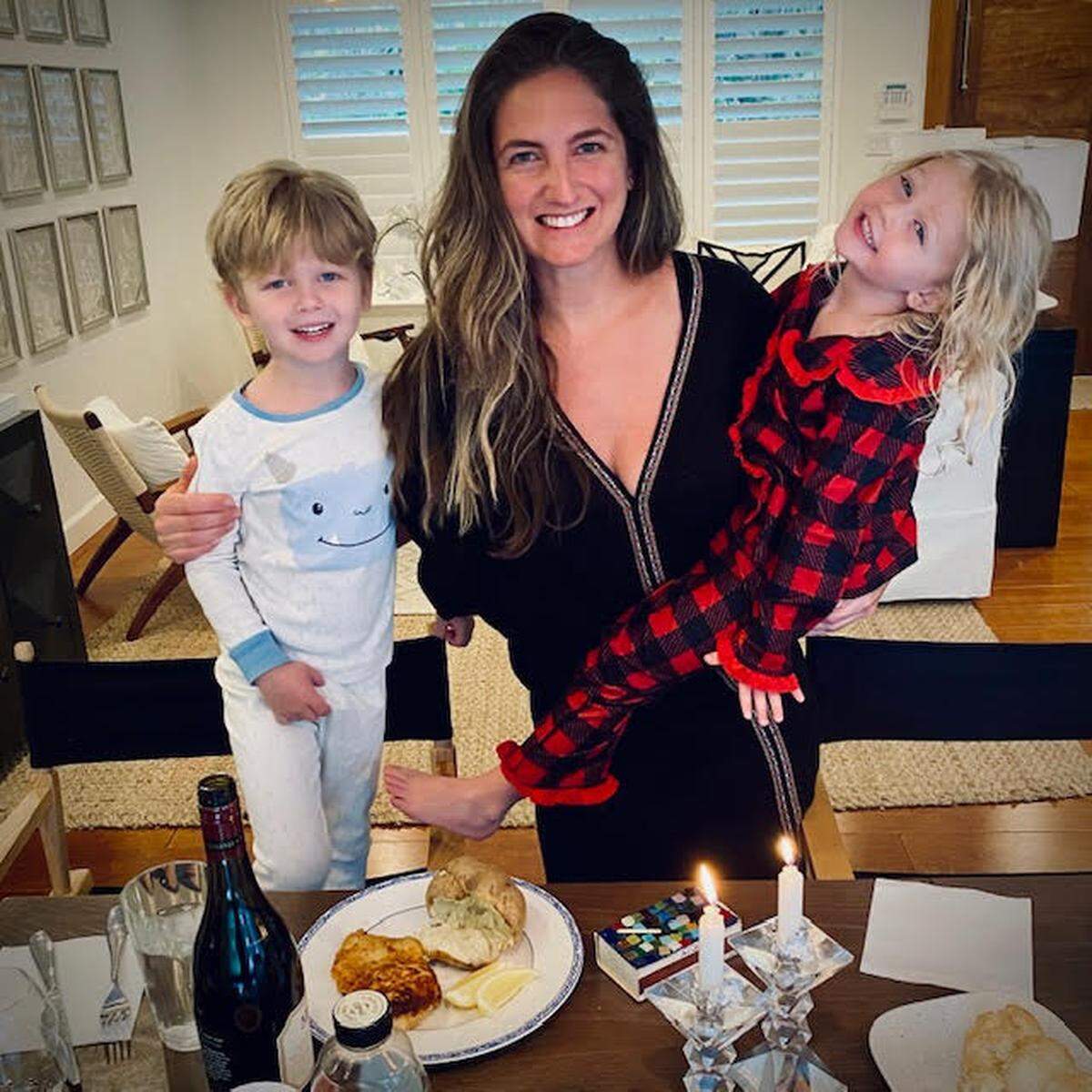
She’s a breast surgical oncologist at the Miami Cancer Institute, part of Baptist Health South Florida. Mautner and her husband, who works in finance for Bank United, had their daily routines down. They had relatives and part-time nannies to take care of Arie, 5, and his sister Silver, 3. They had time for family and careers, for exercise and travel.
“You’re used to making sacrifices, you go into it knowing that that’s what you do,” said Mautner, 37. “I think it’s very empowering to be able to be a mom, have children, be a surgeon and kind of … have it all.”
Since the initial signs of COVID-19 spread in Florida, she has discontinued most in-person office visits and preventive surgeries. She still takes virtual appointments from home, but a lot of her job entails touching and feeling for tumors in person.
“My son asked me the other day, ... ‘Mom, how do you examine the patients when you’re at home?’” as he watched her speaking to patients via telemedicine.
“I said, ‘We do the best that we can visually by seeing them over the computer, like FaceTime. But you’re right: You can’t touch. You can’t feel,”’ Mautner explained. “So it’s limited what I can do virtually.’”
Mautner still operates one or two days a week on her most urgent breast cancer patients. She wears heavy gear, protective equipment she hasn’t worn since she was a medical student. Even though they test every patient for COVID-19 before surgery, she wears an N95 mask when she operates to protect from potentially harmful respiratory secretions that can linger in the air for hours.
She assumes everyone around her has the virus.
“You try to get in and out and just do your job and no one’s like lingering around and socializing,” Mautner said. “None of us actually feel that that we’re doing is that heroic. Not to not take that for granted but this is our job ... We’re just trying to navigate through it and survive it as well.”
When Mautner goes home, she takes all her work clothes off in the garage and drops them in the washing machine. She doesn’t touch anything. She showers. Then, she finally hugs her kids.
As Florida moves forward with attempts to safely reopen, Baptist is also trying to return to some level of normalcy. She and her husband are juggling returning to work and safely caring for their children, with their safety nets upended as they try to limit the people they see.
“There’s been a lot of stories lately about how this has added stress to the normal gender roles that are in the household, and how this is even more stress for mothers now who are the virtual homeschoolers, the chef, the caretaker and working,” Mautner said. “I don’t get it. What are all these other people doing that are not even fortunate enough to be in a good financial situation like we are? The grocery store worker who has two or three kids. What are they doing? Who’s watching their kids?”
Bianca Padró Ocasio
The ‘Mom’ of the Miami firehouse
Around Miami Fire Station 11, Melissa Winchester is known as the mom of the house.
The 42-year-old, who has been a Miami Fire Rescue firefighter for nearly 20 years, makes sure her fellow firefighters are fed, gives the younger recruits advice and worries about everyone’s safety.
At home, Winchester is the proud mom of a 10-year-old boy, whom she loves to hug, kiss and hang out with.
But lately — with the coronavirus looming — Winchester has even more to worry about.
“It’s always on your mind,” she said, fearing she may unknowingly bring COVID-19 home to her family. “We always have to be careful, but this is a new level.”
Instead of leaving work after a 24-hour shift and rushing home to see her son Derek and her husband, Battalion Chief Michael Winchester, also a Miami firefighter, she showers before leaving, puts on fresh clothes and then changes again once she gets home. She doesn’t drink from their cups, doesn’t eat from their plates and washes her hands “all the time.”
And because she knows any routine call could be a possible exposure, she is avoiding seeing her Cuban mom and her 88-year-old grandmother, her mother’s mother.
“Mother’s Day is going to be hard this year,” she said. “But we can’t risk it.”
Normally, she would go to her mom’s house for brunch, as would her two sisters and brother and their families. She said they’ve been talking over FaceTime.
Rita Duran, Winchester’s mother, said it’s been hard not seeing her daughter and grandson, but she is proud of the work her daughter does.
“As a mother, you always worry about your child,” she said. “But she is doing something she loves.”
Winchester, who grew up in the Carol City-Miami Lakes area and graduated from American Senior High, knew early on she wanted to be a firefighter.
“I always loved helping people,” said Winchester, whom Miami Fire Rescue hired in 2000. “And I like that every day is different.”
Around the firehouse, everyone is “extra careful all the time” to minimize exposure, she said. And though everything has changed, she continues to cook for her fellow firefighters so they can have their “family time” in the station house.
“I feel so lucky that I have a job that I enjoy,” she said. “I love doing it and have done it proudly for 20 years.”
Carli Teproff
‘Thank you for being our second mom’
Natalie Buissereth has about 50 kids she’s worrying about.
The North Miami police officer has one biological daughter who is now 26, but she has stepped in to mother dozens of children in the department’s Police Athletic League (PAL) program.
The after-school and summer program offers mentoring, homework help and a safe haven for the children, some of whom don’t have a stable home life.
“They are all my children,” Buissereth said of the children, who range in age from 10 to 17. “It’s very rewarding. We give the kids a chance to see a different side of law enforcement.”
Being apart from the children because of the pandemic has been hard on her. She worries if the nearly 50 kids enrolled are safe, if they have food and if they are staying out of trouble.
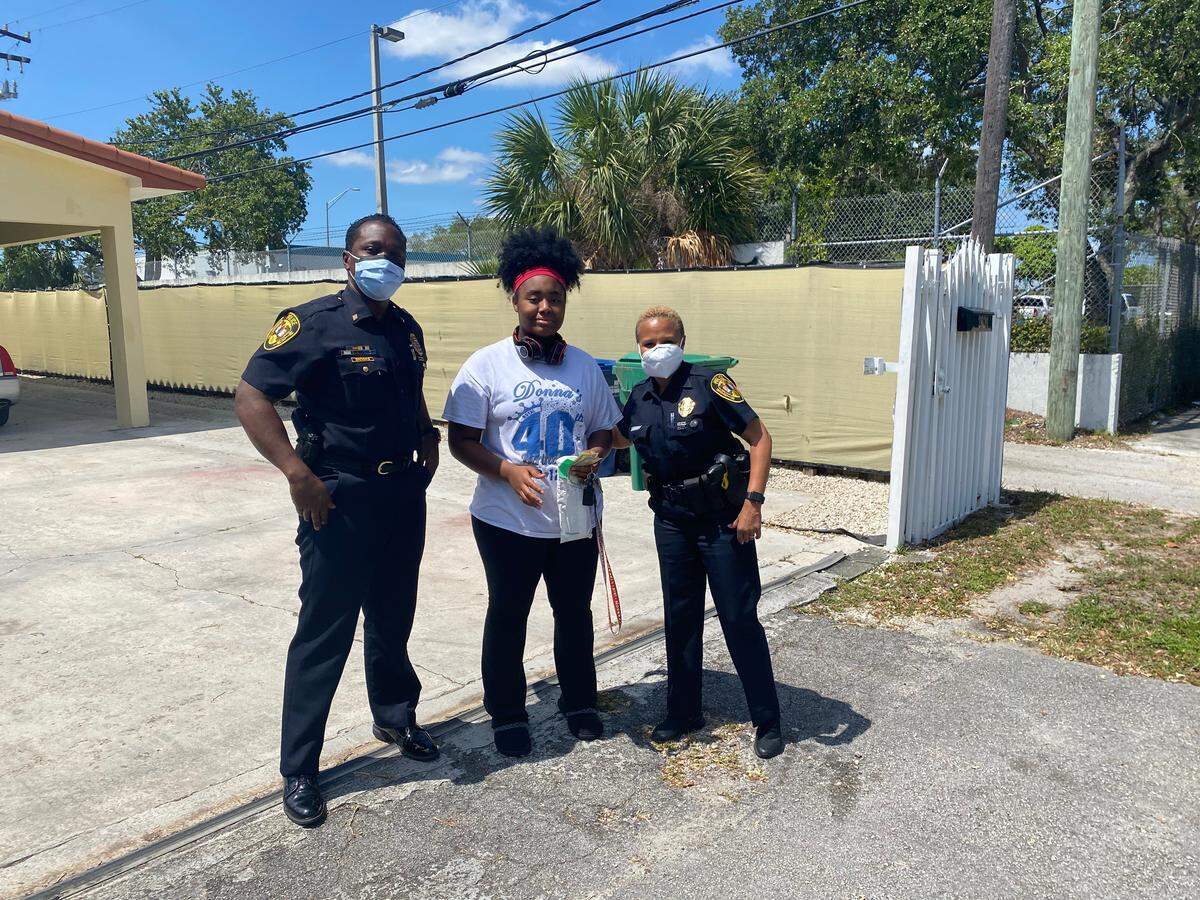
“For a lot of these kids, PAL is the one constant in their life,” she said. “I know they are missing it.”
While they can’t meet in person, Buissereth is holding Zoom meetings, visiting her kids one by one. She even dropped off lunch for the kids who live in the city, so they can have lunch together virtually. She said she is hoping to hear from them on Mother’s Day — a day she usually spends with her cousin after her own mother died a few years ago.
“The new normal is hard on everyone, but especially the kids,” she said.
Buissereth, who was born in New York and grew up in South Florida, worked in the medical field for years before following her childhood dream of becoming a police officer.
“I grew up hearing that Haitian women did not become police officers,” she said. “But it was something I always wanted to do.”
In 2013, North Miami police hired her. She started on routine patrol and became a spokeswoman for the department. In 2017, the department approached her about running the PAL program.
“At first, I didn’t really know if I wanted to do it,” she said.
Today, she said it was the best decision she could have made. She and her husband, who works in telecommunications, had considered fostering or adopting a child, but because of long hours and busy schedules, they didn’t do it.
She said PAL has filled that void.
“It’s like God answered my prayers,” said Buissereth, 49, “I feel like a proud mom,” she said.
North Miami Police Chief Larry Juriga said Buissereth “plays a critical role in the lives of these young children.”
“Many of the PAL children don’t have moms in the house and she fills that important role,” he said. “Her smile is comforting to the children and she truly loves not just working with them, but she loves them.”
Akai Blocker, 15, had a special message to “Officer Nathalie” for Mother’s Day: “Thank you for being there for us and for being proud of us. Thank you for being our second mom and our big, loving teddy bear.”
Carli Teproff
Three generations of teachers, beginning with grandmother in Cuba
Miami schoolteacher Jessica Steszewski gave birth to her second daughter last weekend in the middle of a world pandemic. She wore a face mask almost entirely through labor, until it got so hot that she felt she couldn’t breathe.
Along with her husband, who works for Amazon, Steszewski brought her own sanitizing wipes to the hospital. Not that she had to, but just in case. Until they made her sit in a wheelchair, she tried not to touch anything.
“All the nurses were amazing. It was really reassuring. .. Coming home now, we’re good. We’re quarantining again —just in case,” she said.
Steszewski is the third generation of teachers in her family. Her grandmother was a teacher in Cuba before she fled to Miami. Her mom taught Pre-K in Miami-Dade for 31 years.
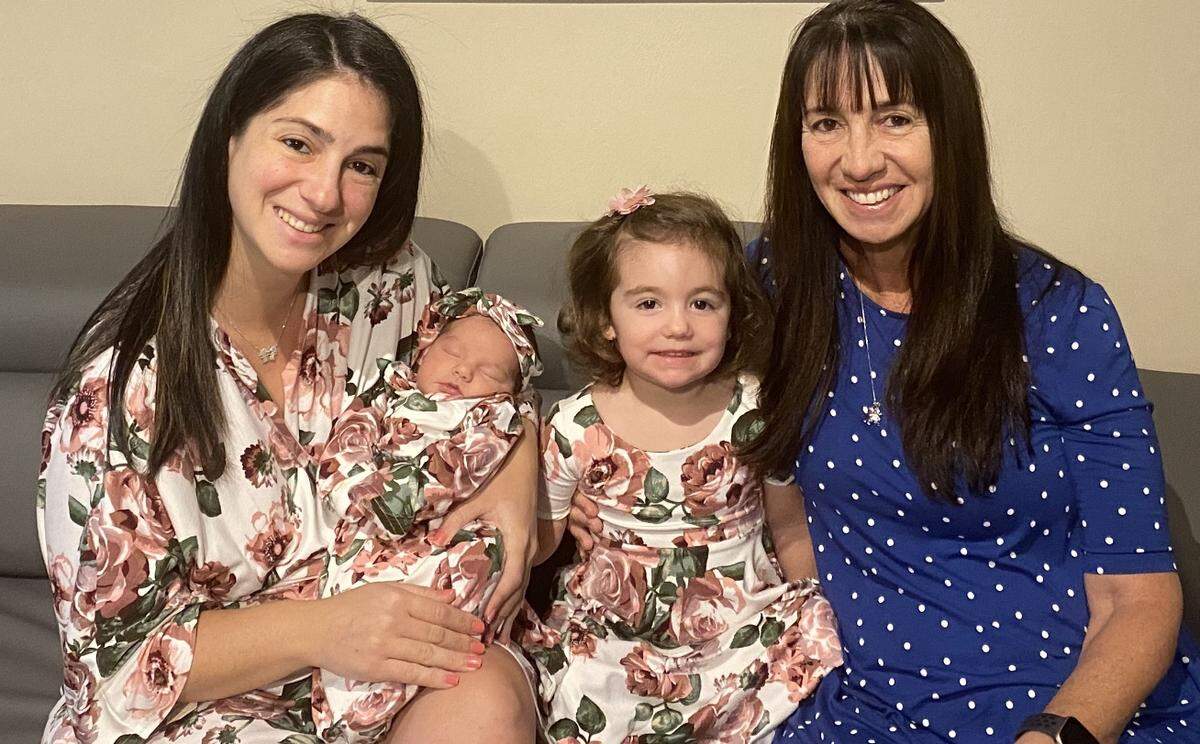
Steszewski, 31, is in her second year as a Pre-K teacher at Ruth K. Broad Bay Harbor K-8 Center in Bay Harbor Islands, after taking over her mom’s old job. Her school was abruptly closed the day before Miami-Dade Public Schools closed due to COVID-19, after an after-school caretaker was tested over suspected infection.
Before she gave birth to her daughter Ava, she was teaching her class, switching between phonics, math, story time and scavenger hunts inside their homes.
“Wednesday, we do show-and-tell so they bring something to the computer and they wait their turn and they watch,” Steszewski said. “They learn to raise their hand. They’re there and they’re actually a good class.”
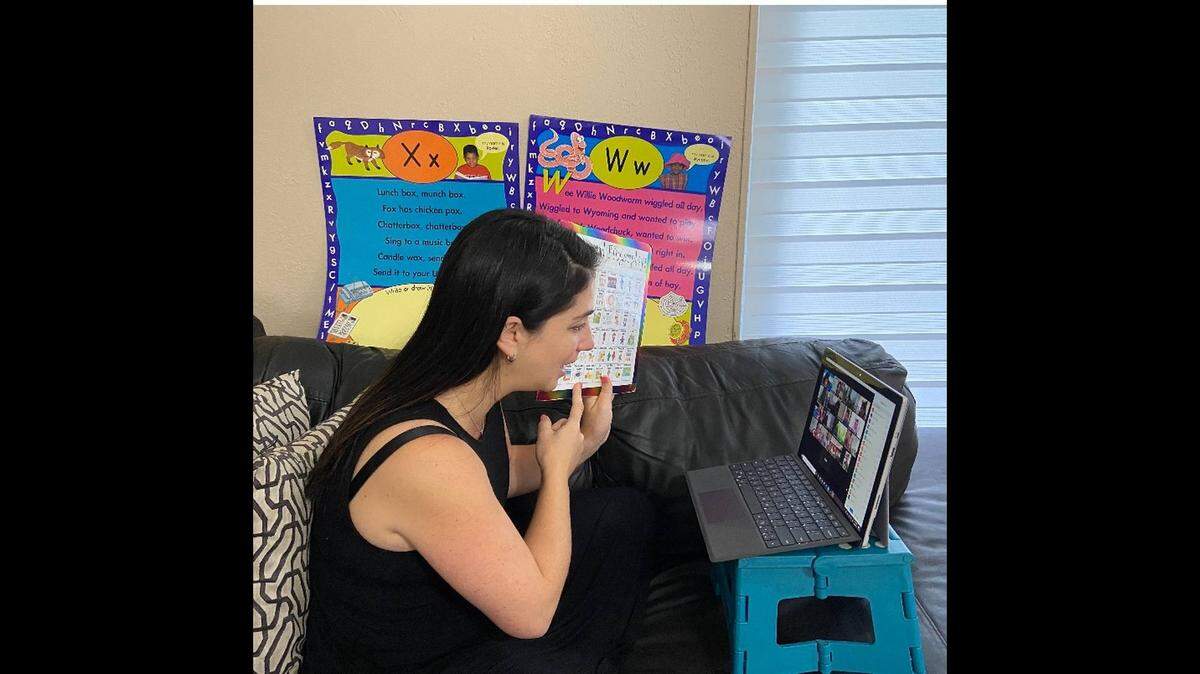
Sometimes the 4- to 5-year-olds will dip into a bit of sadness over missing in-person classes. They’ll talk about how they miss their classroom buddies. They share the most exciting part of their day, which sometimes means one of them got to climb a tree outside.
“I have to comfort them and reassure them that one day it will all go back to normal,” Steszewski said.
But sometimes it feels like the new normal is virtual.
Her oldest daughter, 2-year-old Mia, will sit and watch the class from behind her mom’s screen. When Mia visits with her grandmother across the street, she’ll use a jewelry box in front of a vanity mirror to pretend she’s teaching her own online classes.
“She was saying that she was a teacher and she was teaching her friends,” Steszewski said. “And she would hold a little card with a letter on it because mommy does it.”
Bianca Padró Ocasio
Helping parents take it one day at a time
Maria Paula Attento, a first-grade teacher at Aventura City of Excellence School, is constantly treading the line of how much to discuss about the coronavirus in her daily online classes with her 19 students.
Characters from “Sesame Street” making an appearance in the “One World: Together At Home” program have helped, she said. They talked about self-hugging and the importance of washing their hands.
“We kind of wanted to shelter them. We didn’t want to talk about it too much in the beginning,” said Attento, whose husband works in finance. “Yes, the parks are open, but it’s going to be different … The playground is closed. They have to wear masks; they can’t run up to their friends and play.”
She knows explaining this hasn’t been easy for parents, as she has three children of her own, ages 11, 10 and 7. She homeschools them individually, on top of her teaching responsibilities.
“I’m a mom, I’m a teacher and you’re almost being like a psychologist for the parents. They need that; they need to know whatever they’re doing is OK,” said Attento, 39, whose family is from Ecuador.
“I was telling one … the father is in the hospital like every day, so he’s missing out. And you have the only children who have parents that work, who live for the Zoom. But it’s hard for them to do the work if the parent is not able to,” Attento said.
So, she takes it one day at a time.
On Thursday, most of her class logged into their Zoom class to play Pictionary for a special Game Day session. One by one, she unmuted students as they raised their hands to guess what was in the image. Conforming to the new technology, Attento split the screen into a “breakout room” when she was whispering the answer to the student drawing the picture.
She says the challenges have made her kids’ parents and colleagues more sincere. They compare notes and share lesson plans with first-grade teachers at other schools.
“It’s kind of this rush of life. Everyone’s trying to compete, everyone wants to get the best grades,” she said. But now, she feels the teaching community is more encouraging than it used to be.
“We’re all individual, and we all have a different situation and what you’re doing is amazing.”
Bianca Padró Ocasio
This story was originally published May 9, 2020 at 7:00 AM.