Colombian kingpin dying in prison seeks ‘compassion’ from Miami judge to release him
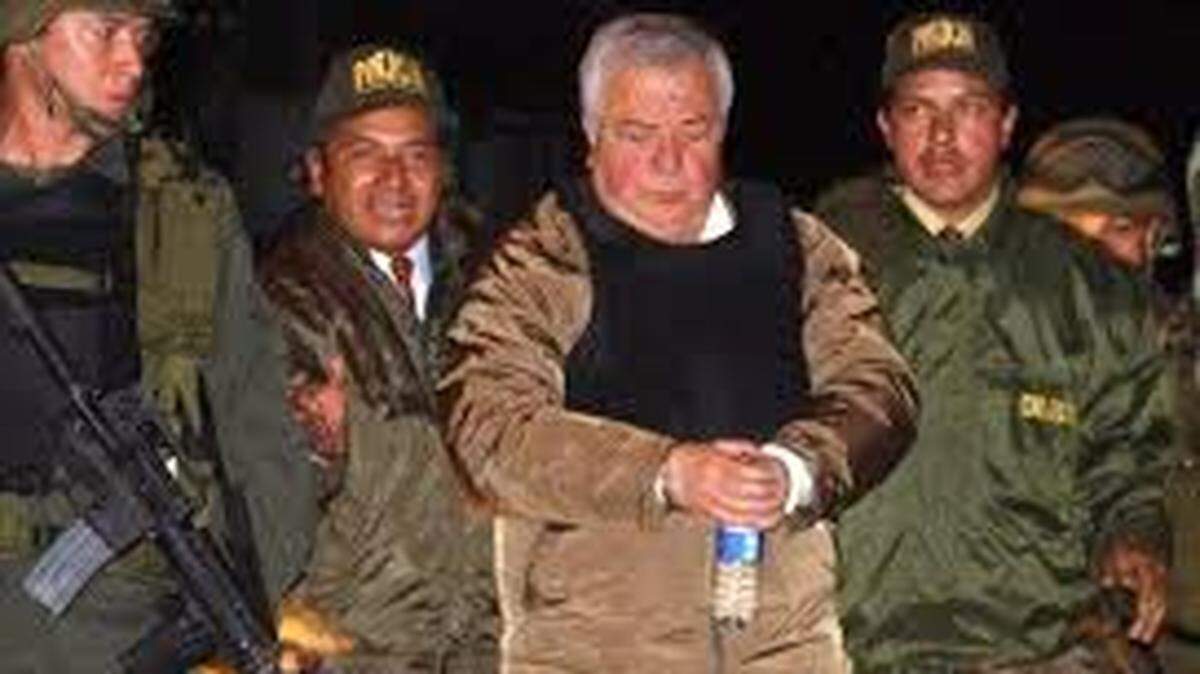
In a gallery of notorious international drug traffickers, Gilberto Rodriguez-Orejuela would rank near the top with Pablo Escobar — though he may not be as legendary as the Medellin kingpin glorified by Hollywood.
Rodriguez-Orejuela and his family led a powerful cartel based in Cali, Colombia, that revolutionized the cocaine-smuggling rackets in the 1980s and 1990s by turning the deadly narcotics business personified by Escobar into a corporate-like enterprise that exported an estimated 200 tons of white powder worth $2 billion into the United States.
But now, the 81-year-old Rodriguez-Orejuela says he’s dying after bouts with cancer in a U.S. prison and is hoping that his poor health will persuade a Miami federal judge to free him as an act of “compassionate release” under a new federal law, so he can spend his final days with his family in Colombia.
“He was a big-time drug dealer,” U.S. District Judge Federico Moreno said Wednesday during the first hearing on Rodriguez-Orejuela’s petition for release after spending 15 years in prison — about half of his sentence. “He was, there’s no question about that.”
Moreno, trying to keep an open mind about the inmate’s request, was stating the obvious. After all, both Gilberto and brother Miguel Rodriguez-Orejuela pleaded guilty to cocaine-smuggling conspiracy charges in 2006, accepting a maximum prison sentence of 30 years, in exchange for the feds’ agreement not to charge their other family members in the massive drug case.
Moreno said he would not decide the inmate’s compassionate release request for at least another month, asking his defense attorney to provide voluminous medical records and any examples of other federal cases like his around the country.
Defense attorney David O. Markus tried to enlighten the judge about his client’s litany of ailments threatening his life and inability to even go to the bathroom in a medium-security federal facility in North Carolina. “We can be compassionate even to major drug dealers,” he told Moreno, emphasizing that his release would pose no danger to anyone.
Assistant U.S. Attorney Lisa Hirsch challenged the suggestion that Rodriguez-Orejuela was at “death’s door,” noting he had recovered from his colon and prostate cancers after undergoing surgery. She strongly opposed his release from prison.
Former prosecutor Richard “Dick” Gregorie, who had prosecuted the Rodriguez-Orejuela brothers and countless other drug traffickers over four decades in the U.S. Attorney’s Office and Justice Department, said the 2018 First Step Act passed by Congress should not benefit a drug lord like Gilberto Rodriguez-Orejuela.
“Should we be letting out one of the biggest drug kingpins in history?” Gregorie said in an interview. “This is not what this act was made for; this is not what it was supposed to be about.”
In a bipartisan effort, Congress passed the First Step Act aiming to improve the criminal justice system by reducing the federal prison population and allowing inmates to seek relief without compromising public safety. Before it passed, only the Director of the Bureau of Prisons could file a motion for compassionate release for inmates. Under the new law, families of inmates can file a motion with a federal judge after exhausting administrative options in the prison.
Last October, U.S. District Judge Robert Scola granted “compassionate release” to Miami imam Hafiz Khan after he served eight years of his 25-year sentence on terrorist conspiracy charges. Khan, 84, died in a North Carolina hospice care center just days after the judge’s order.
Petitions under the First Step law have become more commonplace: On Wednesday, infamous New York investor Bernard Madoff filed a petition asking a federal judge for compassionate release from prison, citing terminal kidney failure. The 81-year-old Madoff, arrested in 2008, is serving 150 years for orchestrating the largest Ponzi scheme in history.
In the Rodriguez-Orejuela case in Miami, both brothers pleaded guilty and apologized to Moreno back in September 2006 for their life of crime.
’‘I am willingly submitting myself to American justice,’‘ Gilberto Rodriguez-Orejuela told the judge.
Said Miguel Rodriguez-Orejuela: “I want to apologize to my family and ask for forgiveness for any suffering I may have caused them. ... I’m doing this fully convinced it will bring something better.’‘
So significant was the case of the Colombian brothers — once responsible for 80 percent of the cocaine sold in the United States in the 1990s — that then-U.S. Attorney General Alberto Gonzales and South Florida’s then-U.S. Attorney R. Alexander Acosta took the rare opportunity to hold a news conference in Washington. “The brothers’ guilty pleas effectively signal the final, fatal blow to the powerful Cali Cartel,’‘ Gonzales said. “There are always other traffickers and thus continuing challenges for law enforcement, but this is a day of pride for the people of Colombia and for international law enforcement.’‘
Prosecutors estimated that the brothers exported ‘‘over 200,000 kilograms’‘ to South Florida and other parts of the country from 1990 to July 2002. The brothers packed the white powder in concrete posts, frozen vegetables, coffee and ceramic tile, among other creative ways. Their organization supported a small-scale war against the Medellin cartel and its boss, which ended in 1993 with Escobar’s death.
As part of the brothers’ plea deal, 28 family members — including sons, daughters and cousins — signed a separate agreement that removes them from a U.S. Treasury Department list that designated them as part of the illicit Cali operation, according to their attorney, Marc Seitles. Of those, six Rodriguez-Orejuela family members were not prosecuted on drug-related charges of obstruction of justice or money laundering.
The brothers’ syndicate reached its zenith in the early 1990s, when they allegedly exported more than 4,000 kilos of cocaine per month to the United States. Despite their incarceration in Colombia, prosecutors said Miguel Rodriguez-Orejuela’s son, William Rodriguez Abadia, a Colombian-trained lawyer, continued the family narcotics business through 2000.
The son, who pleaded guilty, agreed to testify against them before they decided to cut their own plea deals to spare other family members from criminal charges.
The imprisonment of the Rodriguez-Orejuela brothers capped a decades-old investigation known as Operation Cornerstone that led to the prosecution of more than 100 members of the Cali Cartel.
This story was originally published February 6, 2020 at 6:00 AM.