Pictures of the frozen reptiles are popping up everywhere online.
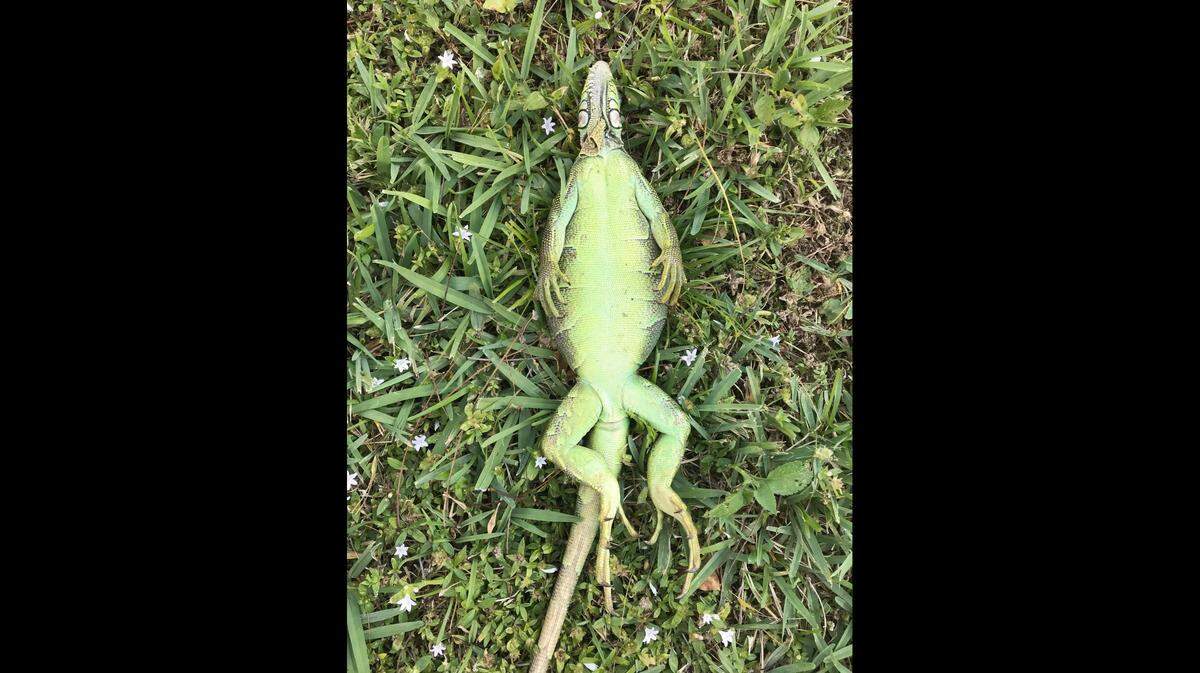
An iguana was found frozen in a backyard of a Palm Springs home early Wednesday. It’s just one of many residents are finding after a cold front swept through Florida overnight, dropping temperatures into the 30s and 40s. The iguanas are not dead. They will wake up once the weather gets warmer. Jose Iglesias jiglesias@elnuevoherald.com
Not dead — just frozen! Temps in South Florida in the 40s leads to the cold blooded iguanas freezing up. They’re still breathing and should eventually ‘thaw’ out pic.twitter.com/X1MSFf4vBX
It shouldn’t be a surprise. The National Weather Service in South Florida did warn everyone about the high falling iguana “rain” chance.
“This isn’t something we usually forecast, but don’t be surprised if you see Iguanas falling from the trees,” the weather service tweeted Tuesday afternoon. “Iguanas are cold-blooded. They slow down or become immobile when temps drop into the 40s.”
They become “frozen” or enter a state of shock that leaves them immobile. They are still breathing.
How much longer will we have to worry about a scaly reptile falling on us?
The weather service says the iguana “rain” chances will drop to zero by Wednesday afternoon, when temperatures climb into the 60s.
Jan 22: Don't know about you, but 4 layers plus a scarf was not enough this morning with wind chills in the 20s and 30s across South FL. Check out the morning lows below! Slight chance of rain today for the east coast (iguana "rain" chances drop to zero by this afternoon) #flwxpic.twitter.com/nVksPFOUHx
Michelle Marchante covers the pulse of healthcare in South Florida and also the City of Coral Gables. Before that, she covered the COVID-19 pandemic, hurricanes, crime, education, entertainment and other topics in South Florida for the Herald as a breaking news reporter. She recently won first place in the health reporting category in the 2025 Sunshine State Awards for her coverage of Steward Health’s bankruptcy. An investigative series about the abrupt closure of a Miami heart transplant program led Michelle and her colleagues to be recognized as finalists in two 2024 Florida Sunshine State Award categories. She also won second place in the 73rd annual Green Eyeshade Awards for her consumer-focused healthcare stories and was part of the team of reporters who won a 2022 Pulitzer Prize for the Miami Herald’s breaking news coverage of the Surfside building collapse. Michelle graduated with honors from Florida International University and was a 2025 National Press Foundation Covering Workplace Mental Health fellow and a 2020-2021 Poynter-Koch Media & Journalism fellow. Support my work with a digital subscription