
How ‘Murph the Surf’ pulled off the biggest heist, and what he did after a life of crime
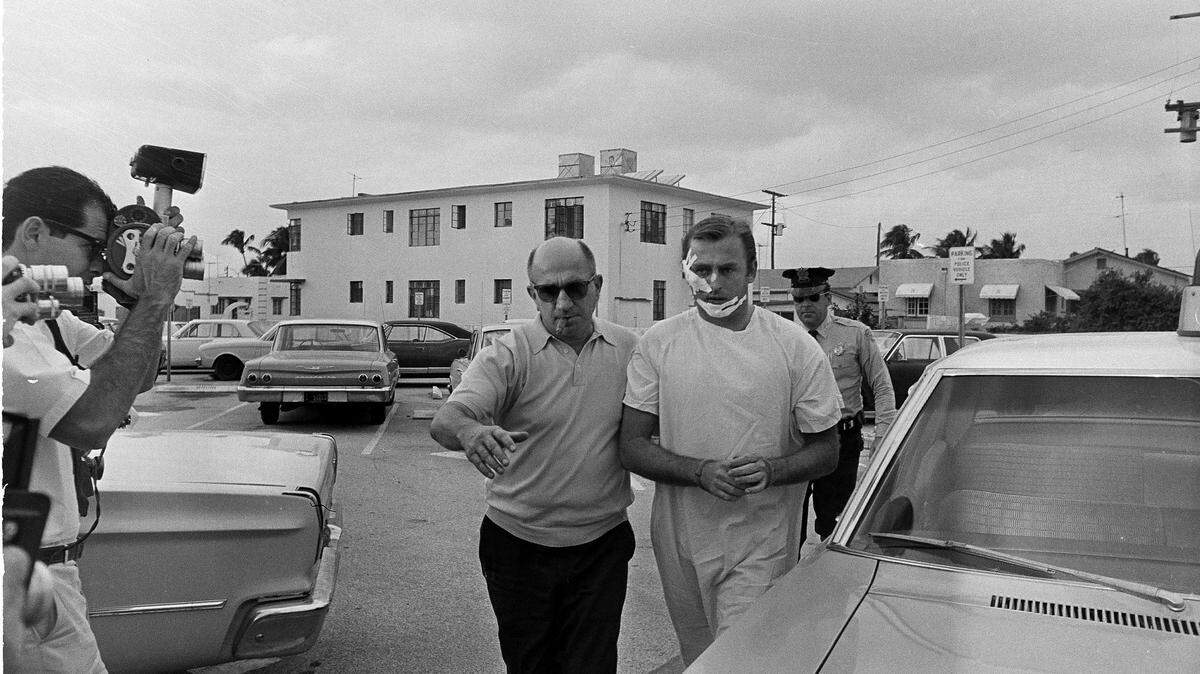
Jack “Murph the Surf” Murphy died Sept. 12, 2020, in Crystal River, Florida, at age 83. Here is his story, told through the archives of the Miami Herald.
-
He was an infamous jewel thief in New York and a convicted murderer in South Florida. His 1960s crime sprees earned him fame and a Hollywood movie.
Perhaps he’s best known for the daring jewel heist in 1964. Murphy was one of three thieves who stole the 563-carat Star of India, the world’s largest sapphire, and other priceless jewels from the American Museum of Natural History.
Murph the Surf was released from prison in November 1986.
Let’s open the Miami Herald archives and look back at Jack “Murph the Surf” Murphy’s last days in prison, what led him there in the first place, and what he devoted himself to after his life in crime.
.JPG "0602270492 (1).JPG")
ONE LAST EFFORT
Published Dec. 14, 2012
TALLAHASSEE — Jack Roland Murphy, the famed jewel thief and surfer known as “Murph the Surf,” has spent the last quarter-century going into prisons and telling inmates that they could still turn their lives around.
Murphy, now 75 and living in Crystal River, said he thought it was time he tried to get his own bit of redemption. He asked the state of Florida to restore his civil rights despite the fact he spent nearly 20 years in prison for a Broward County murder.
“I’d like to be able to go to these guys I talk with and say `Listen, I just came back from the governor’s office and received favor’ because I have been working with the system and trying to do the right thing,” Murphy told Gov. Rick Scott and members of the Florida Cabinet on Thursday.
The answer: No.
Scott was willing to restore Murphy’s rights, but not the other three Cabinet members.
Attorney General Pam Bondi told Murphy he was fortunate just to have avoided execution for his role in the slayings of two women in 1967.
“His blessing is he is out there walking the street,.” Bondi told reporters after the hearing.
Murphy was a national surfing champion, a concert violinist and a tennis pro. But he is probably most famous for a jewel heist.
On the night of Oct. 29, 1964, Murphy and two accomplices broke into New York’s American Museum of Natural History and stole the J.P. Morgan Collection including the Star of India, a 563-carat gem about the size of a racquetball.
They were arrested quickly, and Murphy spent two years in jail.Murphy spent nearly two years in jail.
In 1968 he was the driver and lookout man in a scheme to rob Olive Wofford, a Miami Beach socialite. He was also charged with first-degree murder in the 1967 case of two secretaries who were found shot, bludgeoned and dumped in a creek in Hollywood.
He was sentenced to life in prison for the murder and received a second life sentence for the Wofford robbery. He was released from prison in November 1986.
— Associated Press
‘THE CRAZY THINGS’
Published Jan. 9, 1988
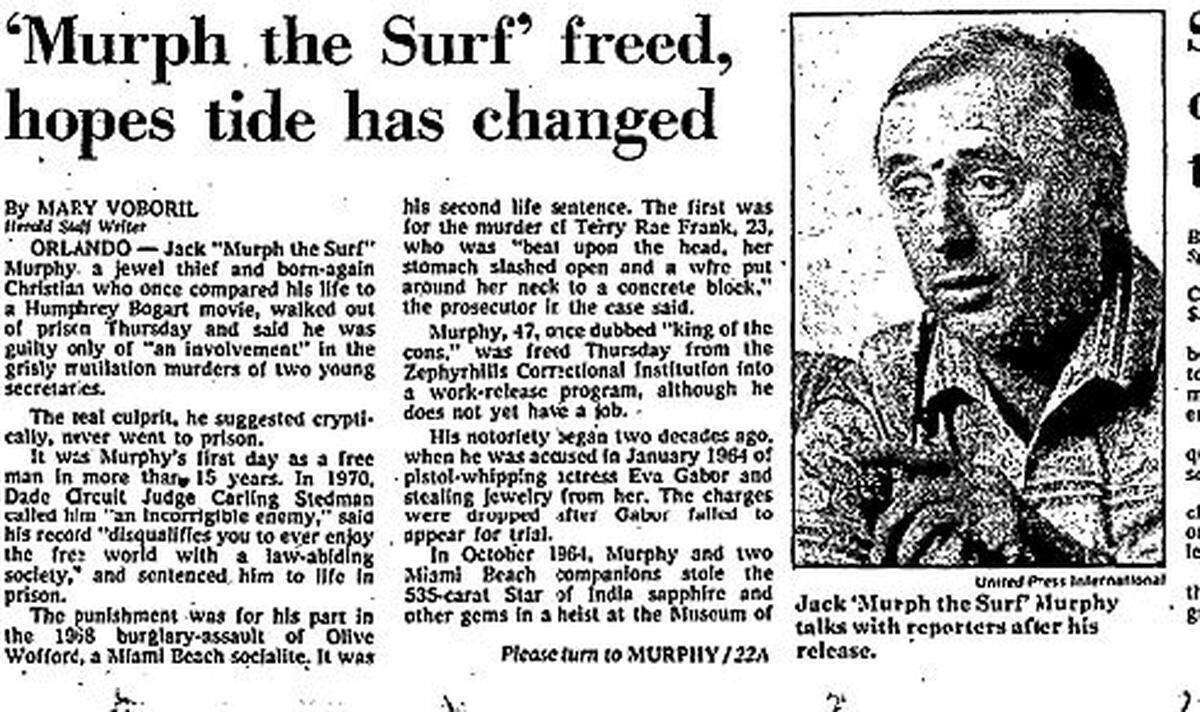
Famed jewel thief Jack “Murph the Surf” Murphy brought his born-again Christian road show to Naples Friday, but he firmly refused to talk about what he called “the crazy things” in his past.
Instead, Murph the Surf preached, prayed and preached some more.
Murphy was convicted in 1969 of robbing a wealthy Miami Beach woman by threatening to pour boiling water on her 8-year- old niece. He was also convicted of murdering a secretary by smashing her head, cutting open her abdomen, tying a piece of concrete to her neck and throwing her into a Broward County creek.
But the crime that earned him fame — and 1974 Hollywood movie — was a daring 1964 jewel heist. Murphy was one of three thieves who stole the 563-carat Star of India, the world’s largest and finest sapphire, and other priceless jewels from the American Museum of Natural History in New York City.
Friday, at a luncheon sponsored by the Full Gospel Business Men’s Fellowship International, Murphy insisted that he’s a changed man.
“I’m here to lift up Jesus Christ,” said Murphy, who was parolled in 1986. “The only thing that helps anybody at all is what Christ does in their lives.”
Murphy, now 50, lives in Orlando with his wife Kitten. He plans four more appearances in Naples and Fort Myers today and Sunday.
Friday, he told a small Naples crowd that he never imagined that he, a violin player and former surfing champion, could wind up in prison.
“I wondered what was an all-American guy who had college scholarships all over the nation for athletics and music, a guy who played in the Pittsburgh Symphony, a guy that had done all sorts of great things . . . what was I doing sitting in that prison cell?”
Whatever the reason, Murphy didn’t like growing old behind bars.
“I noticed that when men did about 10 years in prison, all the sudden things started going downhill. If they had any spunk, any vitality ... by 10 years, it seemed to all shut down and the lights went out. Their attitude and their entire being just became a jaundiced, cancerous, dead, zombie-type experience. I didn’t want to be one of those guys.”
So Murphy turned to two old friends: athletics and music. But he said that wasn’t enough.
“Down inside my guts, those alligators were still eating me up,” he said. “That emptiness, that big space down there that howls . . . Businessmen call them ulcers. I call them alligators.”
He discovered that only one thing made the alligators go away: God. And although some of Murphy’s fellow inmates have said they doubt the sincerity of Murphy’s religious conversion, at least some of those in the Naples crowd were convinced.
“You’ve seen a real trophy of God,” said Larry Hammond, a retired mining executive who became a born-again Christian in 1955. “I know this man has changed — whoever he was — he has changed. I don’t know all the details of what he did, and I’m not interested.”
FREEDOM
Published Nov. 12, 1986
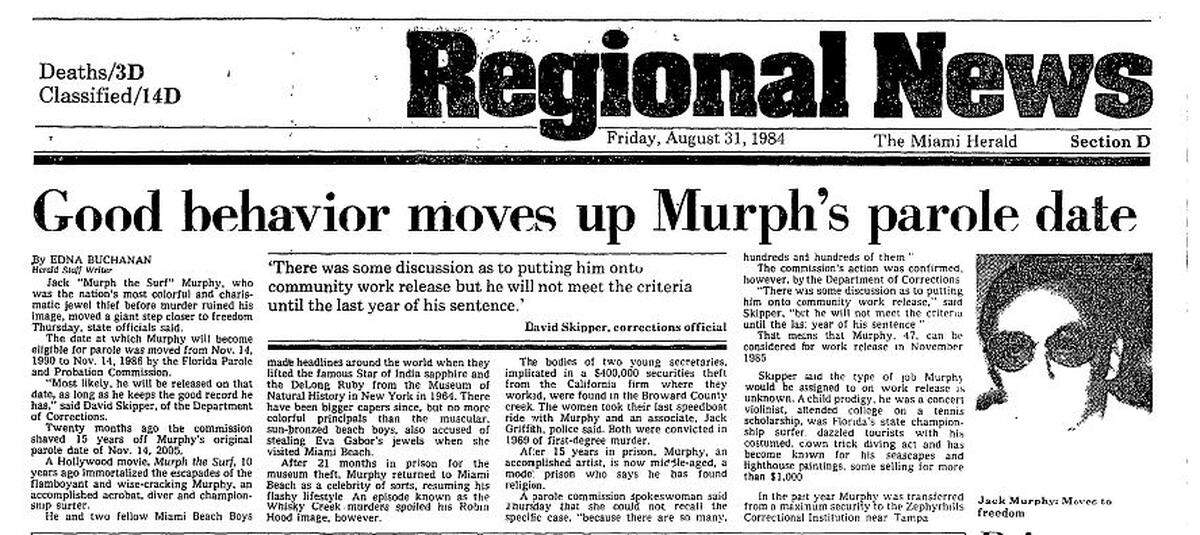
Jack “Murph the Surf” Murphy, imprisoned in 1970 for a term of two lifetimes plus 20 years for murder and armed robbery, celebrated his first full day of freedom Tuesday.
“God has a sense of humor, a sense of timing, and a style of His own,” said the famed jewel thief and surfing champion.
Murph the Surf knows style. His stylish touch as a beach- boy burglar during the mid-1960s made him one of the most glamorous figures in Miami Beach, when the Beach was among the most glamorous places in the world.
Then in 1969-70, Murphy was convicted in quick succession of robbing a wealthy Miami Beach matron by threatening to pour boiling water on her 8-year-old niece, and of murdering a secretary from California by bashing her head, slicing open her abdomen, tying a concrete block to her neck and throwing her in Whiskey Creek near Dania Beach.
At a press conference Tuesday morning at The Bridge, an evangelical work-release center here, Murphy again denied committing the murder. And he outlined his plans to spread the word of God among America’s prison inmates.
Murphy also announced his availability for lectures and personal appearances.
The fee is negotiable, but Murphy said $2,500 per appearance sounds about right.
“That will be up to my corporation and my board of directors, which has agreed to support and guide me,” he said. “I don’t know that I’ll be getting rich, necessarily.”
Murphy, 49, was resplendent as usual, wearing a tailored black sports coat with a ruby-red pocket square. Only his trademark black Ray-ban sunglasses were missing.
Several of Murphy’s paintings, average asking price about $1,000 each, were arrayed by his side.
He spoke in the modulated tones of a Christian television talk show veteran, which he is. Murphy appeared well on the road to achieving the aim he once confided to a court-appointed psychologist: To be like Billy Graham.
From his teens, when he played violin with the Pittsburgh Symphony Orchestra, to his latest prison term, when he taught himself to paint, Murph the Surf has done the spectacular. Murphy went to college on a tennis scholarship, won the Florida state surfing championship, melted the hearts of teen-age girls and divorcees alike.
Crime was just another brand of thrill, he has said. And even in crime, Murphy was bigger than life, playing a starring role in the grandest jewel heist of the century.
On a quiet October night in 1964, Murphy and two accomplices, Allen Kuhn and Roger Clark, lowered themselves through the roof of the American Museum of Natural History in New York City. They escaped with the world’s finest sapphire, the Star of India -- and the world’s most perfect ruby -- the DeLong.
They fled to Miami Beach, where they were caught within days. A cop tipped a bellhop $2 for information on some big- spending beach boys.
The robbery made Murph the Surf a star.
He would walk into Miami Beach restaurants and say, “I’m the guy they suspect in the Star of India case. Mind if I eat here?”
The sapphire was found in a Miami bus station locker. Millionaire John D. MacArthur said he “bribed some S.O.B.” to return the ruby. Murphy and his pals served just three years.
When he returned to Miami Beach, Murph the Surf was an idol. Blonds in bikinis giggled when they met him; boys wore his hairstyle and the trademark shades.
A year later, he was charged with the brutal murder of the secretary from California, one of two women killed as part of a securities fraud Murphy helped plan.
A psychological profile done during the murder trial shows Murphy was interested in religion even then. But psychologist David Rothenberg warned, “He is beginning to wonder if he himself is not God.” Dade Circuit Judge Carling Stedman sentenced Murphy, saying his criminal record “disqualifies you to ever enjoy the free world with a law-abiding society.”
But state parole officials were impressed enough with Murphy’s good behavior to cut 20 years from his minimum stay. They said they must reward model inmates in order to create incentive for other cons to go straight.
Murphy will remain on lifetime parole, which means any new crimes should send him straight back to jail. He is barred from Dade and Broward counties, and he must pay $2,500 to an unspecified Dade charity.
“I have nothing to prove there,” Murphy said of his old South Florida stomping grounds. “I reside now in Central Florida, the healthiest area for Christian prison ministry in the world.”
Murphy will work with reformed Miami Beach gangster Frank Constantino, founder of The Bridge, and Chaplain Ray, a friend of such born-again waywards as Charles Colson, the Watergate henchman.
On weekends, Murphy will indulge a lingering passion. He will surf.
Some of Murphy’s fellow inmates have been quoted expressing doubts about the sincerity of his religious conversion.
Murphy promised to prove the skeptics wrong.
“All I can say is: Watch me.”
THE CRIMES
Published Dec. 21, 1985
Jack “Murph the Surf” Murphy, a jewel thief and born-again Christian who once compared his life to a Humphrey Bogart movie, walked out of prison Thursday and humbly said he was guilty only of “an involvement” in the grisly mutilation murders of two young secretaries.
The real culprit, he suggested cryptically, never went to prison.
For Murphy, 47, it was his first day as a free man in 17 years. In 1970, Dade Circuit Judge Carling Stedman called him “an incorrigible enemy,” said his record “disqualifies you to ever enjoy the free world with a law-abiding society,” and sentenced him to life in prison.
The punishment was for his part in the 1968 burglary-assault of Olive Wofford, a Miami Beach socialite. It was Murphy’s second life sentence.
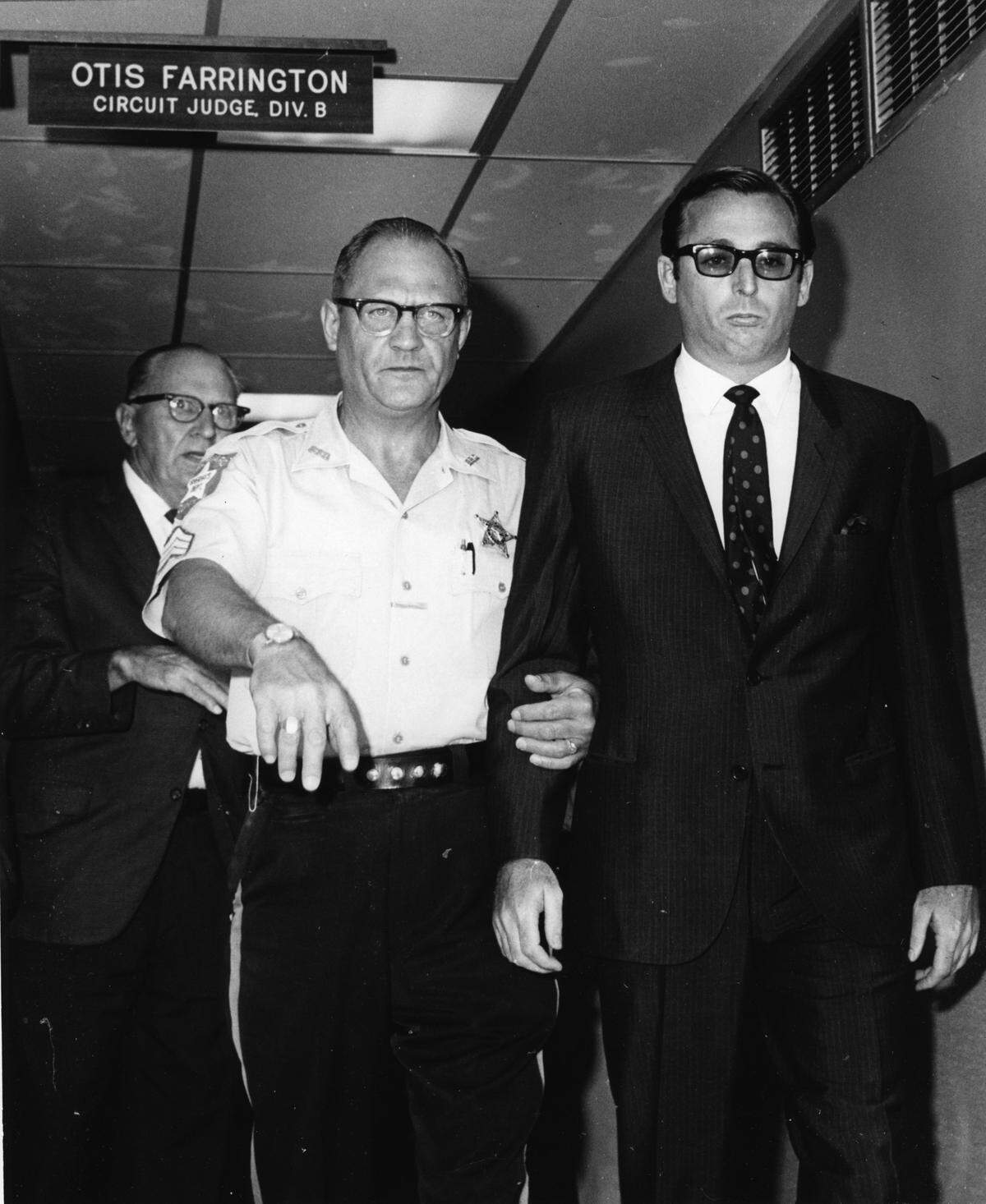
The first was for the murder of Terry Rae Frank, 23, who was “beat upon the head, her stomach slashed open and a wire put around her neck to a concrete block,” the prosecutor in the case said.
She was one of two secretaries from Los Angeles whose bodies were dumped into Whiskey Creek in Hollywood in 1967. Murphy was never prosecuted in the slaying of the other woman, Annelie Marie Mohn, 21.
The victims had worked at a California brokerage house where $500,000 in securities were stolen. Investigators said the bonds were the motive for the murders.
Murphy’s notoriety began two decades ago, when he was accused in January 1964 of pistol-whipping actress Eva Gabor and stealing jewelry from her. The charges were dropped after Gabor failed to appear for trial.
In October 1964, Murphy and two Miami Beach companions stole the 535-carat Star of India sapphire and other gems in a heist at the Museum of Natural History in New York City, a crime that resulted in a 21-month prison term.
A movie entitled Murph the Surf was made about the heist.
During his years in prison, Murphy discovered the saving power of Jesus Christ, and now, he says, he’s a changed man.
Plenty of others agree. On Thursday, Murphy, once dubbed “King of the cons,” was freed from the Zephyrhills Correctional Institution and into a work-release program.
Murphy does not yet have a job. He said he wants to counsel offenders and would-be offenders and spread the word of God.
Slightly nervous, slightly balding and forsaking a prison suit for a nutmeg-colored polyester shirt, cream-colored slacks and brown tasseled shoes, Murphy spoke with reporters for a half-hour Thursday evening at “the Bridge,” a halfway house in a secluded corner of Orlando.
Murphy, who had a reputation as an athletic, smooth-talking charmer in his younger days, winked and smiled as a woman reporter entered a small room at the halfway house. Several of his prison paintings, one with the belly-of-the-beast theme of Jonah and the Whale, were propped up. They are Christmas presents, he said.
Did he kill the secretaries? He dodged the question.
“I’ll say this: Much like the person in the back of an automobile that goes out of control and ends up in a ditch and gets hurt, I found myself in a situation like that. It got out of control,” he said.
“I was, if anything, an accessory after the fact in that situation.”
So did his co-defendant, Jack Griffith, murder the women?
“I made a deposition a number of years ago on his situation that he never even met those women.”
So another person who never went to jail committed those murders?
“Well, that’s something I’ve never ever discussed with anybody. I really don’t know what good it would do to discuss it,” he said. Griffith remains in prison.
Murphy, father of two grown sons, has a record of 19 arrests, three felony and four misdemeanor convictions. He blames his criminal record on “immature decisions, selfish choices.”
He also blamed news accounts for embellishing his “involvements” in the Whiskey Creek crime and others. Judges, he suggested, were far harsher on him than on his co-defendants.
He lumped himself in with Watergate defendants, convicted physician Carl Coppolino and convicted Judge Joseph Peel, all of them non-criminals who went astray -- Coppolino and Peel, like Murphy, straying to murder.
He said he was like them, once a noncriminal, with the status of a state surfing champ, tennis pro, acrobatic diver, “a legitimate father and husband, taxpaying citizen” who made mistakes.
“My period of crime involvement was a very, very, very brief part of my life. Very short. We’re talking months. Like that person getting in the car wreck. It doesn’t take a long time to do that. You can run off the road or into a telephone pole in just a second. . . . Just an unwise choice, just one, can put you into the telephone pole or put you into prison for life.”
Through his sentences, he said, he had to pay for the “commercial value” of his name. “He sold surfboards, but he also sold newspapers,” Murphy said of himself.
“People don’t associate Murph the Surf, whoever that guy was, with a legitimate past. . . . Every time I’ve gone into a courtroom, it seemed like the media pressure does something magic to the sentencing structure.
“On my robbery charges, I went in with a couple of other men. One of them got a 15-year sentence, one got a 20-year sentence, I got life and 20 on the same thing.
On the Whiskey Creek case, “I came out with a life sentence. My co-defendant came out with a 45-year, second-degree sentence.
“It’s just sort of the situation of my life. I went to Florida State Prison. The average inmate spends two or three years there. I spent nearly nine years there. I went to Raiford. Average guy spends two years there. I spent five years there.”
At his trial for the murder of one of the secretaries, Murphy’s defense was innocent by reason of insanity. “I’m probably the only man in the room with papers attesting to my sanity,” he said Thursday, smiling. “Insanity pleas in criminal cases are a legal ploy used by lawyers. You don’t necessarily agree with attorneys, but you go along with them.’
Murphy told a psychiatrist in 1969 that his life seems “somewhat like a Humphrey Bogart movie. I like that, and I guess I need it.”
In his report to the judge, the psychiatrist said Murphy agreed with previous medical opinions that his personality was anti-social and added, “I have no intention of changing.”
But now, Murphy asks skeptics to give him a second chance.
“People who know me know my life has changed, that I’m a different person now. God has changed my life. I know we get a lot of tongue-in-cheek people saying, ‘Oh, that’s hokey, I don’t want to buy that, that’s not going to sell a lot of newspapers.’
“People will say, “Oh, yeah, he’s got jailhouse religion.
“All I can say is: Just watch me. Watch me like those prison officials did for 17 years. I hope people will back up off me a little bit, give me a chance to breathe.”
Had he ever contacted the families of the two secretaries who were murdered?
He repeated he was convicted on only one murder charge; the second was dropped. “I would appreciate some looking into the facts,” he said. He didn’t answer the question.
Does he ever lose any sleep over his past? He paused for seven seconds.
“I’ve had a lot of restless nights,” he said.
Whatever Murphy now thinks of newspapers, he once seemed to welcome his notoriety.
“It was a supreme ego trip,” he said in a 1974 interview. “Looking back, I suppose the publicity was a form of success.”
This story was originally published September 15, 2020 at 6:41 AM.