He was ready for surgery with Miami’s top surgeon. Here’s how it went wrong
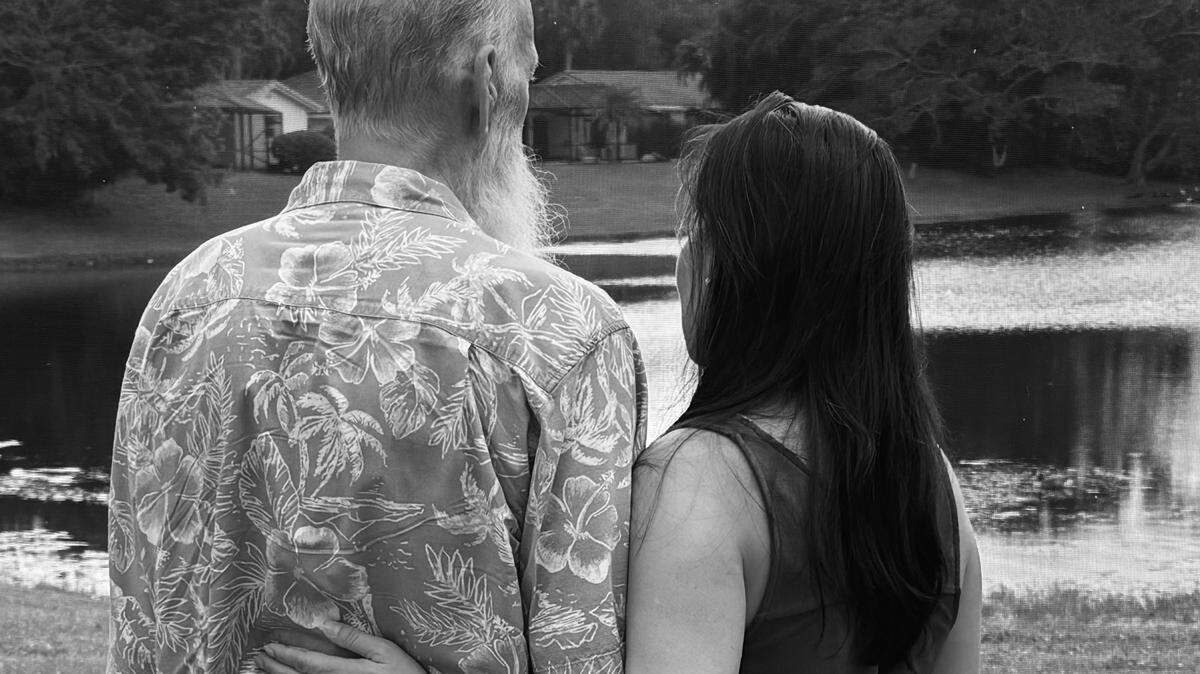
Michael Davis’ heart surgery was hours behind schedule. The 71-year-old South Florida retiree waited and waited and waited inside a chilly room to be taken into the pre-op area for surgery with one of the most renowned surgeons in Miami.
The Marine Corps veteran fidgeted as family members of other patients in the hospital waiting room gobbled down subs, burgers and fries. It had been about 30 hours since Davis’ last meal. He couldn’t eat or drink, as he had to fast before the surgery.
“I had to get up and leave the room and go walk around just to avoid the smell,” Davis said.
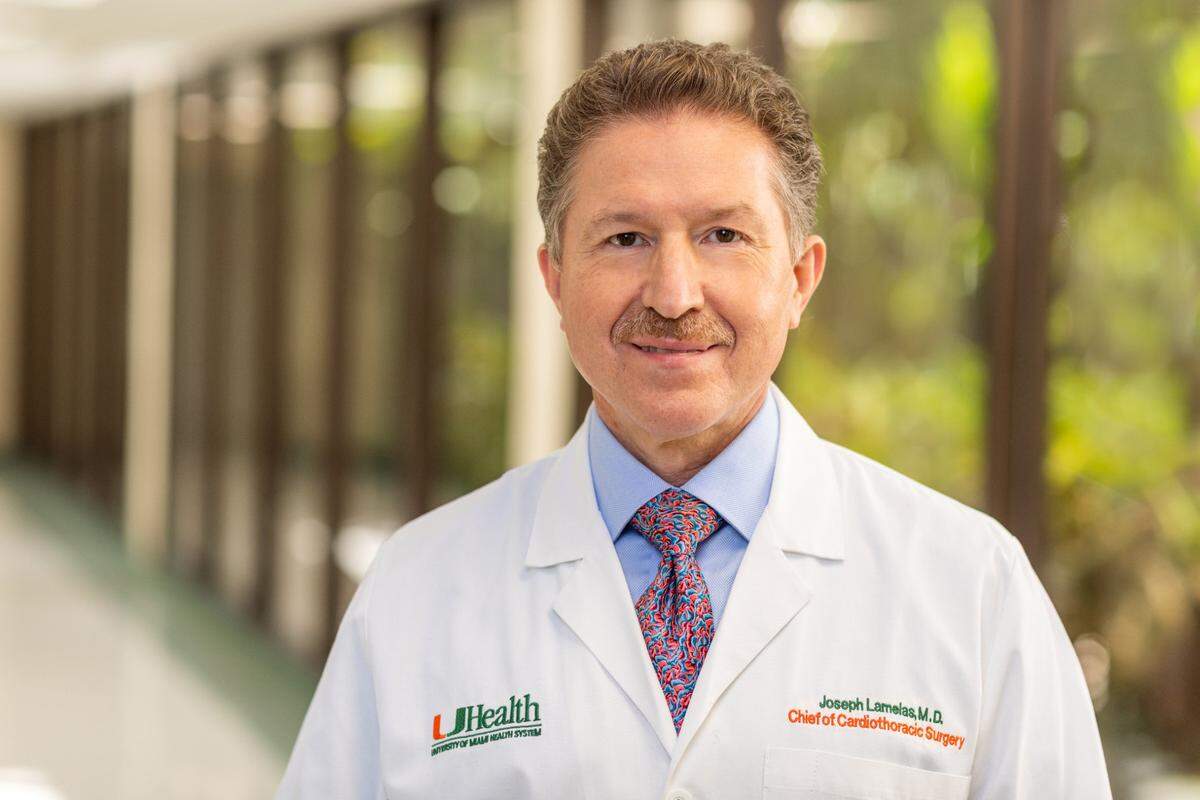
At 5 p.m., nearly eight hours after Davis had arrived for his scheduled surgery on Aug. 29 at the University of Miami’s UHealth Tower, cardiothoracic surgeon Joseph Lamelas canceled his operation. As is his custom, Lamelas had scheduled four patients for hours-long operations that day, with Davis last in the lineup.
When the surgeon experienced complications with the second patient, it caused delays throughout the day and led to Davis’ last-minute cancellation. Davis and his wife Donna slogged through rush-hour traffic, back to their home in Boca Raton.
“I felt like I was being treated as an oil change,” Davis told the Miami Herald in an interview last month. “You know, in your car, you drive in, you change your oil, you drive out. That was the doctor’s approach to me and my surgery from day one.”
When asked about Davis’ canceled surgery, Lamelas, who transferred from UHealth to HCH Rooney Heart Institute in Naples in October, responded in an email last week to the Herald’s queries.
“It is unfortunate that Mr. Davis’s procedure required rescheduling. Patient safety is always of paramount importance,” Lamelas wrote. “On that day, preceding cases were complex and extended longer than anticipated. Rather than proceeding with surgery late in the evening, the prudent and responsible decision was made to reschedule the procedure for a more appropriate time.”
For the Davises, Lamelas’ practice of scheduling multiple patients for heart surgery on the same day was “the root of the problem.”
“It was like a Chick-fil-A, going in and going out,” said Donna, who wrote a four-page letter to UHealth in mid-September complaining about her husband’s canceled cardiac surgery and hospital care.
This is also not the first time Lamelas, a prominent surgeon, has had issues with surgeries. He was implicated with two other surgeons in a $15 million civil settlement last year between his former employer, Baylor College of Medicine, and the Justice Department. The settlement stemmed from allegations that Lamelas, who worked at Baylor before joining UM in 2019, and the other surgeons illegally billed Medicare by claiming they were performing multiple heart procedures simultaneously in adjacent operating rooms.
As they performed these “concurrent” surgeries, the three surgeons falsely claimed that they were present during the entirety of each overlapping heart procedure in their bills to Medicare. In reality, “physician trainees” performed the surgeries because the surgeons couldn’t possibly be in two places at once, Justice Department lawyers alleged in their suit.
At the time, Lamelas declined to comment about the settlement, while Baylor College of Medicine issued a statement denying any wrongdoing and noting that no patients were harmed.
Back-to-back surgeries
Back to back surgeries, such as in Davis’ case, played a role in the delay, and eventual cancellation, of the operation.
Studies suggest same-day surgery cancellations happen between 10% and 25% of the time because of medical problems with the patient, lack of hospital staffing or unexpected surgical delays, like Davis’ experience. While some canceled surgeries are due to unforeseen reasons, many are due to potentially preventable situations, including administrative and operating room inefficiencies, the studies found.
Cancellations are not only bad for patients, they’re bad for hospitals, which lose an estimated $5,000 to $8,000 in revenue every time an elective surgery is canceled.
READ MORE: Last-minute surgery changes? Experts share tips on how to handle cancelled surgeries
Dr. Alexander Marmureanu, a renowned cardiothoracic surgeon in Los Angeles, told the Herald that Lamelas’ scheduling of four heart patients on Aug. 29 was “clearly a factor” in the cancellation of Davis’ operation because he could not get to him after performing three prior surgeries.
But he cautioned that such cancellations “are not that unusual in heart surgery,” especially when an operation on another patient that same day turns into a priority because of complications.
A spokesperson for UHealth, which is owned and operated by the University of Miami, declined to comment about Lamelas and his cancellation of Davis’ surgery.
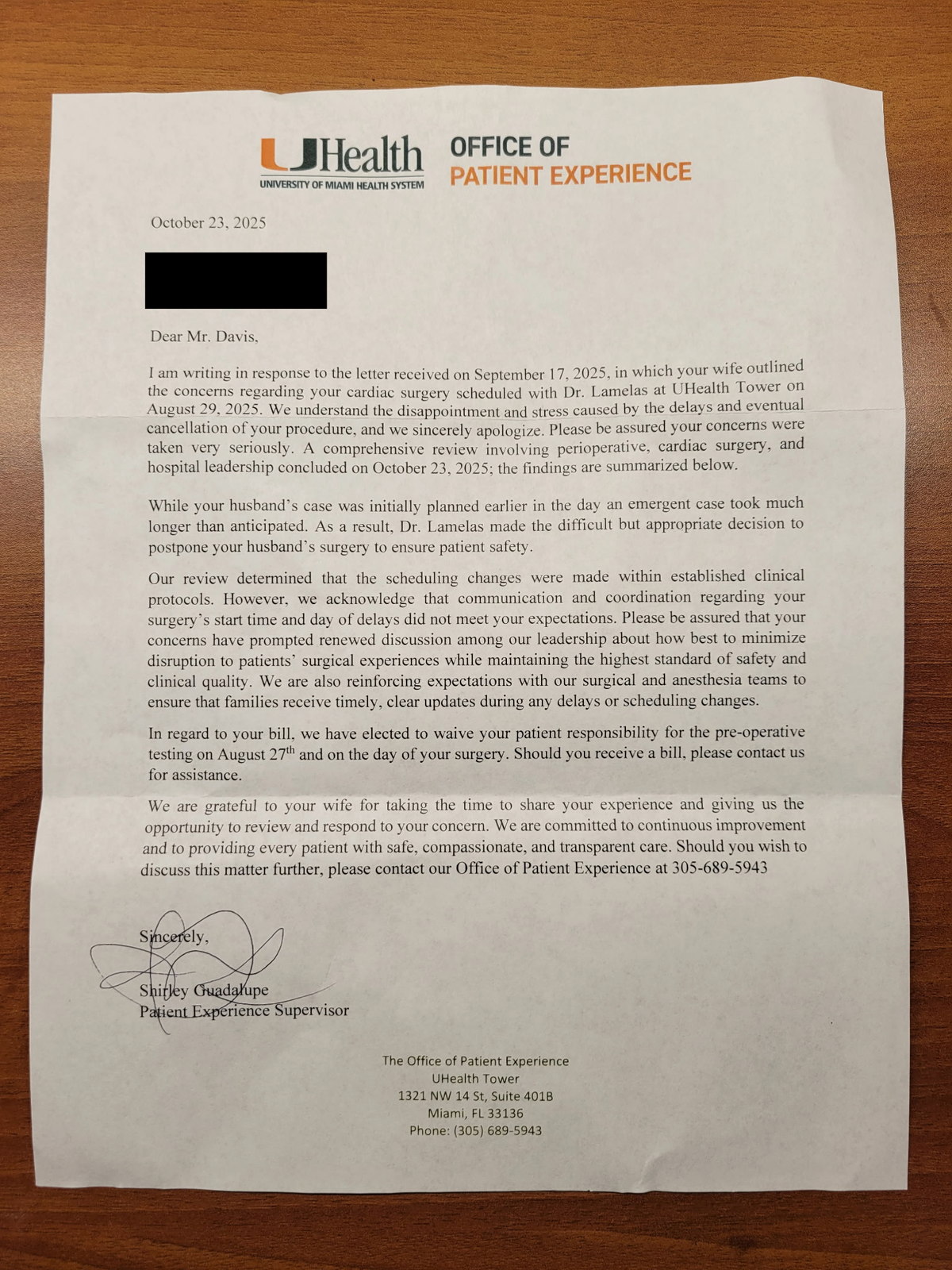
On Nov. 8, slightly more than a week after the Herald contacted UM, Michael Davis received a letter from UHealth’s Office of Patient Experience in response to the complaint that his wife had sent in September. He and his wife provided the Miami Herald a copy of the UM letter, which echoed Lamelas’ explanation but also extended an apology, assuring them that their “concerns were taken very seriously.”
“Tired, old heart”
Davis has traveled the world fixing computer systems. It’s how he met his wife, Donna, while working overseas in Saudi Arabia.
As a Marine, he was trained to always have a Plan A, B and C.
But in late April, he sensed something beyond his control – a shortness of breath, a stagger in his walk, dizziness.
His primary care physician told him he had a “tired old heart.”
In May, after doing some research, Davis and his wife found a doctor who they thought would be ideal for rejuvenating his heart: Lamelas, known for his pioneering minimally invasive aortic and mitral valve techniques that do not require opening the patient’s chest.
Since the early 1990s, Lamelas has been regarded as a top-flight cardiac surgeon in South Florida with no complaints or disciplinary action on his record with the Florida Department of Health. He has performed more than 18,000 heart operations at UM and other hospitals.
READ MORE: UM surgeon at center of settlement says he does 3 to 5 surgeries a day. Is that possible?
The Davises, who live in Boca Raton, said they chose Lamelas for that reason over other cardiac specialists closer to home.
“We didn’t mind driving the 50 to 60 miles [to Miami] if we were going to get superior care, and that’s what brought us to Dr. Lamelas,” Michael Davis said.
After the couple had a brief video call with Lamelas on June 11, his staff scheduled Davis’ surgery for an aortic valve replacement and other procedures for Aug. 29, the Friday before the Labor Day weekend. The surgeon put off the operation for a couple of months to allow Davis’ heart to gain strength with medication and rest.
Hours of waiting at UHealth
Davis said he checked into the hospital around 9:30 a.m. on Aug. 29, thinking he would be second in line for surgery with Lamelas. He had nothing to eat or drink since before midnight, standard protocol for the night before a surgery.
As hours passed in the UHealth waiting room, Lamelas’ staff assured him his surgery would still proceed “no matter how late or how long it takes,” recalled the couple.
They learned from hospital staff that Davis was the fourth patient scheduled for surgery with Lamelas, and that the delay was caused by complications with the second patient.
The head of anesthesia working with Lamelas reassured the couple that the plan was to still perform Davis’ surgery as late as 9 p.m., even as the couple worried that the surgeon would be too tired from performing surgeries for more than 14 hours by then.
But after 5 p.m., the anesthesiologist returned, advising the Davises that “it was in your best interest to go home.” He said Lamelas’ office would call them in the next few days to reschedule Davis’ surgery as the first case within two weeks.
“I simply couldn’t believe what I was hearing, especially after sitting in that cold waiting room all day watching other people eat and drink,” Davis said.
The couple, after a two-hour ride home during South Florida rush hour, felt shattered. In the days following the surgery, “We received no apology or outreach to reschedule,” Donna Davis wrote in her formal complaint to UHealth’s patient relations department.
“At that time, we lost faith in the doctor and discussed pursuing another,” she wrote in the complaint, which the couple provided to the Herald. “Nevertheless, we have now started to receive bills for payment for a surgery that never took place.”
Davis was billed about $300 for his pre-surgery tests under his Medicare coverage, but UHealth zeroed out that bill after receiving his wife’s complaint and being contacted by the Herald. There was no charge for the estimated $278,000 cost of the heart surgery.
“Despite assurances that my husband would be promptly rebooked as [the] first case, no follow-up occurred for 12 days,” she wrote in her complaint to UHealth.
Found new surgeon
After Lamelas cancelled Davis’ heart operation, he and his wife looked for another cardiothoracic surgeon – this time at Memorial Regional Hospital in Hollywood. They set up a meeting with Dr. Michael Cortelli, who insisted on seeing Davis and his wife in person – unlike Lamelas, who met with them over the video call.
Cortelli specializes in open-heart surgery, not minimally invasive procedures like Lamelas. His staff scheduled Davis for surgery on Sept. 8.
His surgery was a success. In the midst of recovery, nearly two weeks after his cancelled surgery, Lamelas’ staff called Donna to reschedule Davis’ operation at UHealth. She told them her husband had already done surgery elsewhere.
“At the University of Miami, I was treated like a number, sit down, shut up,” Michael Davis said. “In Dr. Cortelli’s office and at the hospital, I was treated like a priority. I felt like somebody actually cared about me.”
Lamelas’ plan for Davis was to perform an aortic valve replacement and repair his aortic root and mitral valve. At Memorial, in the midst of surgery, Cortelli replaced his aortic valve but decided he did not need to repair Davis’ aortic root or mitral valve. Davis’ pre-op tests, surgery and six-day stay at Memorial Regional Hospital cost $300,000 and was covered by his Medicare Advantage plan.
While Davis recovered from his open-heart surgery – a process that he described as “brutal” but marked by daily improvements – his wife reached out to the Herald to share his experience with Lamelas.
She also filed a complaint with UM, which referred it to hospital administrators.
Letter from UHealth
“We understand the disappointment and stress caused by the delays and eventual cancellation of your procedure, and we sincerely apologize,” Patient Experience Supervisor Shirley Guadalupe wrote to Michael Davis in a letter dated Oct. 23. “Please be assured your concerns were taken very seriously.”
The supervisor noted UHealth conducted a “comprehensive review involving perioperative, cardiac surgery, and hospital leadership” that ended on Oct. 23. Here’s the key finding:
“While your husband’s case was initially planned earlier in the day, an emergent case took much longer than anticipated,” the letter said. “As a result, Dr. Lamelas made the difficult but appropriate decision to postpone your husband’s surgery to ensure patient safety.
“Our review determined that the scheduling changes were made within established clinical protocols. However, we acknowledge that communication and coordination regarding your surgery’s start time and day of delays did not meet your expectations.”
The letter ended with assurances that Davis’ concerns “prompted renewed discussion among our leadership about how best to minimize disruption to patients’ surgical experiences while maintaining the highest standard of safety and clinical quality.” UHealth also assured Davis that his bill for pre-operative testing was being waived.
Donna Davis also filed a complaint with the Florida Agency for Healthcare Administration, the state agency that oversees hospitals. The agency told her it couldn’t address the matter because it doesn’t regulate doctors, recommending that she take up her complaint with the state Department of Health and with UM’s hospital.
She had already complained to UM, but didn’t follow up with the state health department.
Hospitals’ cancellation rates vary
The Davis incident sheds light on a problem patients sometimes experience while waiting for critical surgeries that are labeled elective.
A 2021 study reviewing elective cardiothoracic surgeries found a last-minute cancellation rate of 14.3% at Maastricht University Medical Centre in the Netherlands between January 2017 and June 2019.
A total of 2,111 patients participated in the study: 301 had last-minute heart-surgery cancellations. Of these, one-quarter were caused by medical reasons such as infection or disease, and two-thirds by another patient in more urgent need of surgery or lack of staff.
But at the Mayo Clinic in Rochester, Minnesota, known as one of the best hospitals for cardiology and heart surgery, same-day cardiac surgery cancellations are infrequent.
Of 7,081 cardiac operations requiring cardiopulmonary bypass from 2010 to 2012, 142 patients experienced same-day cancellations, or about 2%, due mainly to medical reasons or scheduling issues, according to a peer-reviewed 2014 study, which was published in The American Association for Thoracic Surgery.
In the U.S., patients are also waiting longer to see physicians as the country grapples with a growing shortage of doctors and nurses. To see a cardiologist, the average wait time is nearly 33 days for an appointment, up 23% from 2022 and up 74% since 2004, according to a 2025 survey by AMN Healthcare, which provides a snapshot of physician availability in six medical specialties across Miami and 14 other major metropolitan areas nationwide.
Davis himself waited just over a month for his virtual visit with Lamelas.
There’s no way of knowing how many of Lamelas’ patients have experienced surgical cancellations over the course of his long career.
In promotional materials, including UM videos, Lamelas says he has operated on more than 18,000 heart patients throughout his 33-year career. If you divide 18,000 surgeries by 33 years, the math shows that Lamelas would have performed 545 surgeries in a given year, “an extremely high number,” according to Marmureanu, the Los Angeles cardiothoracic surgeon who also does minimally invasive procedures.
A 2018 study published in the Journal of Thoracic and Cardiovascular Surgery noted in 2010, the number of cases performed per cardiothoracic surgeon in the United States averaged 135 per year. The study’s caseloads were based on heart surgery, as well as lung and esophageal surgery.
The reasons behind last-minute surgery cancellations, and what can be done to reduce their frequency, has been studied by Dr. Karuna Wongtanman and Dr. Matthias Eikermann of Montefiore Einstein, a New York-based academic health system. They want to improve the patient experience.
Same-day surgical cancellations frequent: study
While most scheduled surgeries do proceed as planned, same-day cancellations for surgeries and other procedures are fairly frequent, ranging from 2.5% to 20%, depending on the procedure type, according to Eikermann, chair of anaesthesiology at Montefiore Einstein and an anaesthesiology professor at Albert Einstein College of Medicine in New York.
Sometimes, cancellations are due to pre-existing or newly discovered health problems. Other times, patients will bail on the procedure due to anxiety, lack of transportation, caregiver ability or other issues, the doctors said. Sometimes, providers cancel the procedure because they are handling an ER situation or a complication in a previous surgery, similar to what happened in Davis’ situation. Limited availability in specialized surgeons and fatigue can also play a role.
“There is a substantial global burden of surgical procedure cancellation,” with a meta-analysis showing that the “global prevalence of case cancellation” is about 18%, with rates as high as 73% in low-and-middle-income countries, according to a recent study led by Wongtanman that was published in the peer-reviewed journal Anaesthesia in 2024. “In the USA, nearly one-fifth of cases that are cancelled on the day of surgery are never rescheduled and, if they are, the delay can be substantial.”
The two anesthesiologists helped develop a tool to predict which patients were at high-risk of surgery cancellation. The tool, which was featured in a 2022 study published in the peer-reviewed Journal of Clinical Anesthesia, helped their hospital system identify patients high-risk for case cancellation and implement a series of proactive measures to reduce case cancellations. Those measures included nurses calling patients two weeks before surgery, using AI to help identify potential risk factors for surgery, and offering transportation assistance and psychological consultations for anxious patients.
The measures have helped decrease cancellation rates, but more work still needs to be done, said Wongtanman and Eikermann.
And the type of surgery Lamelas specializes in — mitral valve repairs — can take, on average, four hours, Marmureanu said.
Lamelas, in the UM video, says he does three to five surgeries a day. In 2024, UM paid him more than $3 million, according to tax forms filed on Guidestar, which tracks financial information about nonprofits, including their highest-paid employees.
Marmureanu – whose bio says he performs more than 400 heart surgeries a year, including the minimally invasive technique that Lamelas is known for – doesn’t fault Lamelas for cancelling Davis’ aortic valve replacement and other procedures.
“It sounds like he’s trying to do the best he can under the circumstances, and it didn’t happen,” Marmureanu said. “He didn’t want to do another case; he knew when to stop. … Clearly, he didn’t get to him [Davis] and he had to cancel. Not ideal, but there’s no harm here.”
It doesn’t make the sting hurt less for Michael and Donna, who feel that UHealth let them slip through the cracks. The couple said they fully understand that Lamelas was caring for a patient with complications. But, they say the hospital should have done a better job of communicating with them about the cancellation and rescheduling of the surgery.
“I didn’t even know if he was supposed to eat again, because I didn’t know if they were going to book surgery the next day or the day after, because some of his meds he had to stop two days before,” Donna Davis said.
“So they didn’t give us any instructions about medications and when he can start eating. All they said was, ‘We’ll call you in the next few days and reschedule as a first case.’ ”
Justice Department lawsuit
Although Lamelas has been heralded as an innovative cardiothoracic surgeon in the United States, his record is not unblemished.
Lamelas had been a star at Mount Sinai Medical Center in Miami Beach when Baylor College of Medicine lured him to Houston in January 2017 to join an elite team of surgeons who were performing thousands of heart surgeries in dual operating rooms at the same time.
But according to federal authorities, Lamelas and two other cardiac surgeons double-booked their surgical patients for hundreds of simultaneous heart operations at Baylor St. Luke’s Medical Center, Justice Department lawyers said in a 2022 False Claims Act case.
The allegations state that the surgeons relied on “physician trainees” during the procedures because they couldn’t be in two places at once.
The simultaneous booking of surgeries paid off enormously for both the surgeons and the hospital. Between 2013 and 2019, the Baylor College of Medicine-affiliated teaching hospital boosted its revenues by about $150 million from these three surgeons’ cases alone, according to the Justice Department’s lawsuit.
The three surgeons “enjoyed compensation packages some four-times higher than the average for their specialty in Houston, reaching over $2 million per year,” according to the original whistle-blower’s suit filed in August 2019. By then, Lamelas’ two-year stint at Baylor had ended with his hiring by the University of Miami’s medical school earlier that year.
Shared story to help others
Donna Davis, a veteran nurse, said she learned about Lamelas’ role in the Baylor-St. Luke’s settlement with the Justice Department and discussed it with her husband as they did their research on the eminent heart surgeon.
But the couple said they came away so impressed with Lamelas’ overall medical record and his pioneering “Miami method” of performing minimally invasive surgery that they decided he was the ideal choice for the husband’s aortic valve replacement and related procedures.
Davis, who had undergone a variety of surgeries in the past, wanted to avoid having open-heart surgery because of the greater impact on his body and health.
“He’s highly spoken of, and he has the non-invasive technique where they don’t, excuse the expression, crack my chest open,” Davis said.
“But he seemed like a very busy guy,” Davis said. “We had one video teleconference with him, but we never saw him in person. His office scheduled the surgery, and we made all of the arrangements in our lives to be there for the day of the surgery.”
As the Davises looked back on their ordeal, they decided to share the story as a cautionary tale so that other patients would not go through what they did.
“The reason we reached out to you is we want the public to be aware of what this doctor has done and what the University of Miami has allowed that doctor to do,” Michael Davis said, “so that they do not have to suffer the same inconveniences that we have.”
Lamelas said he can’t discuss individual cases “due to federal patient privacy regulations.” However, he said in his statement to the Herald that a patient’s safety must always come first:
“As one of the nation’s most experienced minimally invasive cardiac surgeons, I approach every operation with the utmost care, humility, and respect for the trust patients place in me. I never compromise patient safety or clinical outcomes for the sake of timing or convenience.”
This story was originally published November 19, 2025 at 5:00 AM.