How sick are we? New COVID and flu vaccines coming to Florida. Can you get the shots?
Newly updated COVID-19 vaccines are starting to arrive at pharmacies and doctor offices across Florida as the state records high levels of the virus in wastewater, a sign of circulation.
Both the U.S. Food and Drug Administration and the U.S. Centers for Disease Control and Prevention have given the green light to the new COVID shots to help better protect people against circulating variants during the 2024-2025 fall and winter season.
Federal regulators and health officials are recommending people get vaccinated annually for COVID, just like they do for influenza.
New updated flu shots for the 2024-2025 season are also rolling out to pharmacies and doctors offices.
What’s the COVID and flu situation in Florida? Who should get vaccinated and when is the best time to get a shot?
Here’s what to know about COVID and flu:
What is the COVID and flu situation in Florida?
As of Aug. 23, “the amount of respiratory illness — fever plus cough or sore throat — causing people to seek healthcare is low nationally,” according to the CDC. Nationally, influenza and RSV levels remain low although many parts of the country are continuing to see elevated levels of COVID-19. Some areas are seeing a decline in COVID.
The CDC estimates COVID infections are “growing or likely growing in 27 states, declining or likely declining in 4 states,” as of Aug. 16, the most recent update. The public health agency says that COVID infections are “stable or uncertain in 17 states,” including Florida.
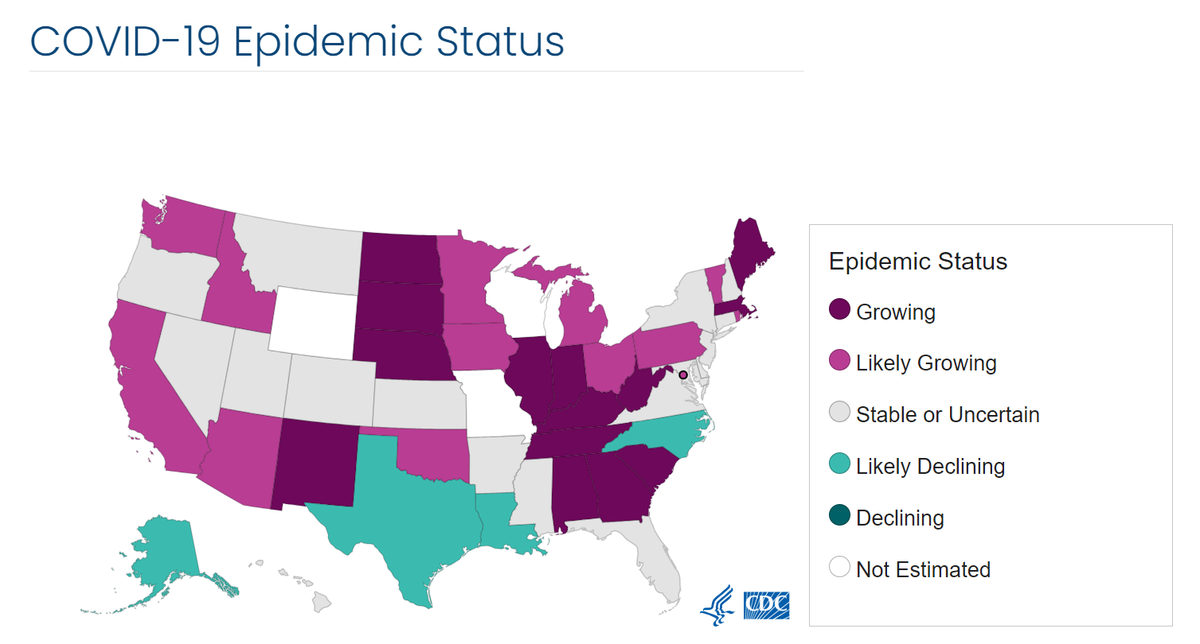
What the CDC says about Florida:
▪ Overall, respiratory virus activity is “minimal” in Florida. This is based on healthcare visits for fever, cough or sore throat.
▪ Florida is seeing a decrease in ER visits for COVID-19 and flu treatment, but that doesn’t mean people aren’t getting sick. The state is recording “very high” levels of COVID-19 in its wastewater. Health experts use wastewater data to identify what type of infectious diseases are circulating in a community. This sewer data can serve as an “early warning” as to whether infection levels are increasing or decreasing, even if people don’t have symptoms or are not seeking care, according to the CDC.
New 2024-2025 COVID and flu vaccines: What’s different?
The new 2024-2025 Pfizer and Moderna COVID mRNA vaccines were formulated to better target COVID infections stemming from Omicron variant KP.2, one of the “FLiRT variants” that has been spreading in the country since early spring. The goal of the shots is to reduce a person’s risk of serious illness.
Remember, the COVID virus mutates quickly and has led to an alphabet soup of variants. KP.2 was country’s dominant strain earlier in the year but now makes up about 3% of cases. The current dominant strain in the country is now KP.3.1.1, which makes up nearly 37% of COVID cases in the U.S., followed by KP.3, with nearly 17% of cases, recent CDC data shows.
The KP.2 and KP.3 variants descend from Omicron and are offshoots of JN.1, which fueled much of the country’s winter infections and are part of a group of variants known as FLiRT variants due to the technical names of their mutations. The FLiRT variants, and their sub-variants, are what caused the majority of infections during this summer’s COVID wave, according to Johns Hopkins Bloomberg School of Public Health.
“The good news is that the updated vaccine closely matches the KP.3 family of viruses that continue to grow in dominance,” said CDC Director Mandy Cohen during a recent news briefing.
Andy Pekosz, a professor in Molecular Microbiology and Immunology at Johns Hopkins Bloomberg School of Public Health, explained in a blog post that due to the similarities between the currently circulating variants and KP.2, the shots are expected to provide “good protection against severe disease, hospitalization, and death.”
“While KP.2 is not causing a significant number of infections, the most prevalent variants circulating right now are very closely related to them,” Pekosz said. “The vaccine will never be a perfect match to the circulating variants because it takes 2-4 months to make the vaccine, and during that time the virus continues to change as it infects people.”
Annual flu vaccine: What to know
In the U.S., flu season runs through the fall and winter, with peaks typically occurring between December and February, according to the CDC.
U.S. health officials look to countries like Australia in the Southern Hemisphere to get a forecast on what type of flu season could be coming our way. The CDC says this year’s 2024-2025 flu shot is “trivalent and will protect against an H1N1, H3N2 and a B/Victoria lineage virus.”
Who should get the new COVID and flu vaccine and when?
Like with previous COVID and flu infections, some of the people most at risk for severe disease continue to be those 65 and older and people who are immunocompromised or who have certain chronic medical conditions.
The CDC is recommending everyone 6 months and older get an updated COVID and flu vaccine. Cohen, the CDC director, is recommending people get vaccinated in September or October “ahead of the expected increases in both viruses this winter.”
And yes, you can get both vaccines at the same time, according to Linda Molaka, pharmacy manager at a CVS Health in Broward County. Her store, 2300 N. Flamingo Rd. in Pembroke Pines, received the new COVID shots on Monday.
“Because our bodies take two weeks for maximum protection on both vaccines, you don’t want to wait until we’re like in peak season,” which is typically November-February to get vaccinated, Molaka told the Miami Herald in a phone interview.
What if you recently had COVID?
The CDC says people who recently had COVID can delay their vaccination for three months after infection, but should consider various factors, including the COVID levels in their community, their personal risk factor for severe illness and the risk factor of people they live with or are in close contact.
If you have questions about the vaccines, ask your doctor.
Where to get the new COVID vaccine? What about the flu shot?
The newly updated COVID and flu shots are rolling out to retail pharmacies, health departments, doctors offices and community health centers across the nation. Some places might already have the shots in stock.
Like with previous COVID and flu shots, the new updated vaccines will be available at retail pharmacies including Publix, CVS, Walgreens, Navarro Discount Pharmacies, Walmart, and CVS y mas. Winn-Dixie has closed all of its pharmacies.
Most retail pharmacies will accept walk-ins, but that will depend on availability and demand. Call your pharmacy or check on the pharmacy website or app to see if appointments for the new shots are available. The federal government is also in the process of updating its Vaccines.gov website to help people find nearby vaccination sites.
Vaccination “is just one important step” to staying healthy and helping to protect the community, said Molaka, noting that getting a shot “is one thing that we know we have control over” to help reduce the risk of serious illness and hospitalization. People also need to remember to take other preventive measures, including frequent hand washing, to reduce the risk of getting sick.
Are the COVID vaccines free again? What about flu shots?
COVID-19 and flu vaccines are covered by most private health insurance plans and are also covered by Medicare and Medicaid. Make sure you get vaccinated at an in-network provider. Check your insurance for more information.
Flu vaccines are also available for free or at a “low cost” to people who don’t have insurance, according to the CDC. As for COVID-19 vaccines, the CDC’s Bridge Access Program that helped give free vaccines to people who didn’t have insurance or were uninsured has run out of funding months earlier then expected, USA Today reported.
That means people who don’t have insurance might need to pay out of pocket for COVID vaccines, and the shots can be pricey. At CVS, for example, expect to pay $201.99 for COVID vaccination. Children under 18 might still be able to get a free COVID vaccine through the CDC’s Vaccines for Children Program. Pharmacists in Florida can vaccinate kids as young as 3. For younger kids, speak with your child’s pediatrician.
This story was originally published August 27, 2024 at 6:22 AM.