
They’re a different kind of detective. They search for medical mystery clues
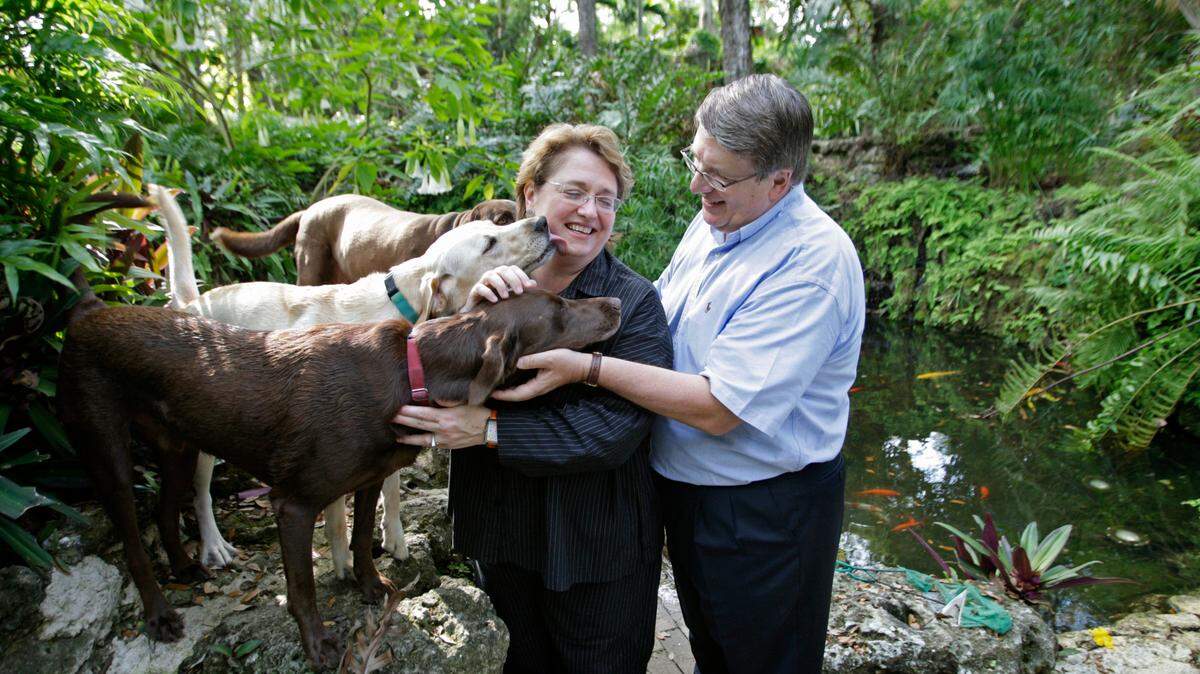
Margaret Pericak-Vance and her husband, Dr. Jeffery Vance, spend their days searching for clues to unlock human disease.
Their maze: the thousands of genes in the human body that cause cancer, heart disease, multiple sclerosis, autism, Parkinson’s and myriad other medical mysteries.
As professional colleagues, they share a storied history of genetic discoveries in their 30 years as scientists. As spouses, they share a family foundation that has withstood the death of their 14-year-old son a decade ago.
Their loss, they say, has given them special empathy for children and people with genetic diseases and drives them in their work.
These are two of the world’s foremost medical researchers. Margaret, who goes by Peggy, was the first to identify the gene connected to Alzheimer’s, a pivotal step in determining who is vulnerable to the neurological condition.
When the dean of the University of Miami’s medical school went looking for top scientists to lead a genetics-research team, he found them in the same household in North Carolina. The Vances were lured from Duke University, where they had established one of the leading genetics-research centers, to create the Miami Institute for Human Genomics. They, in turn, recruited more than 50 scientists from Duke and brought over $34 million in medical-research grants.
“Only two or three groups in the United States can do the work they do and [with] the quality with which they are doing it,” said Dr. Pascal Goldschmidt, dean of UM’s Miller School of Medicine. He worked with them at Duke; they were among his first hires at UM.
South Florida suits the Vances.
Jeff has a passion for orchids. Peggy fancies South Beach and shopping. They bought their house in Coral Gables because they loved the grotto and koi pond, and their three Labradors have the run of the grounds. “We knew the kids would like to come here,” Peggy said.
Genetics and links to family tree
Jeff and Peggy met in graduate school at Indiana University in Indianapolis. It was 1974. Junior students were assigned to senior advisors, and Jeff was assigned to Peggy. Both were working on doctorates in genetics. The study of the body’s genetic code was in its infancy; there were only 16 grad students.
She and Jeff “hung out a lot,” Peggy said. “We did things as a group. I don’t think we really dated. He says I chased him all over the place. I was obsessed with him. He was very good-looking. He had blond, sandy hair,” said the woman who grew up in Buffalo. “He looked very non-Buffalonian.”
Three years later, they had a big wedding. Peggy’s uncle Tore Amico, who lives in Boca Raton, was a dress designer who studied in Paris and New York. He updated the wedding gown he had made for her mother, adding 2,000 beads to the bodice and sleeves.
Instead of having the bride’s family sit on one side and the groom’s family on the other, though, they “mixed it all up because there were five people on his side and about 200 on mine.”
For their honeymoon, they went to Boston, then backpacking in New England.
For Peggy, whose mother was Sicilian and whose father was Croatian, genetics became the link to the family tree, the clues to how our ancestors determine who we are.
“Dad was a social worker, and Mom was in the purchasing department for the University of Buffalo,” she said. “[Dad] was legally blind. My grandmother had German measles, and he was born with cataracts. He never drove, but he was the first in the family to go to college, and he had a master’s in education and a master’s in history, summa cum laude. My father was a big proponent of education. He was the most influential person in my life. I was going to be something; it was never questioned.”
Jeff’s family moved to Los Angeles from Michigan when he was 10. In high school, he was famous for having been one of two football players who broke the collarbone of UCLA Bruins quarterback-turned-actor Mark Harmon.
He also loved music, playing cello, guitar and bass and joining a Hawaiian band while at the University of Puget Sound in Tacoma, Wash.
In grad school, he learned he needed both sides of medicine — research in the lab and patients in the waiting room — to be complete.
Hence, his decision to go to medical school after earning his Ph.D.
“I found that just the lab work was not fulfilling enough for me; I need to understand and be involved in the whole research process.”
Medical studies cited extensively
One measure of making an impact in medical research, and ultimately developing new treatments, is publishing studies in scholarly journals. Other scientists build on them, citing the original work in their discoveries.
The Vances are prolific.
At Duke, where Peggy was director of the Center for Human Genetics and Jeff was associate director, her team was the first to identify a variation of a gene, called APOE4, linked to Alzheimer’s. Her 1993 study, published in the journal Science, established a new paradigm for gene hunting, tracing the outer branches of families to find the disease’s genetic roots.
The paper is one of the most cited in Alzheimer’s research, said Jonathan Haines, director of the Center for Human Genetics Research at Vanderbilt University. “It’s still getting cited about 200 times a year, which is phenomenal considering it’s 14 years old.”
The scientific papers written by both Vances are off the charts in citations. Mary Moore, the UM medical school librarian, found 25,023 citations: “I have never seen citations like this before.”
The Vances’ work centers on human genomics, the science that searches for susceptibility to age-clouded eyes, floppy feet from nerve deterioration, or clogged arteries and heart failure.
“Once you get the landscape of the genes looked at, you can go to other landscapes of treatment and prevention,” Peggy said.
In 2003, scientists from around the world outlined a map of the 25,000 genes in a human being with the Human Genome Project. The implications have been stunning. Now, only five years later, you can go online and test your own genome, gauging your chances of developing Parkinson’s, MS or a host of other genetic conditions.
But such genetic Ouija boards don’t tell the whole story. Genes interact with each other. They are acted upon by the environment. They are buffeted or battered by lifestyle. And certainly not all the genetic variations in common diseases have been found. Autism and Alzheimer’s have many genetic factors, not all yet known.
This is where the Vances excel: They create large, complex studies.
By comparing millions of genetic components called nucleotides, the Vances find statistically significant areas of DNA that may indicate disease susceptibility. They then hone in with the intensity of crime-scene investigators.
Peggy “has real expertise in analysis and interpretation of large data sets and large problems,” said Haines, who has collaborated with her since 1985. “Jeff has an absolutely amazing expertise on the molecular side: How can you actually test the function of some of the [genes]?”
Haines said he would rank the couple among the top five genetics researchers in the country. Then he changed his mind: “Probably the top three.”
Loss of their son
The Vances’ children, Jeffery Joseph, nicknamed JJ, and Danica, two years younger, were central to their parents’ busy lives. “We took JJ to Finland when he was 2 or 3,” remembered Jeff. “And we went all over France and England with a double stroller.”
The children loved sports. On the wall in her office, Peggy has a poster-sized photo of Danica shooting a basketball on her East Chapel Hill high school team among dozens of family snapshots.
One winter night a decade ago, when JJ was 14 and had a knee injury from soccer, he complained of a headache. When it persisted the next day, Peggy stayed home in the morning; Jeff came home for the afternoon. By the middle of that night, JJ had begun to have seizures. He spent three weeks in the hospital. Doctors said he was getting better, but a storm of blood clots related to the injury erupted, a thrombotic overload that could have been spawned by genetics.
JJ died Dec. 12, 1998.
“He was the love of my life,” Peggy said.
Ten years later, Jeff still weeps when he talks about his son. Just last week, they decided they were ready to study the genes involved in JJ’s death.
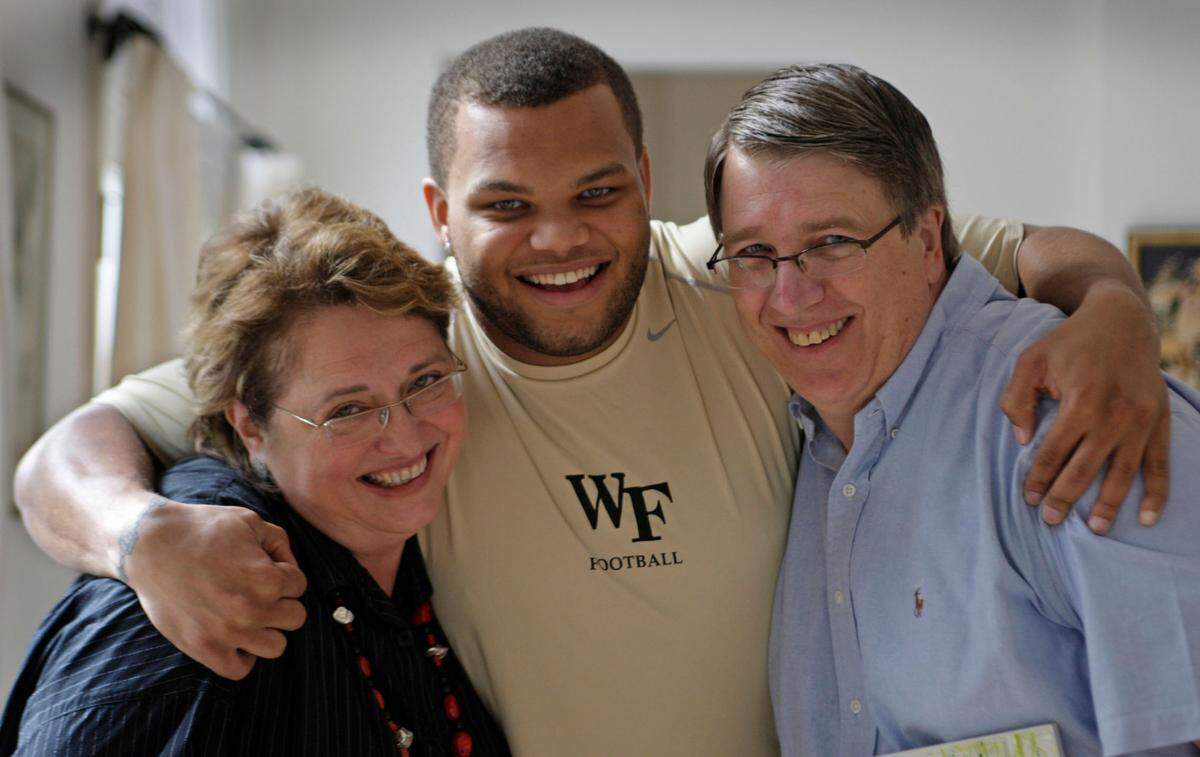
Peggy and Jeff have rebuilt their lives around their daughter, Danica, and a young man, Richard Belton, who first showed up at their door as Danica’s eighth-grade boyfriend.
As they got to know him, they realized Richard needed help in school. His mother, meanwhile, had moved into a Habitat for Humanity home that was outside the East Chapel Hill school district.
To keep Richard in the better school, Peggy and Jeff became his legal guardians. He moved in, living with them for the last two years of high school.
“[Richard’s] talents and smarts were always there; he just needed guidance and support,” said Danica, about to graduate from Duke with a degree in biological anthropology.
Now on a four-year football scholarship at Wake Forest, Richard plays fullback and is majoring in history. Peggy and Jeff and Richard’s biological mother, Pam, travel to all of his games.
“They showed me the importance of school and how football can only last so long,” Richard said. “They welcome my friends and family, anyone, anytime.”
“I knew it was the best for Richard,” said his mother, 46, a cook at the University of North Carolina. “Peggy’s real good people. You don’t find too many people of opposite races who get along. There’s no prejudice.”
Research blooms anew in Miami
The University of Miami embarked on developing a major center for medical genetics in 2002 when it lured Dr. Louis Elsas from the medical-genetics program at Emory University. In 2006, it hired Goldschmidt, chairman of Duke’s department of medicine, as its medical school dean.
Goldschmidt, a cardiologist, had worked with the Vances for years. At one meeting, Peggy said, Goldschmidt told her he was looking at a job in Miami and asked whether she would consider moving. “I said, ‘Oh, God, don’t leave me here.’ “
It was a chance to create something from the beginning, as they did at Duke. When they left after 26 years, there were 200 researchers and Peggy had become the first tenured woman without a medical degree in Duke’s medical school.
The Vances knew Goldschmidt. “Then we met Donna Shalala and saw she had vision and the energy to get things done, which is what Jeff and I are all about,” Peggy said. “We’re interested not only in finding genetic answers, but in translating that to healthcare, and there’s everything here to do that.”
Two weeks ago, Jeff was named the chair of the new Dr. John T. Macdonald Foundation Department of Human Genetics; Peggy will be the department’s first endowed chair. A doctoral program in human genetics is in the works, along with a $50 million building to house the Miami Institute of Human Genomics.
Peggy and Jeff work in offices down the hall from each other. While they’re in the same field, they have different strengths: Hers is envisioning where research ought to go to find genes others might miss; his is in determining techniques that will reach their goals.
“In the ‘70s, we started looking for single genes that caused diseases,” said Jeff, an expert on neurological diseases such as Parkinson’s. “With computers, that has changed a lot. It once took us seven to 10 days to do 20 genotypes. Now, we do one million in one day.
“We’re looking at genes that seem to have an effect on when you get a disease. If you can slow down Alzheimer’s or Parkinson’s for 10 or 15 years, you’ve basically cured it.”
The Vances hope to hook a new generation on their passion. In their son’s memory, they established the JJ Vance Foundation and every year present scholarships and internships to outstanding scholar-athletes at East Chapel Hill. They plan to do the same with high school seniors in South Florida.
Family focus
Peggy and Jeff enjoy South Florida, as do their family and friends.
Peggy’s brother, John, an attorney and judge in Rochester, N.Y., has visited several times this winter.
“I’m running a golf resort in Miami for the people from Rochester,” Peggy joked.
When Richard was on spring break, he brought half a dozen buddies to their home off Old Cutler Road. Peggy, who loves to cook big Italian meals, whipped up mountains of eggs and bacon, 25 New York strips, and, of course, Italian sausages.
“The most important role for me is being a mother,” Peggy said. “That’s how I define myself. If I’m not good at that, the rest doesn’t matter. Hopefully I was a good mother for JJ, and I try to be for Danica. And the same with Richard. If I did nothing else, I’d have my family around me, and that includes Richard and his friends.”
Jeff is more philosophical.
“Richard has never tried to replace JJ, and I have never expected him to,” he said. “No one can replace JJ as a brother to Danica, and we all understand that barrier. But yes, we have a father-son relationship, and I am proud to be thought of in that manner by Richard.”
In the Vances’ living room is a 30th anniversary gift they gave each other last year. It’s a hand-painted chest with whimsical palm trees and sunsets on the front, and the family’s names in painted squares across the top.
In the center is a heart carved with the names: Jeffery and Margaret, 7/23/1977, with Danica and JJ to the right, Richard to the left.