Most hospitals are reluctant to mandate vaccines for workers. That may soon change.
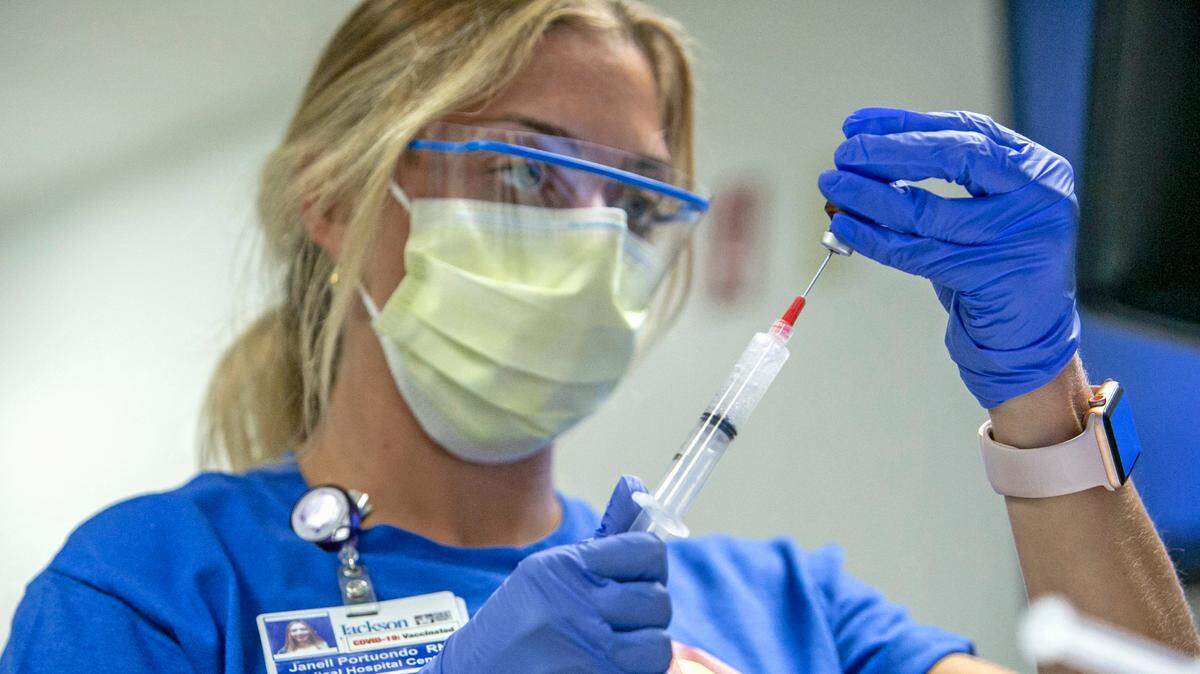
There may be no better argument for employees of Miami-Dade’s Jackson Health System to get vaccinated against COVID-19 than the young nurse colleague who has been hospitalized with the disease for the past three weeks.
“It makes it very real,” said Alix Zacharski, a nurse and manager of the Medical Intensive Care Unit at Jackson Memorial Hospital in Miami. “It hits us now.”
Zacharski said she did not have any information about her colleague, who is one of more than 200 patients with COVID-19 admitted at Jackson Health’s three hospitals in North Miami Beach, Miami and South Miami-Dade. But having to care for a coworker, she said, is something of a wake-up call for those colleagues who have decided not to take the vaccine.
“It does give it a little more reassurance that this is real,” said Zacharski, who is vaccinated. “This can happen to any of us. ... We really need to understand that this is something that can happen to anybody. We’re all exposed. We all are. We can have it.”
Among Jackson Health’s nearly 13,000 employees, about 60% are vaccinated. That’s a lower vaccination rate than Miami-Dade, where more than 1.6 million people — or 70% of the eligible population as of July 30 — are fully vaccinated, according to the Centers for Disease Control and Prevention data.
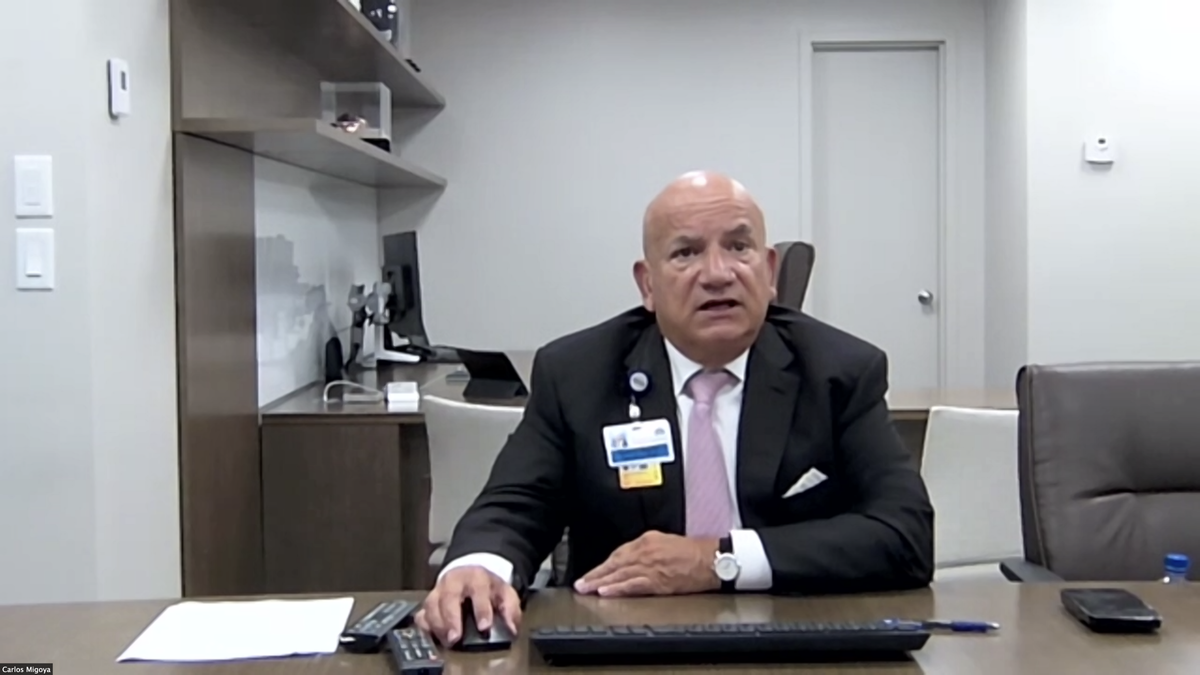
Jackson Health CEO Carlos Migoya said he is “frustrated” that more employees and people in the community have not taken the vaccine as the resurgent pandemic sends more Miami-Dade residents to the hospital.
“I’ve got to figure out a way to dramatically increase the vaccination of our employees,” he said in an interview with the Herald.
Caring for hospitalized colleagues can be emotionally challenging for clinicians, Migoya said. But mourning those who die is even tougher.
“They need to understand that this is the right thing to do not only for themselves but for the patients and their families,” he said. “We’ve had colleagues that have died from COVID.”
At Memorial Healthcare System, the public hospital network for south Broward County, about 61% of the more than 14,000 employees have taken the vaccine.
Aurelio Fernandez, CEO of Memorial Health, said in a prepared statement that administrators are encouraging more employees to get vaccinated by providing educational support to address hesitancy on a one-on-one basis, and bringing vaccine carts to workers on-site for convenience and access.
As the so-called pandemic of the unvaccinated continues to surge, sending more COVID-19-positive patients to Florida hospitals, administrators are struggling with how best to motivate more of their employees to take the vaccine.
Only one South Florida hospital has mandated vaccination for employees: Holy Cross Hospital in Fort Lauderdale. Every other hospital in the region, including the public hospital systems in Miami-Dade and Broward, strongly encourages its employees to get vaccinated. But there is no requirement.
That may soon change.
Last week, President Joe Biden announced that all federal employees must be vaccinated or submit to regular testing. The announcement followed a similar requirement also announced last week by the Department of Veterans Affairs, which mandated vaccines or regular testing for all employees.
California and New York City also imposed vaccine requirements for government and healthcare workers while industry lobbyists and trade organizations, including the American Hospital Association and the American Medical Association, forcefully advocated for mandates for healthcare workers.
Though Florida’s Legislature and Gov. Ron DeSantis have banned so-called vaccine passports, employers can require all workers who are physically entering a building to be inoculated, according to recent guidance from the Equal Employment Opportunity Commission.
This month, the Department of Justice clarified that employers can mandate vaccination for workers even if the vaccine has the Food and Drug Administration’s emergency use authorization and not the agency’s full approval.
‘95 to 99 percent’ of hospitalized not vaccinated
While one might expect healthcare workers to follow the guidance of public health agencies and the medical community, some who work at hospitals, doctors offices, clinics and nursing homes have turned down the vaccine.
Those who work at hospitals and diagnose and treat patients, such as doctors and nurses, are more likely to be vaccinated, according to a recent report by the American Medical Association and an April survey by the nonprofit Kaiser Family Foundation and the Washington Post. And a WebMD and Medscape Medical News analysis of data from the Department of Health and Human Services found that about 1 in 4 people who work in hospitals were not vaccinated as of the end of May.
At Jackson Health, doctors lead the way among those who are vaccinated and declines from there. About 90% of third-year medical residents and 80% of attending physicians are vaccinated. About 55% of clinical staff nurses are vaccinated and nearly 42% of medical assistants. An additional 46 employees have received a first dose.
During a town hall meeting with Jackson Health workers in Miami last week, Migoya said, the question of a vaccine mandate came up.
He said he considers healthcare to be “a higher calling” and that healthcare workers have a duty to protect patients from any risks their caretakers may pose. But he refused to say whether he will mandate vaccines for employees.
“We’re considering a lot of different options, including mandating vaccination,” he said. “We’re also considering what President Biden said yesterday, either you get vaccinated or you get tested every week.”
Migoya said he will make a decision “in the next few weeks” but that his goal is clear.
“I would love for the people to understand on their own that they have to do this but I’ll take some stronger measures if necessary at the right time.”
Martha Baker, a nurse and president of the labor union that represents Jackson Health’s physicians and nurses, said she favors a vaccine mandate for employees.
“This is really a risk-benefit decision that seems like a no-brainer to me,” she said. “Caregivers that we represent — nurses, doctors, social workers, pharmacists, etcetera — have been educated to rely on science, and the science is here.”
Baker, who said she was vaccinated in December, added that she may ask the board of SEIU Local 1991, the labor union, to consider mandating that its members be vaccinated if hospital administrators do not act.
“I think people have to lead where they can,” she said. “I want our healthcare workers to lead on this public health issue.“
Baker said the reasons she has heard from colleagues who have rejected the vaccine are varied. Some cite the fact that the Food and Drug Administration has yet to give full approval to the vaccine, which remains under emergency use authorization status since December.
Others are worried the vaccine may reduce their chances of pregnancy or harm their fetus if they take the vaccine, even though the Centers for Disease Control and Prevention advises pregnant women to get vaccinated. Still others say they want to continue to wait and see.
Then there’s vaccine misinformation. Healthcare workers are just as susceptible to misinformation as the general public — maybe more so, Migoya said.
“When you’re in the healthcare business you’re susceptible to more rumors than outside,” he said. “Read the internet and you’re going to find an awful lot of misinformation. ... Our people read that and some of them think they know more and they’re going to wait.”
Baker said she advises colleagues to “forget the internet” and rely on what they know.
“Right now we’re seeing 95 to 99 percent of the patients coming in with COVID are not vaccinated,” she said. “What could be more of a risk than not being vaccinated?”
Concerns about losing employees
The risk for hospital administrators is not limited to employees who might catch and spread the very virus that is driving patients into their facilities.
Some hospital administrators may be reluctant to impose a vaccine mandate on their employees for fear of losing staff to hospitals that do not. The demand for registered nurses with hospital experience is high due to a years-long nursing shortage, which the pandemic has worsened. Many are burned out after 18 months of caring for COVID-19 patients while others have left local hospitals for more lucrative travel work in other states.
One of the most visible cases involving a vaccine mandate for hospital employees occurred in Texas, where more than 150 healthcare workers were fired or resigned after refusing to comply with Houston Methodist’s vaccine mandate. Employees had sued Houston Methodist to stop the mandate, but a federal judge upheld the hospital’s policy.
In North Florida, two hospital systems have announced vaccine mandates for employees: the Mayo Clinic in Jacksonville and Ascension, which operates hospitals from Pensacola to the Jacksonville area. The Mayo Clinic has set a deadline of Sept. 17 for all employees to be fully vaccinated but Ascension is giving employees until Nov. 12 to do so.
Migoya, Jackson Health’s CEO, said he needs to carefully consider whether a vaccine mandate would drive away a significant part of his workforce.
“We want to know what every other hospital is doing,” he said. “There’s a huge shortage of nursing now and the last thing we want to do is something that forces our nurses to go somewhere else.”
Fernandez, Memorial Health’s CEO, said he also is watching what other hospitals across the country and in South Florida do regarding vaccine mandates
“It may have to be a decision that is executed collectively,” he said, “given the impact it can have in the healthcare industry.”
The University of Miami Health System also has made vaccination optional for healthcare workers even as administrators impose a vaccine mandate for all other university faculty and staff, who must return to work on campus by Sept. 7.
In a July 29 memo to UHealth and UM’s Miller School of Medicine employees, university administrators said they were following what “other local health systems” have done by encouraging — but not mandating — vaccination of “clinical patient-facing staff.” UHealth officials did not respond to a request for comment Friday.
Fort Lauderdale hospital requires vaccine mandate
Administrators for Holy Cross Health in Fort Lauderdale said they don’t want to lose doctors, nurses and other healthcare workers during a pandemic any more than the next hospital does.
But Holy Cross’s parent company, a nonprofit Catholic network called Trinity Health, announced a vaccine mandate for all employees on July 9. With 92 hospitals in 22 states and more than 117,000 employees, Trinity Health estimated that about 75% of its employees had received at least one dose of vaccine.
Dr. Jose Lopez, chief medical officer for Holy Cross, said it’s “the right thing to do” for workers and patients.
“Our patients and colleagues expect to work in an environment that’s safe,” he said. “They don’t want to work in an environment where they could be exposed to covid.
Lopez said about 60% of Holy Cross’s nearly 3,000 employees are vaccinated, and that there are some exceptions to the rule, including those who have a medical reason and women who are pregnant or trying to become pregnant.
“Many nurses are females of childbearing age,” he said. “So that’s a concern for them.”
Lopez acknowledged that some employees are resistant to a mandate, and that he expects some who cannot get an exemption may leave Holy Cross for hospitals that do not require inoculation for employees. He said the risk of employees leaving because of the mandate is “a real one.”
“We know it will probably happen,” he added. “But at the same time, we’re hoping to attract nurses from hospitals that have not mandated it and make ourselves the safe place to work.”
Ending the pandemic
Natasha Garcia, an ICU nurse at Jackson Memorial, said she was among the first in her unit to get vaccinated. Garcia said she expected most of her colleagues to get vaccinated, like she did, after the waves of COVID-19-positive patients that nearly overwhelmed South Florida hospitals in 2020.
“With everything we went through and how traumatizing and horrific our experiences with patients were,” she said, “I thought the majority of nurses would get vaccinated but that’s not the case.”
Though most of her coworkers in the ICU are vaccinated, Garcia said, the ones who have decided not to take the vaccine fear that it may harm their ability to get pregnant or cause damage to their fetus.
“That’s mainly one of the reasons,” she said.
Garcia said she would support a vaccine mandate at Jackson Health, but she doesn’t think administrators will require the shots because of the risk of losing nurses when there’s a shortage of them and a resurgent pandemic.
“I feel that a lot of the nurses would leave,” Garcia said. “Sadly enough, I know it sounds backwards. A lot of people are entitled to decide what they do with their body, and a lot of people unfortunately use that reason not to get vaccinated.”
Migoya said he is at the end of his wits with the pandemic and those who refuse to take the one thing that science says will end it: the vaccine.
“There’s only one thing that stops this stupid virus: vaccination. Period,” he said.
“I hate to be a little crude about this,” he added, “but I think there’s going to be some very resistant people who never get it and what I’m hoping for is that they get infected. If they get infected, they create antibodies and now they have resistance. ... but at least the overall population will have antibodies and we’ll be over this pandemic.”
This story was originally published August 1, 2021 at 6:00 AM.