Coronavirus

Some at-home COVID tests have expiration dates changed by the FDA. How to check yours
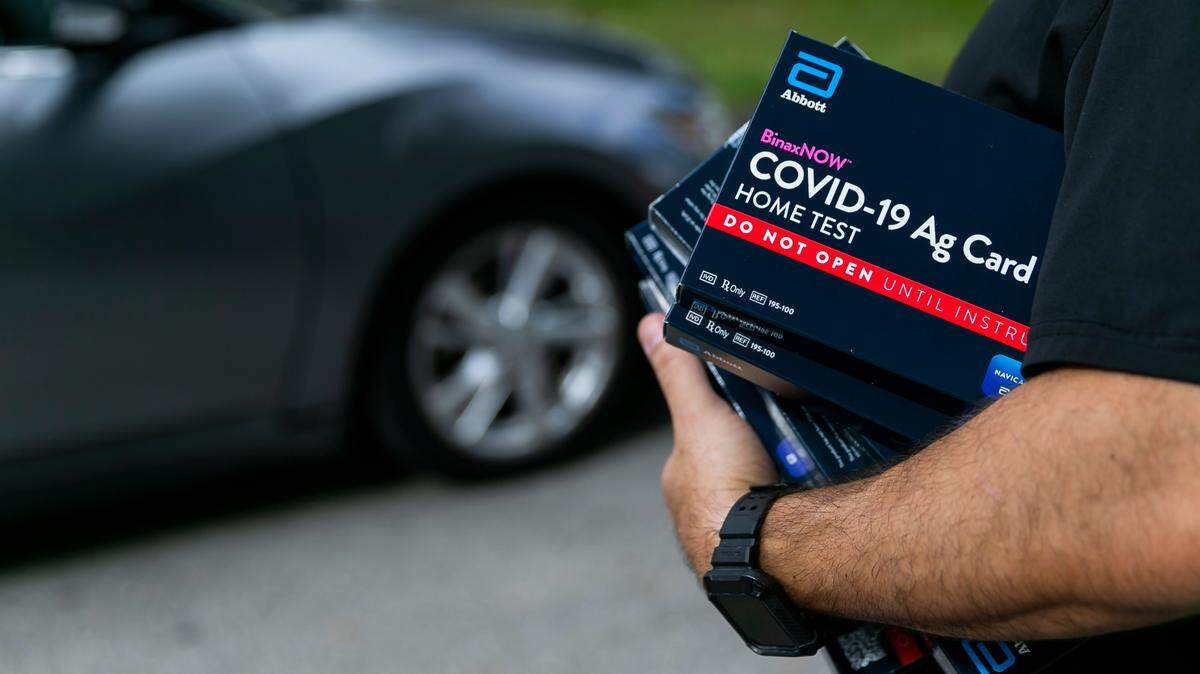
Wilfredo Guilarte, a Broward County employee, hands out free at-home rapid COVID-19 tests at South Regional/Broward College Library in Pembroke Pines, Florida on Saturday, January 8, 2022.
Wilfredo Guilarte, a Broward County employee, hands out free at-home rapid COVID-19 tests at South Regional/Broward College Library in Pembroke Pines, Florida on Saturday, January 8, 2022. mocner@miamiherald.com

Is your at-home COVID test expired?

Don’t throw it out. First, check to see if the expiration date got an extension by the U.S. Food and Drug Administration. If it did, that means the test can still produce accurate results.

Here’s how to check:

Does my COVID at-home test still work? How to check

You’ll need to visit the FDA’s website and search for its “Extended Expiration Date” table.

Once you’re on the page with the table, go to the search function and type the manufacturer and test name shown on the box label of your test. Each result also has a photo of the test’s label, which should make it easier to identify your test.

Check the “Expiration Date” column:

If it says “Expiration Date: See box label” that means the test is expired and you should not use it.

If you see a hyperlinked “Extended Expiration Date” for your test, that means the FDA gave it an extension. Click the hyperlinked text. This will take you to a document that lists lot numbers, original expiration dates, and new expiration dates.
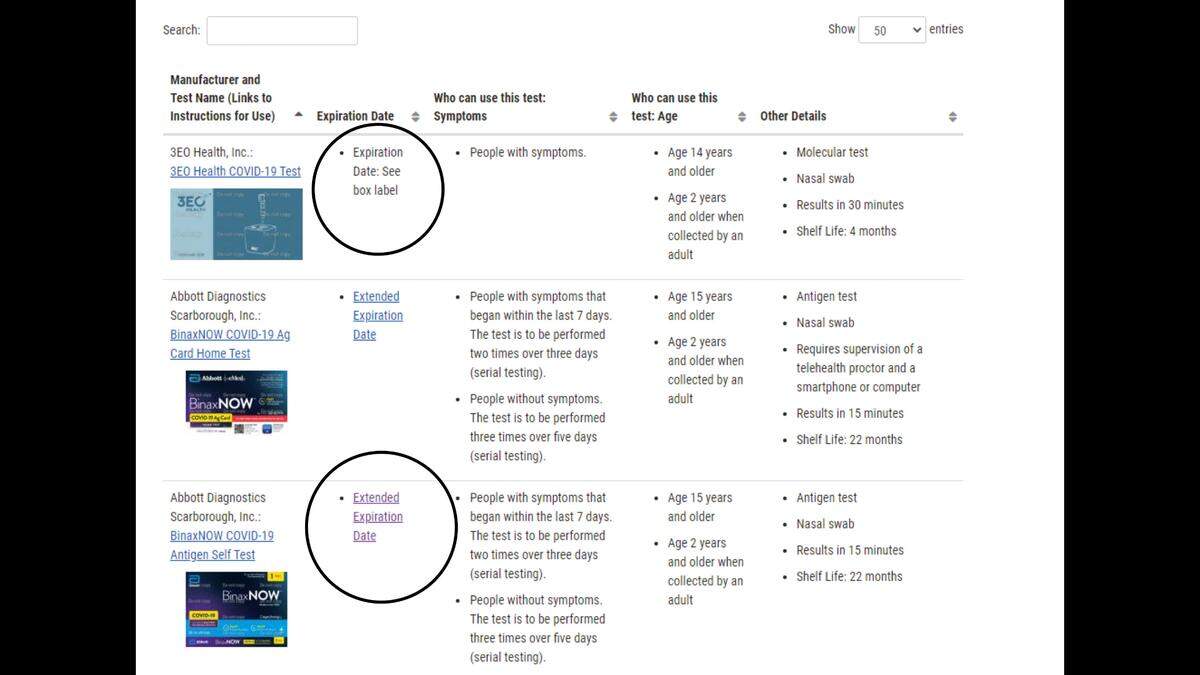
Check the “Expiration Date” column to see if the FDA did or did not give an extension to an at-home COVID test’s expiration date.
Check the “Expiration Date” column to see if the FDA did or did not give an extension to an at-home COVID test’s expiration date. Michelle Marchante mmarchante@miamiherald.com; original screenshot is of FDA's website

Compare your test’s lot number and original expiration date to the list. If you see a match, look at the last column of the document to see the test’s new expiration date. If you don’t find a match, don’t use the test, the FDA says.
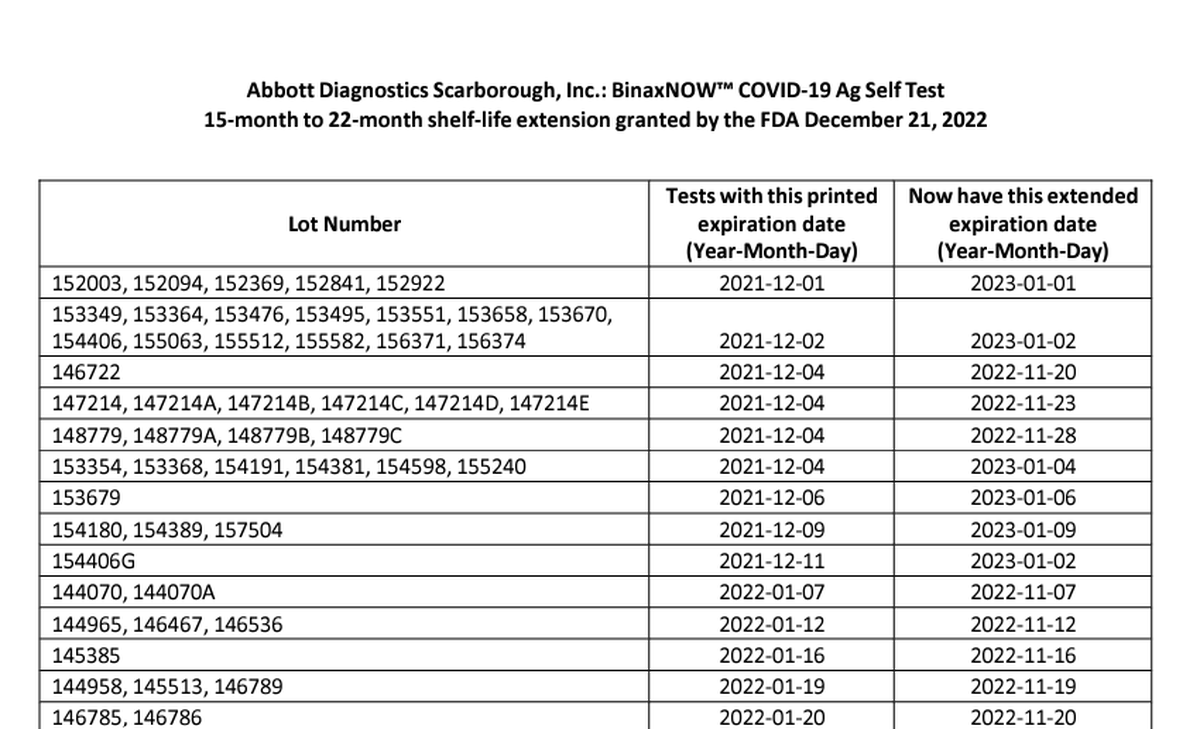
This screenshot is an example of the FDA document that lists the lot number, original expiration date and the extended expiration date for at-home COVID tests.
This screenshot is an example of the FDA document that lists the lot number, original expiration date and the extended expiration date for at-home COVID tests. Screenshot of FDA website

Tip: The lot number and expiration date of your test will usually be near each other on the box. Look for the word “LOT.” This may be a combination of letters and numbers. That’s your lot number. For the expiration date, look for the words “Expiration” or “Use by.” Some boxes might use an hourglass drawing instead to identify the expiration date.

The lot number and expiration date of your test will usually be near each other on the box. Look for the word “LOT.” This may be a combination of letters and numbers. That’s your lot number. For the expiration date, look for the words “Expiration” or “Use by.” Some boxes might use an hourglass drawing instead to identify the expiration date.
The lot number and expiration date of your test will usually be near each other on the box. Look for the word “LOT.” This may be a combination of letters and numbers. That’s your lot number. For the expiration date, look for the words “Expiration” or “Use by.” Some boxes might use an hourglass drawing instead to identify the expiration date. Michelle Marchante mmarchante@miamiherald.com

If your COVID test is expired, should you still use it?

The FDA doesn’t recommend using expired COVID at-home tests that do not have an expiration date extension.

“COVID-19 tests and the parts they are made of may degrade, or break down, over time. Because of this, expired test kits could give inaccurate or invalid test results,” the FDA said.

READ NEXT: More ER patients in Florida test positive for COVID. The surge is different this time

Why did some tests get extensions and others didn’t?

At-home COVID test expiration dates show how long the tests are expected to “perform as accurately as when manufactured,” according to the FDA. These expiration dates were “measured from the date the test was manufactured.”

The FDA said it uses data from initial study results to create an expiration date, which is usually about four to six months from the day the test was manufactured. Once the test manufacturers have more “stability testing results,” usually within 12 or 18 months, they can ask the FDA to review the data and possibly give an OK to a longer shelf-life.

MORE: Do you have COVID? Here’s how long the CDC recommends you stay home

Michelle Marchante
Miami Herald
Michelle Marchante covers the pulse of healthcare in South Florida and also the City of Coral Gables. Before that, she covered the COVID-19 pandemic, hurricanes, crime, education, entertainment and other topics in South Florida for the Herald as a breaking news reporter. She recently won first place in the health reporting category in the 2025 Sunshine State Awards for her coverage of Steward Health’s bankruptcy. An investigative series about the abrupt closure of a Miami heart transplant program led Michelle and her colleagues to be recognized as finalists in two 2024 Florida Sunshine State Award categories. She also won second place in the 73rd annual Green Eyeshade Awards for her consumer-focused healthcare stories and was part of the team of reporters who won a 2022 Pulitzer Prize for the Miami Herald’s breaking news coverage of the Surfside building collapse. Michelle graduated with honors from Florida International University and was a 2025 National Press Foundation Covering Workplace Mental Health fellow and a 2020-2021 Poynter-Koch Media & Journalism fellow.  Support my work with a digital subscription
Get unlimited digital access
#ReadLocal

Try 1 month for $1

CLAIM OFFER