
Florida COVID weekly: New omicron strains gain hold in South Florida as cases spike
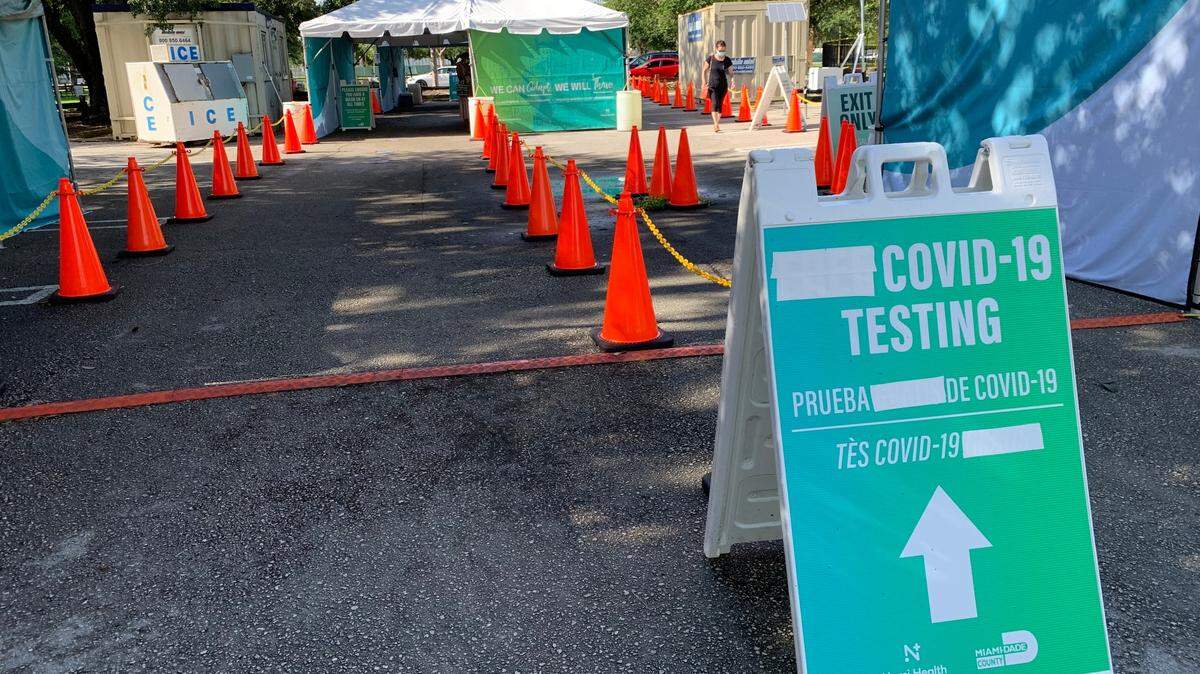
More contagious strains of omicron are gaining a foothold in South Florida, leading to an increase of new COVID-19 cases, hospitalizations and deaths, according to the latest reports.
The two new strains, BA.4 and BA.5, have higher transmission rates and can evade immunity from vaccination and previous infection, but, to date, have not caused more severe illness like previous strains, public health experts say.
“There are a lot of characteristics of these variants that would suggest that they can begin to outcompete the existing variants,” said Jason Salemi, an epidemiologist and associate professor at USF’s College of Public Health. “They are the ones we should be mindful of, in terms of the percentage of all new cases.”
In the past seven days, the state has added 10,318 cases and 33 deaths per day, on average, according to Miami Herald calculations of data published by the Centers for Disease Control and Prevention. Over the past three weeks, on average, 111 more cases were logged each day in Florida.
READ MORE: There’s a new, more contagious omicron strain, and it’s in Miami-Dade
The number of cases is likely an undercount due to positive results from at-home COVID testing. The state also only tracks resident cases and deaths, excluding nonresidents.
READ MORE: Florida undercounted COVID cases and deaths, failed to get test results, state audit says
Salemi said that despite the new variants, Florida will not see the exponential number of new cases that were reported during the delta wave last summer or the omicron surge in January. Daily new case counts in the state topped 20,000 during delta and topped 10,000 during omicron.
“I don’t think there is any evidence that we’re going to get numbers that were anywhere near where we were for the delta surge, in terms of severe illness, or even the first omicron wave,” Salemi said. “In part, that’s because we have so much built-up immunity through recent prior infection as well as through vaccination.”
As of Tuesday, 86% of Miami-Dade’s total population was fully vaccinated, about 2.3 million people. Florida’s fully vaccinated rate is 67.5 percent; the U.S. rate is 66.8 percent. Fully vaccinated means people have received either the single dose J&J/Janssen vaccine or two doses of the Pfizer-BioNTech or Moderna vaccines. It does not include a booster.
Despite the high vaccination rate, Miami-Dade still had a 21 percent positivity rate as of Monday. The positivity rate is the percent of local positive tests.
Miami-Dade, Broward, Palm Beach and Monroe are at a high COVID-19 risk level, according to the CDC. Under the high-risk level, the CDC recommends everyone wear masks indoors, regardless of vaccination status.
READ MORE: Miami-Dade’s COVID-19 cases, positivity rates soar
Tracking COVID Variants
The two new omicron subvariants, BA.4 and BA.5, are spreading throughout the United States. They were first detected in South Africa earlier this year.
From June 5-9, the BA.5 strain accounted for 13.3% of U.S. cases and BA.4 accounted for 8.3%, becoming the third and fourth most dominant subvariants, respectively, according to CDC data. In the first week of May, the two variants accounted for only about 1 percent of new COVID cases.
Dr. David Andrews, vice chief of pathology at Jackson Health Systems, said Tuesday the two subvariants are more contagious than previous strains.
“Clearly [these variants have] increased transmissibility and high properties of immune evasion,” Andrews said.
READ MORE: ‘We should definitely be concerned.’ Miami-Dade’s COVID-19 cases, positivity rates soar
With excessive heat warnings forcing people indoors and no mask mandates, “I would say it’s a reasonable guess that we’re going to have this churning of infections over the summer,” Andrews added.
READ MORE: In some parts of South Florida, it felt like 103 degrees. Will the heat stick around?
“BA.4 and BA.5 will likely become the dominant strains very soon,” he said. “This is most likely due to increased properties of immune escape...and transmissibility.”
South Florida and Manatee County COVID-19 Cases
In the period from June 3-9, Florida has seen 74,412 new cases, according to Miami Herald calculations of the CDC’s Community Profile Report published Tuesday.
New cases were 4% more than those added the previous week.
Here’s a breakdown of the new COVID cases in South Florida and Manatee County, according to the report.
▪ Miami-Dade reported 15,718 new resident cases in the week ending June 2, 9 percent fewer than what was added in the previous week. But testing decreased by 2.93 % from the previous week.
▪ Broward reported 8,475 new resident cases, or 1 percent fewer than those added in the previous week. Testing increased by 8.63% from the previous week.
▪ Palm Beach reported 4,981 new resident cases, or 3% fewer than those added the previous week. Testing increased by 10.3% from the previous week.
▪ Monroe reported 190 new resident cases, or 6% more than those added the previous week. Testing increased by 4.63% from the previous week.
▪ Manatee reported 1,202 new resident cases, 3% more than those added the previous week. Testing increased by 10.12% from the previous week.
South Florida and Manatee County COVID deaths
Florida has added 269 deaths in the past week, according to Herald calculations of the CDC’s Tuesday Community Profile Report. It is unclear when these newly reported deaths occurred. The Community Profile Report updates Florida’s county tolls and rates about once every seven days.
As of Tuesday’s Community Profile Report, Florida had a rate of 349 cumulative deaths per 100,000 people since the start of the pandemic.
Here’s where death rates and tolls stand in South Florida and Manatee County, according to the CDC:
▪ Miami-Dade’s death toll is 11,017, an increase of 29 deaths from Friday’s report. That’s a rate of 405 cumulative deaths per 100,000 people since the beginning of the pandemic.
▪ Broward’s death toll is 5,903, an increase of 10. That’s a rate of 302 cumulative deaths per 100,000 people.
▪ Palm Beach’s death toll is 5,114, an increase of 19. That’s a rate of 342 cumulative deaths per 100,000 people.
▪ Monroe’s death toll is 119, an increase of one new death. The county would be at a death rate of 160 deaths per 100,000 people if its population were that large.
▪ Manatee’s death toll is 1,455, an increase of 10. Manatee has a rate of 361 cumulative deaths per 100,000 people.
Florida COVID-19 hospitalizations
There were 3,324 people hospitalized in Florida, with 347 in the ICU, according to the U.S. Department of Health & Human Services report on Tuesday.
Over the past three weeks, on average, 56 more people were hospitalized each day in Florida. Over the past three weeks, on average, 5 more people were in the ICU with COVID each day in Florida.
At omicron’s January peak, more than 15,000 patients were hospitalized in Florida, according to HHS data.
Miami-Dade County no longer collects and reports COVID hospitalizations data in its “COVID-19 Daily Dashboard.”
Florida COVID-19 vaccinations
About 14,497,198 eligible Floridians — 67.5% of the state’s population — have completed the two-dose series of either the Pfizer-BioNTech or Moderna vaccines or have completed Johnson & Johnson’s single-dose vaccine, according to the CDC.
About 5,966,982 Floridians have received a booster, about 41.2% of the state’s fully vaccinated population.
Here’s how many people have received a booster in South Florida and Manatee County, according to the CDC:
▪ In Miami-Dade, about 797,823 people, or 34.2% of the fully vaccinated population, have received a booster.
▪ In Broward, about 565,590 people have received a booster, or 40.3% of the fully vaccinated population.
▪ In Palm Beach, about 443,864 people have received a booster, or 44.3% of the fully vaccinated population.
▪ In Monroe, about 22,873 people have received a booster, or 39% of the fully vaccinated population.
▪ In Manatee, about 113,761 people have received a booster, or 45.3% of the fully vaccinated population.
This story was originally published June 14, 2022 at 8:04 PM.
%20Cropped%20(2).jpg)