‘It’s clearly in a growth phase.’ The BA.2 subvariant of omicron is rising in South Florida
Two years and four waves into the COVID-19 pandemic, it’s starting to feel like déjà vu all over again.
A new subvariant of omicron, called BA.2, is driving most new COVID-19 infections around the world and now accounts for about 1 in 3 cases in the United States and more than half in certain regions, according to surveillance data from the Centers for Disease Control and Prevention.
CDC data show that in the Southeast, including Florida, BA.2 made up about 1 in 5 cases where virus samples were sequenced during the week ending March 19, the most recent period available. Elsewhere, including the New England region, the omicron subvariant makes up more than half of all cases.
However, there has been no corresponding spike in cases and COVID-related deaths have dropped nationally to their lowest point since late November, prior to the omicron surge.
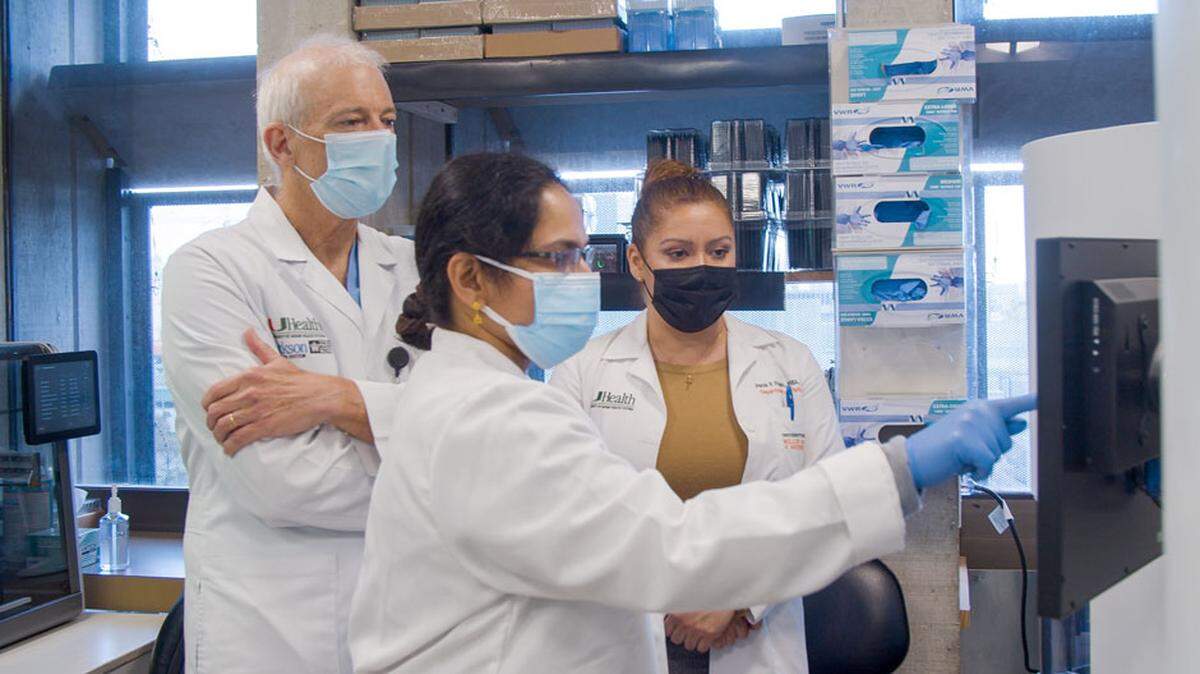
In Miami-Dade, a team of University of Miami researchers has been tracking variants through genomic sequencing of samples taken from COVID-positive patients at UHealth Tower, Jackson Memorial Hospital and students and staff on UM’s campuses.
David Andrews, a physician and associate professor in the Department of Pathology and Laboratory Medicine at UM’s Miller School of Medicine, leads that effort. Andrews said the team found its first cases of BA.2 in mid-January and that for several weeks the counts remained relatively low at about two to three per week.
“Now, in the past couple of weeks, let’s say two or three weeks, we’re starting to see definite growth on a week-to-week basis,” he said. “We are now mirroring the national trends. ... It’s clearly in a growth phase.”

Andrews said he’s not predicting a surge, but that his main concern is that waning immunity from vaccines or prior infections will leave more people with a false sense of security that they are still protected.
“I do think that the opportunity for increased infection rates still remains,” he said.
READ MORE: Five things to know about BA.2
The most recent CDC data for Florida show that during the four weeks ending Feb. 26, BA.2 made up less than 2% of all cases where virus samples were sequenced. But even as the proportion of BA.2 circulating in the Southeast has increased, the 7-day moving average of daily COVID-19 cases in Florida has declined from about 3,000 a day on Feb. 26 to less than 1,200 on March 21, according to CDC data.
With spring break bringing more visitors to Florida, and BA.2 spreading rapidly and overtaking the original version of omicron that dominated in winter, disease modelers and public health experts say they are encouraged by the lack of increase in cases but that it’s still too early to tell whether BA.2 will fuel a fifth wave of the pandemic or how severe it might be.
“There’s still a ton of uncertainty,” said Stephen Kissler, a researcher in the Department of Immunology and Infectious Diseases at Harvard T.H. Chan School of Public Health, during a media teleconference this week. “The question of if and when a surge is coming, and how large is ... very much open.”
More contagious than omicron
The White House’s chief medical advisor, Dr. Anthony Fauci, said current evidence suggests that BA.2 is 50% to 60% more transmissible than the original omicron variant, and the CDC predicts that it likely will become the dominant variant in the coming weeks.
Public health experts say there is hope that the increased proportion of people with immunity from vaccination, prior infection or a combination could help soften the impact in the United States even as the omicron subvariant drives a rise in new cases in other countries, including the United Kingdom and France.
In South Africa, where the original omicron variant was first detected and fueled a surge in cases, BA.2 is also circulating widely but so far has not caused an increase in cases. And though it’s unclear how BA.2 will affect the United States, Kissler said the nation’s high rate of infections during the winter omicron wave — which peaked in mid-January with an average of 800,000 cases a day — may provide protection against the new subvariant.
“I’m still not totally convinced that we’re going to see a major surge from BA.2. ... We’ll just have to see on that,” he said.
Surge in COVID infections likely
The BA.2 subvariant is growing in proportion at the same time that many states are relaxing mitigation measures, such as masking, and reporting data less frequently, leading many experts to worry these changes will create blind spots and delay public health responses.
In addition, Congress has not approved additional funding for the Biden administration’s pandemic response, which is running out of money to buy vaccines, tests and therapeutics.
Some epidemiologists and infectious disease experts say cases are very likely to rise given those developments and the increased contagiousness of the BA.2 variant.
“This variant appears to be more transmissible than the original BA.1 omicron variant, but also it appears to cause less severe disease, which is good news,” said Anna Durbin, a physician who specializes in infectious diseases and a professor at Johns Hopkins University’s Bloomberg School of Public Health.
But Durbin added that COVID-19 likely will become a recurring illness around the world. “Neither vaccination nor infection will prevent COVID forever,” she said. “COVID is here to stay.”
For those who have immunity, however, COVID-19 is not likely to cause severe disease even if they become infected, said Amber D’Souza, an epidemiologist and professor at Johns Hopkins University’s Bloomberg School of Public Health.
“Given the population immunity we have, we do not expect the surge in severe illness to be as large as seen in previous years,” D’Souza said.
She emphasized that not all communities will experience future surges in the same way. Even if a small proportion of people develop severe disease, D’Souza said, when infection is rampant that small proportion can grow exponentially and overwhelm hospitals and communities that are not prepared.
Durbin said the lack of congressional funding for pandemic response is likely to affect the country’s ability to control infections, hospitalizations and deaths during future outbreaks. Taxpayers have funded the vaccines, treatments, masks and many other tools to control COVID-19, she said, making it easier for Americans to access those resources if they want them.
“Without that funding, while we’re still in the midst of omicron and COVID, and we’re not entirely back to normal, there is fear of another surge,” she said.
What the future holds
Florida’s experience, like the rest of the nation’s, will depend largely on individual behavior and baseline immunity from vaccinations and prior infections, experts said. But seasons are also likely to play an important role.
Harvard’s Kissler said he believes that COVID-19 is likely to become a seasonal illness, with cases rising when people gather indoors without proper ventilation and masking. In the Northeast, COVID-19 season might occur in winter, and in warmer climates, like Florida’s, cases may rise in summer when people are more likely to be indoors with air conditioning. He said COVID-19 eventually will settle into a pattern, like influenza.
“One possible future that I can envision is with repeated exposure to SARS-CoV-2, we’ll eventually reach a similar equilibrium point, with large outbreaks in winter when people crowd indoors and substantially lower cases in summer.”
But those patterns are likely to look different depending not only on the season but also the part of the country, creating a need for more localized COVID-19 reports similar to weather forecasts.
D’Souza at Johns Hopkins said she also believes COVID-19 is here to stay and likely to become seasonal. She’s optimistic about the future.
“We will see a stabilization where this has surges, and it may be seasonal, but it is within an expected range,” D’Souza said. “I don’t know that that will happen this year, but I’m confident that if not this year, next year as we continue to build immunity and get enough people to take booster doses.”
This story was originally published March 25, 2022 at 6:00 AM.