Amid Florida COVID spike, Miami hospital’s virus patients are younger, unvaccinated
Florida’s COVID epidemic is on the rise again, driven by outbreaks in the Miami area, Jacksonville and the Panhandle.
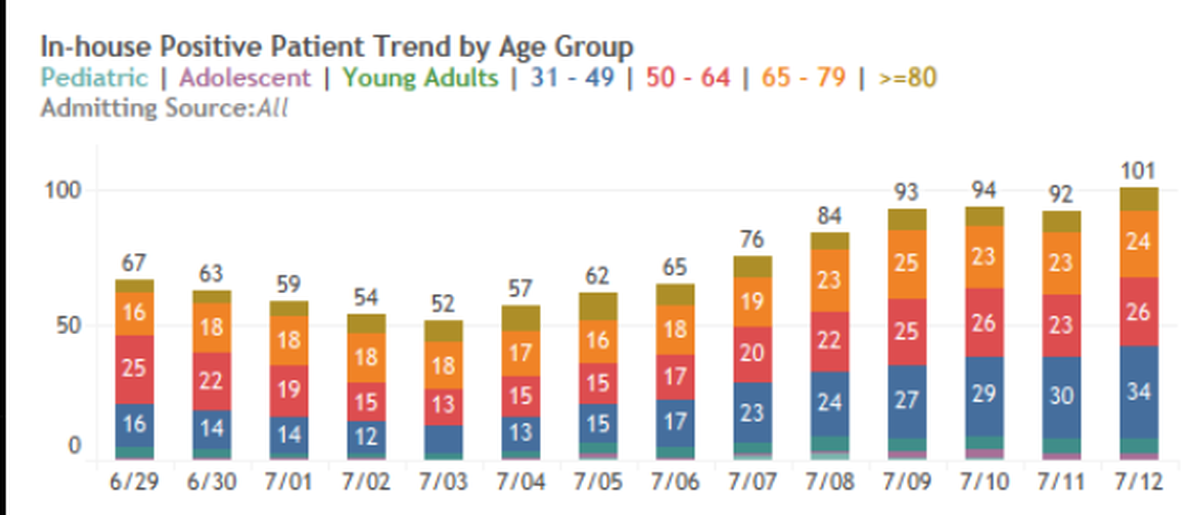
Several months after highly effective and safe vaccines have been made available to the general public over the age of 12, physicians at Miami-Dade’s public Jackson Health System were treating about twice as many COVID patients over the weekend as they had been earlier this month. As of Monday, 101 patients with the SARS-CoV-2 virus were admitted throughout Jackson Health System.
Dr. Lilian Abbo, chief of infectious diseases at Jackson, said her team was watching the trend carefully. She attributed the uptick to behaviors in the community, though there are other factors at play, including hotter and wetter weather driving more people indoors, and the spread of highly infectious variants of the virus.
“People are unvaccinated and unmasked,” Abbo said. “That is not what the [U.S. Centers for Disease Control and Prevention] was recommending when it said people who had received a vaccine no longer had to wear a mask. Here, it’s like a free for all.”
The virus appears to be finding pockets of those people despite relatively high vaccination rates in Miami-Dade, where about 73% of people have received at least one dose of the COVID shot, as of earlier this month.
But cases are spiking in Miami-Dade, which is recording 150 cases per 100,000 people on a seven-day average, behind only Los Angeles County and about five times the national rate, said Mary Jo Trepka, an epidemiologist at Florida International University.
Trepka said Florida’s halting of daily COVID reports in June has made it more difficult to interpret where the virus is taking hold. But she suspected most cases were in younger, unvaccinated people under the age of 50.
“The difference in hospitalization rates is not as extreme as the difference in case rates,” Trepka said, adding that Miami-Dade was recording about twice the national average for COVID hospitalizations. “That’s why I think it’s primarily young people.”
At Jackson, internal data shows that admissions of COVID patients in their 30s and 40s were accelerating faster than for those over the age of 65. Whether they are younger or older, Abbo said most who are coming in very sick with COVID have never received a vaccine dose.
“We are seeing some breakthrough infections but the majority of people who are very sick, who are at risk of death, including pregnant women and healthy women, are those who are unvaccinated,” Abbo said. “Even with the mutations, even with the variants, the vaccines are protective against severe disease and death.”
Florida COVID spike
July was the worst month of Florida’s COVID epidemic last year, and cases are rising once again with the warmer weather in 2021.
Jason Salemi, a University of South Florida epidemiologist who closely tracks Florida’s COVID data, said he was very concerned with the upticks in cases, test positivity and hospitalizations.
Cases hit their lowest weekly total since June 2020 about a month ago, on June 17, averaging about 1,500 per day statewide, Salemi said. Three weeks later, that’s jumped 126% to about 3,400 per day.
“Florida makes up about 6% to 7% of the U.S. population, but according to the CDC, over the last seven days had made up almost 20% of cases nationally,” Salemi said.
Data from the CDC shows those case increases are concentrated in South Florida, Northeast Florida and the Panhandle.
Across the state, hospitalizations have similarly been climbing in that time period, rising from 1,764 people being treated for the virus on June 19 to nearly 2,800 three weeks later, ranking fourth-highest in the country on that measure, Salemi said.
Florida continues to rank in the mid-20s nationally for overall COVID deaths per capita, Salemi said, but that metric has become harder to gauge recently.
Vaccinations continue to slow
Aside from one week, the weekly number of vaccine doses has fallen every week since April 9, Salemi said. Last week, there were just over 200,000 doses administered in the state.
“A decrease is expected as more people become vaccinated, but not when you still have millions of people who have yet to get a single dose,” Salemi said.
Just over 10 million people have been fully vaccinated in Florida, according to the CDC. That means there are more than 8 million who are eligible but have not yet been fully vaccinated, Salemi added.
Dr. Kartik Cherabuddi, an associate professor medicine and infectious disease doctor at the University of Florida, said that the challenge for public health officials at this stage in the pandemic was to convince skeptical people to get vaccinated.
The rise of more-infectious variants causing cases to spike, he said, might help “nudge them further along.”
“But also now, you’re dealing with the counter arguments of people saying we’re still seeing cases, even in vaccinated folks,” Cherabuddi said. “The thing is, uniformly, their symptoms are mild.”
Cherabuddi said the conversations that will work to convince people to get vaccinated are likely to take place among friends and in doctor’s offices. Family, he said, is usually tougher.
“We’re starting to see the uptick of a surge, and hospitalizations going up as well,” he said. “We’re right at that cusp ... Go the extra mile and convince someone to get vaccinated today.”
This story was originally published July 12, 2021 at 6:20 PM.