
How two nurses cared for the tiniest babies before and during the pandemic
.jpg "Giana Marie Verde, who was born at 34 weeks on April 2, 2020, at Baptist Hospital after her mother was diagnosed with COVID-19.")
One baby was born before the pandemic but a lengthy stay led her to be in the hospital as COVID-19 took hold.
Another was born to a mother who had contracted COVID.
While babies are known to be at low risk of contracting COVID-19, the nurses who cared for the newborns navigated the frightening unknowns of the pandemic in its early stage as they allayed the families’ concerns and bonded with their most vulnerable patients.
Lori Livingston, who was born in July 2019 at just 24 weeks, had to fight for her life for 261 days — more than eight months — at South Miami Hospital’s Neonatal Intensive Care Unit (NICU), leaving the hospital in the spring of 2020 when the pandemic was just getting started.
“She was the longest patient [in the NICU] since I’ve been working on this unit,” said Michelle Bernardo, the nurse who took care of Lori. “And on top of it all, she was my primary [baby], so that means that every time I come to work, I take care of her. We do it this way to ensure that our babies have nurses that really know them,” Bernardo added.
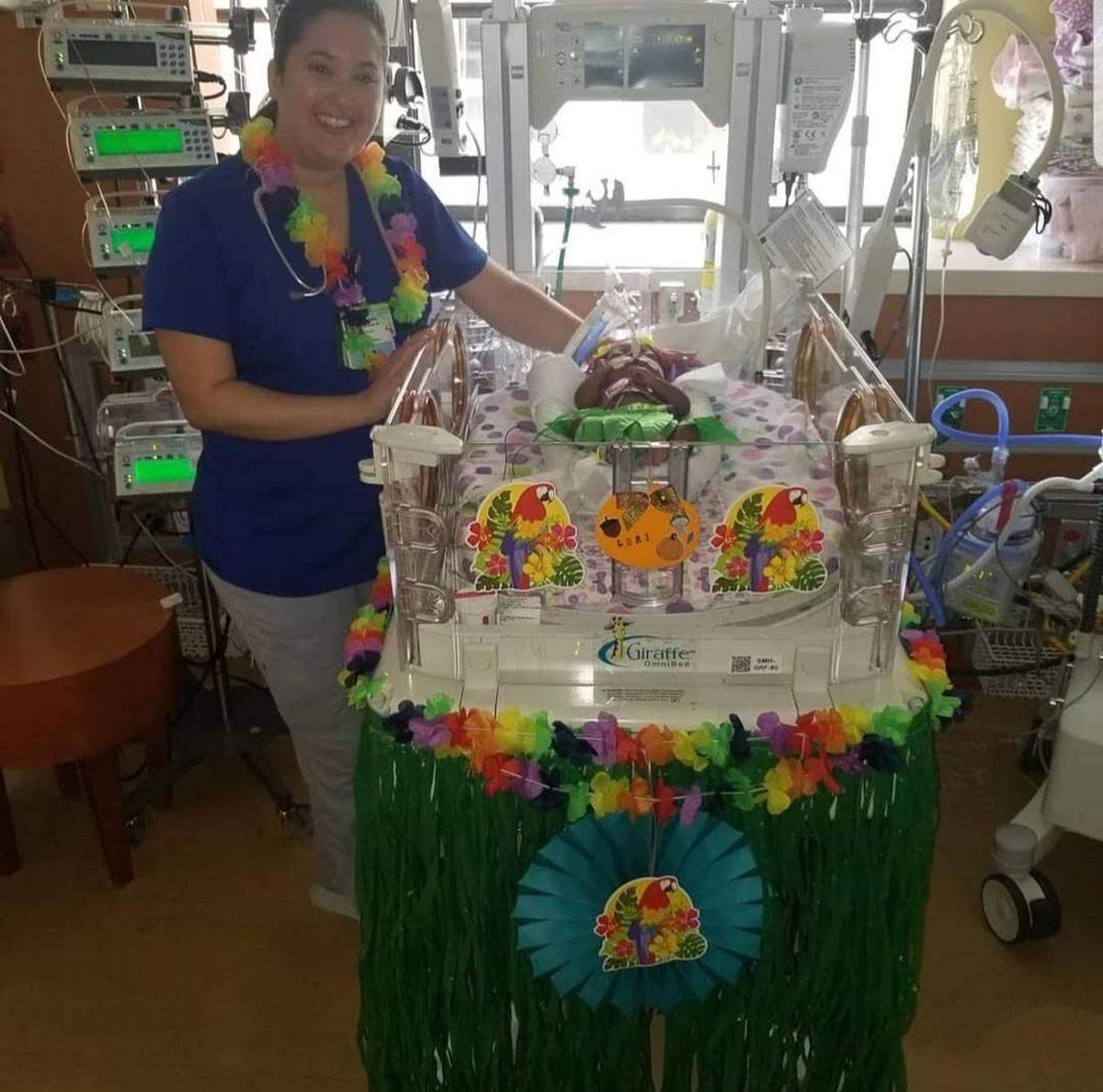
Bernardo, 30, from Fort Lauderdale, has been working in the NICU for eight years, and said it’s rare for South Miami Hospital to get cases where the baby stays in the hospital for eight months.
“She felt like my baby,” she said.
Because Lori was born at 24 weeks — the full-length pregnancy term is 40 weeks — she had several medical issues, as her organs weren’t fully formed.
“In Lori’s case, she ended up with bronchopulmonary dysplasia [where an infant’s lungs don’t develop properly]. She was intubated for a long, long time so the machine was doing the work for her,” Bernardo said. “Eventually, she required a tracheostomy, which at South Miami NICU is rare,” she added.
A tracheostomy involves inserting a tube into a person’s windpipe so they can breathe.
As the pandemic accelerated, doctors and staff decided Lori needed to go home as soon as possible, even though she still had many medical issues.
“I was terrified, mom was terrified, but we both knew we had to get her home. She’s doing so amazing now, which is kind of a miracle. All things considered, she’s not so behind. She’s awesome. She’s a feisty little thing,” Bernardo said.
When Lori finally left the NICU, it was hard for Bernardo to say goodbye.
“I’m not going to lie, when she first left, I missed her super, super much. When she was here, that was my kid. I missed her daily bath times and spa days. We worked hard but we had a lot of fun together,” Bernardo said.
Lori’s mother, Shakeema Smiley, credits Bernardo’s care with helping her daughter make it through.
“Lori was very fortunate to have Michelle as her Neonatal Intensive Care Unit (NICU) nurse. Michelle’s diligence and dedication saved Lori’s life. I appreciate and thank nurse Michelle so much for helping me understand this process, while helping my daughter through some very difficult medical challenges. Nurse Michelle will forever be a part of my family.”
Giving birth with COVID-19
Monica Verde was 34 weeks pregnant when she started experiencing fever, chills and body aches. After speaking to her doctor, she was admitted to Baptist Hospital, where the doctors found fluid in her lungs and low oxygen — classic signs of COVID-19.
It was March 2020, so the pandemic was still new to the medical world.
“Monica was the first mom with COVID that we saw. We got the call on Saturday morning, and we were all on pins and needles,” said Anabel Arcila, the NICU nurse charged with taking care of soon-to-be Giana Marie Verde.
“When you hear that the mom is being affected and the baby, everyone sort of panics,” Arcila added.
Giana, who was born at 34 weeks on April 2, 2020, was luckily born without the virus, which Arcila said is typical of babies that are born from COVID-19 infected moms.
_fitted.jpeg "D1CB334F-8577-4327-8EB5-BDE4358BC6AE (2)_fitted.jpeg")
Before getting the call, Arcila, 44, who has been a nurse for 22 years, and an NICU nurse for 18 of them, said the staff had been alerted that one of their pregnant patients had contracted the disease.
“But I never imagined she would be born with me,” she said. “When they tell you that the mom isn’t doing well, it’s horrible, your stomach just drops to the floor. I honestly panicked, even though I have all this experience, I still panicked,” she added.
Because Verde had COVID, she wasn’t able to hold her baby when she was born. Arcila took care of Giana Marie for a week and made sure that Verde was kept in the loop.
“When you have a baby, the first thing you want to do is count her fingers and toes and make sure everything is OK, and not being able to do that is really hard,” Verde said in tears. “I still get emotional,” she added.
Arcila, a mother herself, could empathize with Verde, so she took photos of the baby and printed them out, and gave them to her.
“I still have them till today. I slept with them and I was hugging those photos until Giana Marie left [the NICU],” she said.
After giving birth, Verde herself had to recover from the virus.
“Everybody, including patients, nurses, and doctors — everybody was at a high-stress level — but everyone took care of me in the best possible way,” Verde said. “I think that the doctors’ and nurses’ quick decisions ended up saving both of our lives.”